






Updated 2 months ago
Garden Spade Buying Guide for Retail and Landscaping Buyers: Blade, Step, Shaft and Use-Case Fit
SCARECROW GARDEN SUPPLIER

garden spade buying guide for retail and landscaping buyers
A garden spade is not simply a shovel with a straight edge. Many garden spade designs feature a flat blade, a sharp cutting edge, and a motion based on downward foot pressure — but specific dimensions, angles, and shaft lengths vary by manufacturer and model. It deserves its own procurement specification.
If you are a garden center buyer, a landscaping supplier, or a hardware retail planner, you already know that spades and shovels sit side by side in most ranges. What you may not have done is specify them separately — giving the spade its own blade, step, shaft, and connection requirements rather than treating it as “the flat one” in a shovel order.
This guide breaks down what a B2B buyer should specify when sourcing garden spades — the blade geometry that determines cutting performance, the step design that determines foot comfort, the shaft and grip that determine control, and the connection structure that determines how long the tool holds together under repeated use.
What Buyers Actually Need to Specify on a Garden Spade
A spade is designed for cutting and digging, not scooping. The blade is flat, the edge is sharp, and the motion is downward — foot pressure drives the blade into the soil, and the user leverages the handle to lift a clean section of earth.
That motion changes the specification priorities. On a shovel, dish depth and shoulder width matter because the tool carries material. On a spade, blade flatness, edge sharpness, and step width matter because the tool cuts and lifts.
Here is what you should specify on a garden spade, not on a generic “shovel” spec sheet:
| Specification Area | Why It Matters on a Spade |
| Blade width and length | Width determines how much soil is cut per stroke; length determines digging depth |
| Edge shape and sharpness | A spade’s job is cutting — a dull or uneven edge defeats the purpose |
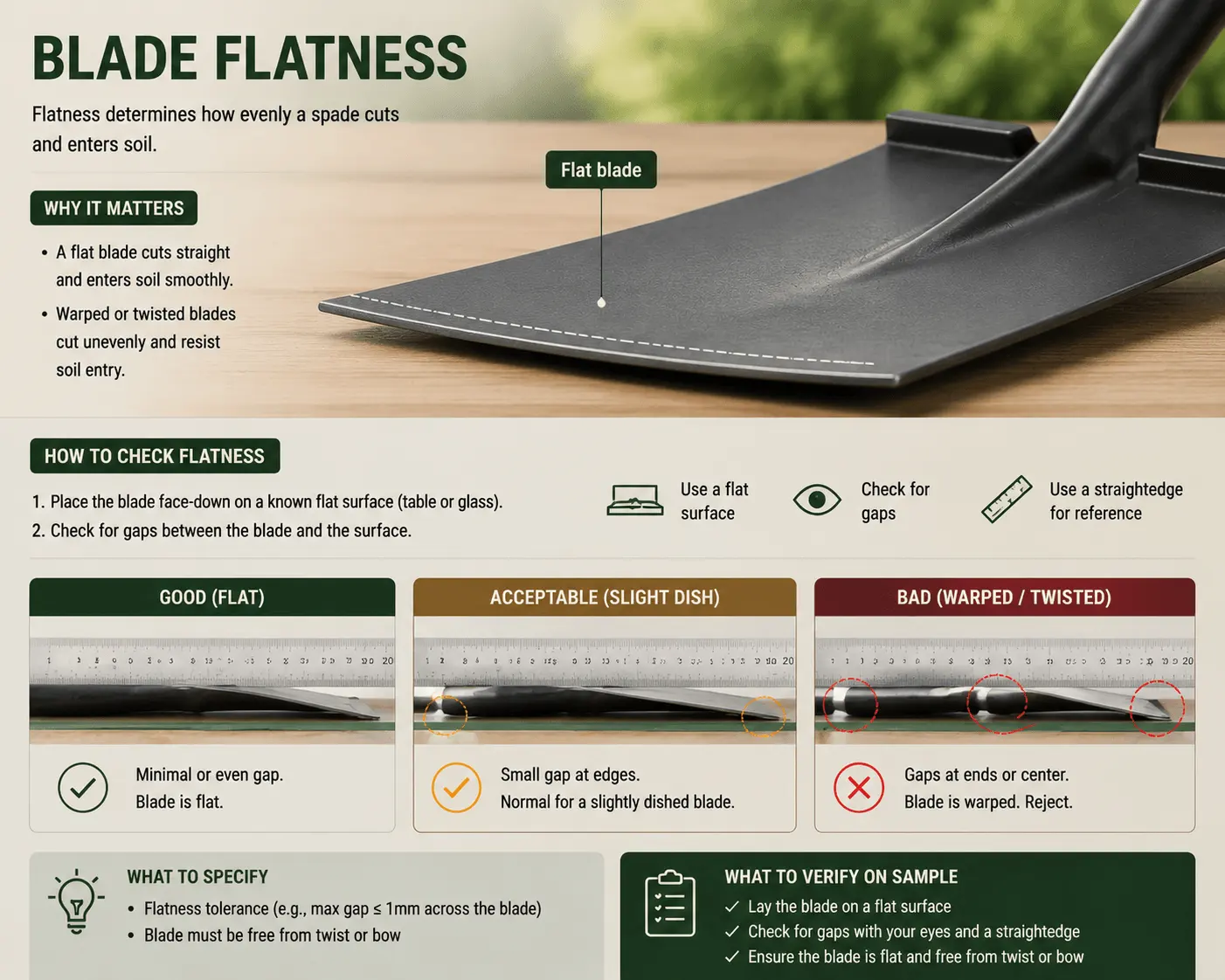
| Blade flatness | A warped blade cuts unevenly and resists soil entry |
| Step/tread width and comfort | The spade motion relies on foot pressure more than a shovel — tread design is critical |
| Shaft length and grip type | Spades typically have shorter shafts for control and direct pressure |
| Connection strength | Repeated downward force stresses the socket joint — verify the connection method |
If your supplier is quoting a spade using the same spec sheet as a round point shovel, something is missing. The two tools share components, but the priorities are different.
Sourcing Garden Spades for Retail or Landscaping?
Compare blade, tread, shaft and connection requirements against the actual channel and use case. A clearer structural match helps you choose garden spade options that fit the intended customer, working environment and retail positioning.
Blade Width, Length, Edge Shape and Flatness
Blade Width
Spade blades are generally narrower than shovel blades. A narrower blade concentrates cutting force — it slices into soil more easily. A wider blade moves more earth per stroke but requires more force to push in.
For retail, a medium-width spade is the safest default. For landscaping supply, consider a narrower blade for heavy soil and a wider blade for lighter soil where efficiency matters more than penetration.
Blade Length
Blade length determines maximum digging depth. Confirm whether the quoted length includes the socket area or refers to the cutting blade only — this is a common source of miscommunication between buyer and supplier.
Edge Shape and Sharpness
The spade’s defining feature is a flat, sharp edge. This is where “spade” and “shovel” diverge most clearly: a shovel’s edge is built for scooping, a spade’s edge is built for cutting.
Things to confirm:
- Is the edge pre-sharpened? Some spades ship with a factory edge. Others have a raw edge that the user must sharpen. Pre-sharpened spades are ready to use but may lose their edge in transit if not protected.
- Is the edge straight? A wavy or uneven edge cuts unevenly. Lay a straightedge across the blade to check.
- Is the edge beveled? A single-bevel or double-bevel edge may be offered. Confirm bevel geometry and edge condition on the actual sample — do not assume that one bevel type is universally sharper or more durable without considering the steel, heat treatment, and intended use.
Blade Flatness
Flatness is a quality indicator that does not appear on most spec sheets — but it should. A blade that is warped, twisted, or bowed will not cut cleanly. It will resist soil entry on one side and dig unevenly.
To check flatness on a sample: lay the blade face-down on a known flat surface (a table, a piece of glass). Look for gaps between the blade and the surface. A small gap at the edges is normal for a slightly dished blade; a twist or bow is not.
What to specify: Blade width, blade length (state whether it includes socket), edge type (pre-sharpened or raw, single or double bevel), and flatness tolerance.
What to verify on a sample: Lay the blade on a flat surface. Run a straightedge across the edge. Photograph any gaps.
Step/Tread Design and Foot Comfort
The step — also called the tread — is where the user’s foot meets the blade. On a spade, the step is particularly important because the primary motion is downward foot pressure.
Things to confirm on a sample:
- Tread width. Measure and record. Compare against your target or reference.
- Edge shape. Check whether edges are folded, rolled, or sharp. Sharp edges may be uncomfortable in soft-soled footwear.
- Structure. Identify whether the tread is single-layer or reinforced. Record the type.
- Alignment. Check that the tread is aligned with the blade and shaft.
For detailed tread structure analysis, reinforcement types, and sample screening methods, see our Foot Tread Design Guide.
Shaft Length, Grip and User Control
Spades typically have shorter handles than shovels. This is not a cost-cutting measure — it is a design choice. A shorter shaft gives the user more control and allows them to apply direct downward pressure, which is the spade’s primary motion.
Shaft Length
A long-handled spade provides more leverage for prying and lifting, but it reduces the control needed for precise cutting. A short-handled (or D-grip) spade provides better control but less leverage. The choice depends on the end user:
- Garden center retail: D-grip spades are popular because they are easier to display and comfortable for average-height users.
- Landscaping supply: Long-handle spades may be preferred for users who do heavy prying and lifting.
- Agricultural retail: Long handles dominate because the work involves deep digging and leverage.
Grip Type
- D-grip: A D-shaped grip at the top of the shaft. Provides a comfortable hand position for downward pressure and lifting. Common on spades for garden retail.
- Long handle (no grip): A plain wooden or fiberglass shaft end. Relies on two-handed grip. Better for leverage, worse for precise control.
- Ergonomic grip: Some spades feature a contoured or padded grip. These can improve comfort for repeated use but add cost.
Grip Material
Wood, plastic, rubber, or composite. The grip material affects comfort, durability, and weather resistance. For spades used in wet conditions (which is most spade use — you dig when the soil is workable, which usually means damp), a non-slip grip surface is valuable.
What to specify: Shaft length, grip type (D-grip/long handle/ergonomic), grip material.
What to verify on a sample: Hold the spade in the intended grip. Apply downward pressure. Check for grip comfort and shaft flex.
Connection Strength: Socket, Rivet/Weld and Handle Fit
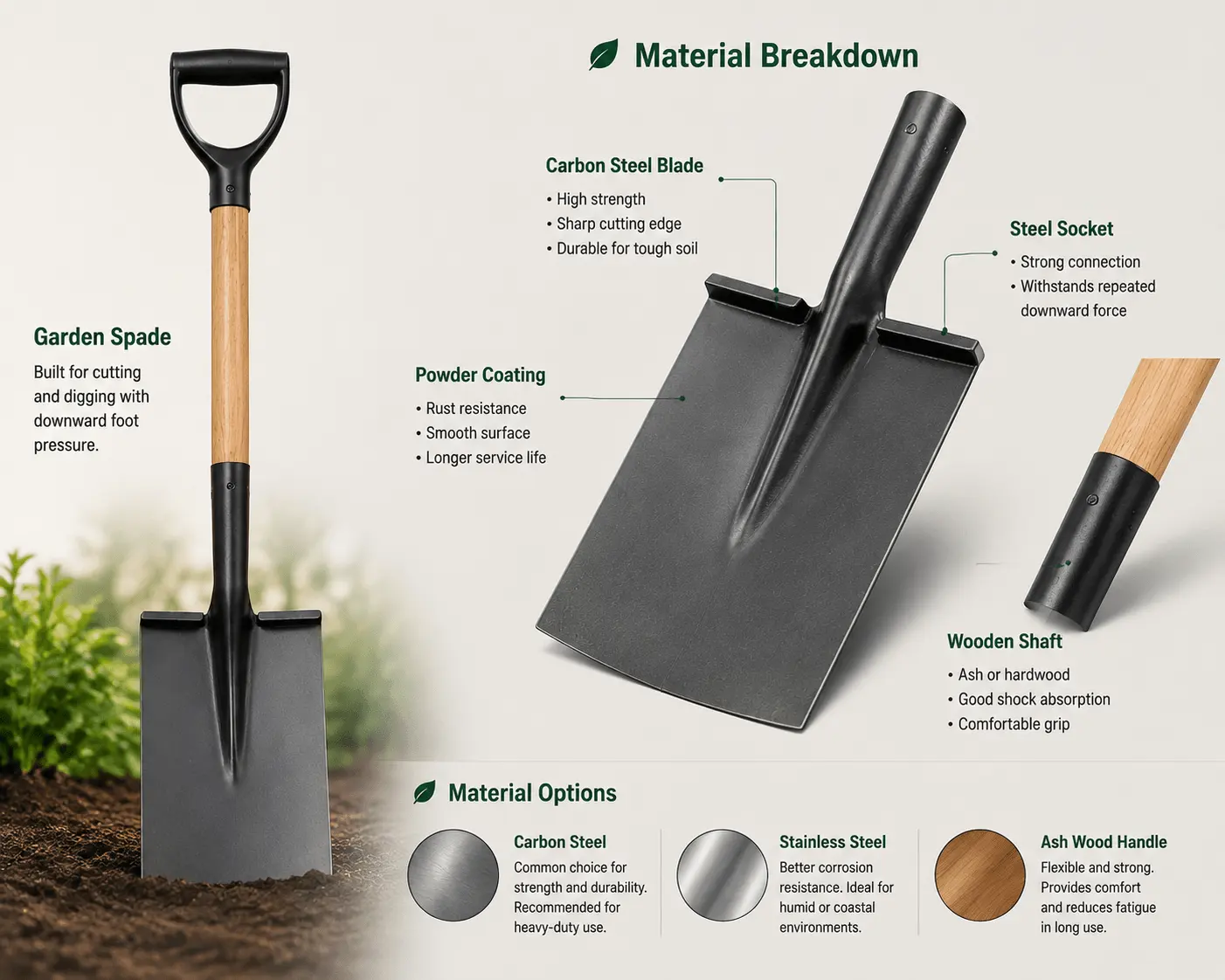
The connection between blade and handle is a critical structural junction. On a spade, repeated downward foot pressure drives the handle into the socket, and the connection may loosen over time.
Socket Depth and Diameter
Socket depth is one variable in connection strength — evaluate it together with fit, fastener, socket geometry, and material. The socket diameter must match the handle diameter. Check for a tight fit with no wobble.
Connection Method
Connection designs vary — including rivets, pins, welds, adhesives, and reinforced necks with collars or combination pipes. Each has different characteristics. Confirm the specific connection method used on your model and verify it on the sample.
For a detailed breakdown of socket depth, connection methods, failure modes, and structural design — see our Socket and Neck Construction Guide.
Handle-to-Socket Fit
Even with the right connection method, the fit matters. A handle that fits snugly into the socket distributes stress across the contact area. To check fit on a sample: hold the blade firmly and twist the handle. Any rotation or wobble means the fit is too loose.
What to specify: Socket depth, socket diameter, connection method, and handle-to-socket fit tolerance.
What to verify on a sample: Twist the handle in the socket. Check for wobble. Measure socket depth. Photograph the connection point.
Retail vs Professional Spade Positioning
Not every spade needs to be a professional-grade tool. But every spade needs a clear position in your range. Define each tier using measurable indicators — blade material, actual thickness, handle material, finish, and connection type — rather than assuming a fixed material recipe.
| Positioning | Example Evaluation Dimensions |
| Entry-level | Confirm blade material and actual thickness on sample; evaluate handle material, finish, and connection type |
| Core | Confirm whether blade is tempered or forged; evaluate handle material, finish, and connection fit |
| Professional | Confirm blade material, heat treatment, and actual thickness on sample; evaluate reinforcement, handle material, and finish |
For a detailed consumer vs professional specification breakdown — see our Consumer vs Professional Garden Shovels guide.
The key decision is not “which is best” — it is “which matches my channel and customer.” A hardware store may carry entry-level and core. A landscaping supplier may carry core and professional. A garden center may carry all three.
Sample Approval Checklist and RFQ Inputs
Sample Approval Checklist
Before approving a spade sample for production, work through this checklist:
| Check | Method | Pass/Fail Criteria |
| Blade width and length | Measure with tape/caliper | Matches specification within tolerance |
| Edge sharpness and straightness | Visual + straightedge | Pre-sharpened if specified; edge straight, no waves |
| Blade flatness | Lay on flat surface | No twist or bow; minor edge gap acceptable |
| Tread width and edge shape | Measure + visual | Width matches spec; edges folded/rolled, not sharp |
| Tread reinforcement | Visual inspection of cross-section or underside | Reinforced if specified; no single-layer deformation |
| Tread alignment | Sight down shaft to blade | Tread perpendicular to shaft, centered on blade |
| Shaft length and diameter | Measure | Matches specification |
| Grip type and material | Visual + tactile | Matches specification; grip comfortable, non-slip |
| Socket depth | Measure with ruler/caliper | Meets minimum depth requirement |
| Connection method | Visual inspection | Matches specified method (rivet/weld/reinforced) |
| Handle-to-socket fit | Twist test | No wobble or rotation |
| Total weight | Scale | Within target range |
| Surface finish | Visual | No bare metal, no coating runs, no rust spots |
| Packaging | Visual | Matches specified retail or bulk format |
RFQ Inputs
When sending an RFQ for garden spades, include:
| RFQ Item | What to State |
| Blade width and length | Target measurements or “match reference” |
| Edge type | Pre-sharpened or raw; single or double bevel |
| Flatness tolerance | State acceptable tolerance or “no twist/bow” |
| Tread | Width, edge type, reinforcement |
| Shaft | Length, diameter, grip type, grip material |
| Socket | Depth, connection method |
| Blade material and construction | Ask supplier to declare specific grade, applicable standard, and manufacturing process |
| Surface finish | Painted/powder-coated/polished |
| Target market | Country/region, soil type, end user |
| Packaging | Retail or bulk; hang tag/barcode requirements |
| MOQ | State minimum order quantity |
| Target price | State target landed cost per unit |
Need a Clear Spade RFQ?
Send a reference product, target market and quantity plan to organize the product requirements before quotation.
Next Step: Plan Your Spade Sourcing
A garden spade is a cutting tool, not a scooping tool. It deserves a specification that reflects that — blade flatness, edge sharpness, tread comfort, and connection integrity. If your current spade sourcing uses the same spec sheet as your shovel sourcing, you are leaving quality to chance.
Send us your spade requirements — or a reference photo of the product you want to match — and we can help confirm the right configuration, coordinate a sample, and support a specification that holds up across repeat orders, subject to model and factory feasibility.
Ready to Review Garden Spade Options?
Move from general product names to measurable specifications and sample approval. A clearer sourcing basis makes it easier to compare garden spade options and confirm the right product before moving toward bulk production.
Related Articles
Round Point Shovel Buying Guide for Wholesale Buyers: What to Specify Before Ordering
Foot Tread Design on Garden Shovels and Spades: What Buyers Should Inspect
Consumer vs Professional Garden Shovels: What B2B Buyers Should Specify Differently