







Updated 2 months ago
Mini Greenhouse Frame Quality: Tubes, Coatings, Connectors and Structural Stability
SCARECROW GARDEN SUPPLIER

mini greenhouse merchandising bundles
When a consumer returns a mini greenhouse, the complaint may mention the cover tearing, the zipper jamming, or the shelves sagging. These are visible failures. But underneath those failures, there may be a root cause that the consumer never sees: the frame was not strong enough to hold its shape under stress.
The frame is the skeleton. If the skeleton flexes too much, the cover stretches and may tear at stress points. If the joints are loose, the entire structure shifts, and the zipper track may misalign. If the surface treatment corrodes, the frame weakens from the inside out — long before the damage is visible.
For B2B buyers, frame quality is not a technical detail. It is a variable that affects whether your product lasts one season or several — and where your return rate sits within the range this product category typically sees.
This article covers frame quality considerations for mini greenhouse models with metal or tubular frames. Not all mini greenhouse models use the same frame system — the specific components, materials, and design depend on the SKU. Confirm the frame configuration for each product you source.
Tube Gauge: A Variable Worth Understanding
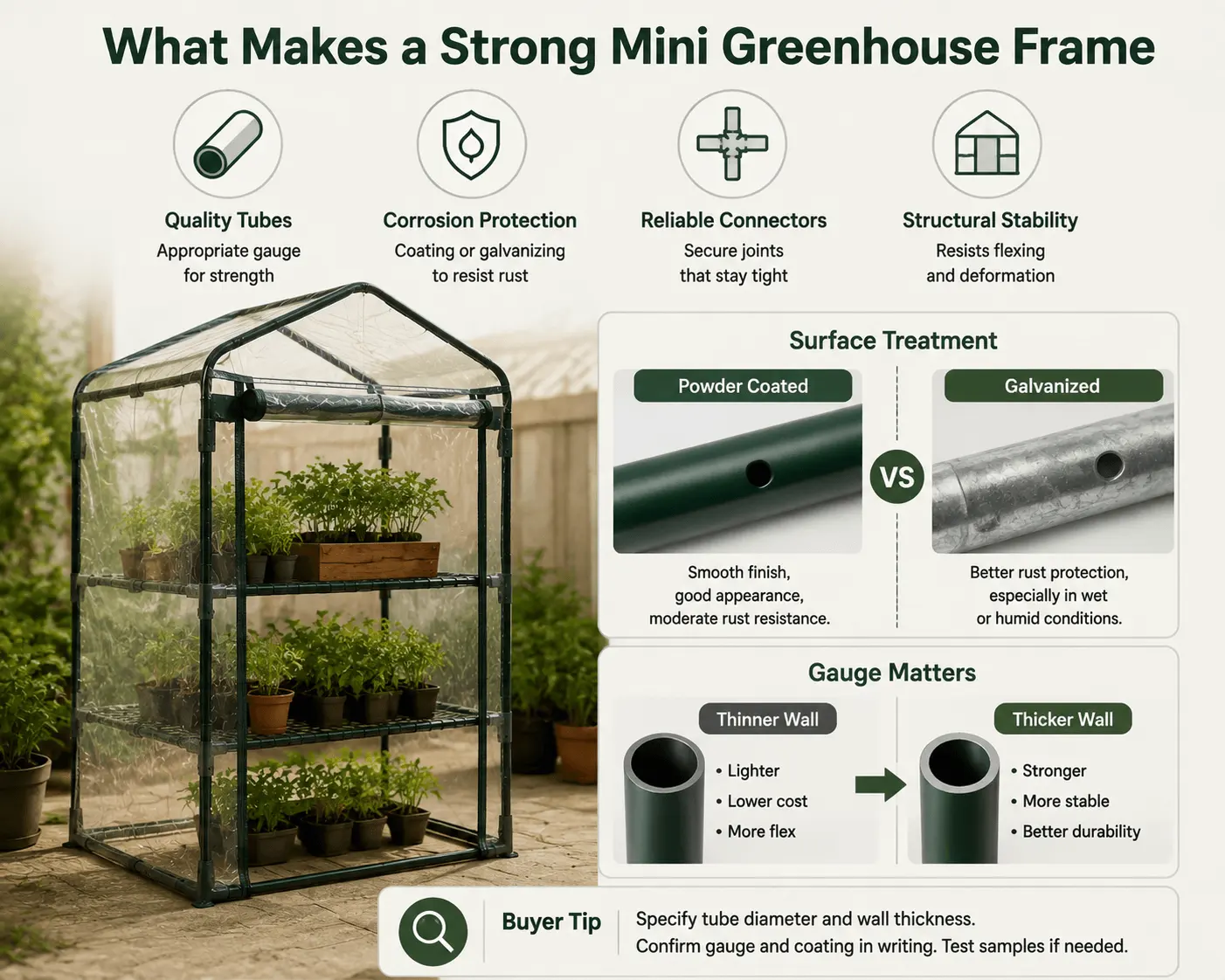
The wall thickness of the steel tubing — referred to as the gauge — is a significant variable in frame quality and price. A mini greenhouse frame may use steel tubing with various outer diameters and wall thicknesses, depending on the design and supplier.
A thinner wall means a lighter tube, which means lower material cost and lower freight cost. It also means a frame that may flex more under wind load, may bend more easily during assembly, and has less structural reserve to absorb impacts during shipping and handling.
The difference between a thinner and thicker wall is not something you can see in a product photo. It is not something you can feel by holding a single tube. But it may show up in the field — in how the frame performs the first time a gust of wind hits it, and in how many units come out of the carton with bent tubes after parcel shipping.
What Buyers Should Do
When you specify the frame in your RFQ, include the tube diameter and wall thickness as required fields. Ask the supplier to confirm the gauge in writing. If you are comparing two suppliers and one quotes a thinner gauge at a lower price, you now know where the cost saving comes from — and what you may be giving up to get it.
If you are not sure which gauge suits your market, consider ordering samples at two different gauges and testing them. Assemble both, apply pressure to the top of the frame, and observe the difference in flex. This is not a lab test, but it may give you a tactile sense of what the gauge difference means in practice.
A Note on Gauge Terminology
Steel tubing is sometimes specified using the gauge system rather than millimeters. These two systems do not always convert cleanly, and different suppliers may use slightly different conversion conventions. To avoid confusion, specify the wall thickness in millimeters in your RFQ and ask the supplier to confirm in the same unit.
Comparing Mini Greenhouse Frame Options?
Review tube, coating and connector details before deciding which frame specification suits your market. Compare the complete frame structure instead of evaluating only the visible size or appearance.
Surface Treatment: Powder Coating vs Galvanizing
The surface treatment on the steel tube affects how the frame handles moisture, humidity, and time. Two treatments are common in the mini greenhouse market: powder coating and galvanizing.
Powder coating provides a colored finish (typically black or dark green), a reasonably smooth surface, and moderate corrosion resistance. It looks good out of the box. However, powder coating can chip — at cut ends, at connector contact points, and anywhere the tube is scratched during assembly or shipping. Once the coating is breached, the exposed steel is vulnerable to rust.
Galvanizing — typically hot-dip galvanizing — applies a zinc layer to the steel that provides sacrificial corrosion protection. Even if the surface is scratched, the zinc continues to protect the underlying steel. Galvanizing may offer better corrosion resistance in wet or humid conditions but typically costs more and has a grayish appearance that some buyers find less attractive for retail.
What This Means for Your Market
If your market is primarily indoor use — tabletop mini greenhouses for seed starting on a windowsill — powder coating may be sufficient. The frame will not face significant moisture exposure.
If your market includes balcony, patio, or outdoor use, the frame will face rain, humidity, and temperature cycling. In that context, the surface treatment matters more. Powder-coated frames may corrode faster at scratch points and cut ends. Galvanized frames may resist corrosion longer.
Ask your supplier which treatment they use as standard and whether the alternative is available. If both are available, get quotes at both specifications and weigh the cost difference against your market’s conditions.
Cut Ends
Regardless of the surface treatment, the ends of the tubes — where they have been cut to length — are vulnerable points. Cut ends expose raw steel, and in a powder-coated frame, these ends may receive only a light coating or none at all. Moisture can enter through cut ends and travel inside the tube, where corrosion is invisible until the frame weakens.
Ask the supplier how cut ends are treated. Some suppliers apply end caps or a rust inhibitor. Others leave them bare. This is a detail that may have an outsized impact on long-term frame durability.
Connectors: The Joints That Affect Structural Rigidity
The connectors are the joints of the frame. In frame-based mini greenhouse models, they are typically plastic (PP or similar) with steel screws, and they hold the vertical tubes and horizontal cross-pieces together. Their quality affects whether the frame feels solid or wobbly — and whether it stays that way after repeated assembly and disassembly.
Connector quality has several dimensions:
Material strength. A PP (polypropylene) plastic connector is common. A reinforced connector — with glass fiber or a higher-grade polymer — may be stronger and resist cracking under stress. The difference may show up when the frame is under wind load.
Tolerance and fit. Connectors must fit snugly onto the tubes. If the internal diameter is too large, the frame is loose and wobbly. If it is too small, assembly becomes difficult and the connector may crack during insertion. Tolerance consistency across a production batch is a quality indicator.
Wall thickness and ribbing. The connector itself has walls. Thicker walls and internal ribbing (reinforcing fins inside the connector) may increase structural strength. A thin-walled connector with no ribbing is typically cheaper and may be weaker.
What Buyers Should Do
Ask the supplier for the connector material, whether reinforced options are available, and whether they can provide a cut sample or a photo showing the connector’s internal structure. During sample evaluation, assemble the frame and test the rigidity: push the top of the frame laterally and feel how much it flexes. A well-connected frame resists lateral movement; a poorly connected one sways.
Structural Principles from Greenhouse Research
Structural engineering research on lightweight greenhouse frames provides insights that are relevant to mini greenhouse design — but these studies typically cover larger structures than consumer mini greenhouses. The principles are useful as background, not as a substitute for product-specific testing.
Research on lightweight greenhouse frames indicates that these structures are characterized by high flexibility and low mass, making them sensitive to wind loads. The structural response under wind pressure is primarily bending stress. Studies also indicate that wind loads may produce more severe structural demands than snow loads on this type of structure.
Research also suggests that under wind pressure, the maximum displacement tends to occur near the top of the structure, and critical stress may occur near the base. For a mini greenhouse, this suggests that the top of the frame is most exposed to movement, and the base — where anchoring occurs — is structurally important.
These are structural principles, not a product-specific wind rating. Product-specific performance must be verified through sample testing and field experience — not assumed from research on different structures.
For a deeper discussion of wind stability and anchoring options, see our dedicated wind stability article.
Need Sample-Level Frame Checks?
Send your target frame requirements and market. We can help organize sample comparisons before bulk approval. Review key frame details based on your actual application, expected performance and sourcing requirements.
Frame Quality Checklist for Mini Greenhouse Buyers
| Check Item | What to Look For | Why It Matters |
| Tube wall thickness | Confirm in mm; do not accept “standard” | Affects frame strength and wind resistance |
| Surface treatment | Powder-coated or galvanized; confirm which | Affects corrosion resistance for outdoor use |
| Cut end treatment | End caps, rust inhibitor, or bare | Bare ends may corrode from inside the tube |
| Connector material | PP, reinforced PP, or other | Affects joint strength at stress points |
| Connector fit | Snug fit, no wobble, no cracking on insertion | Loose fit = wobbly frame; tight fit = assembly difficulty |
| Connector wall and ribbing | Thick walls, internal ribs (if visible) | Thin-walled connectors may crack under stress |
| Shelf wire gauge (if applicable) | Diameter in mm | Sagging shelves may trigger consumer returns |
| Anchoring accessories | Ground pegs, wind ropes included or available (if applicable) | Without anchoring, wind damage risk increases |
| Frame rigidity test | Push frame laterally; check flex | Excessive flex may signal weak tubes or connectors |
| Coating integrity | No chips at cut ends or connector contact points | Breached coating = corrosion entry point |
The Frame Is the Foundation
A mini greenhouse with a strong cover, a good zipper, and solid shelves may still fail if the frame cannot hold its shape. The frame affects whether the cover stays taut (or sags and pools water), whether the zipper stays aligned (or shifts and jams), and whether the shelves stay level (or tilt under load).
When you source mini greenhouses, the frame is where your attention should start. Specify the gauge, verify the surface treatment, test the connectors, and require anchoring where applicable. The cover and the zipper are important — but they are only as reliable as the frame underneath them.
Send us your mini greenhouse frame specifications and target market. We will help you identify suppliers who can meet your tube gauge, surface treatment, and connector requirements — and provide samples for hands-on evaluation. You focus on growing your business. We help you find the right suppliers, verify quality, and get it shipped.
Ready to Review Frame Quality?
Send us your mini greenhouse frame specifications and target market. We will help you identify suppliers who can meet your tube gauge, surface treatment, and connector requirements — and provide samples for hands-on evaluation.
Related Articles
Mini Greenhouse Assembly Quality: Fit, Missing Parts, Instructions and Consumer Complaints
Wind Stability and Anchoring for Balcony and Outdoor Mini Greenhouses
Mini Greenhouse Zipper and Ventilation Quality: What B2B Buyers Should Check