




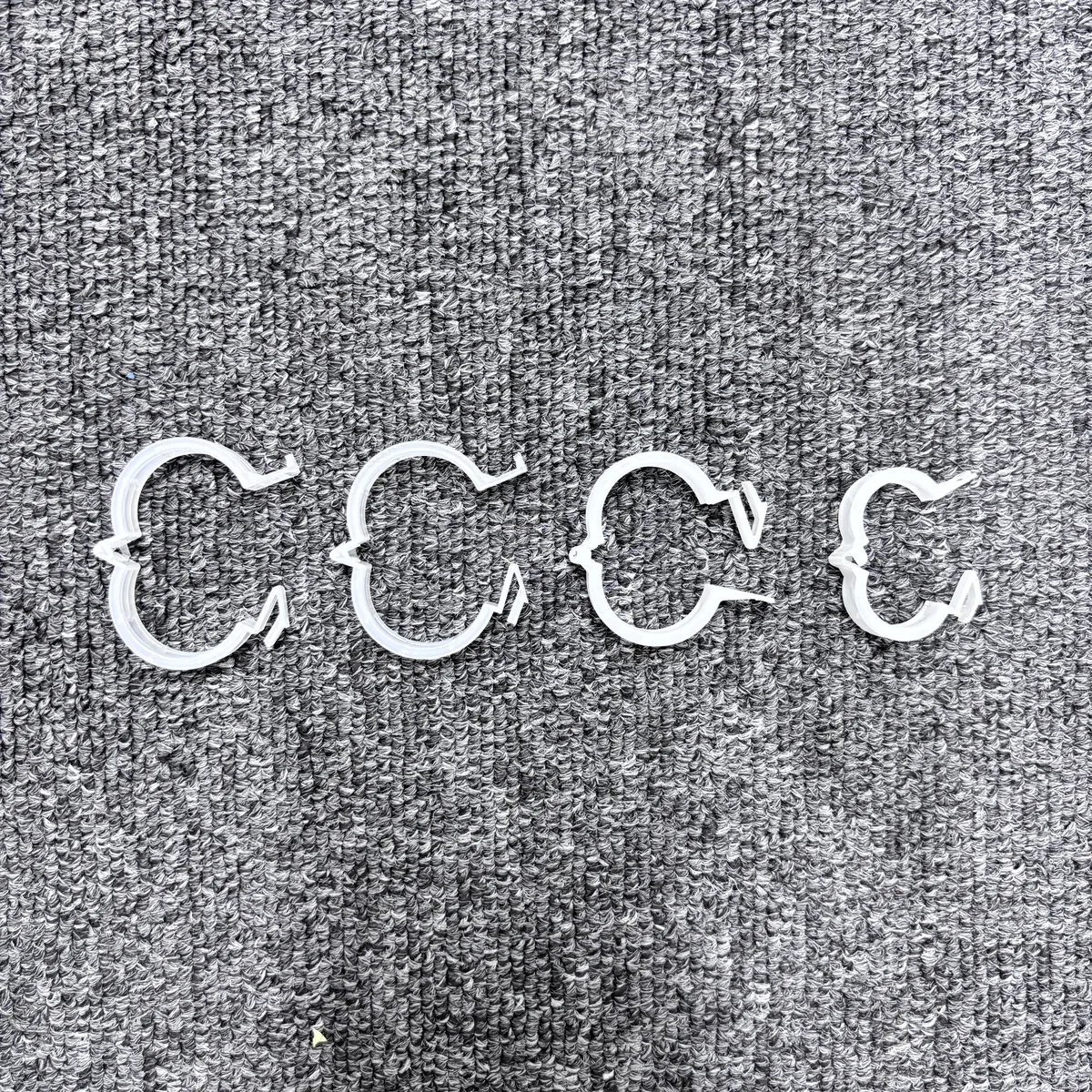
Four white round clips shown open, with their closing sections visible.
A greenhouse buyer asks a short question with the order: when the crop is cleared out at the end of the season, can the plant clips and the support twine stay with the plant waste and leave in the same collection?
It reads like a question about material. It is really three questions stacked on top of each other, and they are easy to blur into one.
The first is what the support is made from. The second is whether that exact finished item has been shown to break down under the treatment the waste will actually receive. The third is whether the route that collects the crop residue will accept it in the first place. A "yes" on the first does not carry the other two. Most of the confusion in this area comes from treating the first answer as if it settles the whole thing.
Feedstock, function, and what happens after use are three different things
A plant clip has a job to do while it is in use. It holds a stem to a support line without cutting into the plant, and it has to survive a season of tension, sunlight, and moisture without losing its grip. Support twine has to hold weight under tension for months. Neither of those requirements has anything to do with what happens to the clip or the twine after the crop comes out. A material can be excellent at the first job and completely unproven for the second.
This is where "bio-based" gets misread. A bio-based plastic is one made wholly or partly from biological raw material. That describes where the carbon came from, not what the material does when it is discarded. A bio-based clip is not automatically biodegradable, and it is certainly not automatically compostable. The European Commission's own material on these plastics makes the separation explicit, and it treats its policy framework as a non-binding communication rather than a product rule that a buyer can point to in an order.
Compostable is a narrower word, and it is a subset of biodegradable. In practice it usually means the item breaks down in an industrial composting facility under controlled conditions. That is a specific environment, not a general promise. A European Environment Agency briefing on these materials makes the point that whether and how fast something degrades depends on the design of the item and on the conditions it is exposed to after use. A product shown to break down in an industrial facility is not thereby shown to break down in a home compost heap or in open soil.
These four words get used as if they were interchangeable. Three of them name different end-of-life environments, and the fourth names the feedstock.
- Bio-based describes the feedstock, not an end-of-life environment.
- Industrially compostable describes breakdown in a managed facility.
- Home compostable describes breakdown in a cooler, less controlled home heap.
- Soil biodegradable describes breakdown in soil.
When a supplier answers with one and your waste route needs another, the answer does not match the question.
Three evidence states, and what each one lets you approve
For a buyer trying to decide whether to accept a combined disposal claim, it helps to sort whatever the supplier provides into one of three states.
Material wording on its own. The offer says "bio-based," "plant-based," or "contains recycled content." This tells you something about the input, and nothing about whether the item will be accepted wherever your crop residue goes. It cannot qualify the offer as meeting a compost-with-crop-residues requirement. If this is all you have, the requirement is still open.
A treatment scope for the exact item. Now you have something that could move you a step up: a statement that this specific finished clip or twine is industrially compostable to a named standard. An unchecked statement does not get the item into this state by itself, even when it carries a standard number or a third-party name. What does is a traceable basis that has been checked against this exact finished item, this defined treatment, and these conditions. Where that check has been made and matches, the item can be treated as having a supported treatment scope for those conditions, and the rest of this article uses that as its working premise. Even then, it is still not enough on its own. It does not establish that your particular collector or facility will take it, because acceptance is a local decision about what a plant is set up to receive. Until the intended route is confirmed, the combined disposal claim stays unapproved.
Item scope plus a route that actually accepts it. Now the clip or twine is shown to break down under the right treatment, and the receiving route has confirmed it takes that item alongside the crop residue. This supports the named route, within the conditions you established. It does not extend to home composting, it does not extend to soil, and it does not grant permission in every market. A scope is only as wide as the environment it was written for.
The asymmetry matters. One unavailable document does not prove a product is unusable for everything. It only means one route is not yet supported.
A named example shows why evidence does not travel between products
It is worth looking at a real supplier example, because it shows the boundary in practice.
In a supplier release on its biopolymer grades for horticulture, BASF described three grades applied to three different uses. The grade named for plant clips, ecovio 60 IA 1552, was presented as industrially compostable against EN 13432; the grade for black twine, ecovio T 2206, was also presented against EN 13432; the grade for mulch film, ecovio M 2351, was presented as soil biodegradable against EN 17033. This is the supplier's own description of its materials in specific applications, and the grade names and standard numbers are kept here so the comparison can be checked against the supplier's own material. It is not a certificate attached to any harvested product on a shelf.
Read the structure of that announcement rather than its claims. The same company, in the same release, kept a clip application, a twine application, and a soil-biodegradable film application separate, and it used two different standards to do it. That separation is the lesson. Evidence for one application does not migrate to another application, and a standard for one end-of-life environment does not cover a different one. A resin grade is not a finished clip. A finished clip given industrial composting scope is not automatically accepted by your collector.
The performance figures, the yield and cost claims, and the food-contact and microplastic statements in a release like that are not something a buyer should transfer to an unspecified product. What transfers is the discipline of keeping the applications apart.
What a clip-and-twine combination actually needs
Suppose the clip carries solid industrial composting evidence for the exact item, and the twine does not. The combination cannot be approved on the clip's evidence. The buyer is still handling a set, and a set is only as supported as its weakest documented part. If the twine is the part with the thinner evidence, the whole combined claim waits on the twine, not on the better-documented clip.
So the practical move is to separate the two questions whenever a set is on the table. What can the clip support, and what can the twine support, under the route you intend to use? Only when both reach the same named route does the pair go through together. When they do not, the option is to hold the combined claim, or to split the supports by what each can actually be sent into, rather than to assume the stronger item covers the weaker one. The BASF example above is a small version of the same logic in reverse: the supplier could name one standard for its clip and twine and a different one for its film, because the applications were kept apart. A buyer handling a clip and twine as one ordered set has to close that same gap in the other direction.
The selection consequence
If your intended route is a crop-residue collection that ends in an industrial composting stream, ask for checked, traceable evidence identifying the exact finished clip and twine and supporting the treatment conditions that route uses. Confirm the receiving facility's acceptance separately. A material word on a spec sheet, however green it sounds, does not get you there.
If that evidence is not available, the honest position is that the combined disposal route is unconfirmed, not that the product is bad. The clip and twine can still be exactly right for holding the crop. The gap is only about what can be sent out with the waste.
To compare physical support formats, browse Plant Ties & Support. Check the treatment evidence and receiving route separately for any item you select.

Written by
ScarecrowGarden
💡About Scarecrow Garden Supplier Co., Ltd.
Scarecrow Garden Supplier Co., Ltd. is a China-based sourcing and wholesale partner specializing in garden tools, landscaping equipment, and outdoor supplies for international wholesalers, distributors, contractors, and brands.
With hands-on experience rooted in real garden use scenarios, we focus on durable materials, functional design, and stable large-volume supply. Our product range covers pruning tools, watering systems, hand tools, outdoor hardware, and customized garden solutions to support both retail and professional landscaping markets.
Beyond products, we help our partners navigate supplier selection, quality control, compliance requirements, and long-term sourcing strategies in China. Through our blog, we share practical insights on product selection, material comparisons, industry trends, and cost-effective purchasing—helping global buyers build stronger, more competitive supply chains.