





A potting kit and a living plant pull in opposite directions inside a box, and this is the single most useful thing to understand before you try to ship them together.
The plant wants air moving past it. It is alive, it is respiring, and it is producing heat, moisture and carbon dioxide inside an enclosed space. The kit wants everything packed tight, with no movement and no air gaps, because a loose trowel and a bag of soil will find each other and the pot will lose.
Both requirements are real. Whether they actually conflict depends on the kit and on the parcel, and that distinction is worth holding on to, because it decides how much this problem is going to cost you. A kit of soft goods, a folded fabric pot, a bag of coir in a sealed pouch, creates nothing like the pressure a trowel and a stack of rigid pots create. A small kit in a box with generous void space may satisfy both requirements with nothing more than a divider. Where the conflict does appear, it does not have a perfect solution, only a set of trade-offs.
One prerequisite sits in front of all of it. Whether the plant may be shipped this way at all is a separate question from how to pack it. Within the United States, plants and plant products are mailable but subject to federal agricultural regulations and to the quarantine requirements of the destination, and where those make a shipment unlawful the plant is not mailable however well it is packed. International shipments add phytosanitary requirements in the importing country, certified by the plant protection authority rather than by the seller. Carrier rules are a third layer, and at least one major carrier treats plants and seeds as requiring specific contract arrangements rather than ordinary drop-off.
That is permission rather than protection, and it is worth settling before the packing bench.
The plant is not a static object in transit
Shipping a live plant is not like shipping a mug with a plant printed on it. The plant continues to metabolise, and inside a closed box that has consequences.
Respiration produces heat, moisture and carbon dioxide, and in a sealed space all three accumulate. Ventilation exists precisely to remove them, to prevent oxygen depletion and to stop the humidity from saturating the air around the foliage.
The other requirement is time. Perishable goods cannot be stabilised in transit, only slowed, which is why the guidance for fresh produce is always to move it as quickly as possible. A plant in a box is a perishable good, and every extra day in the parcel is a day of respiration with no fresh air.
A potting kit has none of these properties. It does not respire, it does not mind being sealed, and it is completely indifferent to how long the journey takes. What it minds is movement.
Rigid contents and three ways they cause damage
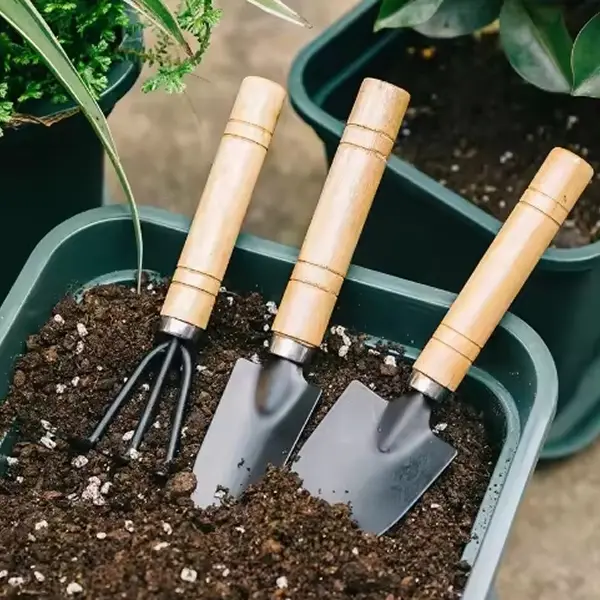
A kit typically contains hard, dense or abrasive items. A trowel, a bag of dry medium, a small bag of fertiliser, a stack of pots. Each of them behaves differently in a parcel that is being handled.
The first risk is movement. Anything loose in a box travels, and it travels towards whatever is nearest. Internal cushioning has three jobs, absorbing shock, holding contents still and keeping them off each other, and all three fail in a parcel containing a plant, because a plant needs air space that cushioning would otherwise fill.
The second risk is granulated material behaving like a liquid. A bag of loose medium, or any granular buffer, will shift and settle during handling. Books on the subject say the same thing in almost the same words: granular cushioning material can move in transit, so it has to be pressed down firmly, filling the space without letting the box bulge.
The third risk follows from the first two, and it is often described more confidently than the evidence supports. A parcel with a heavy item at one end and a light item at the other tends to settle with the dense end downward, and a parcel dropped on its end puts that end against the floor first. That does not mean the heavy item ends up on the plant every time. Orientation during handling is not predictable, a parcel can land on a side, and a plant packed centrally is not necessarily under the heavy item. Treat the pattern as a reason to stop heavy and fragile items sharing space without separation, not as a forecast of what will happen to a specific parcel. If you want to know what happened to yours, the test in the next section is the way to find out.
What the conflict actually means in practice
Given a plant that needs ventilation and a kit that needs compaction, the practical answer is not to find a middle setting. It is to use a structure that gives each its own space.
That means the parcel is divided rather than blended. Each part gets its own cushioning, each part is held away from the other, and the plant's compartment retains enough volume of air to buffer the humidity for the journey rather than being wrapped tight against the foliage.
Carrier packing rules for parcels containing more than one item point the same way. The USPS mailer standards require that when multiple items share a single container, they be cushioned so they protect each other as well as against external force, and that heavy dense items not be packed with fragile ones unless they are carefully separated. That is a general requirement for multi-item parcels rather than a rule written for plants, and it is a reasonable starting point here.
The trade-off is volume. A divided parcel is usually bigger than a blended one, which can mean a higher weight tier or a dimensional charge, and that cost lands on the whole order. Compare the divided parcel against two things, not one. Against the blended parcel it tells you what the division costs. Against two separate parcels it tells you whether the division is worth doing at all, and that second comparison is the one that decides the question. A divided parcel that costs less to send than two parcels has already justified itself, even if it costs more than the single blended box would have.
What to test
There is no published guideline for shipping a potting kit beside a living plant. Anyone who tells you there is one is describing their own method. What you can do instead is run a test that is honest about what it is testing.
Pack three parcels the way you intend to ship, using a plant of the size you usually ship and a kit as it will be sold. Then give them the handling and the time a real parcel gets. That means more than leaving them on a shelf. A parcel that sits undisturbed for four days has been tested for time and not for handling, and a parcel that is turned over once and opened has been tested for handling and not for time. Both variables act on the same box, and the failures they produce look different.
So handle them, and then wait. Turn each parcel over, set it down on each face once, and then leave it closed for the length of your longest realistic transit. Where your route includes a specific handling risk you can reproduce, a drop from a known height onto a hard floor for instance, do that deliberately and record the height and the surface, because a result you cannot describe is not a result you can compare against next time.
When you open them, inspect four things. The pot, the foliage, the kit's contents, and the inside surfaces of the box. Moisture marks on cardboard tell you about ventilation. Displaced dunnage tells you about compaction. A cracked pot tells you about the drop. A kit component that has travelled tells you about both.
Three parcels is not a shipping study. But it is a real test of your real parcel, and it will catch the failures that a supplier's packing reference cannot show you.
When they should travel separately
There is a commercially boring answer that is often the right one: ship them separately, and price the kit with its own shipping.
A kit shipped alone can be packed the way a kit wants to be packed, tight and dense and cheap. A plant shipped alone can be packed the way a plant wants to be packed, with volume and ventilation and no sharp objects. Both are simpler, both are faster at the packing bench, and neither exposes the other to risk.
The cost is a second parcel, a second label and a second delivery experience. Whether that is acceptable depends on the order value and on how often the pairing occurs. A kit that is bought with a plant 60% of the time is a different problem from a kit bought with a plant 5% of the time.
One box, two compartments, or two boxes
A potting kit can travel beside a living plant, but only if you accept that the two need separate space inside one box, and that this costs volume and therefore postage. Any design that satisfies one requirement fully will work against the other. How much that matters depends on what is in the kit, so start with the kit and the parcel rather than with a general rule about plants and hard goods.
Test it with the real transit duration and real handling, and inspect the box as carefully as the contents. Then decide whether the combination is worth shipping together at all.
The question that settles it is not whether the parcel survives. It is whether the divided kit, bought with a plant often enough, pays for the extra volume it forces on every order. Where it does not, the boring answer is the right one. One order, two parcels, two labels, and neither product compromising the other for the sake of a single carton.
Comparing how a divided carton actually packs is quicker than reasoning about it. Look at custom kit packaging formats before you commit to one.
Send Scarecrow Garden your plant pot size, kit contents and current carton, and discuss dividers and carton options that keep the two apart inside one box.

Written by
ScarecrowGarden
💡About Scarecrow Garden Supplier Co., Ltd.
Scarecrow Garden Supplier Co., Ltd. is a China-based sourcing and wholesale partner specializing in garden tools, landscaping equipment, and outdoor supplies for international wholesalers, distributors, contractors, and brands.
With hands-on experience rooted in real garden use scenarios, we focus on durable materials, functional design, and stable large-volume supply. Our product range covers pruning tools, watering systems, hand tools, outdoor hardware, and customized garden solutions to support both retail and professional landscaping markets.
Beyond products, we help our partners navigate supplier selection, quality control, compliance requirements, and long-term sourcing strategies in China. Through our blog, we share practical insights on product selection, material comparisons, industry trends, and cost-effective purchasing—helping global buyers build stronger, more competitive supply chains.