







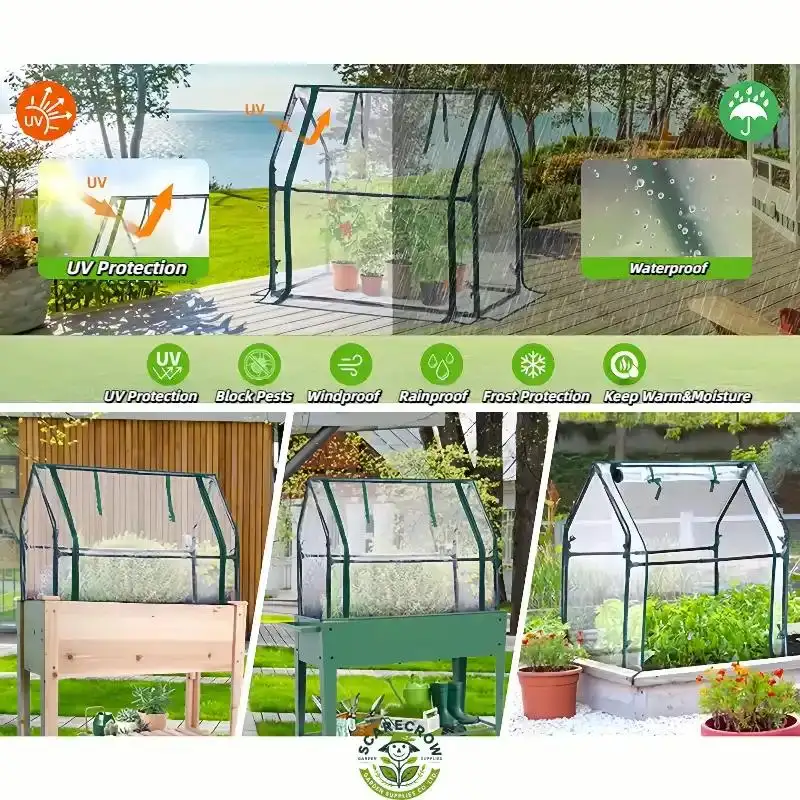
Indoor Greenhouse for Vegetables
An Indoor Greenhouse for Vegetables is more than just a plant enclosure for providing heat. It is designed to establish a more stable, controlled micro-climate for growing plants, predominantly by managing the variables of air movements and moisture in the root zone, as well as relative humidity and air temperatures.
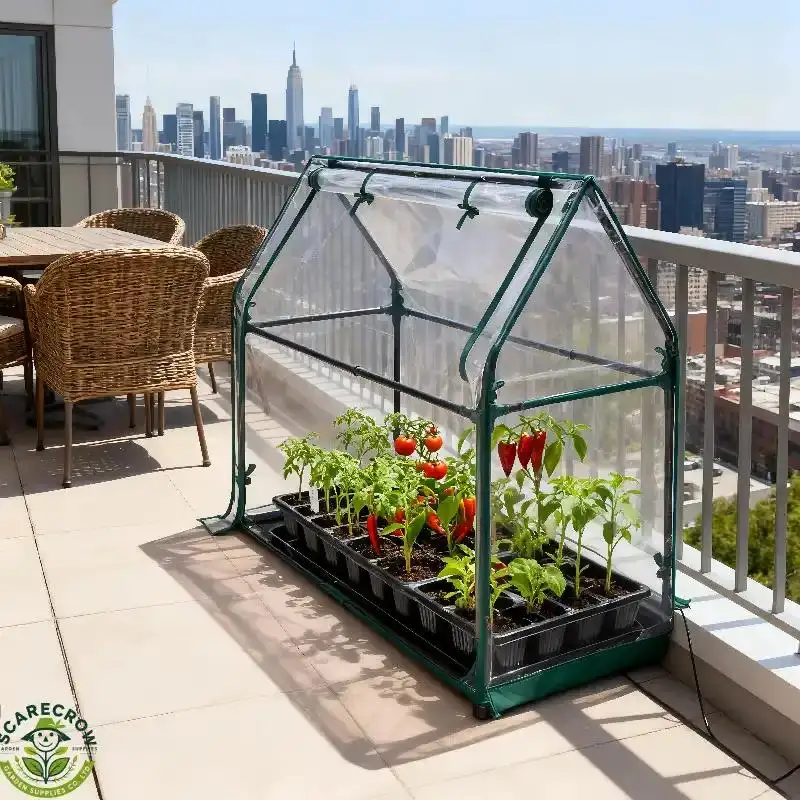
At Scarecrow Garden Supplier, our line of greenhouse product systems is based on the above design philosophy. The growing and establishing of vegetable and plant seedlings requires more stability in the growing environment, as compared to the levels of heat and humidity in the environment.
A practical Indoor Greenhouse for Vegetables should help growers manage four variables:
•Air temperature
•Growing-medium temperature
•Relative humidity
•Air exchange around seedlings
When these factors are poorly balanced, growers may see slow germination, condensation, fungal growth, damping-off, or weak seedlings.
Temperature Requirements for an Indoor Greenhouse for Vegetables
One common mistake is treating air temperature and root-zone temperature as the same thing.
They are not.
During germination, the temperature surrounding the seed is often more important than the room temperature. For many vegetable crops, growing media in the range of approximately 65–75°F (18–24°C) supports reliable germination. Cool-season crops such as spinach, cabbage, and broccoli can germinate effectively at lower temperatures.
Warm-season vegetables usually need more heat.
| Crop Group | Typical Examples | Temperature Strategy |
| Cool-season crops | Lettuce, spinach, cabbage, broccoli | Moderate to cool root-zone temperature |
| Warm-season crops | Tomato, pepper, cucumber, eggplant | Warmer and more stable germination temperature |
| Mixed seedlings | Herbs and assorted vegetables | Group trays by temperature requirement |
For an Indoor Greenhouse for Vegetables, this means growers should monitor the growing media rather than relying only on room temperature.
After emergence, excessive heat should also be avoided. Too much warmth combined with limited light often produces elongated, weak seedlings.
What We Recommend Monitoring
For professional seed starting, we recommend checking:
•Air temperature at canopy level
•Root-zone or tray temperature
•Day/night temperature fluctuation
•Distance from grow lights
•Direct sunlight exposure
A fully enclosed mini greenhouse placed near a sunny window can heat rapidly, even when room temperature remains comfortable.
Humidity Requirements Change After Germination
Humidity is useful during seed germination because it reduces moisture loss from the growing medium.
However, high humidity should not remain constant throughout the entire seedling cycle.
Moisture and ventilation strategies should be modified as crops grow.
| Growth Stage | Moisture Strategy | Ventilation Level | Main Risks |
| Germination | High | Low | Drying of media |
| Early Emergence | Decreasing | Moderate | Condensation |
| Developing Seedling | Moderate | Higher | Fungal infections |
| Mature Seedling | Crop specific | Controlled | Transpiration |
This is particularly important in a controlled-environment vegetable greenhouse.
After the germination stage, the cover of the greenhouse may trap moisture. As the seedlings begin transpiring, the relative humidity inside the enclosure may rise and condensation may form on the cover, media and seedling leaves.
That creates ideal conditions for fungal problems.
Condensation Is a Climate-Control Warning
Condensation should not simply be considered normal greenhouse behavior.
It indicates that warm, humid air is contacting a cooler surface and reaching its dew point.
The process usually follows this pattern:
Moist Growing Media → Evaporation → High RH → Temperature Drop → Condensation
Persistent condensation can lead to:
•Wet leaf surfaces
•Mold growth on growing media
•Reduced oxygen around roots
•Higher damping-off risk
•Less effective plant transpiration
For this reason, an Indoor Greenhouse for Vegetables should provide both humidity retention and an effective method of releasing excess moisture.
RH and VPD: A More Professional Way to Understand Humidity
Relative humidity alone does not completely describe how plants experience moisture.
Professional controlled-environment growers also use Vapor Pressure Deficit, or VPD, to understand the drying force of the air around the plant.
More specifically:
•Air with very low VPD is saturated with water and transpiration will slow.
•Air with a high VPD is dried with water and transpiration will quicken.
•Transpiration is considered balanced with moderate VPD.
For small indoor vegetable greenhouses, growers do not necessarily need advanced control systems. A reliable thermometer-hygrometer combined with visual monitoring of condensation is usually sufficient.
The important point is that temperature and humidity must be evaluated together.
How We Design an Indoor Greenhouse for Vegetables for Better Climate Management
At Scarecrow Garden Supplier, we do not view a humidity cover as a permanently sealed growing chamber.
Its purpose is to create a controllable environment.
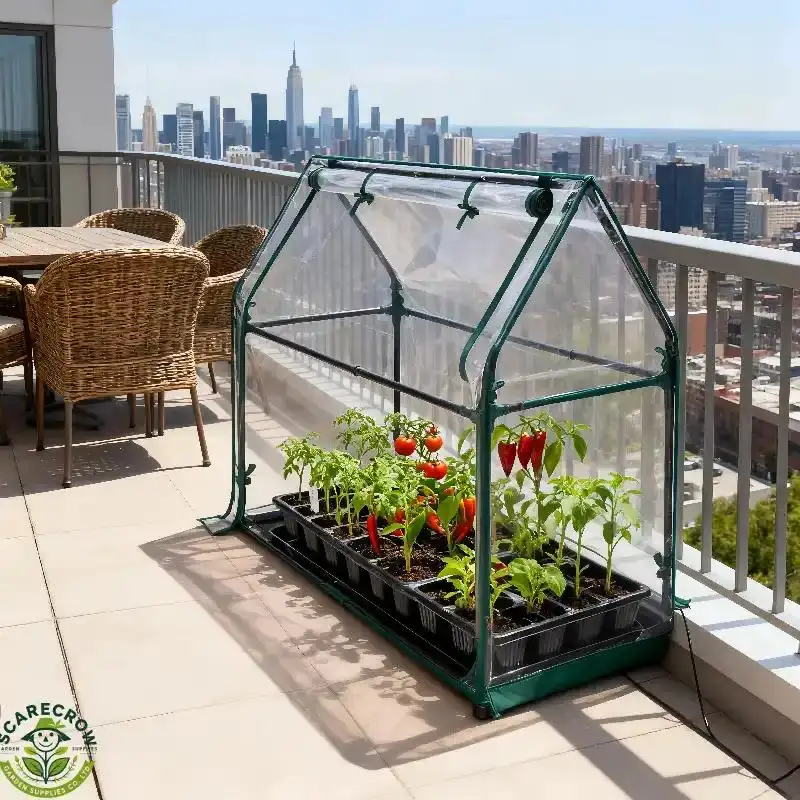
Our Mini Greenhouse with Waterproof Pad & Humidity Dome combines several structural features that support this approach.
Key Product Specifications
| Specification | Product Data |
| Product Model | SKU2509063 |
| Main Structure | PVC + Iron Frame |
| Connectors | Durable Plastic |
| Frame Treatment | Rustproof Electrophoretic Coating |
| Base | Waterproof Pad |
| Access | Roll-Up Door |
| Closure | Heavy-Duty Zipper |
| Package Size | 91 × 14 × 11 cm |
| Gross Weight | 1.95 kg |
| MOQ | 500 pcs |
| Lead Time | About 15 days for orders up to 500 pcs |
The transparent cover helps reduce rapid moisture loss during germination, while the roll-up opening allows growers to increase air exchange after emergence.
The waterproof base is particularly important for indoor growing because it helps contain irrigation water and protects flooring or shelving underneath the greenhouse.
Practical Climate Management
The Indoor Greenhouse operates as follows.
1. Germination
Maintain even moisture of the root-zone and keep the root-zone temperature at an even level.
2. Emergence
Allow the seeds to germinate and then begin to open the enclosure.
3. Seedling
Increase the rate of air movement and reduce humidity.
4. Active Growth
Regulate the growing environment to best suit the needs of the vegetable.
Growers should also avoid:
•Constantly saturated growing media
•Standing water inside trays
•Keeping the greenhouse sealed all day
•Strong direct sunlight on a closed enclosure
•Growing warm-season and cool-season crops under identical conditions
Why Crop Type Still Matters
An Indoor Greenhouse for Vegetables does not eliminate crop-specific requirements.
Tomatoes, peppers, and cucumbers, as well as other vegetables, fruit, and flowers, will usually germinate and grow better with higher temperatures. Lettuce, spinach, and other vegetables will do better and germinate faster with cooler temperatures.
Managing different seedling temperatures to a degree will allow for more control over the climate. This reduces the need for excessive climate control on the system.
Start with a Better Structural Design
Modulating moisture, temperature, and CO2 allows growers to control some major factors that impact plant growth. With an Indoor Greenhouse for Vegetables, the goal is to provide a stable environment. Greenhouses will always allow for some level of control over major environmental factors and reduce the effects of outside seasonal changes.
At Scarecrow Garden Supplier, we have a strong OEM/ODM background, and with our garden and nursery supply manufacturing experience, we are equipped to assist you with your private label needs.
Check out our Indoor Vegetable Greenhouse for some ideas or to share your ideas for other designs.
FAQs
Q1. What is Scarecrow Garden Supplier’s Indoor Greenhouse for Vegetables designed for?
Scarecrow Garden Supplier’s mini greenhouse is designed for indoor seed starting, seedling propagation, herbs, and compact vegetable growing. Its enclosed structure helps retain moisture during germination while allowing growers to manage ventilation as seedlings develop.
Q2. What materials are used in Scarecrow Garden Supplier’s mini greenhouse?
The greenhouse uses a PVC cover with an iron frame, durable plastic connectors, and a rust-resistant electrophoretic coating. This structure is designed to provide a practical balance between stability, portability, moisture retention, and indoor use.
Q3. Does Scarecrow Garden Supplier’s Indoor Greenhouse for Vegetables include a waterproof base?
Yes. The mini greenhouse includes a waterproof base pad that helps contain irrigation water and reduce direct water contact with floors, shelves, or other indoor surfaces.
Q4. How does the greenhouse help control humidity?
The transparent cover helps reduce rapid moisture loss around seeds and seedlings. After germination, growers can use the roll-up door and heavy-duty zipper to increase air exchange and reduce excessive humidity or condensation.
Q5. What is the package size and weight of the Scarecrow mini greenhouse?
The listed package size is approximately 91 × 14 × 11 cm, with a gross weight of about 1.95 kg. The compact packaging can be useful for distributors, retailers, and private-label garden product programs