










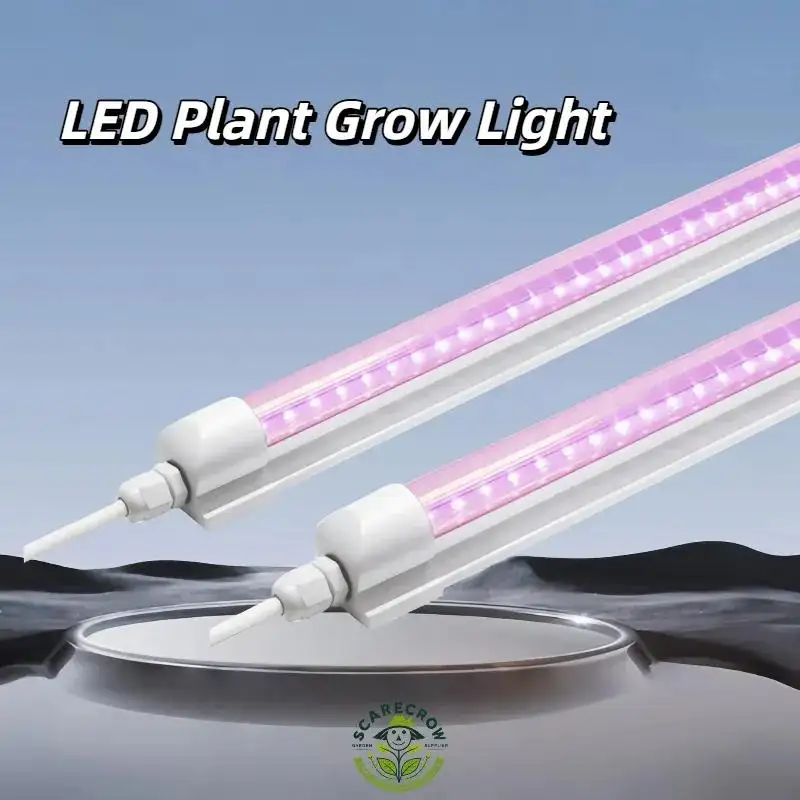
Plant Grow Light Wholesale
When purchasing lighting for commercial vertical farms, Plant Grow Light Wholesale isn't just about quantity discounts. The performance of grow lights directly correlates to the crops' uniformity, power consumption, unit density on racks, air conditioning load, and ultimately the cost per kilogram to produce the crops.
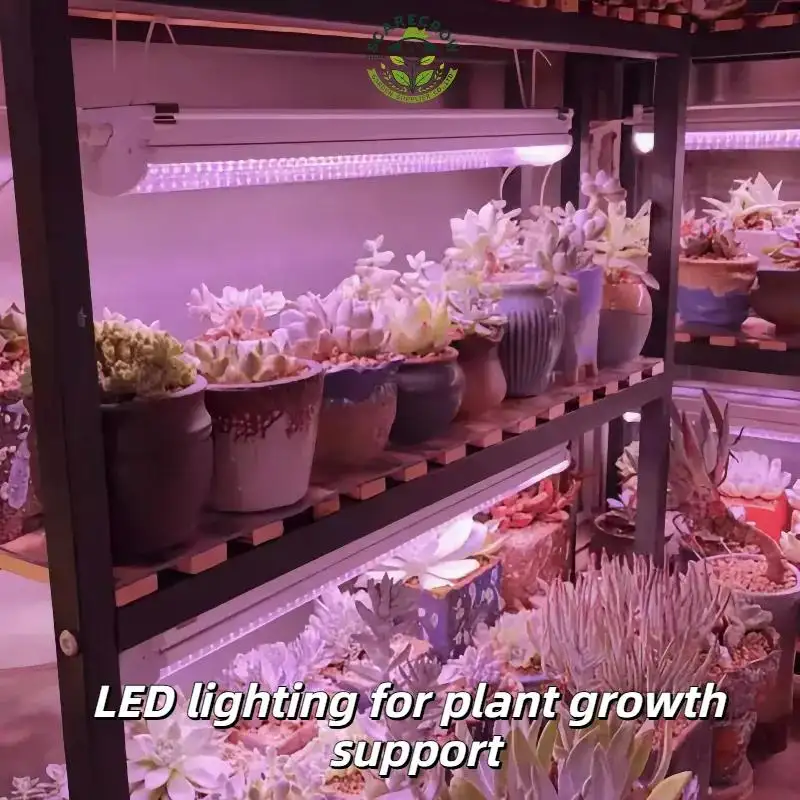
At Scarecrow Garden Supplier, we approach Plant Grow Light Wholesale projects from the application side first. Before selecting a fixture, buyers should define crop type, target PPFD, photoperiod, rack dimensions, mounting distance, thermal conditions, and control requirements. A fixture that works well in an open greenhouse may not perform equally well inside a compact multi-layer growing rack.
Why Multi-Layer Farms Need Application-Specific Lighting
Vertical farming places multiple crop layers within the same footprint. This improves space utilization, but also reduces the distance between the lamp and canopy.
As a result, lighting design must solve several issues at the same time:
• Maintain stable PPFD across the entire tray
• Avoid excessive center hotspots
• Limit heat accumulation between shelves
• Provide sufficient crop light without wasting electricity
• Fit within restricted rack height
• Support different crop stages through dimming or zoning
For this reason, professional Plant Grow Light Wholesale selection should be based on system performance rather than wattage alone.
PPFD, DLI and PPE: Three Metrics Buyers Should Understand
PPFD: Light Reaching the Canopy
PPFD measures the number of photosynthetically active photons reaching one square meter of crop area each second.
Its unit is:
μmol/m²/s
The important point is that PPFD describes crop-level light delivery. Two LED fixtures with the same wattage may produce very different PPFD because of differences in LED efficiency, optical layout, fixture width, and mounting height.
DLI: Total Light Received Per Day
DLI combines PPFD with photoperiod.
A simplified formula is:
DLI = PPFD × lighting seconds per day ÷ 1,000,000
For example:
250 μmol/m²/s × 16 hours ≈ 14.4 mol/m²/day
This matters because a vertical farm does not only need a target instantaneous light level. It needs a suitable daily light dose.
PPE: Electrical Efficiency
PPE is measured in μmol/J and describes how efficiently electrical energy is converted into photosynthetic photons.
For Plant Grow Light Wholesale, PPE is especially important because lighting often represents one of the largest energy loads in indoor agriculture.
| Metric | Main Question It Answers |
| PPFD | How much usable light reaches the crop? |
| DLI | How much light does the crop receive per day? |
| PPE | How efficiently does the fixture use electricity? |
| PPF | How many photosynthetic photons does the fixture produce? |
These parameters should be evaluated together.
Do Not Judge Grow Lights by Wattage or Lumens Alone
One of the most common purchasing mistakes is comparing LED grow lights only by watts or lumen output.
Our current Scarecrow LED plant grow light is specified with:
• 3500 lm luminous flux
• 3000K / 4000K / 5000K / 6500K options
• RA > 80
• LED light source
• Constant-current driver
• IP20 protection rating
• Optional PC light cover
• Optional dimming, sensor, low-voltage and related electrical configurations
These specifications are useful for understanding the electrical and visible-light characteristics of the fixture.
However, for a professional Plant Grow Light Wholesale project, lumens should not replace horticultural measurements. Lumens are weighted according to human vision, while plants respond to photon quantity and spectrum.
For vertical-farm projects, we recommend additionally confirming:
• PPF
• PPE
• Spectral distribution
• PPFD map
• Measurement height
• Fixture spacing
This makes supplier comparison much more meaningful.
PPFD Uniformity Is Critical in Multi-Layer Racks
Peak PPFD can be misleading.
A fixture may produce a strong reading directly under the center of the lamp while delivering much lower PPFD near the tray edges.
In commercial farming, this can lead to:
• Uneven plant height
• Different maturation rates
• Lower tray utilization
• Higher labor requirements during harvesting
• Inconsistent product quality
A better Plant Grow Light Wholesale evaluation should therefore examine the full PPFD distribution.
A useful method is to compare:
Minimum PPFD ÷ Average PPFD
The closer the values are, the more uniform the light distribution.
We recommend that buyers provide the actual rack width, shelf depth, crop height, and planned fixture-to-canopy distance before finalizing fixture quantity.
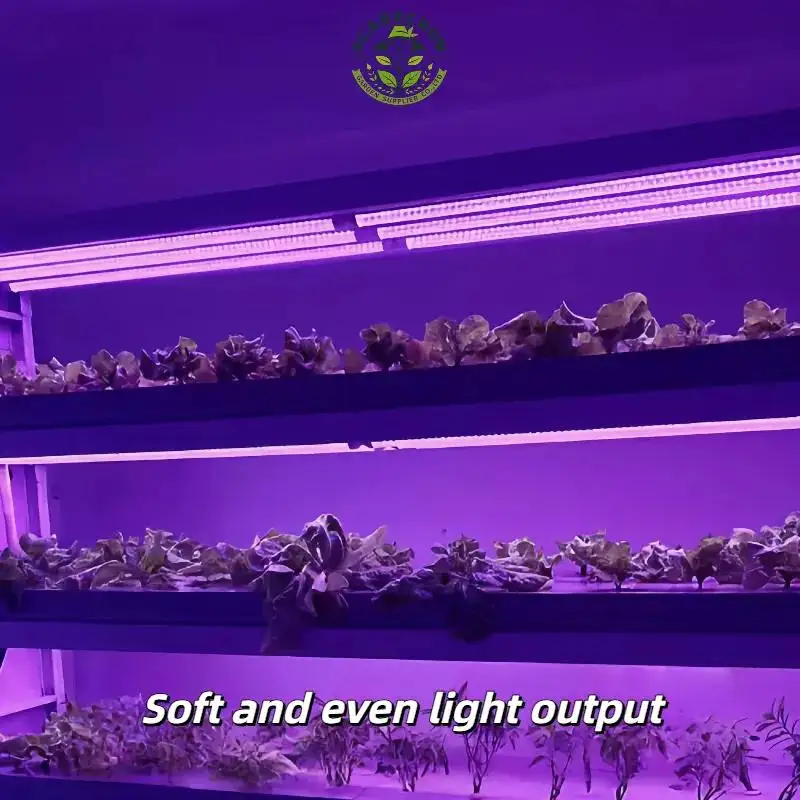
Rack Height Determines Fixture Layout
Available lighting distance can be estimated as:
Shelf Height – Mature Crop Height – Irrigation Space – Airflow Clearance = Available Fixture Distance
This is particularly important in compact racks.
When mounting height is limited, the lighting system normally requires:
• Low-profile fixture construction
• Broad light distribution
• Controlled fixture temperature
• Appropriate fixture spacing
• Reduced hotspot intensity
Our LED grow light uses an LED board structure with plastic housing and optional PC cover. The internal board and housing arrangement can support heat dissipation and relatively even visible-light distribution.
For actual vertical-farm use, however, we still recommend validating PPFD at the intended installation height rather than assuming one layout fits every rack.
Spectrum Should Match the Crop Strategy
Spectrum should not be treated as a single universal formula.
Different wavelengths influence plants differently:
• Blue light supports compact morphology and leaf development
• Red light contributes strongly to photosynthetic efficiency
• Green light can penetrate deeper into dense canopies
• Far-red light can influence elongation and shade responses
Scarecrow currently offers 3000K, 4000K, 5000K and 6500K configurations, allowing buyers to select different white-light characteristics according to their application.
For commercial plant factories, we recommend evaluating actual spectral data when crop response is a critical production parameter.
Heat, Airflow and Lighting Must Be Designed Together
In multi-layer farms, light fixtures also affect the thermal environment.
Poor rack design can create:
• Hot zones near drivers
• Uneven leaf temperature
• Higher HVAC demand
• Different humidity levels between shelves
• Inconsistent transpiration
This is why Plant Grow Light Wholesale should not be separated from ventilation and cooling design.
A high-output fixture is not automatically the best choice if it forces the facility to spend significantly more energy on cooling.
In practice, growers should evaluate:
Lighting energy + HVAC energy + crop output
Rather than fixture wattage alone.
Dimming and Zoning Improve Operational Flexibility
Different crop stages rarely need identical light levels.
Vertical farm racks may have:
Propagation Zone
Contains less favorable conditions, such as lower levels of light.
Vegetative Zone
Contains conditions that are more favorable and varies based on the crop.
Finishing Zone
May implement light control for photoperiod and/or light intensity in order to achieve production goals.
For this reason, dimming is valuable in many Plant Grow Light Wholesale projects.
Scarecrow Garden Supplier can discuss order-specific configurations such as:
• Dimming
• Sensor integration
• Low-voltage options
• Flicker-free configuration
• Driver selection
• EMC requirements
• CE-related requirements
• Plug and voltage specifications
This allows buyers to configure the electrical system according to their target market and cultivation environment.
What Buyers Should Check Before Wholesale Purchase
We recommend buyers compile the information outlined below prior to sending a request for a Plant Grow Light Wholesale quotation:
Information About the Project
| Crop Information | Description of Light Requirements |
| Rack Information | Number of Fixtures |
| Mounting Height | Impact on PPFD Uniformity |
| Target PPFD | Minimum Level of Light Required for the Crop |
| Photoperiod | Required DLI |
| Voltage and Plug | Electrical Compatibility |
| Required Dimming Level | Stage based Control |
| IP Rating | Environmental Condition |
| Certification | Imported / Exported Market |
| Packaging | Required for Wholesale Shipment |
For our current Fixture, an IP20 rating applies. This signifies protection against access to hazards by the protected individual and allows the fixture to be used in a fully enclosed, indoor environment. For growing conditions that are of a high humidity, and/or involve splashes and/or wash downs, it may be necessary for the buyer to look for a Fixture that has a higher IP rating.
Design the Lighting System Before Ordering the Fixture
A practical Plant Grow Light Wholesale process should follow this sequence:
Crop → DLI → PPFD → Photoperiod → Rack Geometry → Fixture Layout → Uniformity → Heat Load → Controls → Energy Cost → Sample Validation
Our experience in plant factory and controlled environment systems gives us the ability to aid our customers in designing the lighting system for their project, starting from the assessment of crops, racks and controls, and ending with the determination of energy costs. We look forward to serving you.
FAQs
Q1. What specifications does Scarecrow Garden Supplier's LED plant grow light offer?
The current LED Plant Grow Light has a listed luminous flux of 3500 lm, IP20 protection, RA>80 color rendering, and color temperature options of 3000K, 4000K, 5000K, and 6500K. It uses an LED light source with a plastic housing and optional PC cover.
Q2. Is Scarecrow's Plant Grow Light Wholesale solution suitable for vertical farms?
It can be considered for protected indoor growing applications such as plant shelves, seedling rooms, plant factories, greenhouses, nurseries, and vegetable growing areas. For commercial vertical farms, buyers should additionally confirm PPFD, PPF, PPE, spectrum, and rack-specific lighting distribution.
Q3. Can Scarecrow provide different color temperatures for bulk orders?
Yes. Available color-temperature options include 3000K, 4000K, 5000K, and 6500K, allowing buyers to select different white-light characteristics according to their application.
Q4. Does Scarecrow support dimmable Plant Grow Light Wholesale orders?
Dimming can be discussed as an optional configuration. Other options such as low-voltage, sensor, emergency, flicker-free, and high-efficiency configurations may also be available depending on the selected model and order requirements.
Q5. What driver options are available for Scarecrow LED grow lights?
The standard specification uses a constant-current driver. Other driver and electrical configurations can be confirmed according to project requirements and target-market standards.