






Garden tool library kit with individually identified hand tools and a reusable carrying case
A gift set is designed for a single presentation. A loan kit is designed to be handled, checked and reissued repeatedly. Those are different design briefs, and a product built for the first does not automatically serve the second.
Consider a tool library that orders its hand tools as matched gift sets. The reasons are easy to understand: they are what the catalogue offers, they look complete in a box, and a set is simpler to specify than a list of individual tools. The risks that follow over a season are worth working through before the order is placed. Trowels can go missing without anything breaking, one kit can end up short of a fork with no route to buying a single one, the boxes can end up carrying something else, and the volunteer at the desk may not be able to tell which item belongs to which kit. These are the failure modes a set-based order leaves open, and each one is avoidable by ordering differently. How often that happens, and how quickly, is something a library knows from its own records rather than something this article can put a figure on.
Build the kit around one borrowing task
A kit should be a task, not a collection.
Related reading: wholesale garden tool sets and hand-tool assortments.
Three common garden tasks have quite different tool requirements. Ground preparation needs a digging tool, a cultivating tool and something to move material. Transplanting needs a planting tool, a means of lifting and handling a root ball, and something to firm and water. Pruning needs a cutting tool suited to the material being cut, and something to hold or carry the cut material. A borrower who wants to plant out six seedlings does not need a pruning saw, and a kit that includes one because the box had a space has added a hard-to-replace item to every loan.
The task-based approach has three practical consequences. It removes duplicate tools, which reduces both weight and the number of items exposed to loss. It makes substitution sensible, because a missing trowel can be replaced by any suitable trowel when the kit's purpose is planting, whereas a kit built around matching handles is broken by any substitution. And it makes the kit's identity explainable at the desk, which matters when a borrower asks what they need.
The number of items per kit should also be a decision rather than a default. More items per kit means fewer kits for the same budget and more exposure per loan. A library serving beginners may reasonably consider more kits of four tools rather than fewer kits of nine, because the failure that hurts a borrower most is a loan turned away. That is a purchasing assumption to test against the library's own borrowing pattern, not a conclusion that smaller kits are better, and the right number is whichever one the library's own records of turned-away requests and unused items support.
Make every item identifiable outside the case
Identity has to survive the case being left open on a bench.
Three levels of identification are needed and they serve different purposes. The kit number, so a kit can be tracked as a unit and its history known. The item identity within the kit, so a returned item can be checked against the kit's contents list and a missing item detected at the desk rather than a week later. And the library's ownership mark, so that an item found in a shed or returned by a neighbour can be restored to the right kit.
The reconciliation point matters most. If the check at return is a count of items, a kit missing one trowel and containing one extra fork passes. If the check is against a contents list with each item identified, it fails correctly. That distinction turns the desk check from a gesture into a control.
The identification method should be chosen for durability rather than elegance. Engraving or stamping survives handling in soil; an unproven paper label may not survive a wet session, while water-resistant and waterproof label materials exist and should be chosen and tested for the conditions the tools will actually meet; painted marks wear; a tag attached by a ring can be removed. The mark also needs to be readable by a volunteer in poor light, which argues for something visible rather than a fine code.
There is one design implication worth putting to a supplier. An item that is identifiable when loose, and replaceable as a single unit, is worth more to a library than a matched set that must be replaced as a whole. Replaceability is a design property, and a library's procurement should prefer it.
Design the case for repeated handovers
The case is the working interface, and it is where gift sets most often fall short.
Four requirements apply. Ease of taking out and putting back, because a case that requires careful arrangement to close will be left open, and an open case in a shed is where items go missing. Missing-item visibility, meaning a case whose contents can be checked at a glance, which usually means a defined position or a labelled slot per item rather than a single deep compartment. Protection, meaning that tools do not damage each other in transit, which for cutting tools means a guard or a fixed position. And cleanability, because soil comes back with the tools and a case that traps wet soil becomes a hygiene and durability problem.
How those four are met is a matter of comparing candidates rather than of picking a moulding style. A fixed slot and a moulded cavity are two ways of doing the same job, and neither wins on principle: what wins is the one that holds the replacement items the library will actually buy, survives being dropped and hosed, and shows at a glance what is missing. A case whose cavities only accept the original tool is a case that fails the first of those three tests, however well it presents.
The gap between return and next loan is where the comparison pays off. A case that is easy to open and hard to close will be handed in open. A case with a lid that does not latch will spill in a car boot. A case with a fabric lining will hold damp. None of these show up in the first week; all of them show up within a season.
There is a related point about what the case should not be asked to do. A presentation case, built to look good on a shelf with inserts cut for one fixed set, usually does its own job well and a lending job badly, because its inserts assume the exact original contents and it has little tolerance for substitution. That is a statement about fit to purpose rather than about quality: the same case can be the right choice for retail display or for a gift, and the wrong one for a lending desk.
Plan the gap between return and the next loan
No product solves the process behind the counter, and that is where a loan kit lives or dies.
Between one loan and the next, a kit needs four stages. Inspection, meaning the contents check against the list and a condition check on each item. Processing, meaning cleaning and drying, which for garden tools is not optional and is the step most often skipped when a queue forms. Maintenance, meaning sharpening, tightening, or treating handles, which extends life and is the reason a cheap tool becomes expensive. And quarantine, meaning a place for an item that is damaged or suspect, so that it cannot go out on the next loan.
Quarantine is the stage most easily left out of a lending system, and it is the one that protects the next borrower. A fork with a cracked socket does not fail gracefully; it fails with a load on it. An item that has been reported as faulty by one borrower and returned to stock has transferred the problem rather than solved it. A labelled quarantine box and a rule that nothing leaves quarantine without a decision is a small system with a large effect.
The time in this process is real, and it should be planned rather than absorbed. If inspection and cleaning take a measurable number of minutes per kit, then the number of kits a library can turn around in an evening is finite, and the number of kits it should own is a function of that throughput rather than of the budget alone. A library with more kits than it can process has a storage problem dressed as an asset.
Buy replacements without replacing every kit
This is where the case for task-based kits pays off, in money.
Two costs attach to loss and damage. The direct cost of the replacement item, and the indirect cost of the kit being unusable until it is replaced. If kits can only be bought whole, one missing trowel can take four tools out of service, and the weight of that indirect cost is decided by how long the kit stays out of use and how many borrow requests go unmet rather than by the missing item's price. Whether it outweighs the direct cost is a question for the library's own numbers.
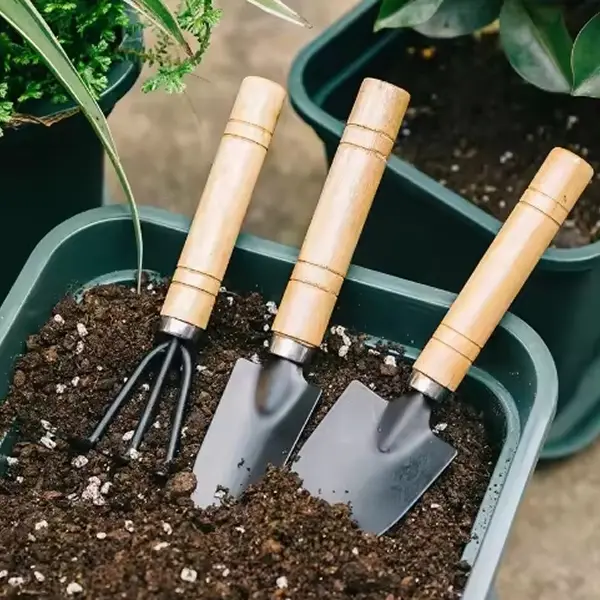
Three things make single-item replacement possible. A kit design where items are standard and substitutable rather than matched. A supplier position where single items can be sourced alongside kits, in quantities a library can actually use, which is a question to confirm item by item rather than assume. And a contents list that names each item by type and size, so that the replacement ordered is the replacement needed.
Standard tool types help here, and it is worth being precise about how much. A common pattern, a standard size and a wide supply base make it more likely that a replacement can be found from more than one source, and more likely that the item is still available when the original purchase is two years old. That lowers the difficulty of replacement; it does not guarantee availability. Supply continuity has to be confirmed line by line for the items a library actually depends on, because a widely sold type can still be discontinued in the particular specification that was bought.
The comparison that matters is between replacing the item and replacing the kit, and it has to be done with the actual numbers: the price of the single item, the delivery cost and minimum order, against the price of a new kit and the disposal of the old one. Which way that comes out depends on the item, the order terms and the delivery, so it is a calculation each library should run on its own figures rather than a conclusion this article can supply.
For suppliers, this points at a supply conversation rather than a single product. What a library needs to establish with its supplier is which items can be replenished singly or in small quantities, what the minimum order position is for each, and how long a given tool type is likely to stay available. Those answers determine whether single-item replacement is realistic, and they have to be confirmed item by item rather than assumed from a catalogue's structure.
The buying arrangement that fits a library is a wholesale one, and it exists in two forms that sit side by side. A mixed selection across categories can go in a single order, with a minimum order value of US$500 for that mixed order, which lets a library build its first kits from several product types at once instead of committing to one item in volume. Alongside that, repeated single-product quantities suit a library that has settled on one tool type and wants it replenished as a line rather than as part of a blend.
What Garden offers in this relationship is wholesale supply and purchasing coordination, which means matching an order to the items a library actually needs and coordinating supply across categories rather than manufacturing a bespoke kit to order. Quantities per single item, and any configuration or branding of kits to a library's own specification, are separate questions that depend on the item and have to be confirmed with the supplier rather than promised in advance.
The boundary to state clearly is that this discussion concerns hand tools, and that the logic does not extend to powered equipment. A loan kit for a strimmer or a hedge trimmer raises inspection, testing and liability questions that are a different subject, and a library should treat powered equipment as a separate category with its own rules rather than as a bigger version of a trowel.
The overall proposition worth putting plainly is that a tool library is not buying a present. It is buying a set of items that will be handled, checked, cleaned and counted many times, and the product that survives that is unglamorous: standard tools, clear marks, labelled slots, visible contents, and a route to replacing one item without replacing the set.
Developing garden hand-tool ranges for tool libraries or community gardening programs? Share the tasks, tools, quantities and preferred packaging. Scarecrow Garden Supplier supports single-product wholesale and mixed-category sourcing, with mixed orders starting at US$500 and product-specific minimum quantities confirmed separately.

Written by
ScarecrowGarden
💡About Scarecrow Garden Supplier Co., Ltd.
Scarecrow Garden Supplier Co., Ltd. is a China-based sourcing and wholesale partner specializing in garden tools, landscaping equipment, and outdoor supplies for international wholesalers, distributors, contractors, and brands.
With hands-on experience rooted in real garden use scenarios, we focus on durable materials, functional design, and stable large-volume supply. Our product range covers pruning tools, watering systems, hand tools, outdoor hardware, and customized garden solutions to support both retail and professional landscaping markets.
Beyond products, we help our partners navigate supplier selection, quality control, compliance requirements, and long-term sourcing strategies in China. Through our blog, we share practical insights on product selection, material comparisons, industry trends, and cost-effective purchasing—helping global buyers build stronger, more competitive supply chains.