








Updated 2 months ago
Wood vs Fiberglass vs Steel Shovel Handles: Procurement Trade-Offs for Wholesale Buyers
SCARECROW GARDEN SUPPLIER
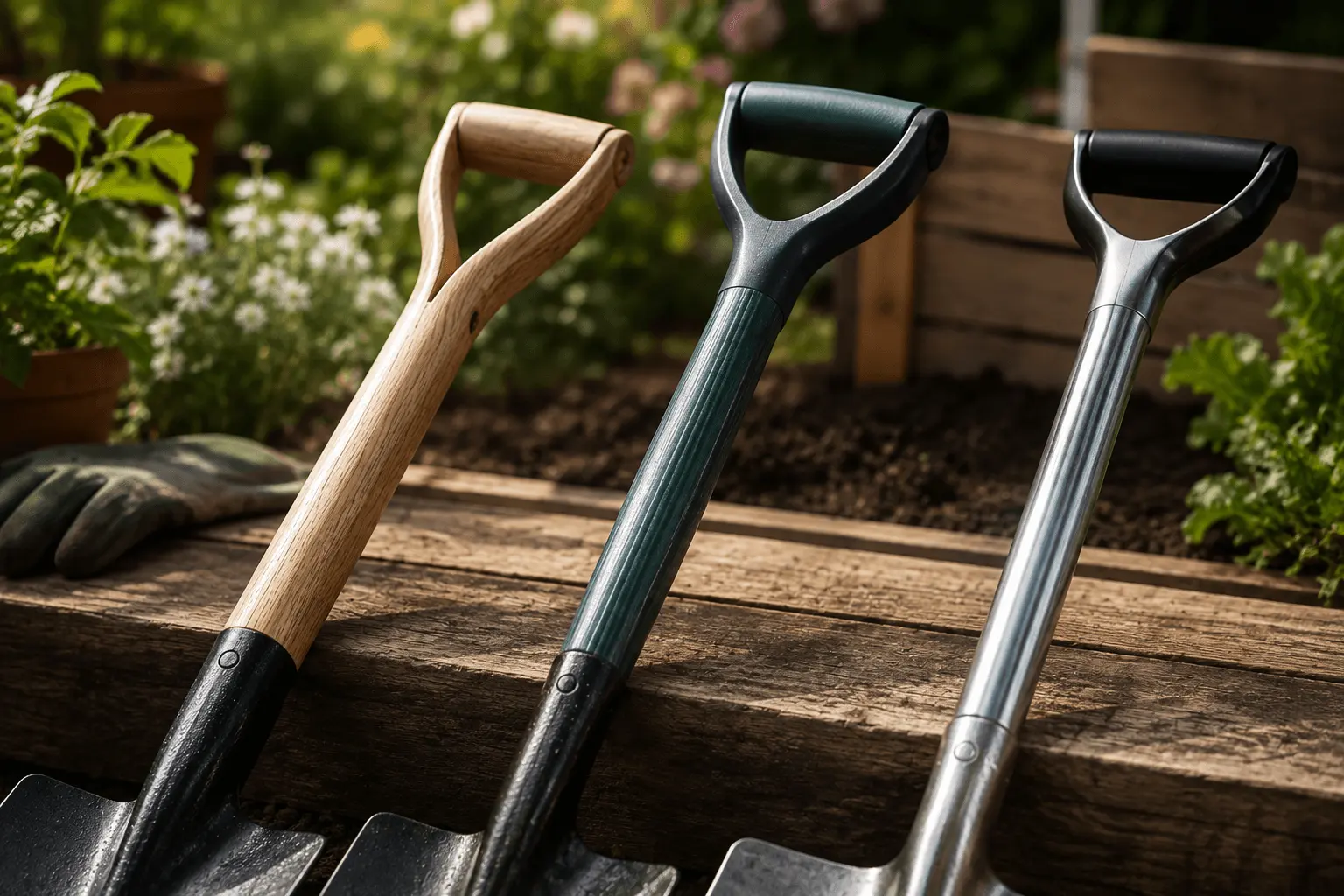
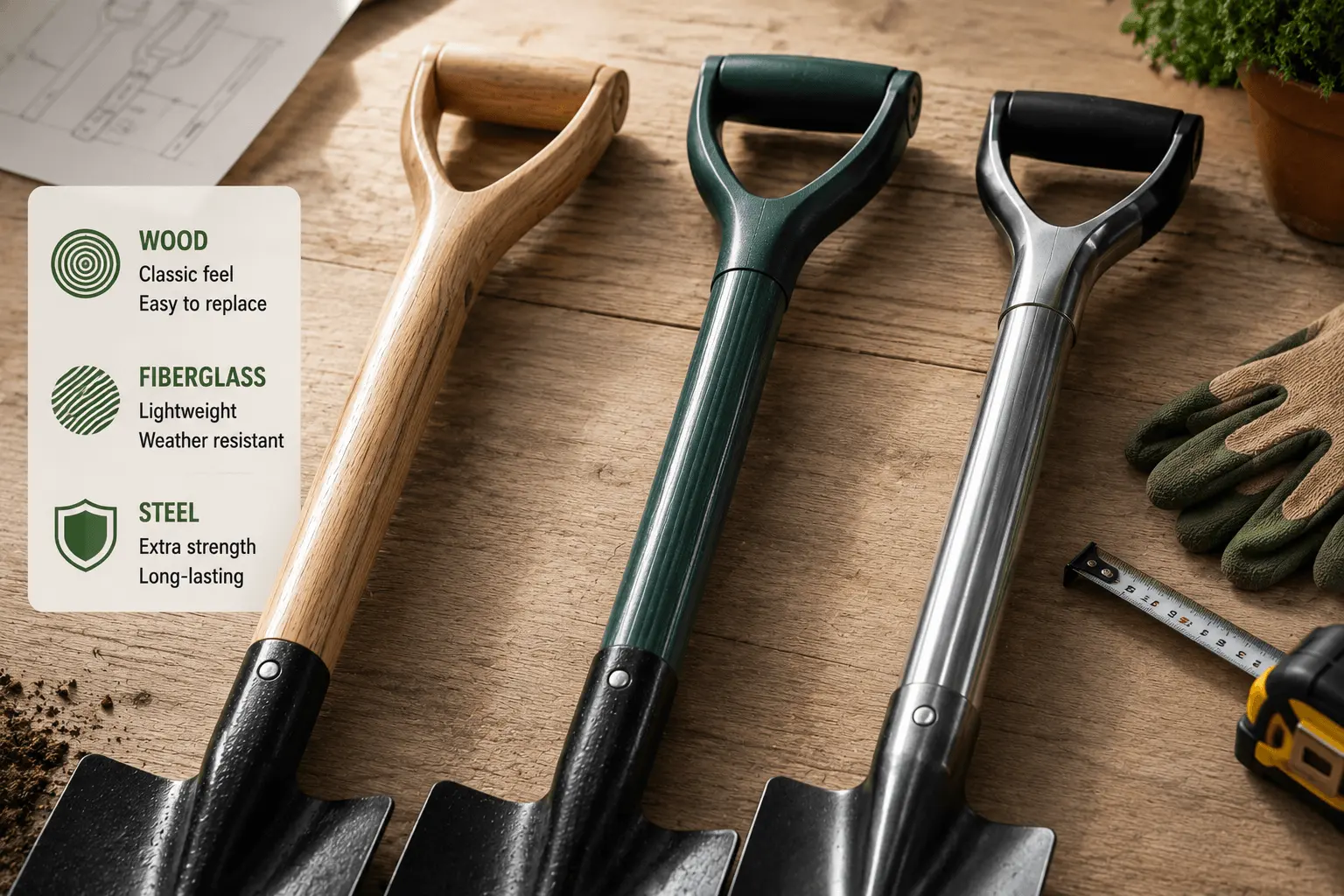
wood fiberglass and steel shovel handles
Handle material is not a cosmetic choice. It changes the weight, the balance, the connection design, the weather resistance, the replacement strategy, and the price point of the entire tool. Two shovels with identical blades but different handle materials are, for procurement purposes, two different products.
This guide is for wholesale buyers who need to decide which handle material to specify when sourcing garden shovels and spades. It does not compare handle types long handle vs. D-grip — that topic is covered in our existing guide. Here, we focus on the material itself: wood, fiberglass, and steel, and the trade-offs each one creates across the supply chain, the retail shelf, and the end user’s hands.
Handle Material Is a Structural Decision, Not a Cosmetic Choice
When you specify handle material in an RFQ, you are making four decisions at once:
Weight and balance. Handle material contributes to total tool weight and affects the balance point. The actual weight and balance must be compared on specific handle constructions, diameters, wall thicknesses, lengths, and material grades — do not assume universal weight rankings across all models.
Connection design. Wood handles typically fit into sockets with rivets or wedges. Fiberglass handles may require different socket diameters or adhesives. Steel handles can be welded directly to the blade. Each material may change the connection method.
Weather resistance. Wood absorbs moisture, swells, and can split. Fiberglass composites are generally more moisture-resistant but still subject to resin system, UV, and surface treatment effects. Steel is strong but can rust at exposed points. The material influences how the tool ages in outdoor storage.
Replacement and repair. Wood handles are often the easiest to replace. Fiberglass handles may be harder to source as replacements. Steel handles may require the whole tool to be replaced if the handle is welded and fails. Confirm replaceability for each specific model.
These are not secondary considerations. They affect your landed cost (steel is heavier, which affects shipping), your complaint rate (wood splits in dry climates, fiberglass can delaminate), and your after-sales strategy (can you offer replacement handles, or is the tool disposable?).
Comparing Shovel Handle Materials?
Review wood, fiberglass and steel against the actual product, channel and replacement strategy. Compare handle options around the requirements of the complete shovel rather than choosing by material name alone.
Wood Handles: Grain, Moisture, Finish and Replacement Considerations
Wood is the traditional shovel handle material. It is familiar to users, affordable to produce, and widely available. It also has specific vulnerabilities that a buyer should understand before specifying it.
Grain and Strength
The strength of a wood handle depends on the grain orientation and the wood species. Ash and hickory are commonly used for shovel handles, but other species may also be suitable. Do not assume that a different species is inferior — confirm the species, grain quality, moisture, defect limits, and finish on the actual sample. The grain should run straight along the length of the handle — cross-grain or short-grain sections are potential weak points.
Things to check on a sample:
- Grain direction. Run your eye along the handle. The grain should run straight from the grip end to the socket end. Any diagonal or interrupted grain is a weakness.
- Knots. Small, tight knots may be acceptable. Large or loose knots are failure points.
- Species. Ask the supplier to confirm the wood species. Evaluate the species against your strength and cost requirements on sample — do not assume only ash or hickory are acceptable.
Moisture and Dimensional Stability
Wood is a natural material. It absorbs moisture from the air, which causes it to swell. In dry conditions, it loses moisture and shrinks. This dimensional change affects the socket fit — a handle that fits tightly in a humid factory may loosen in a dry retail environment or a dry climate.
Things to specify:
- Moisture content at production. Ask the supplier what moisture content they target. Handles that are too wet when assembled will shrink and loosen. Handles that are too dry may crack.
- Sealing. A sealed or varnished handle resists moisture exchange better than raw wood. Specify whether the handle should be sealed, varnished, or left raw.
Finish
Wood handle finishes range from raw sanded wood to varnish, paint, or lacquer. The finish affects grip comfort, moisture resistance, and shelf appearance.
- Raw wood — traditional, comfortable grip, but absorbs moisture and stains easily. May not look good after extended shelf display.
- Varnished — adds a protective layer, slightly smoother grip, better moisture resistance. The varnish can chip or wear over time.
- Painted — uniform appearance, good for retail display. Paint can chip, exposing bare wood underneath.
Replacement Considerations
Wood handles are often the most replaceable handle type. However, replacement compatibility cannot be determined by diameter alone — it also depends on taper, socket depth and shape, rivet diameter and position, handle length, and grip design. Confirm replacement handle availability and compatibility with the supplier for each specific model.
This is a significant after-sales advantage for channels that serve professional users — a landscaping supplier who can offer replacement wood handles has a service advantage over one who sells disposable tools.
What to specify: Wood species (ash/hickory), grain quality (straight, no large knots), moisture content target, finish type (raw/varnished/painted), and handle diameter.
What to verify on a sample: Check grain direction along the full length. Look for knots. Feel the finish. Measure the diameter at the socket end and the grip end. Check for moisture-related swelling or cracking.
Fiberglass Handles: Structure, Surface and Connection Points
Fiberglass handles are made from glass fiber strands embedded in a resin matrix. They are generally more moisture-resistant than wood and do not split or crack along grain lines. They are increasingly common in mid-tier and professional-grade shovels. However, fiberglass composites are still subject to resin system quality, UV exposure, surface treatment, and impact effects — confirm actual handle construction and performance on sample.
Structure
Fiberglass handles may be hollow or solid, and may be produced by pultrusion, filament winding, or other processes. Confirm the actual handle construction with the supplier. The wall thickness (if hollow) or overall construction affects strength and weight.
Things to check on a sample:
- Wall thickness. If possible, check the wall thickness at the open end of the handle. A thin-walled fiberglass tube may flex excessively under leverage.
- Surface texture. Fiberglass surfaces range from smooth (resin-rich) to textured (fiber-visible). A smooth surface is more comfortable but can be slippery when wet. A textured surface provides better grip but may cause abrasion over extended use.
- Color. Fiberglass handles are often colored (yellow, blue, orange) for retail visibility. Confirm whether the color is resin-integral or a surface treatment, and check UV performance and surface condition on sample — color may age depending on the resin system and surface layer.
Connection Points
Fiberglass handles connect to the socket differently from wood. Because fiberglass cannot be compressed like wood (it does not swell to fill a socket), the connection relies on:
- Adhesive — epoxy or similar bonding agent fills the gap between handle and socket. The adhesive must be rated for the temperature and stress conditions the tool will encounter.
- Rivet or pin — a mechanical fastener through the socket and handle. On fiberglass, the rivet hole must be properly drilled — fiberglass can delaminate around holes if the drilling is rough or the hole is oversized.
- Combination — adhesive plus rivet is the most secure connection for fiberglass handles.
The risk with fiberglass connections is delamination — the outer layers of fiberglass can separate around the rivet hole or at the socket interface under repeated stress. A patent describing a metal-and-synthetic-resin shaft combination addressed this by covering the connection pipe with an extra combination pipe before riveting, specifically to prevent shaft-to-blade separation.
Performance Evidence
One study, published in the International Journal of Industrial Ergonomics, compared wood, solid fiberglass, and hollow fiberglass handles under specific test conditions and sample configurations. The study observed differences in measured effort and subjective ratings between handle types under those conditions.
These findings apply to the specific handle configurations and test conditions used in that study. They do not automatically extend to all fiberglass handles, all wood handles, or all products. Handle construction, resin system, diameter, wall thickness, and use context all affect performance. If handle performance is a purchasing priority, evaluate it through sample comparison in your target use case.
Fiberglass handles are harder to replace than wood. The handle diameter and socket fit are often proprietary to the manufacturer. If replacement handle availability is important for your channel, ask the supplier before committing. For detailed spare parts and after-sales planning, see our Replacement Handles and After-Sales Guide.
What to specify: Wall thickness (or describe as “standard” or “heavy-duty”), surface texture (smooth/textured), color, connection method (adhesive/rivet/combination), and replacement handle availability.
What to verify on a sample: Check the surface for exposed fibers or rough spots. Flex the handle — it should have some give but not bend excessively. Check the connection point for adhesive squeeze-out or rough drilling around rivets. Ask about replacement handle sourcing.
Steel Handles: Strength, Weight and Corrosion Considerations
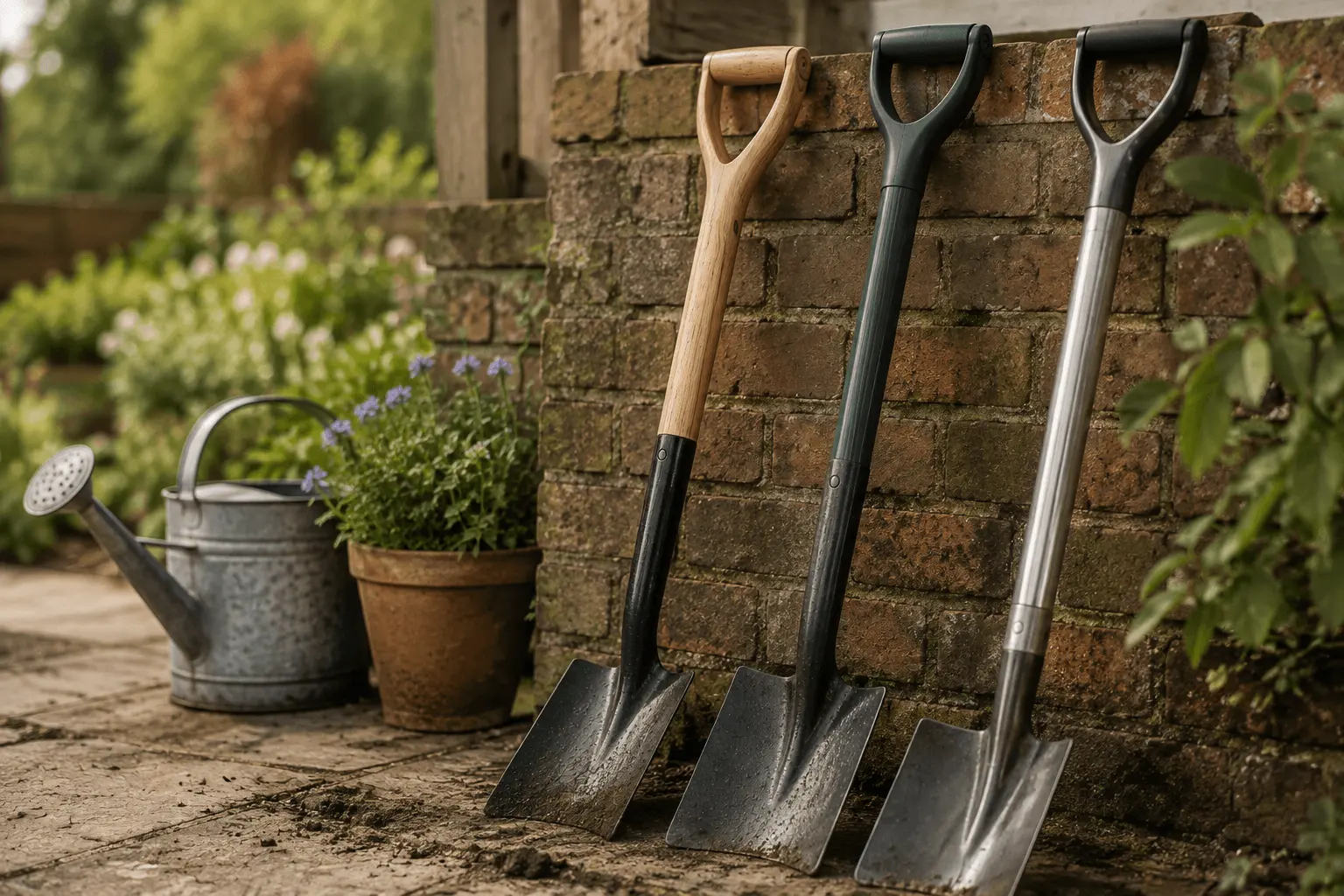
Steel handles are typically made from tubular steel and are most common on heavy-duty and agricultural shovels where strength is a priority. A steel handle will not split, crack, or delaminate. It can withstand prying, levering, and heavy loads. However, strength, weight, corrosion resistance, and repairability trade-offs should be evaluated on the actual sample — do not assume steel is universally the strongest or the only option for heavy use.
Weight
Steel is heavier than both wood and fiberglass. A steel-handled shovel is noticeably heavier than the same shovel with a wood or fiberglass handle. This affects:
- User fatigue. A heavier tool tires the user faster during repetitive use.
- Shipping cost. Steel handles add weight to every unit, which increases freight cost per carton and per container.
- Balance. A steel handle shifts the balance point toward the handle end, which can make the tool feel handle-heavy compared to a wood or fiberglass version.
Corrosion
Steel rusts. Unlike fiberglass (more moisture-resistant) or sealed wood (resistant), bare steel will corrode when exposed to moisture. Steel handles are typically painted or coated to prevent rust, but:
- The coating can chip during use, exposing bare steel.
- The interior of a tubular steel handle is often uncoated — moisture can enter through the open ends and cause internal rust.
- Weld points (if the handle is welded to the blade) may have thinner coating.
Things to specify:
- Coating type. Painted, powder-coated, or galvanized. Powder coating is more durable than paint. Galvanizing provides the best corrosion resistance but adds cost.
- End sealing. Ask whether the open ends of the tubular handle are sealed to prevent moisture entry.
- Weld corrosion protection. If the handle is welded to the blade, check whether the weld area has additional coating.
Connection
Steel handles are often welded directly to the blade or socket, eliminating the socket-to-handle fit problem entirely. A welded steel connection is the strongest available — but it is also permanent. If the handle or blade fails, the entire tool is scrap. There is no replacement path.
Some steel-handled shovels use a socket-and-rivet connection instead of welding. This allows handle replacement but introduces the same socket fit concerns as wood and fiberglass.
Replacement Considerations
Welded steel handles are not replaceable. Socket-and-rivet steel handles may be replaceable, but sourcing a steel replacement handle of the correct diameter and wall thickness is more difficult than sourcing a wood replacement.
For most channels, steel handles are specified for heavy-duty tools where strength is the priority. Confirm whether the connection is welded (permanent) or socket-and-rivet (potentially replaceable) for each specific model.
What to specify: Tubing gauge (wall thickness), coating type (painted/powder-coated/galvanized), end sealing (yes/no), connection method (welded/socket+rivet), and whether replacement handles are available.
What to verify on a sample: Check the weight against a wood or fiberglass equivalent. Inspect the coating for chips or thin spots. Check weld areas for rust. Check open ends for sealing.
How Handle Material Changes Balance and User Fatigue
The interaction between handle material and tool balance is often overlooked. Two shovels with the same blade can feel different depending on the handle material. However, actual weight and balance must be measured on specific handle constructions — do not assume universal rankings across all models.
For detailed weight and balance evaluation methods, see our Weight and Balance Guide.
The practical takeaway: handle material should match the use pattern. Evaluate on sample in the intended task — do not assume one material is universally superior.
- Occasional use (consumer): Wood may be adequate. Weight and fatigue are less critical than cost and familiarity.
- Regular use (prosumer): Wood or fiberglass. Evaluate comfort on sample.
- Daily professional use: Fiberglass or steel. Evaluate fatigue and durability on sample.
- Agricultural/heavy material: Steel or other heavy-duty options. Evaluate strength on sample.
What Buyers Should Inspect on Handle Samples
When handle samples arrive, inspect them side by side — not in isolation. Place a wood, fiberglass, and steel handle next to each other and compare:
| Check | Wood | Fiberglass | Steel |
| Weight | Weigh each handle | Fiberglass should be lightest; steel heaviest | — |
| Surface | Check grain, knots, finish | Check for exposed fibers, texture, color | Check coating for chips, rust spots |
| Flex | Should flex slightly under pressure | Should have slight give, not excessive bend | Should not flex visibly |
| Socket end | Check diameter, taper, fit | Check for adhesive residue, rivet hole quality | Check weld quality or socket fit |
| Grip end | Check grip shape, comfort | Check grip surface (slippery when wet?) | Check grip coating or sleeve |
| Moisture response | Check for swelling, cracking | Should be unaffected | Check for internal rust (if tubular) |
Photograph each handle from the same angles: side profile, socket end, grip end, surface close-up. These photos become your handle material reference set for future RFQs and sample comparisons.
Need Handle Sample Comparison?
Send your target material, use case and reference product so key handle checks can be organized. Compare samples against the actual product requirements instead of evaluating handle material alone.
Choosing Handle Material by Channel and Price Tier
Handle material should be evaluated against the failure mode the end user will encounter, the channel’s after-sales expectations, and the price tier. The table below offers planning considerations — not fixed rules. Actual material choice should be confirmed on sample and validated against your market.
| Channel / Tier | Planning Considerations |
| Hardware store (entry-level) | Evaluate wood for cost-effectiveness and consumer familiarity; confirm replacement availability if needed |
| Hardware store (core) | Evaluate wood or fiberglass against price and upsell strategy |
| Garden center (core) | Evaluate wood or fiberglass against retail display and color appeal |
| Garden center (professional) | Evaluate fiberglass for potential performance advantages; confirm on sample |
| Landscaping supplier | Evaluate fiberglass or steel against daily use requirements and abuse tolerance |
| Agricultural retail | Evaluate steel or wood against heavy-load requirements and replaceability |
The key decision framework: match the handle material to the use pattern and failure mode. Confirm on sample — do not assume universal material rankings.
[CTA: Send Your Handle Requirement — Send us your handle material preference, length, diameter, grip type, target market, and order quantity. We can help confirm handle and blade configurations with suppliers, subject to model and factory feasibility.]
Next Step: Match Handle Material to Your Market
Handle material is one of the first specifications a buyer should lock down — because it changes the connection design, the shipping weight, the balance, the weather resistance, and the after-sales strategy. If you leave handle material to the supplier’s default, you are leaving a structural decision to chance.
Send us your target quality tier, end-user type, and handle material preference — or send us a reference product to match — and we can help confirm the right handle-and-blade configuration, coordinate samples for side-by-side comparison, and support a specification that holds up across repeat orders, subject to model and factory feasibility.
Ready to Match Handle Material to Your Market?
Use actual sample measurements and connection details rather than generic material assumptions. Review the complete handle specification against the product, intended use and requirements of your target market.
Related Articles
Consumer vs Professional Garden Shovels: What B2B Buyers Should Specify Differently
Shovel Socket and Neck Construction: Why Head-to-Handle Connections Fail
Garden Shovel Weight and Balance: How Buyers Can Evaluate Ergonomics Without Chasing the Lightest Tool