








Updated 2 months ago
E-Commerce Packaging for Mini Greenhouses: Reducing Parcel Damage and Return Risk
SCARECROW GARDEN SUPPLIER

mini greenhouse e-commerce packaging
A mini greenhouse leaves the factory in good condition. Components are counted and bagged, the cover is folded, the frame is bundled. It goes into a carton, the carton goes onto a pallet, and the pallet goes into a container.
Then the parcel journey begins.
The carton is removed from the pallet, labeled individually, and handed to a parcel carrier. From that moment, it travels alone — through sorting facilities, conveyor systems, delivery vans, and finally to a consumer’s doorstep. Along the way, it is handled, dropped, rotated, compressed, and stacked under other packages. The corrugated carton that was designed to protect the product on a pallet is now the only thing between the product components and the consumer’s first impression.
For B2B buyers — especially e-commerce sellers and marketplace merchants — packaging is not a shipping detail. It is the difference between a product that arrives ready to assemble and a product that arrives with bent components, torn covers, or missing parts.
This article examines what makes mini greenhouse packaging vulnerable in parcel shipping, what buyers should specify, and how to reduce damage-related returns. The focus is on frame-based soft-cover mini greenhouse models that use tubular frames, connectors, and soft covers — the specific BOM and component configuration should be confirmed for each SKU.
The Parcel Shipping Environment: What Happens to Your Carton
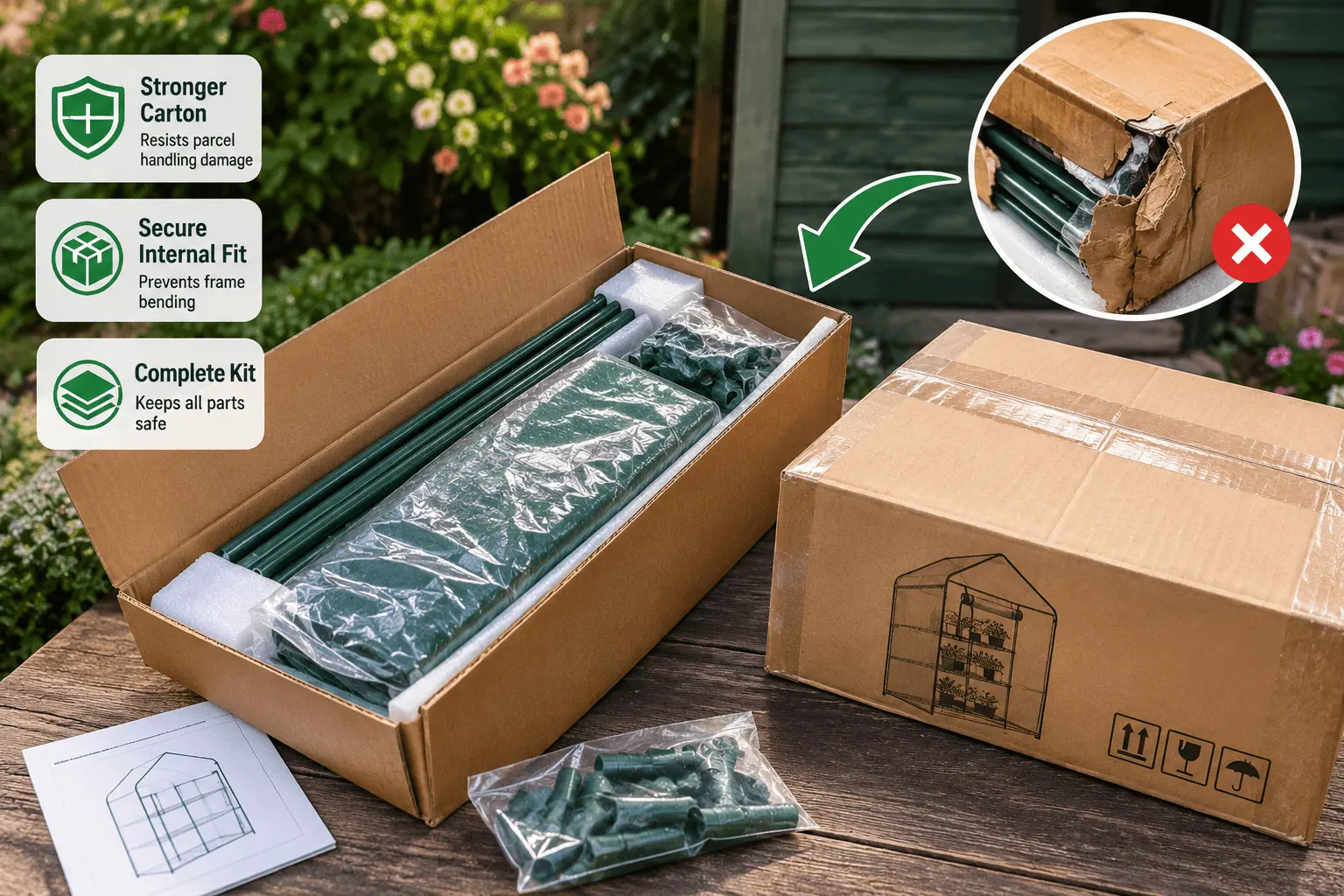
Parcel transit involves multiple handling points — sortation centers, conveyor belts, delivery vehicles — where cartons are dropped, stacked, and compressed. The specific damage patterns depend on the carrier, route, packaging design, and product configuration.
For mini greenhouses, the consequences of parcel damage may include:
Bent frame components. Steel tubes, depending on gauge and wall thickness, may bend if the carton is crushed on one side or impacted at a corner. A bent tube may not fit into its connector — turning assembly into a frustrating experience that can end in a return.
Torn covers. The cover material — typically PVC or PE, depending on the model — is folded inside the carton. If the carton is punctured or crushed, the cover can tear at fold lines or where it contacts component edges. A torn cover is a visible defect that may trigger immediate consumer dissatisfaction.
Connector breakage. Plastic connectors can crack if the carton is dropped on a corner. A cracked connector may not be visible until the consumer tries to assemble the frame — and discovers that a joint will not hold.
Missing parts. If the carton’s tape fails or a corner opens during transit, small components (screws, pegs, ties — if applicable to the SKU) can spill out. The consumer opens the carton, counts the parts, and finds the product incomplete.
Whether these issues occur, and how frequently, depends on the packaging design, the carrier, and the product configuration. The point is that parcel shipping puts demands on packaging that pallet shipping does not — and the packaging needs to be specified accordingly.
Why Mini Greenhouse Packaging Is Challenging
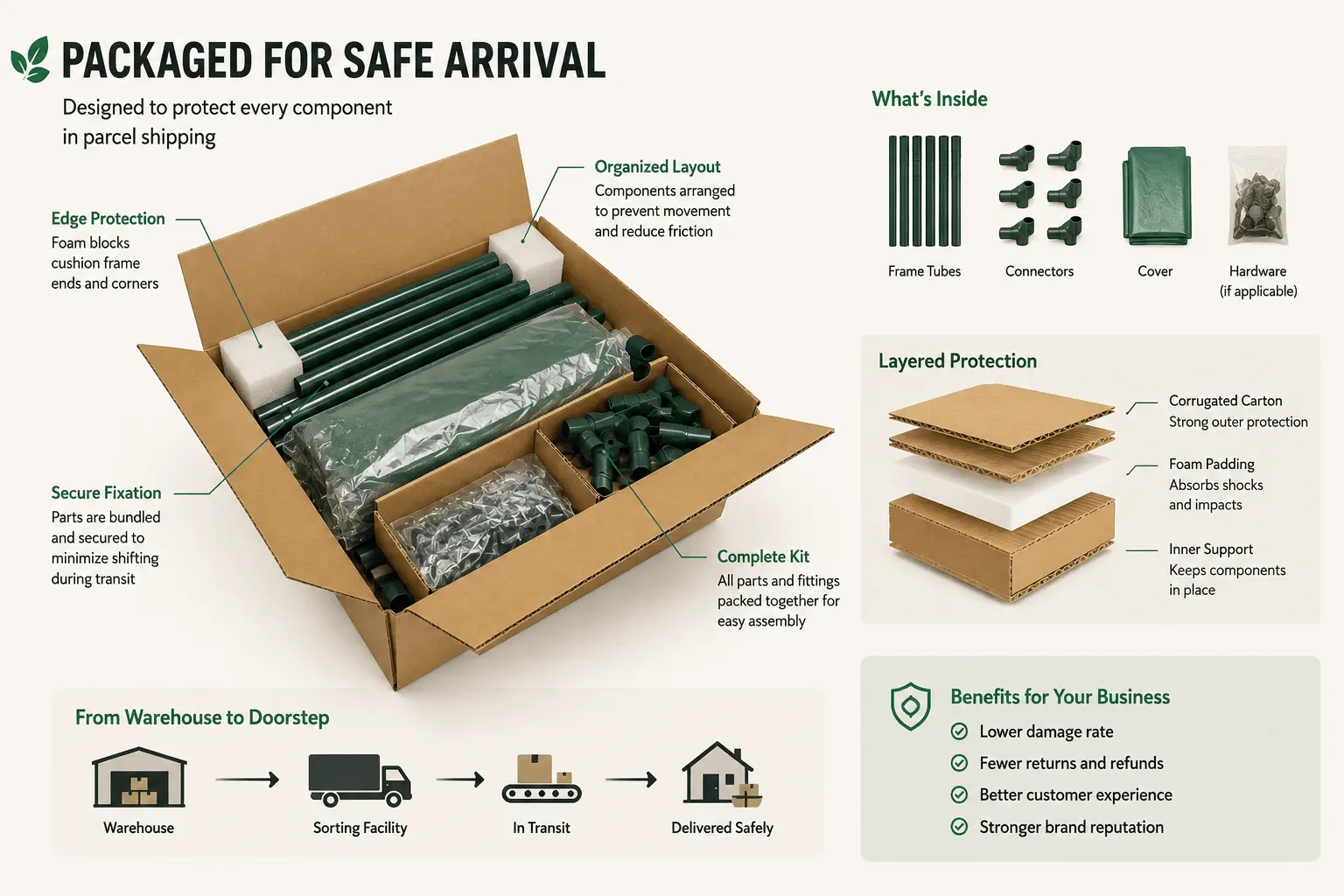
Mini greenhouse packaging is difficult because the product is a mix of hard and soft components that do not naturally protect each other — this applies to frame-based models with tubular frames, connectors, covers, and shelves:
- Frame tubes are rigid and can damage other components if they shift inside the carton
- The cover is soft and vulnerable to puncture from tube edges
- Connectors are small and can be crushed if they end up at a carton corner
- Shelves (if included in the SKU) are wire grids that can bend under compression
- Small parts (screws, pegs — if applicable) are loose and can migrate if not contained
A well-designed carton arranges these components so that rigid parts protect soft parts, small parts are contained in a bag or box, and nothing sits at a vulnerable corner. A poorly designed carton throws everything in, seals it, and hopes for the best.
What Buyers Should Specify in Packaging
Carton Construction
Corrugated board comes in different grades — single-wall and double-wall, with various flute types. The appropriate grade depends on the shipping method, product weight, and packaging performance requirements. For parcel shipping, a higher-grade board (such as double-wall) is generally recommended — but the specific grade should be determined based on the product configuration, target fulfillment channel, and any packaging testing you conduct.
If the supplier quotes a plain brown carton without specifying the board grade, ask. The difference between single-wall and double-wall is not visible in a photo, but it shows up the first time the carton is stacked under heavier parcels in a delivery van.
Internal Arrangement
How components are arranged inside the carton matters as much as the carton itself. Ask the supplier:
- Are tubes bundled and secured, or loose?
- Is the cover placed where tube edges cannot contact it?
- Are connectors bagged and positioned away from carton corners?
- Are small parts (if applicable) in a sealed bag that is attached to the carton interior?
- Is there internal padding or dividers between component groups?
If the supplier cannot describe the internal arrangement, the arrangement may be inconsistent across production batches.
Sealing Method
Specify the sealing method. Standard packing tape may be sufficient for pallet shipping, but parcel shipping puts more stress on carton seams. Ask whether the supplier uses reinforced tape, H-seal (tape on all seams), or strapping in addition to tape. Tape failure can result in a carton that opens in transit — and missing parts that cannot be recovered.
Retail Box vs. Mail-Order Packaging
If you are selling through retail channels (garden centers, hardware stores), the carton may need to serve as both shipping container and retail display. This requires a printed outer carton with product information, barcodes, and marketing copy.
If you are selling through e-commerce marketplaces, the carton needs to survive parcel shipping — and may also need to meet specific platform requirements. Check the target platform’s current official seller requirements for packaging and labeling, as these rules are updated periodically and vary by category and region.
These are different design objectives. A retail-optimized carton may not survive parcel shipping, and a parcel-optimized carton may not look good on a retail shelf. If you sell through both channels, you may need two packaging specifications.
Need Mini Greenhouse Options for E-Commerce?
Compare soft-cover mini greenhouse options based on your fulfillment channel, carton format and target market. Review the complete product-and-packaging combination before deciding which models belong in your range.
How to Test Packaging Before Committing to Bulk
The Drop Test
Take a sealed carton from the sample or pilot production. Drop it from a consistent height onto one corner, then edges, then faces. Open the carton and inspect every component.
This is an internal screening test — it is not a substitute for a standardized transit testing protocol. If you need certified testing, consult the applicable ISTA test procedure for your package type, weight, and shipping method. The ISTA standard involves specific drop heights, drop sequences, and acceptance criteria that depend on the package characteristics — do not assume a single drop height applies to all products.
The Shake Test
Hold the sealed carton and shake it. Listen for movement inside. If you can hear components shifting, the internal arrangement is not securing them. Components that move during a shake test will move during parcel transit — and every movement is a potential for damage.
The Compression Test
Place weight on top of the sealed carton and check whether it deforms. Parcel shipping involves stacking — your carton will have other parcels on top of it. The specific weight and duration should reflect your target fulfillment channel. If the carton cannot support moderate weight without deforming, the contents may be compressed.
These tests help you compare packaging options and identify obvious failure points. They are buyer-defined screening tests — the acceptance thresholds should be set based on your quality target, product value, and channel requirements.
Planning Parcel-Ready Packaging?
Review carton construction, internal protection and packaging customization before approving a bulk order. Build the packaging specification around how the product will actually be packed, handled and shipped.
The Cost of Inadequate Packaging vs. the Cost of Good Packaging
Upgrading packaging costs money. Moving to a higher-grade board, adding internal dividers, using reinforced tape, and including a small-parts bag with proper sealing — these add cost per unit. The exact amount depends on the supplier, the order quantity, and the specific upgrades.
But consider the alternative. A single return may cost you:
- Reverse logistics (return shipping from consumer to your warehouse)
- Inspection and repackaging (if the product is salvageable)
- Disposal or liquidation (if it is not)
- Customer service time to handle the complaint
- The potential negative review that affects future sales
Whether better packaging is cost-justified depends on your current return rate, your product’s retail price, and your order volume. The calculation is worth doing — but it should be based on your actual numbers, not on generic assumptions.
Packaging Checklist for Mini Greenhouse Buyers
| Check Item | What to Specify | Why It Matters |
| Corrugated board grade | Grade and flute type appropriate for parcel shipping | Higher-grade board resists crushing and puncture better |
| Internal arrangement | Tubes bundled, cover protected, connectors bagged | Prevents component-on-component damage |
| Small parts containment | Sealed bag, attached to carton interior (if applicable) | Prevents missing parts from carton opening or bag failure |
| Sealing method | Tape type, H-seal, strapping | Prevents carton opening during transit |
| Drop test result | Internal screening — compare options and identify failure points | Helps assess parcel shipping survivability |
| Shake test result | No audible component movement | Confirms internal arrangement is secure |
| Compression test result | No deformation under weight representative of stacking | Simulates stacking in delivery vehicles |
| Platform compliance | Check target platform’s current official packaging requirements | Prevents platform-level rejection or additional fees |
| Retail vs. parcel design | Matched to your primary sales channel | Retail display needs differ from parcel survival needs |
Packaging Is Part of the Product
When a consumer receives a mini greenhouse, the first thing they experience is the carton. If it is crushed, torn, or rattling, their confidence in the product drops before they open it. If the contents are damaged, the product experience is over before assembly begins.
For e-commerce sellers, packaging is not a supplier’s problem that you inherit. It is a sourcing decision that you control. Specify the board grade, test the internal arrangement, verify the sealing, and run your own screening tests on the sample. The cost of good packaging may be recoverable through fewer returns. The cost of inadequate packaging shows up in your return rate, your reviews, and your margins.
Send us your mini greenhouse packaging requirements and sales channel. We will help you specify carton construction, internal arrangement, and sealing methods that survive parcel shipping — and arrange screening tests on samples before you commit to bulk. You focus on your market. We help you source smart, verify thoroughly, and ship on time.
Ready to Discuss Your Mini Greenhouse Project?
Send us your mini greenhouse packaging requirements and sales channel. We will help you specify carton construction, internal arrangement, and sealing methods that survive parcel shipping — and arrange screening tests on samples before you commit to bulk.
Related Articles
How Mini Greenhouse Carton Design Affects Freight Cost, Damage and Retail Handling
Mini Greenhouses for E-Commerce: What Buyers Should Check Before Listing a New SKU
Pre-Shipment Inspection for Mini Greenhouses: What to Check Before Bulk Orders Leave China