






Updated 2 months ago
Waterproof, UV-Resistant and Fade-Resistant Plant Labels: What Buyers Should Verify
SCARECROW GARDEN SUPPLIER
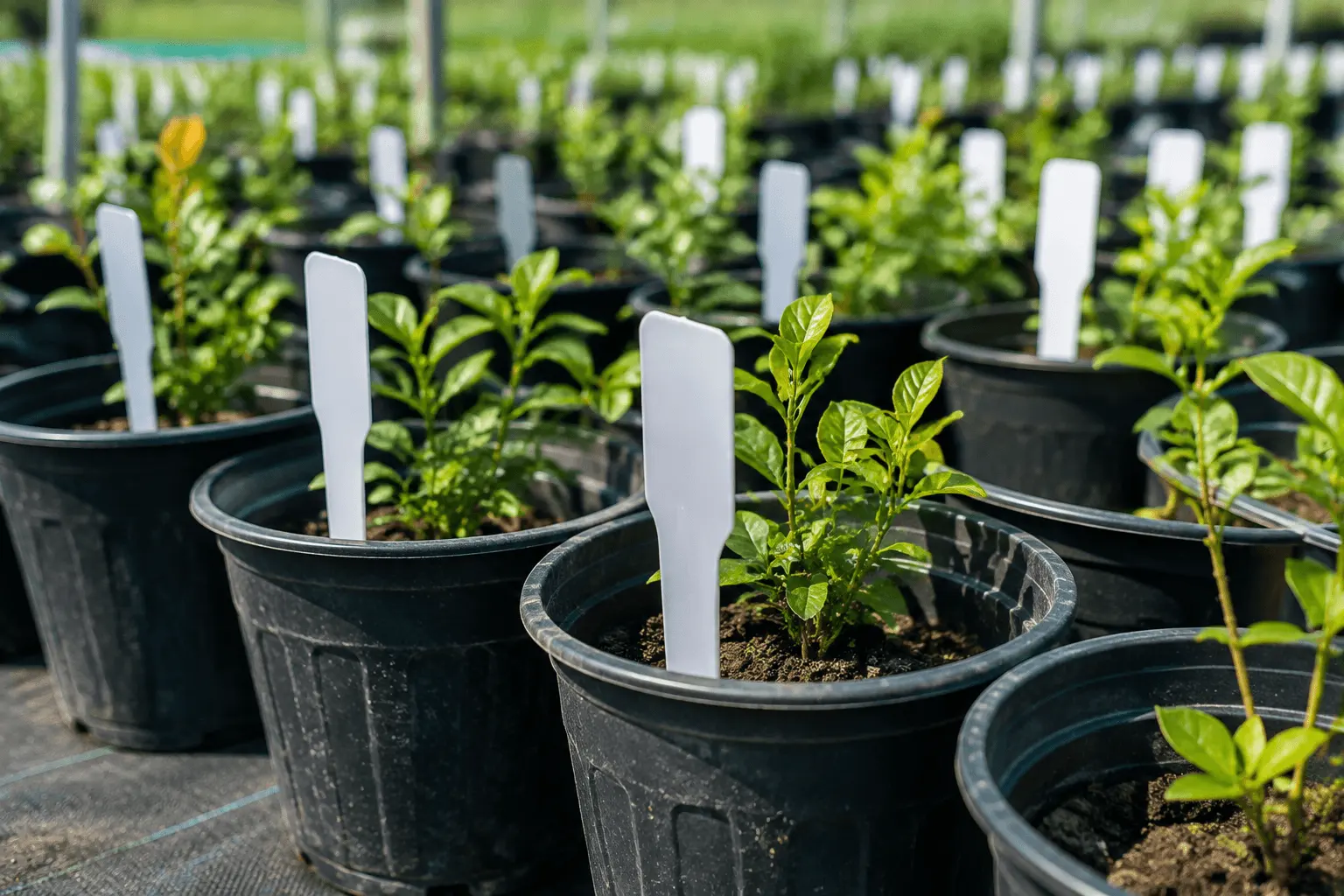
Plant labels checked under water and outdoor exposure for durability testing
A nursery buyer orders 20,000 PP plant labels. The supplier’s product description says “waterproof, UV-resistant, fade-resistant.” The buyer reads this and assumes the labels will survive an outdoor growing season without visible degradation. The order is placed, the labels are inserted into outdoor pots, and the season begins.
Three months later, the nursery manager notices that the white labels have developed a slight yellow tint. The writing is still legible, but the surface looks different from the labels that were kept indoors. Six months in, some labels in full-sun exposure areas have become brittle — the surface has a chalky texture and the stake tips snap when bumped. The writing on labels in overhead irrigation zones has faded — the marker ink has run or washed off where the labels are sprayed daily.
The buyer contacts the supplier. The supplier says: “The labels are waterproof — the material does not dissolve. They are UV-resistant — they have UV stabilisers. They are fade-resistant — the colour does not fade immediately.” Technically, all of these statements are true. But none of them mean what the buyer assumed they meant.
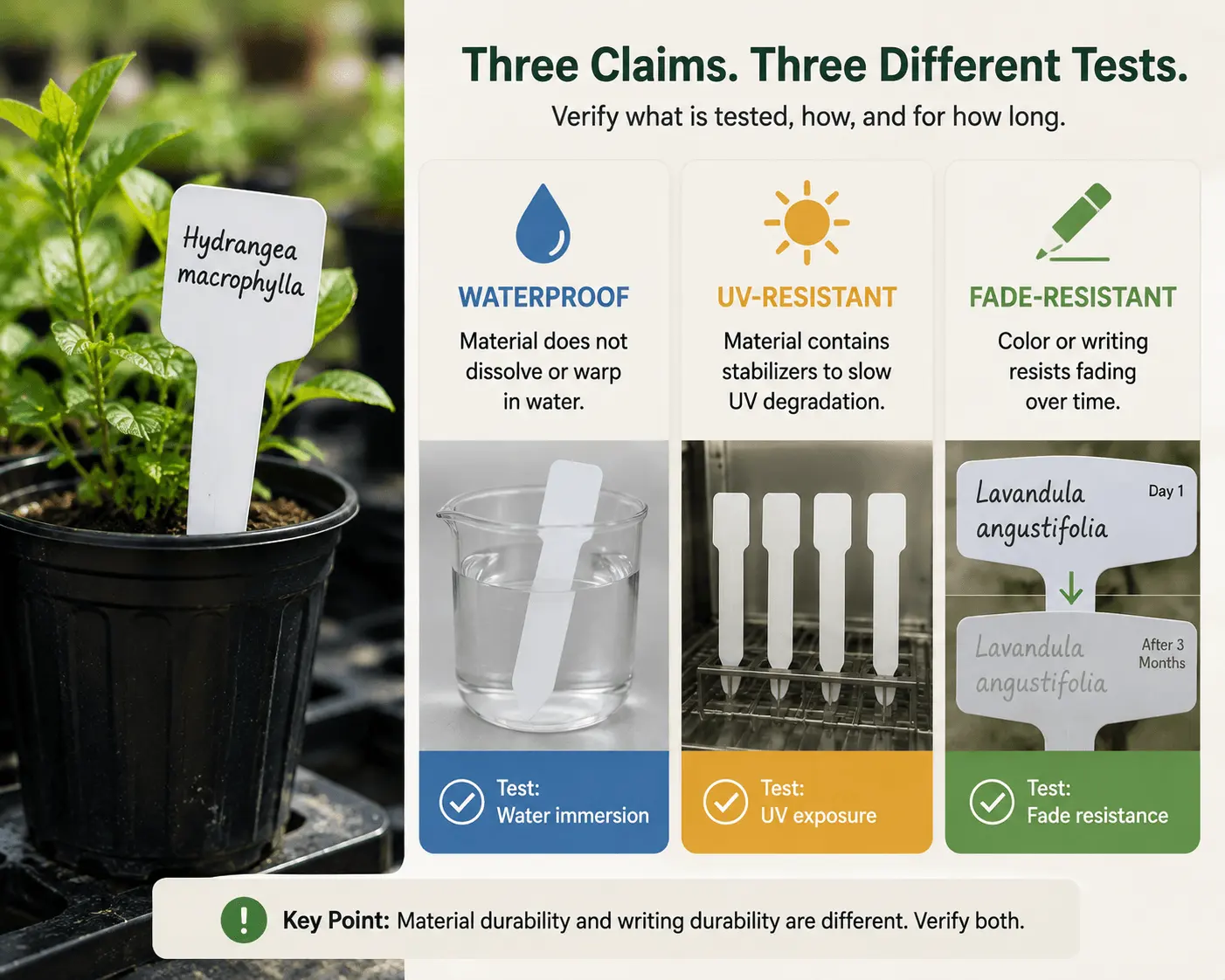
Waterproof, UV-resistant, and fade-resistant are three different claims about three different things — and none of them is a guarantee of outdoor durability over a full growing season. A buyer who treats these words as interchangeable is making an assumption, not a verified decision.
For plant label buyers, durability claims are primarily verification questions, not product attributes. The question is not whether the label is “durable” — it is what “durable” was tested for, and against what standard. If a supplier says “waterproof, UV-resistant, fade-resistant” and you have not asked what was tested, how it was tested, and for how long, you have a label on a product — not a specification you can rely on. (Illustrative example. Actual specifications, pricing, and outcomes vary by supplier, quantity, and order requirements.)
For the broader procurement risks created by vague durability assumptions, see our plant label sourcing mistakes guide.
Waterproof, UV-Resistant and Fade-Resistant Are Different Questions
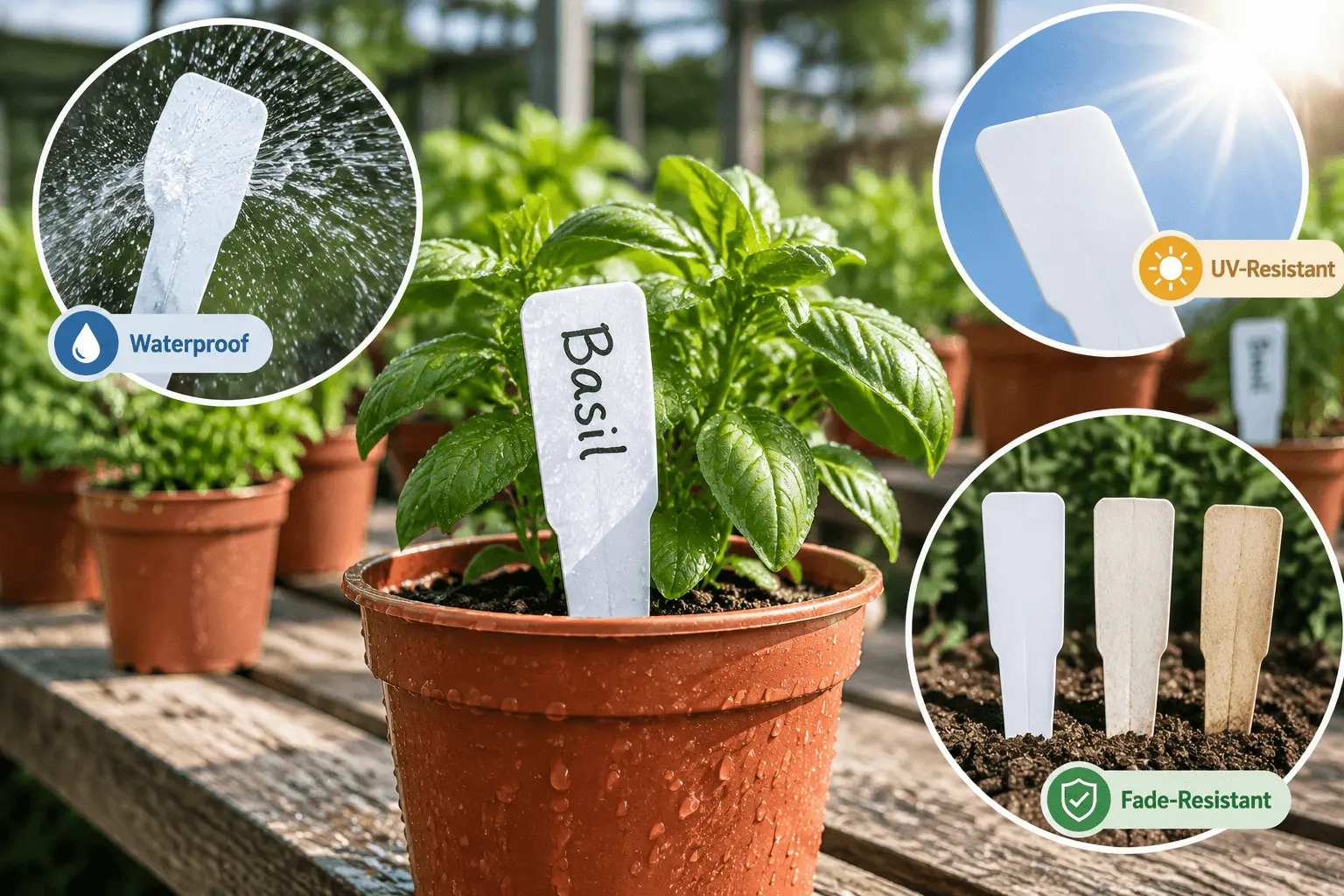
These three terms are often used together in product descriptions, as if they describe one unified property. They do not. They describe three separate things, and each one needs to be understood and verified separately. These terms must correspond to specific test conditions and objects. The definitions below describe what the terms typically claim — not what they guarantee.
What Each Term Actually Means
| Term | What It Claims | What It Does Not Claim | Common Misunderstanding |
| Waterproof | The label material will not dissolve, warp, or degrade from water contact | Does not mean the writing on the label is waterproof; does not mean the label survives long-term outdoor exposure | “Waterproof” is assumed to mean “survives rain and irrigation indefinitely” |
| UV-resistant | The material contains UV stabilisers (such as HALS and carbon black formulations, where applicable to the formulation; supplier to confirm the specific stabiliser approach) that slow degradation from UV exposure | Does not mean the material will not degrade; does not specify a duration or condition; does not mean the writing is UV-resistant | “UV-resistant” is assumed to mean “will not yellow or become brittle for years” |
| Fade-resistant | The label colour or the writing is designed to resist fading | Does not specify how long; does not mean “will not fade”; does not distinguish between material colour fading and writing fading | “Fade-resistant” is assumed to mean “the writing will never fade” |
The critical distinction: these are material properties, not performance guarantees. A PP label can be waterproof (the material does not dissolve) and still become brittle after months of UV exposure. A label can be UV-resistant (it contains stabilisers) and still yellow over time. The writing on a “waterproof” label can fade or run if the ink is not water-resistant — even though the label itself is fine.
Choosing Labels or Tags for Outdoor Use?
Compare outdoor label and waterproof tag formats before defining performance requirements. Start with the intended application, attachment method and exposure conditions before deciding what the product needs to withstand.
Review size, shape, material and application method against the intended nursery, garden or retail use.
Compare tag formats, attachment methods and material requirements for products exposed to outdoor conditions.
Separate the Label Material From the Writing
Beyond the three terms, there is one more distinction — and it is the most important one in this article. It determines how you design every test that follows: the durability of the label material is not the same as the durability of the writing on the label.
| What Can Degrade | What Causes It | What “Resistant” Means | What It Does Not Mean |
| Label material (PP) | UV exposure over weeks and months | Contains stabilisers that slow degradation | Will not become brittle, yellow, or chalky — it will, but more slowly |
| Label material (Slate) | Water absorption, freeze-thaw cycles | Natural stone is resistant to water absorption in most conditions — but long-term performance depends on the specific environment, including freeze-thaw cycles, porosity, and impact exposure | Will not chip or crack from environmental exposure — it can, from impact |
| Label colour | UV exposure on the pigments or surface | Colour is designed to resist fading | Colour will never change — it may, depending on UV intensity and duration |
| Writing (marker ink) | Water contact, UV exposure on the ink | Ink is formulated to resist water and fading | Ink will never run or fade — it may, depending on the ink and the exposure |
| Writing (pencil) | Water washing graphite off the surface | Graphite is more water-resistant than most inks | Writing is permanent — it can be washed off with enough water or rubbed off by handling |
A supplier who says “waterproof labels” is, in most cases, talking about the label material — not the writing. A buyer who assumes “waterproof” includes the writing is setting up a customer complaint. The writing and the label are separate durability questions, and each needs its own test.
For writing-tool and surface compatibility, use our plant label writing surface test.
Ask What Was Actually Tested
When a supplier makes a durability claim, the buyer’s job is to find out what is behind the claim. Not to challenge it — to understand it.
Questions to Ask
| Question | Why It Matters | What a Useful Answer Looks Like |
| What was tested? | Was it the material, the colour, the writing, or all three? | “The PP material was tested for water immersion; the writing was not tested.” |
| How was it tested? | Was it a standardised test, a field test, or an assumption? | “We tested by immersing samples in water for 24 hours and checking for deformation.” |
| How long was the test? | A one-hour test and a six-month test tell you very different things. | “The water test was 24 hours. We do not have long-term UV test data.” |
| What conditions? | Laboratory conditions and real-world conditions are not the same. | “The UV test was conducted under greenhouse glass, not full outdoor exposure.” |
| What was the result? | “Resistant” is not a result — “no visible degradation after X hours” is a result. | “No visible deformation after 24-hour immersion. Surface yellowing began after approximately 8 weeks under greenhouse glass.” |
| What was not tested? | What the supplier does not know is as important as what they do know. | “We have not tested writing durability under outdoor irrigation. We have not tested long-term UV exposure beyond greenhouse conditions.” |
What to Expect
Most suppliers of PP and slate plant labels will not have formal long-term outdoor durability data. If a supplier does not have formal long-term durability data, treat any durability claim as unverified — not as a norm or an industry standard. What matters is whether the supplier is honest about what they know and what they do not know. A supplier who says “we do not have UV test data, but the material contains HALS stabilisers” is more trustworthy than one who says “UV-resistant — guaranteed for years” without any data to back it up.
If a supplier makes a specific durability claim — “five-year outdoor life,” “will not fade for three years,” “100% waterproof writing” — ask for the test data. If they cannot provide it, treat the claim as marketing, not specification.
Short-Term In-House Tests vs. Long-Term Outdoor Claims
A buyer cannot run a five-year outdoor test before placing an order. But they can run short-term tests that give useful signals — as long as they understand what those tests do and do not tell them.
What Short-Term Tests Can Tell You
| Test | What It Tells You | What It Does Not Tell You |
| Water spray test (mist for 30 seconds, check writing) | Whether the writing survives short-term water contact | Whether the writing survives months of daily irrigation |
| Water immersion test (submerge for 10 seconds, check label and writing) | Whether the label material and writing survive brief full immersion | Whether the label survives standing water or repeated immersion |
| Sun exposure test (place written label in full sun for 1–2 weeks, check for yellowing or fading) | Whether the material and writing show early signs of UV degradation | Whether the material will become brittle or the writing will fade over months |
| Greenhouse test (place written label under greenhouse glass for 4–8 weeks) | Whether the material and writing survive greenhouse conditions over a representative period | Whether the label will survive full outdoor exposure with direct UV, rain, and temperature cycling |
| Handling test (write, insert into soil, pull out, re-insert — check writing survival) | Whether the writing survives the physical handling of normal use | Whether the writing will survive repeated handling over a season |
What Short-Term Tests Cannot Tell You
Short-term tests are screening tools — they tell you whether a product is worth testing further. They do not tell you:
- How long the label will last in full outdoor exposure
- Whether the writing will remain legible after a full growing season
- How the label will perform in a different climate (tropical, arid, cold)
- Whether the UV stabilisers will continue to protect the material after the first season
If your application requires confirmed long-term outdoor durability, the only reliable test is to place written labels in the actual environment where they will be used and check them over time. There is no shortcut — and any supplier who offers one is making a claim they have not verified.
How to Build a Buyer Test Plan
Knowing what short-term tests can and cannot tell you, the next step is to turn that understanding into a plan. The framework below is not new theory — it is the previous sections translated into action. Match the test to the application, set a review schedule, and document what you see. The durations below are example observation schedules, not standard test periods. Final test duration should be based on the buyer’s environment and product lifecycle requirements.
Need to Define the Right Outdoor Checks?
Tell us the use environment and intended duration so the relevant checks can be discussed. Start with the real application before deciding which performance requirements should be included in sample review or bulk inspection.
Match the Test to the Application
| Application | Key Durability Questions | Tests to Run |
| Greenhouse (single season) | Will the label and writing survive 3–6 months under glass with daily watering? | Water spray test; greenhouse placement test (4–8 weeks); writing smudge test after watering |
| Outdoor nursery (single season) | Will the label survive full sun, rain, and temperature changes for one season? | Sun exposure test (1–2 weeks); water spray test; handling test |
| Outdoor (multi-season) | Will the label remain structurally sound and legible for more than one year? | Long-term outdoor placement test (6–12 months minimum); there is no reliable short-term substitute |
| Retail pack (indoor storage, outdoor use) | Will the label survive in the pack, then perform when the customer uses it outdoors? | Pack storage test (check for warping or colour change after 6 months in storage); then outdoor use test |
| Mother plants / stock plants | Will the label survive for years on a plant that stays in place? | Long-term outdoor test (12+ months); this application has no shortcut |
What to Include in the Plan
Define the environment — Greenhouse, outdoor, mixed. Be specific: “overhead irrigation, full sun, Zone 7 climate.”
Define the duration — Single season, multi-season, permanent. This determines whether short-term tests are sufficient or long-term placement is needed.
Test the writing separately from the material — Use the writing tools your customers will use. Test the writing and the label material as separate durability questions.
Document the conditions — Date, location, weather, label SKU, writing tool. A test without documentation is an anecdote, not evidence.
Set a review schedule — Check the labels at 1 week, 1 month, 3 months, 6 months. Record what you see. The progression tells you more than a single endpoint.
For greenhouse and nursery workflow context, review our commercial nursery plant label guide.
Documenting Results
A test result that is not documented might as well not exist. This is not the same as the writing comparison sheet in Article 16 — that records which pen works on which surface. This records how the label and writing degrade over time under specific environmental conditions. When a customer asks “how long do these labels last?” or when a supplier dispute arises, this documentation is what you have.
What to Record
| Field | What to Fill In |
| Date | When the test was started and when each check was made |
| Label SKU | Item number, material, colour, surface finish |
| Writing tool | Brand, type, colour (e.g. “Sharpie permanent marker, black”) |
| Environment | Greenhouse / outdoor / indoor; sun exposure; irrigation type |
| Location | Geographic location and climate zone |
| Check 1 (1 week) | Photo + notes: material condition, writing legibility, colour change |
| Check 2 (1 month) | Photo + notes |
| Check 3 (3 months) | Photo + notes |
| Check 4 (6 months) | Photo + notes |
| Overall assessment | Pass / Fail / Conditional — with reasoning |
Photos are essential. Written notes like “slight yellowing” are subjective; a photo at each check point lets you and your customer see the progression.
What to Put Into the Purchase Specification
If durability matters for your application, put it in the specification — do not leave it as a verbal assumption.
Specification Language
| Instead of Saying | Say This | Why |
| “Need waterproof labels” | “Labels must not deform or degrade under daily overhead irrigation for one growing season” | Specifies the condition and duration, not just the property |
| “Need UV-resistant” | “Labels should include UV stabilisers appropriate to the formulation (e.g. HALS, carbon black, or other stabilisers depending on colour and formulation); supplier to disclose the stabilisation approach; buyer will conduct field testing for specific outdoor applications” | Acknowledges the stabiliser without claiming a duration the supplier cannot guarantee; does not assume all PP labels require the same stabiliser package |
| “Need fade-resistant writing” | “Writing must remain legible after 3 months of overhead irrigation and greenhouse UV exposure; buyer will test with specific marker brands” | Separates writing durability from material durability and specifies a testable condition |
| “Need outdoor labels” | “Labels will be used in full outdoor exposure for [duration]; buyer requests samples for field testing before bulk order” | Does not ask the supplier to guarantee outdoor life — asks for samples to test |
The principle: turn assumptions into specifications. A supplier who receives “labels must not deform under daily irrigation for one season” knows what to deliver. A supplier who receives “need waterproof” will deliver something — and it may or may not match the buyer’s assumption.
Next Step: Turn Verification Into Specification
Durability claims on a product description are not lies. They are starting points — not answers. “Waterproof” means the material does not dissolve. “UV-resistant” means the material contains stabilisers. “Fade-resistant” means the colour is designed to resist fading. None of these tell you how the label will perform in your customer’s garden over the duration they expect.
If you are sourcing plant labels for outdoor or long-term use, request samples and run the tests in this article in your actual environment. Document the results. Then — and this is the step most buyers skip — put those results into the purchase specification. Instead of writing “need waterproof” on the RFQ, write “must not deform under daily overhead irrigation for one growing season.” Instead of “UV-resistant,” write “must include UV stabilisers appropriate to the formulation (e.g. HALS, carbon black, or other stabilisers depending on colour and formulation); supplier to disclose the stabilisation approach; buyer will conduct field testing for specific outdoor applications.” Your verification results should become your specification language — not the supplier’s marketing words.
A label that has been tested and specified is a label you can stand behind. A label that has only been described is a label you are hoping about.
Ready to Verify Product Performance?
Verify the selected product under the conditions that matter to your market. Use samples to evaluate practical performance before moving from product selection to bulk approval.
Related Articles
Plant Label Writing Surface Test: Marker, Pencil & Chalk
Commercial Nursery Plant Labels: Buyer Selection Guide
9 Plant Label Sourcing Mistakes Bulk Buyers Should Avoid