






Why Garden Buyers Need a Sourcing Partner vs. Direct Factory
Let me tell you about a buyer who sourced 100,000 pairs of garden scissors directly from a factory.
The quotation looked great. The price was competitive. The factory confirmed everything — material, size, packaging. The order was placed.
When the goods arrived at the buyer's warehouse, every single pair had orange streaks running down the blades where the screws had corroded.
The blades were stainless steel, but the screws were iron. And the factory, to keep the price low enough to win the order, skipped rust protection entirely. After weeks in transit through humid conditions, every screw had rusted. 100,000 pairs of scissors, sitting in a warehouse, completely useless.
The factory didn't lie about the price. They just didn't tell the buyer what that price didn't include.
Here's another one. This one happened to me.
I gave a factory detailed requirements — target market, usage scenario, the works. They sent back a quotation. Looked reasonable. After going back and forth several times to confirm, I discovered something: the price only covered the basic kit. To actually use the product in my target market, I needed three additional accessories.
And here's the part that would have killed me if I were a new buyer — those three accessories couldn't just be added later. They had to be integrated during production. Once the product was assembled without them, it was done. No fix. Just a container of products that wouldn't work in the market they were made for.
If I hadn't caught that, I would have shipped a batch of useless products — and I wouldn't even have known why until the customer called me.
These two stories are not unusual. They happen all the time.
Finding a factory is easy. Getting the right product delivered? That's the hard part.
Why "Direct from Factory" Looks Cheaper Than It Really Is
Maybe you're thinking: I've sourced directly before. It wasn't perfect, but it worked. Do I really need a partner?
Fair question. Let me ask you this — have you ever had a shipment arrive a little later than promised? A sample that looked great, but mass production was slightly different? A communication gap that you chalked up to "cultural differences" and moved on?
Those aren't just hiccups. Those are signals. The problem with "it worked" is that it often means "it didn't blow up this time." The risk was there. You just got lucky.
When buyers compare going direct versus working with a sourcing partner, the first thing they notice is the unit price. A factory will almost always offer a lower number on paper.
But the real cost of sourcing is not just the product price. There's a whole list of costs that never appear on any quotation:
·Supplier screening — who's actually reliable and who just has a nice website?
·Communication — explaining your requirements, following up on changes, chasing replies across time zones
·Sample comparison — ordering from multiple suppliers, comparing, re-ordering
·Product testing — does it actually work the way the catalog says?
·Packaging confirmation — will it survive shipping? Is it retail-ready?
·Time — your time, your team's time, the hours spent managing all of the above
·Quality risk — what if mass production doesn't match the sample?
·Delivery risk — what if the factory delays and your season is over?
·After-sales risk — who handles complaints when something goes wrong?
Someone has to do this work. If your own team handles it, that costs money too — salaries, management overhead, and the learning curve of dealing with Chinese factories from 8,000 kilometers away. Hiring a purchasing employee in Europe or North America isn't cheap. And having your own person doesn't automatically mean the process will be faster, safer, or better.
Big Factories Are Strong — But Not Built for You
Large factories have real advantages. Production capacity, management systems, certifications, experience with big-volume orders. All genuine.
But here's what buyers often don't realize: a large factory's workflow and priorities are built for scale. They're optimized for standardized, high-volume, stable orders. That's their sweet spot.
Many garden trade buyers don't work that way. You need multiple product categories. You need small-batch tests before committing to larger orders. You need mixed containers. You need custom packaging. You need to go back and forth on details before making a final decision.
For a large factory, you're not the priority. Not because they don't care — because their system isn't designed for the way you buy.
Then there's the turnover problem. I've had clients who knew their factory salesperson's name better than their own relatives. Then that person left, and they had to start from zero. New person, same explanations — your product requirements, your packaging standards, your market preferences, your quality concerns, the things that absolutely cannot go wrong.
Every time that happens, you're rebuilding a relationship from scratch.
Small Factories Are Flexible — But Uncertainty Is the Price
Small and mid-sized factories have their own strengths. They're responsive. They're willing to cooperate on special requirements. Sometimes they offer better prices and better customization than the big guys.
But the uncertainty is real.
Does this factory actually have the production capacity they claim? Is that low quotation sustainable — or are they planning to make it up somewhere else once the order is locked in?
You can't answer these questions by looking at a website, a few workshop photos, or a handful of English emails.
And if you test suppliers one by one on your own, the trial-and-error cost can be brutal. The money you saved from a lower price? It might not even cover the legal fees of one dispute.
What Scarecrow Actually Does to Reduce Your Risk
I could tell you that we "ensure quality" and "manage communication." Every sourcing company says that. Let me be more specific.
We Don't Just Forward "No Problem"
When a factory says "No problem," they might mean:
·Everything is genuinely fine
·"I'll agree first and figure it out later"
·"We can make something similar, but not exactly what you described"
·"I didn't fully understand your requirement, but I don't want to lose the inquiry"
An overseas buyer often can't tell the difference. We can — because we've been on the other end of that conversation hundreds of times.
When a factory tells us "No problem," we don't just pass it along. We follow up. How exactly will you do it? What material? Is it the same as the sample? Are there any risks with the timeline? We turn a vague confirmation into specific, verifiable information you can actually make decisions on.
This isn't language translation. It's business logic translation — turning your market needs into production requirements a factory can execute, and turning a factory's real situation into information you can judge.
Two-Sample Policy: Because Memory Isn't Enough
For suitable projects, we use a two-sample policy. One approved sample goes to you. One matching sample stays with us in China.
Why? Because once mass production starts, the approved sample becomes the only reference that matters. If there's any question about material, size, color, structure, packaging, or finish — we compare the production goods against the retained sample. Not against memory. Not against a photo. Against the physical sample you approved.
This is especially important for overseas buyers. You're not here to walk the production floor. You need someone local who can hold up the real thing and say, "This is different from what was approved — let's fix it before it ships."
Tested in Our Own Garden
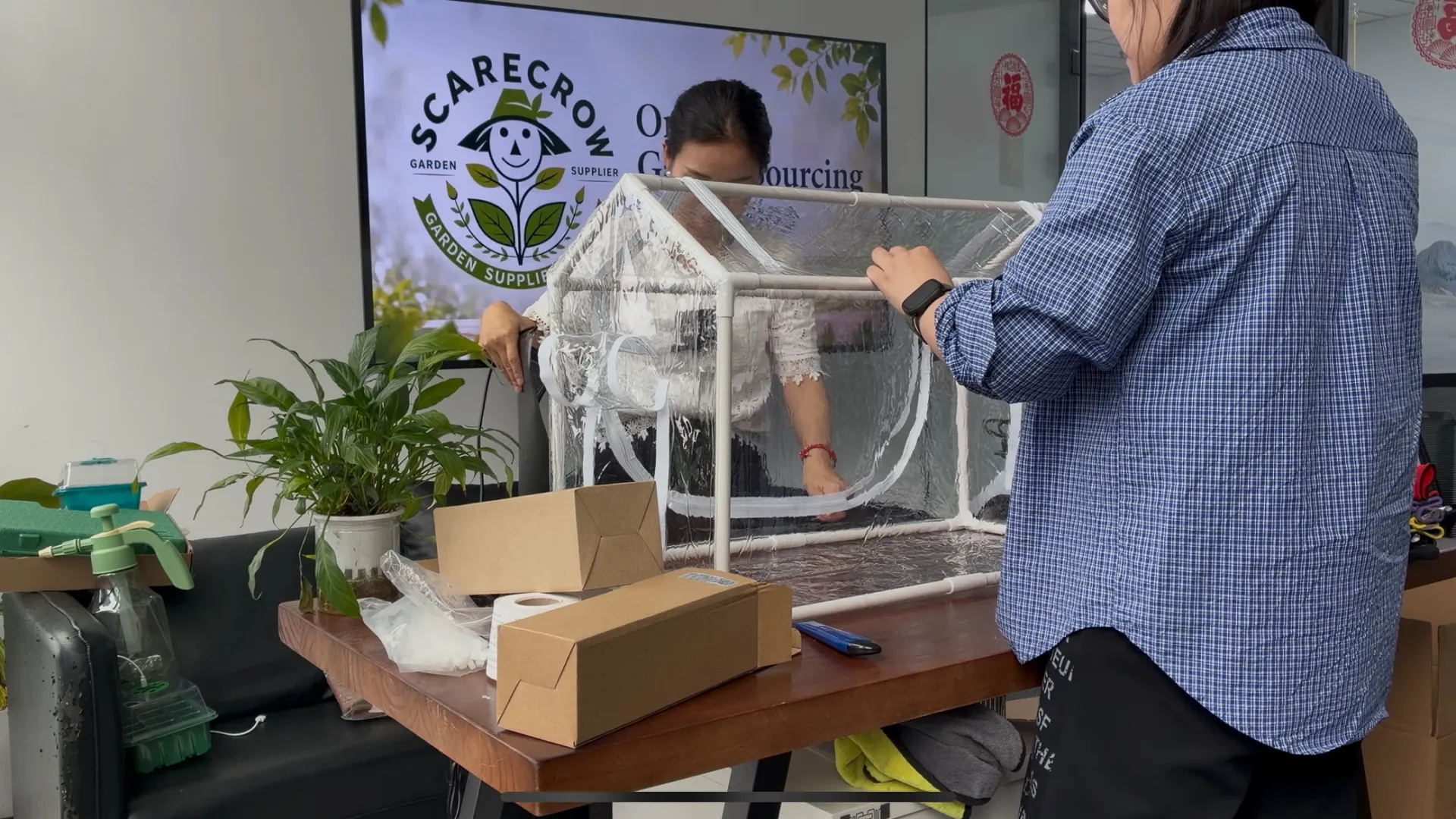
I've broken more garden tools in my own backyard than I'd like to admit.
But every broken tool taught me something a catalog photo never could. Is the handle comfortable after an hour of use? Does the assembly actually make sense? Will the packaging survive being shipped halfway around the world and still look good on a retail shelf? Can a customer figure out how to use it without calling support?
We test products in real gardening scenarios because garden products shouldn't just look good in pictures. They need to work when it matters — in the dirt, in the rain, in the hands of someone who's never read the manual.
Your Long-Term Memory in China
We remember what you've purchased before. Which products sold well. Which suppliers to avoid. Which packaging details cannot be messed up. Which market requirements are non-negotiable.
When a factory's salesperson leaves — and they do, often — your requirements don't leave with them. Because they're not stored in one person's head. They're stored with us.
Every order we handle has a complete record: product specs, packaging requirements, mistakes we caught, factory performance. Next time you order, we pull that up. No re-explaining. No starting over.
Supplier Screening: Not a Contact List — a Usable Solution
We don't hand you a spreadsheet of factory names and let you guess who's reliable.
Before we recommend a supplier, we visit the factory. We verify their production capacity. We compare quotations from multiple sources. We test samples. We confirm that the factory can actually deliver what they promise — not just say they can.
The difference matters. A list of contacts is information. A vetted supplier with confirmed samples and a track record — that's a solution.
You're Not Paying for a Middleman
Some people still think trading companies make money from information gaps — that we exist because buyers can't find factories on their own.
But today, finding a factory is the easy part. A few searches online, a visit to a trade show, a post on LinkedIn — you'll have more supplier options than you know what to do with.
The 100,000 rusty scissors? A sourcing partner would have caught the material substitution before production started. The missing accessories? A sourcing partner would have pushed past the first quotation and asked, "What else is needed for this product to work in the buyer's market?"
Clients don't work with us because they can't find factories. They work with us because they've learned — sometimes the hard way — that the lowest quotation isn't always the cheapest option, and that a controlled sourcing process beats a cheap one almost every time.
You're not paying for a middleman. You're paying for judgment, efficiency, and a result you can actually sell.
Scarecrow Garden Supplier helps overseas garden trade buyers source, verify, test, consolidate, and ship garden products from China. Contact us to discuss your product list, sample plan, or mixed order needs.
Written by
ScarecrowGarden
💡About Scarecrow Garden Supplier Co., Ltd.
Scarecrow Garden Supplier Co., Ltd. is a China-based sourcing and wholesale partner specializing in garden tools, landscaping equipment, and outdoor supplies for international wholesalers, distributors, contractors, and brands.
With hands-on experience rooted in real garden use scenarios, we focus on durable materials, functional design, and stable large-volume supply. Our product range covers pruning tools, watering systems, hand tools, outdoor hardware, and customized garden solutions to support both retail and professional landscaping markets.
Beyond products, we help our partners navigate supplier selection, quality control, compliance requirements, and long-term sourcing strategies in China. Through our blog, we share practical insights on product selection, material comparisons, industry trends, and cost-effective purchasing—helping global buyers build stronger, more competitive supply chains.