











Updated 5 days ago
Vertical Hanging Grow Bags: Pocket Stitching, Drainage and Wall-Load Checks for Wholesale Buyers

ScarecrowGarden
💡About Scarecrow Garden Supplier Co., Ltd.
Scarecrow Garden Supplier Co., Ltd. is a China-based sourcing and wholesale partner specializing in garden tools, landscaping equipment, and outdoor supplies for international wholesalers, distributors, contractors, and brands.
With hands-on experience rooted in real garden use scenarios, we focus on durable materials, functional design, and stable large-volume supply. Our product range covers pruning tools, watering systems, hand tools, outdoor hardware, and customized garden solutions to support both retail and professional landscaping markets.
Beyond products, we help our partners navigate supplier selection, quality control, compliance requirements, and long-term sourcing strategies in China. Through our blog, we share practical insights on product selection, material comparisons, industry trends, and cost-effective purchasing—helping global buyers build stronger, more competitive supply chains.
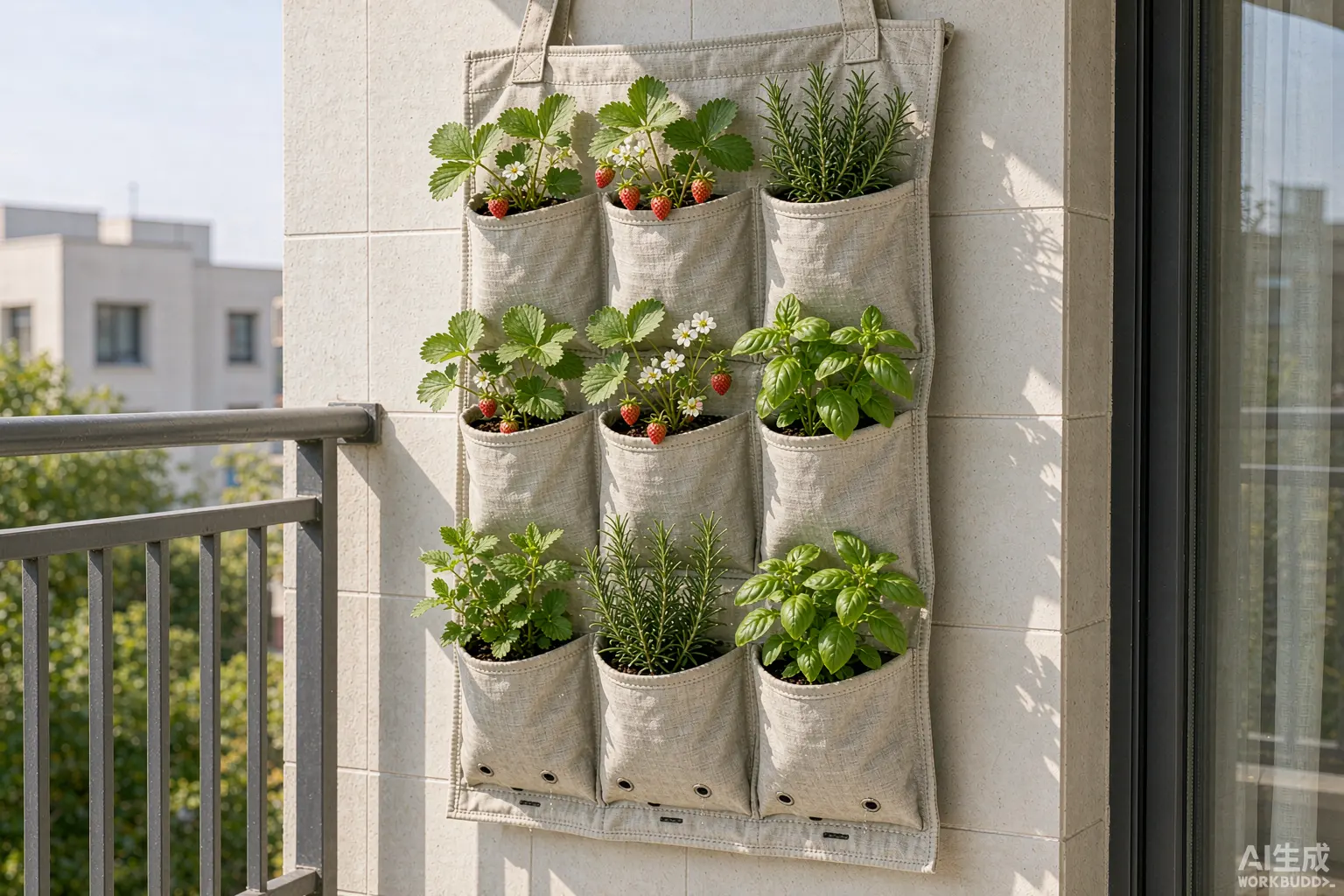
Vertical hanging fabric grow bags with stitched pockets planted with strawberries and herbs
AI-generated editorial illustration; not a product photograph.
Individual grow bag specifications cover fabric composition, GSM, size and handle construction. These specifications remain relevant, but a multi-pocket vertical hanging grow bag filled with wet substrate, hung from a wall and watered from the top requires additional checks. The load path runs from the wet fill in each pocket through the pocket seams, through the backing fabric, through the grommets or straps, and into the wall mounting hardware. A failure at any point in the load path affects the system's ability to support the defined load; inspect each connection point.
This guide covers what to inspect on a vertical hanging grow bag sample: the load path from wet substrate to top hanger, pocket stitching and edge reinforcement, drainage without wall staining, water distribution across upper and lower pockets, fabric and UV claims, and folding and shape recovery.
The Load Path Runs From Wet Substrate to the Top Hanger
How Does Wet Fill Reach the Top Mounting Points?
Estimate or test the actual filled mass by sample. Wet substrate is significantly heavier than dry. A six-pocket grow bag filled with wet potting mix may weigh several kilograms (illustrative example only, not a model load rating; use measured filled mass for the actual SKU). That load transfers from each pocket through the pocket seams to the main body fabric, then through the grommets, straps or hangers to the mounting hardware.
Record substrate moisture and mass, and the exact pocket, backing and suspension arrangement from sample or BOM evidence. The load path is not theoretical. It is the physical chain through which every gram of wet fill reaches the wall.
What Mounting Conditions Bound the Observation?
Do not publish a load rating without a defined test and mounting method. Use a supported, controlled setup and document the hardware and substrate suitability. A hanging comparison in a controlled setup is not a certified safe wall-load rating. The wall type, fastener selection and installation method are separate variables that the grow bag supplier does not control.
Pocket Stitching and Edge Reinforcement
Where Are the Pocket Seams Reinforced?
Inspect stitch type and density, seam allowance, bar-tacks or reinforcement where used, and the pocket-to-back-panel attachment. Inspect pocket corners, seams, backing and suspension connections along the documented load path; do not assume a stress ranking without configuration-specific evidence. Bar-tacks at pocket corners are a common reinforcement method, but they are not universal.
Photograph the stitch path, pocket and backing connection, and any actual reinforcement. Link the stitching record to the textile construction specification.
Does the Defined Wet Fill Change Seam Shape?
Use a safely supported, manufacturer-permitted filled-pocket comparison. Record fill mass and seam growth or tearing. An observation does not authorize a wall-load rating, but it does tell you whether the seams stretch, distort or fail under the defined wet load.
Record seam growth or tearing before and after a permitted, supported comparison at documented fill mass. Do not invent an allowable suspended load. What you can observe is whether the seams hold their shape or distort, and whether any stitching fails.
Drainage Without Staining the Wall
Does Runoff Reach Lower Pockets, the Wall or the Intended Outlet?
Check drainage openings and whether runoff from upper pockets lands on lower pockets or on wall surfaces. Depending on the drainage design, water from upper pockets may flow to lower pockets or to the wall; verify the actual drainage construction. Water that drains from the top pocket may flow into the second pocket, overflow the second pocket and run down the backing fabric to the wall.
If a liner or backing is used, verify its role and material. A waterproof backing protects the wall but may redirect water sideways. A permeable backing allows drainage but may wick water to the wall surface. Map actual drainage openings and backing or liner construction with photographs and a controlled watering record. Do not assume the wall stays dry.
Water Distribution Across Upper and Lower Pockets
How Do Upper and Lower Pockets Handle Equal Inputs?
Use equal watering input and record retained and drained water per level. Do not assume vertical systems water uniformly. Gravity pulls water downward. The top pocket may drain quickly while the bottom pocket retains excess water. Or the top pocket may retain more because the substrate has not fully saturated before water passes to the next level.
Keep plant-performance claims out unless horticultural evidence is available. What you can measure is water input, retained water and drained water at each level. That tells you whether the drainage design distributes water evenly or concentrates it at the bottom.
Fabric, UV and Reuse Claims
What Does the Fabric Evidence Actually Support?
Confirm material and GSM only if relevant to the actual SKU. Do not treat GSM as durability proof. Evaluate composition, textile construction, coatings and model-relevant weathering evidence together; GSM alone does not establish outdoor service life.
UV and reuse claims require material or test evidence. Match composition, GSM and any backing or coating to the exact SKU. Obtain model-relevant weathering or reuse evidence rather than equating fabric weight with service life. A product page that claims “UV resistant” or “reusable for multiple seasons” is making claims that need textile supplier documentation or weathering test results.
Folding, Packaging and Shape Recovery
Do Packed Pockets and Hangers Recover Their Working Shape?
Check crease memory, grommet deformation and pocket shape after compressed packing and re-hanging. Vertical grow bags are typically folded and compressed for shipping; confirm the actual packing method from the supplier. Compressed packing can crease the fabric permanently, deform grommets and distort pocket openings.
Record packing state and post-unpacking pocket and grommet geometry. Then rehang by the approved setup. Do not assume all six, eight or ten-pocket variants behave alike. A larger bag with more pockets may have different stress distribution and drainage characteristics than a smaller one.
If you are sourcing vertical hanging grow bags, provide your wall-mounting scenario, pocket count and intended filled load for sample comparison.
Written by
ScarecrowGarden
💡About Scarecrow Garden Supplier Co., Ltd.
Scarecrow Garden Supplier Co., Ltd. is a China-based sourcing and wholesale partner specializing in garden tools, landscaping equipment, and outdoor supplies for international wholesalers, distributors, contractors, and brands.
With hands-on experience rooted in real garden use scenarios, we focus on durable materials, functional design, and stable large-volume supply. Our product range covers pruning tools, watering systems, hand tools, outdoor hardware, and customized garden solutions to support both retail and professional landscaping markets.
Beyond products, we help our partners navigate supplier selection, quality control, compliance requirements, and long-term sourcing strategies in China. Through our blog, we share practical insights on product selection, material comparisons, industry trends, and cost-effective purchasing—helping global buyers build stronger, more competitive supply chains.