











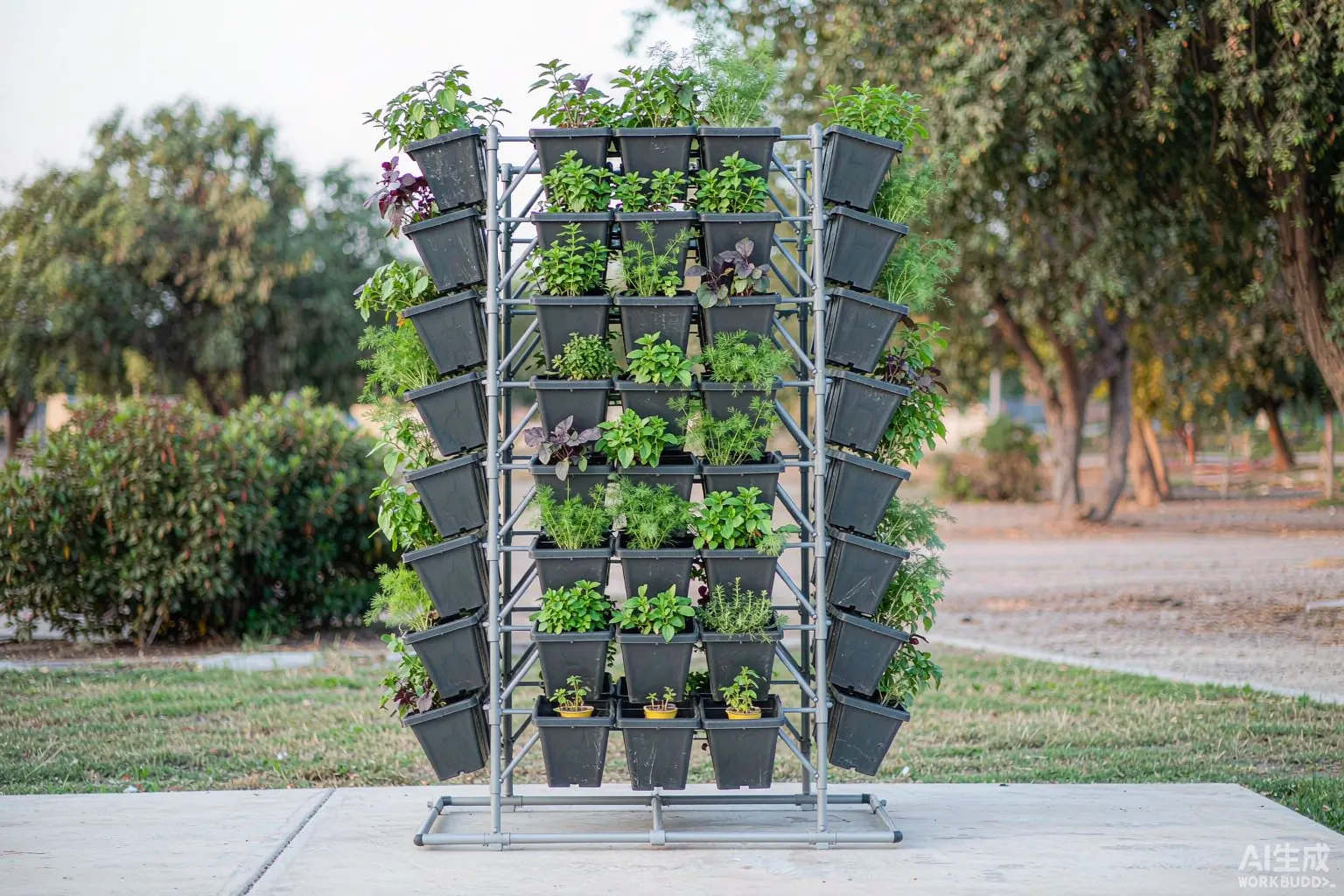
Multi-layer vertical planter tower with herbs and leafy greens on stacked tiers
AI-generated editorial illustration; not a product photograph.
A product listing that describes a vertical planter as having “multiple layers” and “drainage channels” does not tell you how the planting levels are supported, whether any parts detach or stack, or where drainage from each level exits. The term “vertical” describes orientation, not construction. Before comparing samples, the buyer needs to confirm the actual architecture: fixed layers, a supported arrangement, or detachable tiers that lock or rotate.
This guide covers what to confirm and compare on a multi-layer vertical planter: the architecture before comparison, layer support and seating, filled configuration, drainage from each level to its exit, the final discharge boundary, and packed component checks.
Confirm the Multi-Layer Architecture Before Comparing It
What Supports Each Planting Level?
Obtain the model drawing, manual, complete assembly photographs and a component map showing how each planting level reaches its support or base. Distinguish fixed layers, a supported arrangement and detachable tiers only where the evidence identifies them. Do not assume rotation or locking because the planter is described as vertical.
Use an exact model component or assembly drawing and complete photographs to identify the real architecture. The source copy alone is not engineering confirmation. A product page that says “vertical multi-layer planter” is describing the product's appearance, not its structural system.
What Has Not Been Established for This Product?
Record the actual planting-level count and the intended assembled configuration. If the website copy describes “vertical” and “multiple layers” but does not specify how levels connect, whether they are detachable, or whether they lock together, those features remain unconfirmed.
Keep vertical and multiple-layer descriptions separate from unconfirmed stacking, detachable joints, locks and allowed layer counts. Obtain the supplier's exact configuration record before making any such claim. Do not label the product stackable or locking without evidence.
Compare Layer Support and Seating Only Where Present
Does the Evidenced Support Keep the Layer in Position?
For an evidenced interface, inspect seating, contact and movement under the manufacturer-permitted filled configuration. Ask whether the support arrangement maintains layer position. Radial play, rocking, rotation and disengagement apply only if such a joint actually exists on the confirmed model.
Record only actual contact and seating features and permissible loaded behavior. Do not invent a locking tier because the planter is vertical. If the levels are fixed and molded as one piece, there is no tier-lock to test. If the levels are separate and sit on each other, the seating and stability of that arrangement is the relevant check.
When Is a Detachable-Tier Comparison Applicable?
Proceed only after the model manual confirms detachable assembly, retention and permitted tier count. For a confirmed detachable-tier design, consider repeated assembly and disassembly and wear under the manufacturer's procedure. Fixed-layer systems have no assumed tier-lock test. A fixed-layer design uses its own support checks, not a fictional stack-lock protocol. If the product is a single molded unit with multiple planting levels, the architecture is fixed and the comparison focuses on drainage and fill behavior, not on inter-layer locking.
Record the Filled Configuration
Which Fill Distribution Is Being Compared?
Record empty, evenly filled and asymmetric-fill mass distribution as support and drainage setup records. Record level position, substrate moisture and filled mass for the confirmed structure.
Is a Stability Observation Justified for This Configuration?
Center-of-gravity or tip tendency may be recorded only in a justified, qualified, manufacturer-permitted evaluation of the exact arrangement. No assumed safe load, universal tip angle, added tier count or improvised lateral disturbance is authorized.
Use only manufacturer-permitted qualified evaluation and exact support assumptions.
Trace Drainage From Each Planting Level to Its Actual Exit
Where Does Water Leave Each Level?
Trace the actual outlet or channel of each planting level. Does upper-level drainage enter a lower level, leave separately, or bypass the base? Document the path rather than assuming cascade watering or a shared reservoir.
Create a level-to-outlet diagram from the actual sample. Record separate discharge, downward transfer or bypass. A three-level planter may have water flowing from the top level into the middle level and from the middle level out through a side channel, bypassing the bottom level entirely. Or each level may drain independently. Trace the drainage path using controlled water input, the model drawing and assembled sample observations to confirm the actual route.
Does the Measured Input Overload a Lower Level or Bypass the Base?
Compare measured water input, per-level outlet or retained water and exit location under the same documented substrate and fill and orientation. Record any lower-level overload or bypass. The result is a sample drainage comparison, not a plant-growth or watering-uniformity guarantee.
Use equivalent substrate, orientation and water inputs and record collection points. The comparison applies only to the documented configuration, not to universal drainage performance.
Identify the Final Drainage Outlet
What Is the Final Exit, Without Assuming a Reservoir?
Record the final discharge point and any evidenced saucer or base containment only to complete the multi-level drainage map. Verify rather than assume a reservoir, overflow device or sealed floor-protection function.
Complete the actual drainage map and briefly identify any evidenced containment.
Check Packed Components Against the Confirmed Assembly
Does Unpacking Change Real Support or Drainage Features?
Check the supplier-documented packing and nesting arrangement for deformation at actual support, seating or drainage features. Then compare the assembled structure and drainage path after unpacking. Inspect lips or locks only if present.
Compare the documented packed and assembled configuration before and after relevant handling. Nesting, tier lips and locks are inspected only if confirmed on that model. If the planter nests for shipping and the nesting deforms a drainage channel, that is a packing issue that affects product performance.
If you are sourcing multi-layer vertical planters, confirm the actual structure, support and connection design, drainage arrangement and intended planting-level configuration before discussing a sample.

Written by
ScarecrowGarden
💡About Scarecrow Garden Supplier Co., Ltd.
Scarecrow Garden Supplier Co., Ltd. is a China-based sourcing and wholesale partner specializing in garden tools, landscaping equipment, and outdoor supplies for international wholesalers, distributors, contractors, and brands.
With hands-on experience rooted in real garden use scenarios, we focus on durable materials, functional design, and stable large-volume supply. Our product range covers pruning tools, watering systems, hand tools, outdoor hardware, and customized garden solutions to support both retail and professional landscaping markets.
Beyond products, we help our partners navigate supplier selection, quality control, compliance requirements, and long-term sourcing strategies in China. Through our blog, we share practical insights on product selection, material comparisons, industry trends, and cost-effective purchasing—helping global buyers build stronger, more competitive supply chains.