











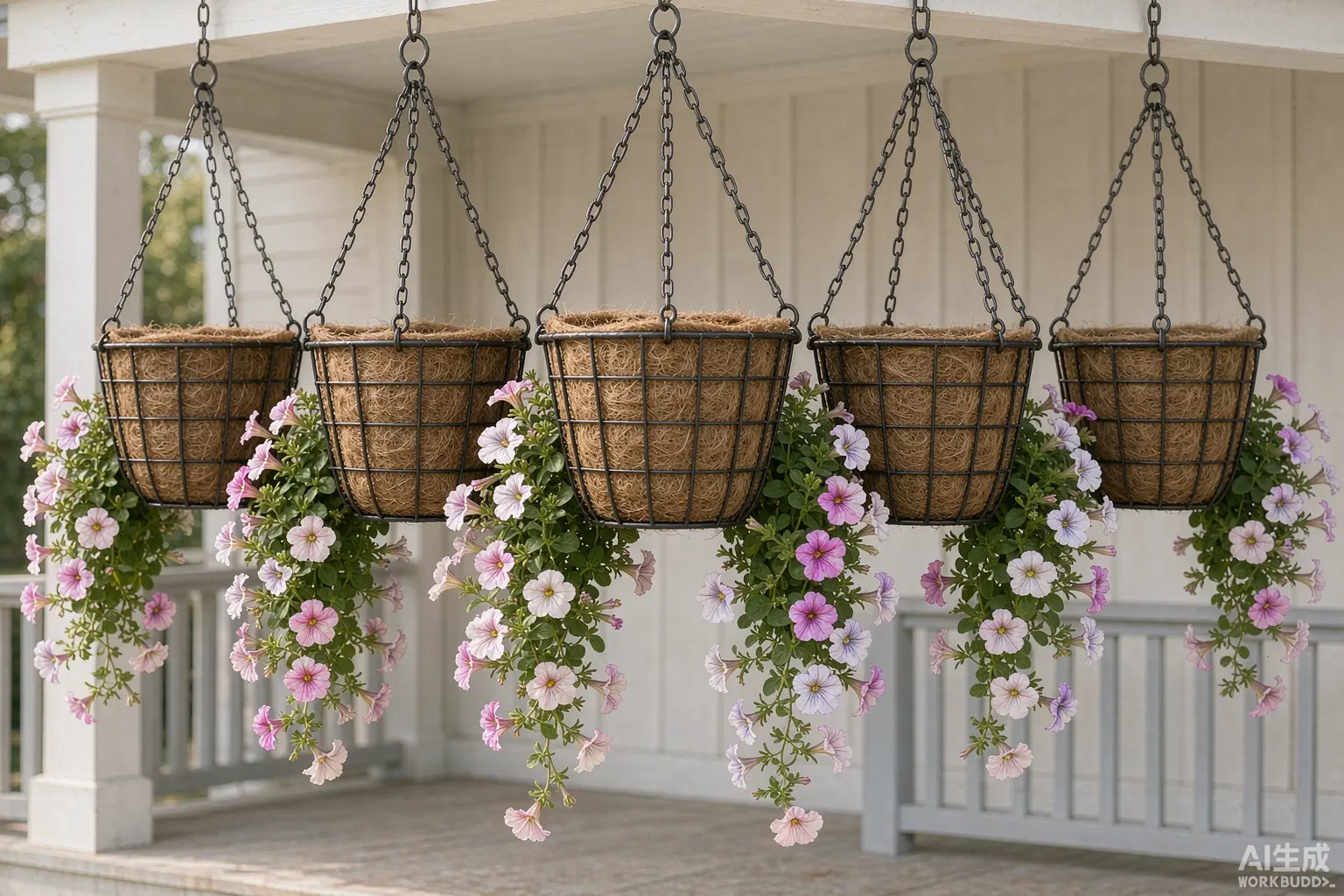
Hanging wire planter baskets with coco coir liners and cascading petunias
AI-generated editorial illustration; not a product photograph.
A hanging planter with a coco liner is a system of three components: the metal basket, the coco liner and the chain or hook hanger. Each can look correct individually and fail together. The liner may not fit the basket profile, the chain may not carry the filled load, and the drainage may follow the chain, basket frame or liner depending on the actual basket and hanger orientation. These failures come from the interfaces between components, not from any single part.
This guide covers what to inspect on a hanging planter with a coco liner sample: the three-component fit, coco liner fit and soil retention, chain and hook load path, drainage and runoff, metal frame coating at welds and cut points, and nested shipping and liner compression.
Three Components Must Fit: Basket, Liner and Hanger
Do the Basket Profile, Liner and Hanger Form the Documented Set?
Record the basket profile, liner shape and overlap, and hanger attachment points. The liner must conform to the basket's interior shape. If the basket is round and deep but the liner is shallow and flat, the liner will not cover the sides and soil will escape through the gaps.
Record component identities and dry-fit photographs for the exact assembly. The three components may come from different suppliers. The basket may be manufactured in one factory, the liner pressed in another, and the chains assembled at a third. The fit between them is not guaranteed by any single component's specification.
Does Wetting Open Gaps at the Rim or Seams?
Coco fiber liners can change shape when wet. A liner that fits dry may sag, shrink or separate from the basket rim after watering. Check liner shrink or gap formation after wetting if relevant to the material.
Use the same defined wetting procedure and photograph changes. The liner binder composition needs supplier confirmation; do not assume a specific binder. The liner supplier's specification, not visual inspection, determines the composition.
Coco Liner Fit and Soil Retention
Where Could Substrate Escape Around the Liner?
Inspect liner coverage at the rim and seams, thickness and density from the actual supplier specification, and whether soil escapes through gaps. Coco liners are porous by design. They hold soil through fiber density and thickness, not through a waterproof barrier. If the liner is thin or has gaps at the seams, soil particles will wash through during watering.
Use a defined fill and water test rather than generic “water retention” claims. Measure actual rim and seam coverage and compare soil loss under documented fill and water conditions. Composition and density need the liner supplier's specification, not visual estimation.
Chain and Hook Load Path
Which Chain and Hook Connections Carry the Filled Basket?
Inspect attachment points, chain links, S-hooks, rings, welds and symmetry. The filled basket load transfers through the chains to the hook and then to the mounting hardware. Each link, weld and connection is part of the load path.
Use hardware drawings and close photographs of actual links, rings, hooks and attachment points. Chain link construction (welded vs bent) affects load capacity; require material, diameter, joint quality and configuration evidence. An S-hook that is too small for the basket eyelet may slip under load.
Does the Permitted Filled Configuration Change Those Connections?
Use a supported, controlled filled-load screening setup under manufacturer instructions and qualified guidance where needed. Do not improvise an overload or publish a hanging-load rating without appropriate evidence. The goal is to observe whether the connections, chains or hook show visible change under the defined wet fill, not to test the assembly to failure.
Use a supported, controlled evaluation with qualified guidance and documented mass. This is not an improvised overload or a suspended-load certification. The mass of wet soil in a hanging basket is significant, and the evaluation must be conducted safely.
Drainage and Runoff
Is Runoff Distributed or Concentrated at One Exit?
Measure how quickly excess water exits and whether flow is concentrated at one point. Hanging baskets with coco liners drain through the fiber. If drainage is concentrated at the lowest point, water may drip from a single spot. If it is distributed, trace the observed water exit and any contact with the liner, basket or nearby surfaces under the recorded hanging orientation.
Separate drainage from moisture-retention claims about coco fiber. Coco fiber holds some moisture, but its primary function in a hanging basket is soil retention, not water storage. Record the defined water input and observed collection paths for this basket and liner. Drainage speed alone does not prove coco-fiber moisture retention.
Metal Frame Coating at Welds and Cut Points
What Coating Evidence Covers the Welds and Cut Points?
Verify the actual metal and coating system and inspect high-risk joints. Inspect welds, cut wire ends and formed edges for the actual coating condition. Obtain the manufacturing and coating sequence before attributing exposed metal to a process; location alone does not establish where failure occurs first.
Match actual metal and coating records to localized sample observations. Powder-coating wording does not establish outdoor life. The coating's performance depends on surface preparation, coating thickness and coverage at the high-risk points. A supplier's “powder coated” claim is a starting point, not evidence of corrosion resistance.
Nested Shipping and Liner Compression
Does Compression Change Basket Shape or Liner Fit?
Check frame deformation, coating rub and whether compressed liners recover enough to fit after unpacking. Hanging baskets are often nested for shipping, with multiple baskets stacked inside each other. Nesting can deform the basket rim, rub the coating off contact points and compress the liners.
Use before and after measurements and unpacking photographs tied to the supplier's packing format. A liner that is permanently compressed may not spring back to fill the basket profile, leaving gaps at the rim and sides.
If you are sourcing hanging planters with coco liners, compare liner fit, hanger construction and filled-load behavior on a sample.

Written by
ScarecrowGarden
💡About Scarecrow Garden Supplier Co., Ltd.
Scarecrow Garden Supplier Co., Ltd. is a China-based sourcing and wholesale partner specializing in garden tools, landscaping equipment, and outdoor supplies for international wholesalers, distributors, contractors, and brands.
With hands-on experience rooted in real garden use scenarios, we focus on durable materials, functional design, and stable large-volume supply. Our product range covers pruning tools, watering systems, hand tools, outdoor hardware, and customized garden solutions to support both retail and professional landscaping markets.
Beyond products, we help our partners navigate supplier selection, quality control, compliance requirements, and long-term sourcing strategies in China. Through our blog, we share practical insights on product selection, material comparisons, industry trends, and cost-effective purchasing—helping global buyers build stronger, more competitive supply chains.