











Updated 3 days ago
Protective Gardening Arm Sleeves: Cuff Retention, Coverage and Cut-Resistance Claims Buyers Should Verify

ScarecrowGarden
💡About Scarecrow Garden Supplier Co., Ltd.
Scarecrow Garden Supplier Co., Ltd. is a China-based sourcing and wholesale partner specializing in garden tools, landscaping equipment, and outdoor supplies for international wholesalers, distributors, contractors, and brands.
With hands-on experience rooted in real garden use scenarios, we focus on durable materials, functional design, and stable large-volume supply. Our product range covers pruning tools, watering systems, hand tools, outdoor hardware, and customized garden solutions to support both retail and professional landscaping markets.
Beyond products, we help our partners navigate supplier selection, quality control, compliance requirements, and long-term sourcing strategies in China. Through our blog, we share practical insights on product selection, material comparisons, industry trends, and cost-effective purchasing—helping global buyers build stronger, more competitive supply chains.
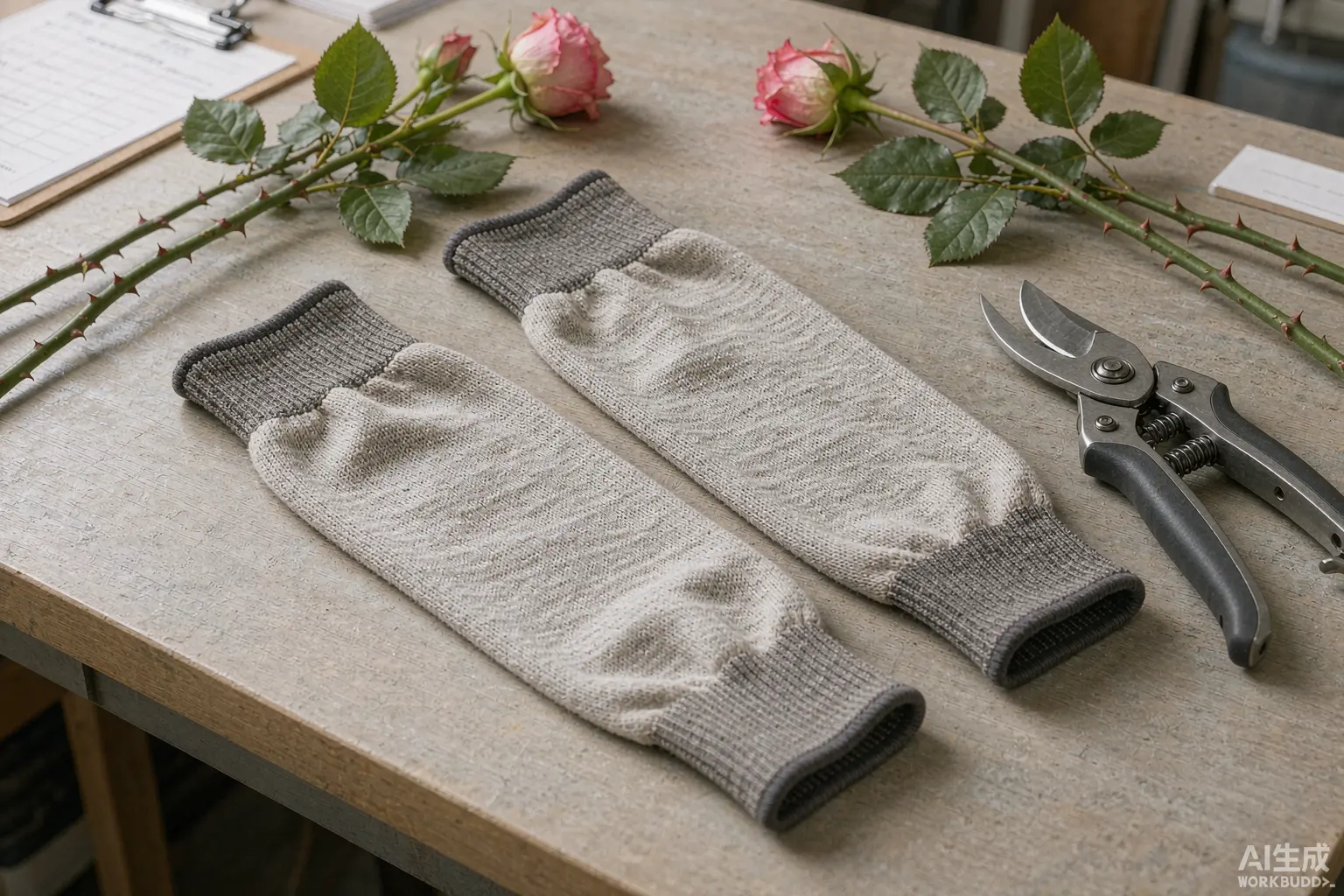
Cut-resistant knitted gardening arm sleeves beside pruning shears and rose stems
AI-generated editorial illustration; not a product photograph.
A product page for gardening arm sleeves may list a fiber blend and describe the product as “heat and cut resistant.” These are two different protection claims, each requiring different evidence. Cut resistance is not thorn resistance. Heat resistance is not cut resistance. And a cut-resistance level printed on a listing, without a named standard, edition or test report, is not usable evidence. Buyers need to separate these claims and verify each one against the exact sleeve and target market.
This guide covers what to inspect and verify on protective gardening arm sleeve samples: the intended hazard, coverage and migration, cuff retention and seam construction, dexterity and glove interaction, evidence behind protection claims, and packaging and size communication.
Define the Intended Hazard Before the Material
Which Specific Hazard Is the Sleeve Intended to Address?
Differentiate thorn and abrasion, cut, and heat claims. Each requires different evidence. Thorn protection depends on puncture resistance. Cut protection depends on the blade cutting through the fabric. Heat protection depends on thermal insulation or resistance. These are separate mechanical and thermal properties, not interchangeable “protective” labels.
Build a claim-to-evidence list for the actual model and market. Abrasion, cut, puncture or thorn, and heat are separate questions. A sleeve that resists cutting may not resist thorn puncture. A sleeve that resists heat may not resist cutting. Do not bundle all hazards under one claim.
Coverage, Length and Sleeve Migration
Does the Sleeve Keep the Intended Area Covered During Movement?
Measure actual coverage from wrist to upper arm and observe slippage during pruning and handling movements. A sleeve that covers the forearm when static may slide down during reaching, leaving the wrist or lower forearm exposed. This is where cuff retention matters.
Check elastic or cuff pressure qualitatively or with defined sample measurements. No universal comfort threshold is supplied. Document wearer dimensions, sleeve length and migration during representative non-hazardous tasks. Comfort and fit observations are not protective-performance tests.
Cuff Retention and Hem and Seam Construction
Which Cuff and Seam Features Resist Rolling or Twisting?
Inspect elastic or knit structure, thumb-hole if present, seam position and edge finishing. A thumb-hole may help anchor the sleeve at the hand; the actual retention depends on the exact construction, fit and use. If there is no thumb hole, identify the actual retention features and assess their fit on the supplied sample; do not assume a particular elastic arrangement.
Cycle donning and doffing and arm movement. Record rolling, twisting or seam irritation. Use exact construction photographs and a defined don, doff and movement record. Thumb holes or elastic details are included only where present on the actual sample.
Dexterity and Interaction With Gloves
Does the Glove-Sleeve Overlap Stay Usable at the Wrist?
Check overlap with glove cuffs and whether sleeve bulk interferes with wrist flexion or grip. If the sleeve is thick at the wrist, it may prevent a glove from sealing against the skin, creating a gap where thorns or debris can enter. If the sleeve is thin, it may layer comfortably under the glove cuff.
Record the actual glove and sleeve sizes and ordinary wrist movements without exposing a wearer to hazards. This article covers the forearm coverage and sleeve retention question; glove selection is a separate topic.
Evidence Behind Cut, Heat and Abrasion Claims
Does the Report Match This Sleeve and Claimed Protection?
If a protection level or standard is printed on the listing or packaging, require the exact report, test method, level and product or model scope. “Level 5” without identification of the standard, edition and test report is not usable evidence. Cut-resistance levels are defined by specific standards, and the level number means nothing without the standard name. If a cut-resistance level is claimed, require the exact standard name, version, test report and product scope. EN 388:2016+A1:2018 (titled “Protective gloves against mechanical risks,” published by CEN) specifies requirements and test methods for protective gloves against abrasion, blade cut, tear, puncture and, where applicable, impact. The BSI official product page states that the test methods in EN 388 may also apply to arm protectors. ISO 13997:2024 (titled “Protective clothing — Mechanical properties — Determination of resistance to cutting by sharp objects,” published by ISO) specifies a tomodynamometer cut test method for materials and assemblies designed for protective clothing, including gloves. ISO 13997:2024 is the current published edition; the 2023 edition is withdrawn. Whether these standards apply to a specific arm sleeve depends on the product's regulatory classification in the target market, which requires confirmation from the standards body or a qualified compliance assessment for the exact product and market. A cut-resistance test performed on a glove does not automatically establish the same level for an arm sleeve made of the same fiber; the product scope and regulatory classification must be confirmed for the exact sleeve and target market.
Is That Method and Claim Applicable in the Target Market?
Confirm applicable regional PPE rules before publishing certification or standard claims. Different markets regulate protective equipment differently. A sleeve sold as PPE in one market may be classified differently in another.
Check current primary regulator or standards-body documentation for the sleeve's classification. Do not automatically transfer glove rules or a cut result to another hazard. Cut resistance is not proof of thorn or puncture resistance. Cut resistance is not proof of heat resistance. Each claim requires its own evidence for the exact product and market.
Never test protection on a person's arm. Protection claims are verified through laboratory testing under defined standards, not through improvised field tests on human subjects.
Packaging and Size Communication
Will the Buyer Receive the Correct Size and Quantity?
Clarify whether the product is sold as a pair or a single sleeve. Some listings sell arm sleeves individually, while others sell them in pairs. A buyer who expects two sleeves and receives one has a packaging communication problem.
Clarify size range, length measurement method, labeling and care instructions. Compare the approved label and care specification with the sample pack. Include single sleeve versus pair and the stated measurement method. Keep safety wording limited to verified evidence.
If you are sourcing protective gardening arm sleeves, confirm the intended hazard, target market and sizing and coverage requirement before comparing samples.
Written by
ScarecrowGarden
💡About Scarecrow Garden Supplier Co., Ltd.
Scarecrow Garden Supplier Co., Ltd. is a China-based sourcing and wholesale partner specializing in garden tools, landscaping equipment, and outdoor supplies for international wholesalers, distributors, contractors, and brands.
With hands-on experience rooted in real garden use scenarios, we focus on durable materials, functional design, and stable large-volume supply. Our product range covers pruning tools, watering systems, hand tools, outdoor hardware, and customized garden solutions to support both retail and professional landscaping markets.
Beyond products, we help our partners navigate supplier selection, quality control, compliance requirements, and long-term sourcing strategies in China. Through our blog, we share practical insights on product selection, material comparisons, industry trends, and cost-effective purchasing—helping global buyers build stronger, more competitive supply chains.