








Updated 2 months ago
Round Point Shovel Buying Guide for Wholesale Buyers: What to Specify Before Ordering
SCARECROW GARDEN SUPPLIER
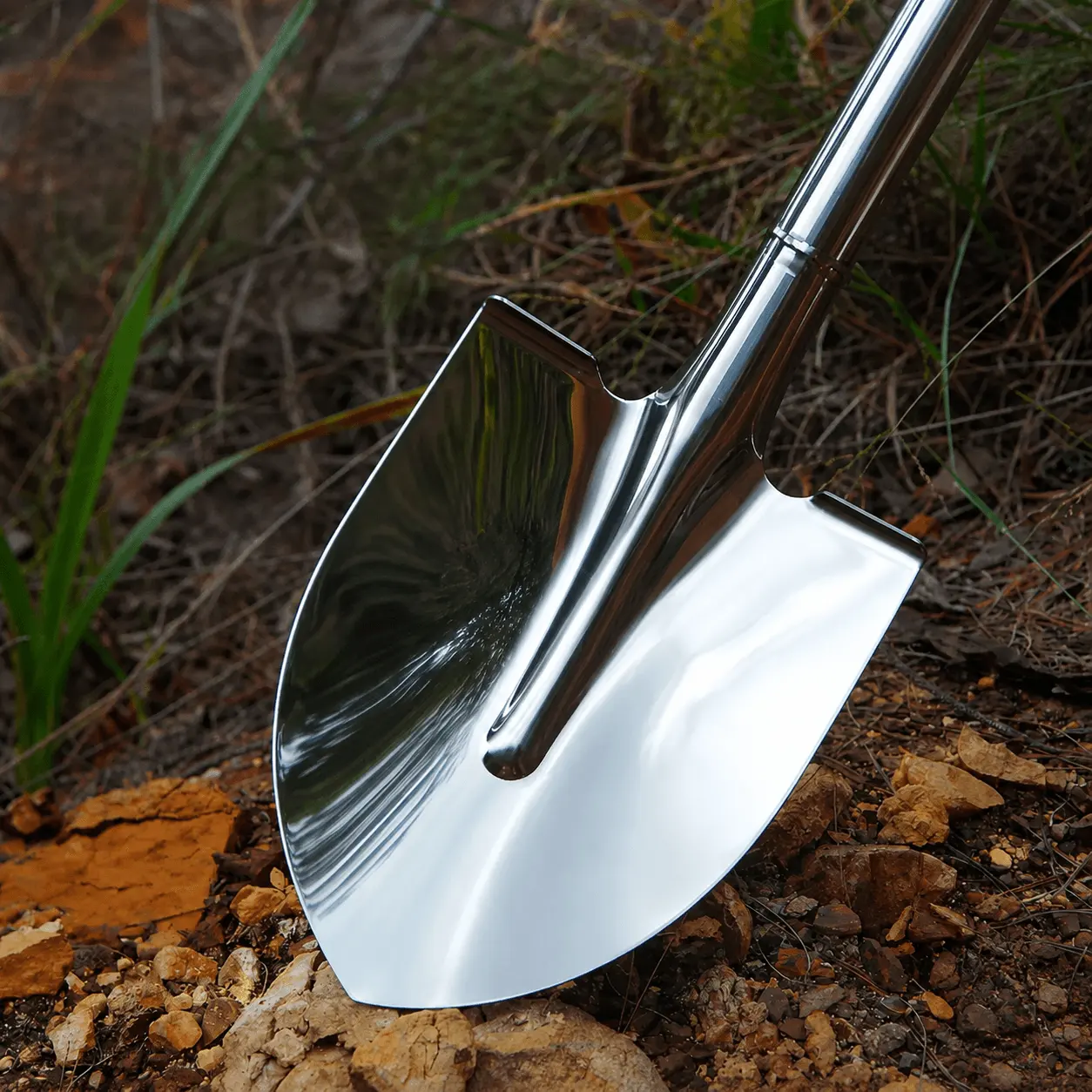
round point shovel buying guide for wholesale buyers
You already know you need a round point shovel. That is not the question. The question is what, exactly, you should tell a supplier before a single unit goes into production — and what you should check on the sample before you commit to a bulk order.
A round point shovel looks straightforward. It is a blade with a rounded tip, a handle, and a connection between them. But when you are buying by the container or planning a retail range, the details that separate a product that sells quietly and a product that generates returns are all in the specification. Blade profile. Socket depth. Tread width. Handle material. Each one changes how the tool performs, how long it lasts, and what your customer says about it after a season of use.
This guide breaks down what a wholesale buyer should specify, verify, and request when sourcing round point shovels — not as a list of features, but as a set of decisions that affect your landed cost, your complaint rate, and your reorder pattern.
Why Round Point Shovels Deserve Their Own Procurement Specification
If you have read our comparison of square point, round point, and garden spade, you already know the basic distinction: round point shovels are built for digging and scooping, with a curved blade and a pointed tip that penetrates soil. Square point shovels handle flat scooping and edging. Spades cut clean lines.
This article does not rehash that comparison. Instead, it focuses on what happens after you have decided on round point — the procurement specification that follows.
Round point shovels appear in hardware stores, garden centers, agricultural supply shops, and landscaping catalogs. But “round point” is a shape, not a specification. Two shovels with the same point shape can differ in blade thickness, socket construction, handle material, tread design, and total weight. Any of those variables can change the product’s price, performance, and shelf appeal.
That is why round point shovels deserve their own specification checklist — not a generic “shovel” spec sheet, but one tuned to how this particular tool is used, what fails on it, and what your customers expect from it.
Blade Profile: Point Shape, Shoulder Width, Dish Depth and Working Angle
The blade is where the tool meets the ground. Four profile elements determine how it performs:
Point shape. The rounded tip is the defining feature. But “rounded” covers a range — from a gentle arc that barely departs from a flat edge to a pronounced point that looks almost like a digging spear. A more pronounced point may penetrate compacted soil more easily. A gentler curve may scoop more material per bite. The choice depends on your end user and target soil — but verify actual performance by comparing samples in the intended use material, not by assuming geometry alone.
Shoulder width. The shoulder is the widest part of the blade, where the blade meets the socket. A wider shoulder may carry more soil per scoop but may also require more foot force to push into the ground. A narrower shoulder may penetrate more easily but moves less material. These are design trade-offs, not universal rules. Your specification should state the shoulder width you want, or provide a reference product for the supplier to match.
Dish depth. The dish is the concave curve of the blade. A deeper dish may hold more material — soil, gravel, mulch — but may add weight and manufacturing complexity. A shallower dish is lighter and may be easier to swing but may spill more. This is a trade-off, not a right answer. Your specification should state the dish depth you want, or at minimum, describe the holding capacity you expect.
Working angle. The angle between the blade and the shaft affects the motion of use. Many shovel designs have a larger blade-to-shaft angle than spades, which suits the scooping and lifting motion. But the exact angle varies by manufacturer and model. Do not accept “standard angle” as a specification — either measure the sample and record the number, or describe the working motion you expect (scooping, digging, or mixed) and let the supplier match it.
What to specify: Point shape (describe or provide a reference photo), shoulder width, dish depth (or describe holding capacity), and working angle (or describe the intended motion).
What to verify on a sample: Measure all four. Photograph the blade profile from the side. Compare against your reference.
Sourcing Round Point Shovels?
Start with the target use, blade profile, handle type and quantity plan before comparing supplier options. A clearer product scope helps you evaluate suitable shovel structures, specifications, and sourcing solutions more efficiently.
Foot Tread, Socket and Handle Requirements Buyers Should Confirm
The blade is only half the tool. The connection between blade and handle — and the way the user applies force — is a critical structural junction that deserves specification attention.
Foot Tread
The foot tread is the flat or folded platform at the top of the blade where the user steps to push the blade into the ground. Things to confirm on a sample:
- Tread width. Measure and record. Compare against your target or reference.
- Edge shape. Check whether edges are folded, rolled, or sharp. Sharp edges may be uncomfortable in soft-soled footwear.
- Structure. Identify whether the tread is single-layer or reinforced (folded, welded, or thicker shoulder). Record the type.
- Alignment. Check that the tread is aligned with the blade and shaft. Misalignment may cause the blade to twist under pressure.
For detailed tread structure analysis and sample screening methods, see our Foot Tread Design Guide.
Socket and Connection
The socket is the fitting where the handle enters the blade. Key things to confirm:
- Socket depth. Measure and record. Socket depth is one variable in connection strength — evaluate it together with fit, fastener, socket geometry, and material.
- Socket diameter. The socket must match the handle diameter. Check for a tight fit with no wobble.
- Connection method. Identify whether the handle is secured with a rivet, pin, screw, weld, or adhesive. Record the method and fastener details.
For a detailed breakdown of socket depth, connection methods, and failure modes, see our Socket and Neck Construction Guide.
Handle
Things to confirm:
- Handle type. Long handle (for leverage and two-handed digging) or D-grip (for control and close work). Your choice depends on the end user and the retail display space available.
- Handle material. Wood, fiberglass, or steel. Handle material changes the socket design, the connection method, and the total weight — it is a performance variable, not just a cost variable. For detailed material trade-offs, see our Handle Materials Guide.
- Handle length and diameter. Length affects leverage and user height range. Diameter affects grip comfort. Both should be specified, not left to “standard.”
Handle material can affect handling characteristics. For detailed performance data and material comparisons, see our Handle Materials Guide and our Weight and Balance Guide.
What to specify: Tread width and edge type, socket depth and connection method, handle type/material/length/diameter.
What to verify on a sample: Step on the tread with a work boot. Wiggle the handle in the socket. Measure socket depth with a ruler. Photograph the connection point.
How Soil Type and End-User Task Change the Required Construction
The same round point shovel is not right for every market. Soil type and user task change what to evaluate:
| Soil/Task Condition | Variables to Evaluate |
| Clay, rocky, or compacted soil | Blade thickness (actual mm), blade material and heat treatment, tread reinforcement, socket depth and connection |
| Loose or sandy soil | Total weight, blade geometry, whether standard construction is adequate for the intended use |
| General garden soil (mixed) | Balance of cost and durability — evaluate actual blade thickness, material, and connection on sample |
| Heavy material moving (gravel, compost) | Shoulder width, dish depth, handle-to-blade connection strength |
| Precise digging (planting, transplanting) | Blade width, point shape, handle length for control |
If you are sourcing for a single region, evaluate construction against the dominant soil type. If you are sourcing for a multi-region catalog, consider two SKUs with different construction — but do not assume that thicker or more expensive always means better for every market. Evaluate on sample against the actual use case.
What to specify: The target soil condition and primary user task for each SKU in your range.
What to verify: Ask the supplier what blade material, thickness, and construction they recommend for your soil condition. Cross-check against what you know about your market — and verify on sample.
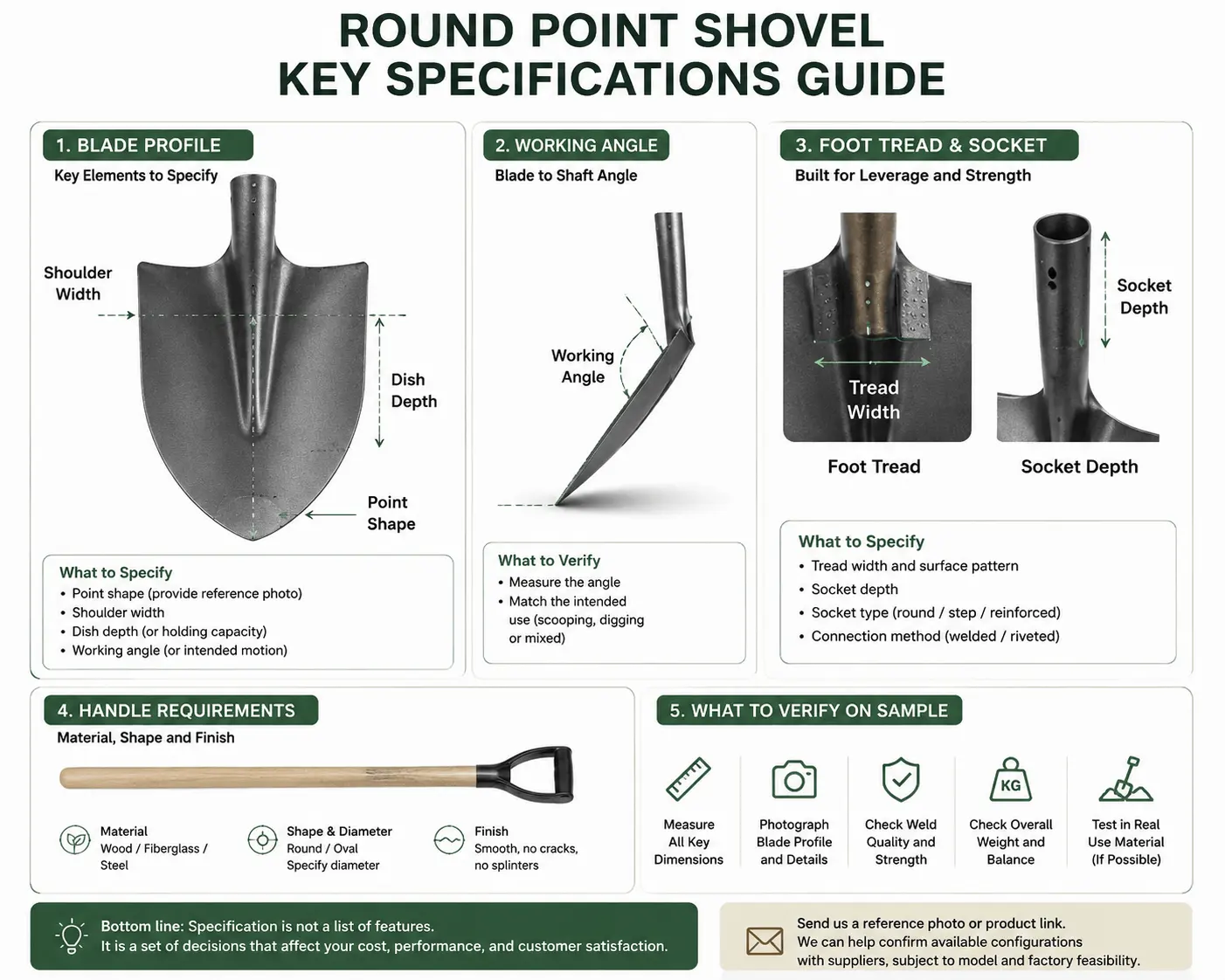
What to Measure and Photograph on a Round Point Shovel Sample
When a sample arrives, do not just hold it and decide if it “feels right.” Measure it. Photograph it. Create a record that you can compare against the bulk order later.
Here is what to capture:
| Measurement | Tool Needed | Why It Matters |
| Total length (blade tip to handle end) | Tape measure | Determines shipping carton length and display space |
| Blade length × width | Tape measure or caliper | Core product spec; affects digging depth and scooping capacity |
| Blade thickness (gauge) | Caliper | Determines durability and weight; verify against quoted gauge |
| Dish depth | Ruler pressed across blade shoulders | Affects material-holding capacity |
| Point shape profile | Side photograph | Visual record of the blade curve for reorder comparison |
| Socket depth and diameter | Caliper or ruler | Connection strength indicator; must match handle spec |
| Handle length, diameter, material | Tape measure + caliper | Core spec; affects leverage, grip, and shipping length |
| Total weight | Scale | Shipping cost and user fatigue indicator |
| Foot tread width and structure | Ruler + close-up photo | Comfort and durability indicator; verify reinforcement |
Photograph these angles:
Full tool, side view (blade and handle visible)
Blade close-up, showing point shape and dish
Socket and connection point, close-up
Foot tread, top-down view
Handle grip or end
This photo set becomes your reference standard for the approved sample. When the bulk order arrives, you pull out the same checklist and compare. (Illustrative Example: if the blade thickness on the bulk sample measures differently from the approved sample, the photos and measurements tell you immediately.)
How Garden Centers and Distributors Can Position Round Point Shovels in a Range
A round point shovel is rarely the only shovel in your range. In a garden center, it is typically the core digging tool — the one most customers pick up first. In a hardware store, it may sit alongside a square point shovel and a scoop. In a landscaping supply catalog, it may be the standard-duty option next to a professional-grade spade.
Positioning questions to answer:
- Is round point your core digging SKU? If yes, it should be available in at least two handle types (long handle and D-grip) to cover different user preferences.
- What price tier does it occupy? Round point shovels are available across a range of quality tiers. Define each tier using measurable indicators — blade material, actual thickness, handle material, finish, and connection type — rather than assuming a fixed material recipe. Decide where your round point sits in your range before you specify construction.
- What is the next step up? If a customer wants something heavier or more specialized, what do you offer? Having a clear upgrade path from round point to a professional spade or a specialty digging tool helps avoid the “one SKU does everything” trap.
- How does it display? Long-handle round point shovels need vertical display space. D-grip versions can sit on lower shelves. Factor this into your assortment decision — not just what to stock, but where it physically goes in your store.
RFQ Checklist for Round Point Shovel Projects
Before you send an RFQ to a supplier, gather this information:
| RFQ Item | What to State |
| Point shape | Describe or attach reference photo |
| Shoulder width | State target measurement or “match reference” |
| Dish depth | State target depth or describe holding capacity |
| Blade thickness (gauge) | State nominal gauge if used by supplier; require actual mm measurement at agreed point on sample |
| Blade material | Ask supplier to declare specific grade and applicable material standard |
| Blade construction | Stamped or forged — ask supplier to confirm manufacturing process |
| Foot tread | Width, edge type (folded/sharp), reinforcement |
| Socket | Depth, diameter, connection method (rivet/weld/pin) |
| Handle type | Long handle or D-grip |
| Handle material | Wood, fiberglass, or steel |
| Handle length and diameter | State target measurements |
| Surface finish | Painted, powder-coated, polished |
| Target market | Country/region and dominant soil type |
| End user | Consumer, prosumer, or professional |
| Packaging | Retail (hang tag, barcode) or bulk/bundle |
| MOQ | State your minimum order quantity |
| Target price | State your target landed cost per unit |
Need Help Structuring the RFQ?
Send a reference photo, target market and quantity plan so the sourcing requirements can be organized clearly. We can help structure the key information before supplier communication, quotation comparison, and sample discussion.
Next Step: Review Your Round Point Shovel Sourcing Plan
If you are planning a round point shovel purchase, the most important thing you can do is specify before you order and verify before you commit. A round point shovel is a simple tool, but a simple tool sourced without a specification is a simple way to get returns.
Send us your target specification — or a reference photo of the product you want to match — and we can help confirm the right configuration, coordinate a sample, and support a sourcing plan that holds up across repeat orders, subject to model and factory feasibility.
Ready to Review a Round Point Shovel Project?
Use the approved specification and sample requirements as the basis for your next sourcing step. We can help review product details, sourcing requirements, and practical options before moving forward.
Related Articles
Garden Spade Buying Guide for Retail and Landscaping Buyers: Blade, Step, Shaft and Use-Case Fit
Shovel Socket and Neck Construction: Why Head-to-Handle Connections Fail
Garden Shovel Sample Test Plan Before Bulk Ordering: What to Measure, Load, Use and Photograph