










Updated 2 months ago
How to Compare Mini Greenhouse Supplier Quotations on the Same Basis
SCARECROW GARDEN SUPPLIER
compare mini greenhouse supplier quotes
Three quotes arrived. One is $14.50. One is$19.80. One is $23.00.
The cheapest one looks like the obvious choice. But is it?
A mini greenhouse quotation is not a single number. It is a bundle of component specifications, packaging decisions, trade terms, minimum order quantities, and service commitments — all compressed into one unit price. When you compare only the unit price, you are comparing bundles that may have nothing in common except the product photo on top.
This article explains how to compare mini greenhouse supplier quotations so that the differences you see reflect real differences in what you are being offered — not artifacts of how each supplier chose to quote.
All supplier names, prices, and specifications in this article are hypothetical examples for illustration. Your actual quotes will differ.
The Classic Trap: Same Photo, Different Specs
Here is how the trap works in practice.
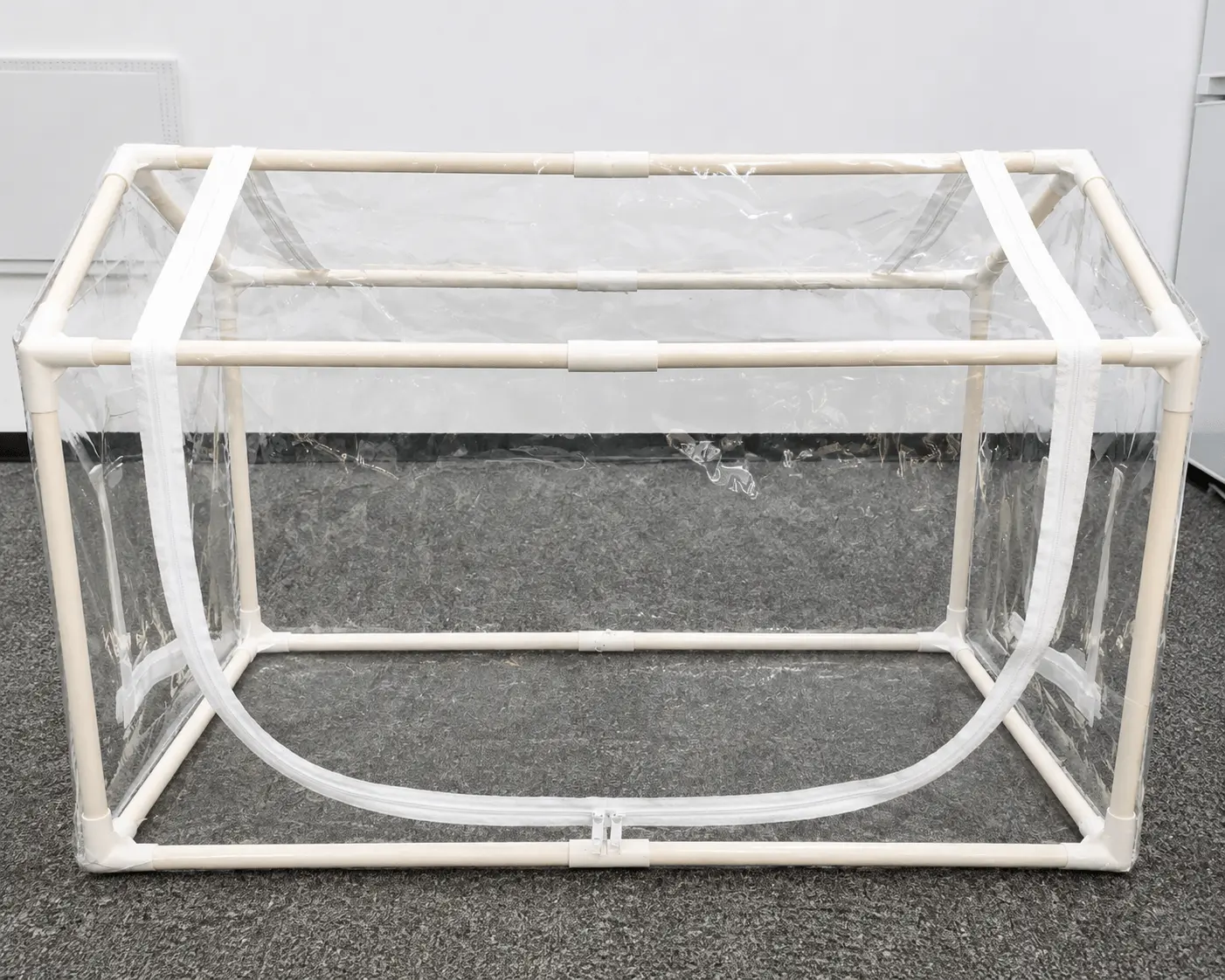
You send the same product photo to three suppliers. The photo shows a 4-tier mini greenhouse with a clear cover, a zippered roll-up door, and a black powder-coated frame. It looks straightforward.
Supplier A quotes $14.50. They are quoting a thinner cover, a lighter tube wall, and a standard PP plastic connector. They quote EXW, which means you pay for inland transport, export clearance, and loading.
Supplier B quotes $19.80. They are quoting a thicker cover, a heavier tube wall, and a reinforced connector. They quote FOB, which means the price includes delivery to the port and loading onto the vessel.
Supplier C quotes $23.00. They are quoting specs similar to Supplier B but include a printed retail box, spare connectors in each carton, and a replacement part arrangement on the next order.
On unit price alone, Supplier A looks significantly cheaper than Supplier B and Supplier C. But when you normalize for spec differences, packaging inclusions, Incoterms, and after-sales support, the gap may narrow considerably — or even reverse.
This is why comparing quotations on the same basis is not a nicety. It is the difference between making a sourcing decision and making a gamble.
The Dimensions You Must Align Before Comparing
To compare quotations fairly, you need to align the following dimensions across all suppliers. If any of these differ, you are not comparing the same product.
Component Specifications
| Component | What to Align | Why It Matters |
| Cover material | Type (PVC/PE) and thickness (mm) | Different specs affect material use, cost, and performance — verify by sample/test |
| Tube gauge | Diameter and wall thickness (mm) | Wall thickness differences affect frame performance and cost |
| Surface treatment | Powder-coated vs galvanized | Different cost and corrosion resistance characteristics |
| Connector | Material (PP/reinforced) and tolerance | Affects assembly ease and frame rigidity |
| Shelves | Wire diameter and coating (if applicable) | Determines load capacity and sag resistance |
| Zipper | Type (nylon/plastic/metal) and grade | Component quality affects user experience |
If Supplier A quotes a thinner cover and Supplier B quotes a thicker cover, you cannot compare their prices until you either ask Supplier A to re-quote at the thicker spec or ask Supplier B to re-quote at the thinner spec. Pick one specification and align all suppliers to it. Any spec change affects material use, cost, and performance — and must be verified by sample or test, not assumed.
Comparing Mini Greenhouse Suppliers?
Review mini greenhouse options on the same specification, packaging and commercial basis before choosing a supplier. A consistent comparison framework helps you identify real product differences instead of comparing headline prices alone.
Packaging
Packaging is a cost line item that can affect the unit price. Check whether each quote includes:
- A plain brown carton (lowest cost)
- A printed retail box (adds cost but improves shelf presentation)
- Mail-order packaging (designed for parcel shipping, adds cost but may reduce damage)
- Individual component bagging and labeling
- An instruction sheet (and in what language)
A supplier who quotes without a printed retail box looks cheaper — until you add the cost of having boxes printed separately or accepting a plain carton that does not support retail display. The specific cost impact depends on the packaging specification and supplier.
Incoterms
This is where misleading comparisons happen. EXW (Ex Works) means the supplier’s price ends at their factory door. You pay for everything after that. FOB (Free on Board) means the supplier covers inland transport, export clearance, and loading onto the vessel. CIF (Cost, Insurance, and Freight) means the supplier also covers ocean freight and insurance to the destination port.
A quote at EXW may look cheaper than a quote at FOB, which may look cheaper than CIF. But the total cost you pay may be the same — or the EXW quote may end up more expensive if your freight forwarder charges more than the supplier’s. The key point is that different Incoterms cannot be directly compared — you need to normalize all quotes to the same cost basis before comparing.
Rule: Convert all quotes to the same Incoterm before comparing. If you have a freight forwarder, ask all suppliers to quote FOB. If you want the supplier to handle shipping, ask all to quote CIF to your destination port. Either way, compare apples to apples.
MOQ and Sample Terms
Minimum order quantity affects pricing. A supplier quoting for 500 units will offer a different unit price than one quoting for 100 units — because fixed costs spread across more units. If suppliers are quoting at different MOQs, the price comparison is not valid.
Align the order quantity across all quotes. Also check sample terms: some suppliers offer free samples, some charge a fee, and some credit the sample fee against the bulk order. These are small amounts, but they signal the supplier’s approach to new business.
After-Sales and Warranty Terms
This is the dimension most buyers ignore — and it is the one that can make the cheapest quote the most expensive in the long run.
Ask each supplier:
- Do you provide replacement parts for defective units?
- Under what conditions? (Factory defect only? Shipping damage? Any reason?)
- Is there a warranty period? What does it cover?
- Are spare parts included with the order, or only on request?
A supplier who includes spare connectors and pegs in every carton is adding a small cost — but potentially saving you the cost of handling individual consumer complaints for missing or broken parts. A supplier who offers replacement parts on the next order is giving you a mechanism to resolve after-sales issues without returning goods.
A Practical Quote Comparison Structure
Here is a structure you can use to compare mini greenhouse quotations side by side. Build it as a spreadsheet with one row per supplier and one column per dimension. All numbers are hypothetical.
| Dimension | Supplier A | Supplier B | Supplier C |
| Unit price (as quoted) | $14.50 | $19.80 | $23.00 |
| Incoterm | EXW | FOB | FOB |
| Cover material & thickness | PVC, thinner | PVC, thicker | PVC, thicker |
| Tube gauge | Thinner wall | Thicker wall | Thicker wall |
| Surface treatment | Powder-coated | Powder-coated | Powder-coated |
| Connector | PP standard | PP reinforced | PP reinforced |
| Packaging | Plain brown carton | Plain brown carton | Printed retail box |
| Spare parts included | No | No | Yes (connectors + pegs) |
| Warranty | None stated | None stated | Replacement on next order |
| MOQ | 200 pcs | 300 pcs | 500 pcs |
| Sample fee | Charged, not credited | Charged, credited on bulk | Free |
| Estimated freight add-on (EXW→FOB) | [Forwarder quote] | $0 | $0 |
| Adjusted FOB equivalent | [Calculate] | $19.80 | $23.00 |
| Adjusted for spec parity | [Request re-quote] | $19.80 | $23.00 |
| Adjusted for packaging parity | [Add retail box cost] | [Add retail box cost] | $0 |
| Final comparable price | [Calculate] | [Calculate] | $23.00 |
The numbers in this table are illustrative — your actual quotes will differ. But the structure is the point. When you lay out every dimension side by side, the real comparison emerges.
Need a Like-for-Like Quote Comparison?
Send the specifications and quotations you already have. We can help organize the differences before you decide, so products, packaging and commercial terms can be reviewed on a clearer and more comparable basis.
What to Do When Suppliers Will Not Provide Line-Item Detail
Some suppliers will resist providing a line-item breakdown. They will say “this is our standard product” or “the price is the price.” This is not necessarily dishonest — many factories quote as a single number because that is how their internal costing works. But it does make comparison harder.
If a supplier will not break down the quote, you can still compare by doing the work yourself:
Take the most detailed quote (the one with the most line items) as your baseline.
For each less-detailed quote, ask: “Does this include packaging? What Incoterm? What cover thickness? What tube gauge?” — and add the cost of upgrading to parity where the spec is lower.
If the supplier will not confirm specs, treat the quote as incomplete and note the risk. A quote without confirmed specifications is not a quote — it is an estimate with hidden variables.
Beyond Price: What the Quotation Process Tells You About the Supplier
How a supplier responds to a structured RFQ tells you as much about them as the numbers in their quote. Consider these signals:
- Response completeness: A supplier who responds with all fields filled in may be operating at a different service level than one who omits half the fields. Define your own responsiveness and completeness criteria based on your business needs.
- Willingness to customize: A supplier who engages with your specification questions and offers alternatives is thinking about your business. One who says “take it or leave it” is thinking about their production convenience.
- Transparency about limitations: A supplier who says “we do not offer that, but here is an alternative” is being honest. One who says “yes, no problem” to everything may be overpromising.
- Quality of communication: Clear, organized responses with correct technical terms indicate a supplier who understands their product and respects your process. Sloppy, incomplete responses may suggest similar care in production.
These signals matter because the quotation phase is the easiest part of your relationship with a supplier. If communication is difficult now, it is unlikely to improve after you have placed an order and money is on the line.
Next Step: Turn Your Quote Comparison Into a Sourcing Decision
Once you have aligned all quotes on the same basis, the decision becomes clearer. You are no longer choosing between a $14.50 product and a$23.00 product. You are choosing between suppliers at different service levels, spec levels, and risk levels — with prices that reflect those differences.
The next step is to order samples from your top two candidates. Compare the samples against the specifications in the quotes. If the sample does not match the quoted spec, you have your answer before you commit to a production run.
Send us your mini greenhouse specifications and target quantity. We will help you build a side-by-side quote comparison that aligns specs, packaging, Incoterms, and after-sales terms — so you can see the real difference between suppliers, not just the difference in unit price. You focus on selling. We help you source, verify, organize, and ship.
Ready to Compare Supplier Options?
Send us your mini greenhouse specifications and target quantity. We will help you build a side-by-side quote comparison that aligns specifications, packaging, Incoterms and after-sales terms — so you can see the real difference between suppliers, not just the difference in unit price. You focus on selling. We help you source, verify, organize and ship.
Related Articles
Mini Greenhouse RFQ Checklist: What Buyers Should Specify Before Asking for a Quote
How to Calculate the Landed Cost of Mini Greenhouses: Beyond Unit Price
Private Label Mini Greenhouse Projects: From Reference Sample to Approved Production