







Updated 3 months ago
How to Reduce Shipping Damage to Clear Humidity Domes and Plastic Nursery Trays
SCARECROW GARDEN SUPPLIER
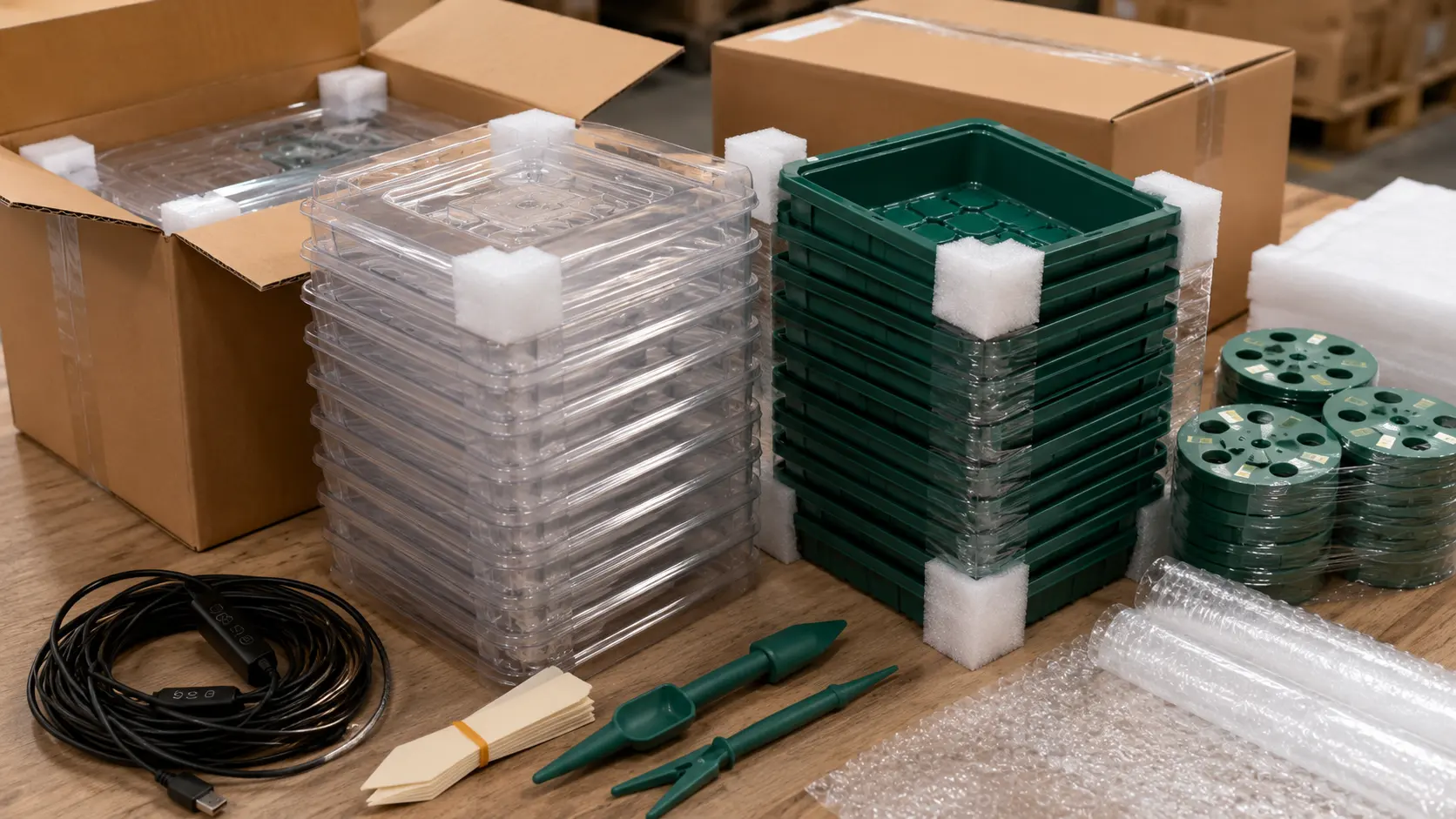
How to Reduce Shipping Damage to Clear Humidity Domes | B2B Packaging Guide | Scarecrow Garden Supplier
You open the container. The cartons look fine from the outside. But when you pull the first box of humidity domes off the pallet, you hear it — the unmistakable crunch of cracked plastic. Clear dome tops, shattered into jagged pieces. A few trays underneath have cell walls bent out of shape, their drainage holes pinched shut.
If this has happened to you, you already know the feeling: the order was fine when it left the factory, and somehow it arrived broken. You file a claim, you wait for a response, and in the meantime your propagation schedule slides.
This is not a rare problem. It is not a quality problem, either — the domes and trays were made correctly. The damage happened between the factory floor and your receiving dock, and most of it comes down to one material property and a few shipping decisions you can control.
Wondering whether your humidity dome and nursery tray shipping setup is doing enough to protect your order? Send us your product list and current packaging specs — we can review it together and flag the gaps before your next shipment.
Why Clear Humidity Domes Break in Transit (And Why It’s Not Your Fault)
Clear humidity domes are almost always made from general-purpose polystyrene (PS). That is the same plastic used for disposable labware and protective packaging — and Thermo Fisher, one of the world’s largest lab supply manufacturers, states plainly: “Products made of polystyrene are brittle at ambient temperature and may crack or break if dropped from bench height.”
That sentence tells you everything you need to know. Bench height is roughly 30 inches. If PS cracks from a fall that short, imagine what happens inside a shipping container that gets tossed by a crane, stacked under heavier cargo, or subjected to temperature swings from day to night.
The numbers confirm it. PS has an elongation at break of only 1.2–3.6%. Compare that to polypropylene (PP), the material most nursery trays are made from, which stretches 100–600% before it snaps. When PS hits its limit, it does not bend — it breaks. There is no warning, no gradual deformation. One impact, one crack, and the dome is done.
This is not a manufacturing defect. It is a material characteristic. PS is brittle by nature, and you might wonder: can you just switch to a tougher version?
High-impact polystyrene (HIPS) solves part of the problem — it adds 5–10% polybutadiene to the mix, which gives it enough toughness to maintain strength down to −12°C. But HIPS sacrifices optical clarity. It is translucent, not transparent. Your growers need to check seedling development without lifting the cover — with HIPS, they are looking through fog, not glass. For a humidity dome, that trade-off does not work.
So you are locked into clear PS. The dome you need for propagation visibility is the same PS that shatters under stress. You cannot change the material without losing the function, so you have to change how you handle it — because the material will not protect itself.
How Damage Happens: The Three Mechanisms That Destroy Your Products
Humidity domes and nursery trays fail in different ways, but the root cause is the same: force meets a structure that cannot absorb it.
For clear humidity domes
Mechanism 1: Impact cracking. A dropped carton, a forklift bump, a container lurching at sea — the dome’s dome-shaped top is a natural stress concentrator. When force hits the top of the dome, it does not distribute across the surface. It concentrates at the peak, and PS, with its 1.2–3.6% elongation limit, cracks right there.
Mechanism 2: Nested stacking pressure. Domes ship inverted and nested, roughly 40–50 per carton. The upper domes press down on the ones below, and all that weight transfers through the dome peak to the next dome’s peak. If the carton is under-packed, vibration during transit causes the domes to shift and press harder against each other. Over time, micro-cracks form and spread.
Mechanism 3: Cold plus impact — the worst combination. PS’s glass transition temperature (Tg) is around 100°C, far above any shipping temperature. That means PS stays in its rigid, glassy state throughout the entire shipping range. And at lower temperatures, it gets even more brittle. A container crossing the Pacific in winter can, based on industry experience, drop below −10°C internally. A dome that survives a bump at 20°C is more vulnerable to cracking from the same impact at −5°C.
For plastic nursery trays
Mechanism 1: Cell wall bending. A 128-cell tray is 540×280mm of thin-walled structure, with each cell acting as a small cylinder. When trays nest inside each other for shipping (80–100 per carton for 128-cell trays), the cell walls of the lower trays bear the weight of everything above. Side pressure bends cell walls inward, shrinking the root zone and sometimes blocking drainage holes.
Mechanism 2: Impact deformation. Unlike domes, trays do not usually shatter — they deform. A carton dropped during loading can bend cell walls, warp tray edges, or crack the rim. The tray still looks like a tray, but its function is compromised: deformed cells change root growth patterns, blocked holes cause waterlogging.
Mechanism 3: Invisible crush damage. When compressive force transfers through stacked cartons, trays at the bottom bear the weight of everything above. And here is the part that catches people off guard: tray damage is often invisible from the outside. The carton looks fine. You open it, and the top few trays are perfect. But the ones at the bottom — the ones that bore the weight — have cell walls pushed inward, drainage holes pinched shut, edges warped. The product looks usable until you try to fill cells with growing media and discover half of them do not hold volume the way they should. This invisible damage is unique to trays — domes crack visibly, but trays fail silently.
Quick comparison: What breaks and how
| Dimension | Clear Humidity Domes (PS) | Plastic Nursery Trays (PS/PP) |
| Primary damage type | Cracking, shattering | Cell wall deformation, edge warping, cracking |
| Brittleness risk | Very high (elongation 1.2–3.6%) | High (PS trays) / Lower (PP trays) |
| Structural weak point | Dome peak — stress concentration | Cell walls — thin cylinders under side load |
| Nested stacking risk | Peak-to-peak pressure transfer | Cell walls bearing upper tray weight |
| Effect of set packing | Dome protected inside tray walls | Tray interior space utilized by dome |
Why LCL Is Approximately 3x More Likely to Damage Your Order
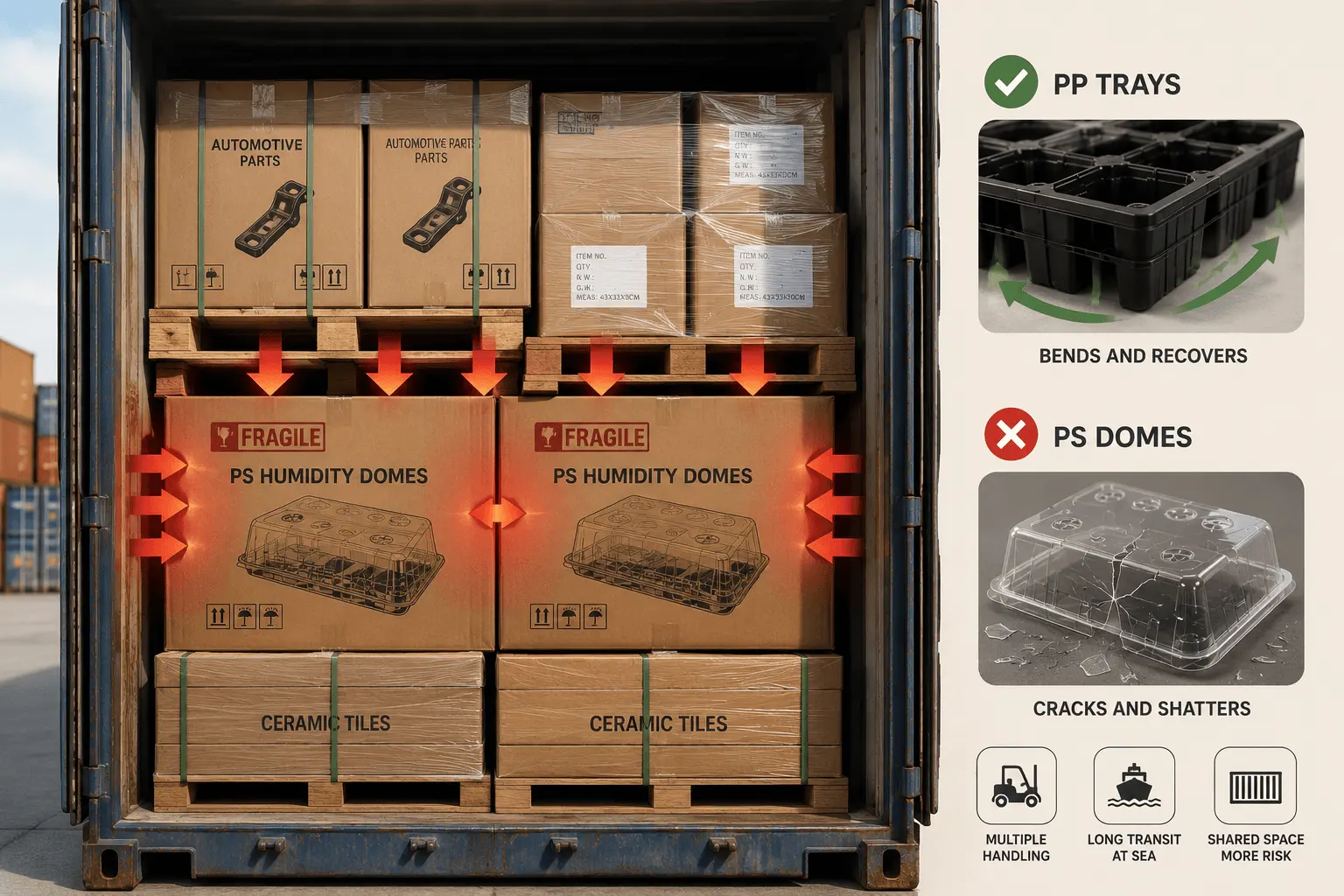
LCL shipments — where your cartons share a container with other companies’ cargo — experience approximately 3x the damage rate of FCL shipments (we covered the general LCL vs FCL differences in our freight comparison article). But here is what matters for your specific products: PS humidity domes and trays are more vulnerable in LCL than almost any other nursery supply.
The reason is simple. PP products — most nursery trays, most propagation pots — can absorb compressive force. They deform, then spring back. PS products cannot. When a pallet of metal fittings gets stacked next to your dome cartons in an LCL consolidation, PP trays might come out with bent cell walls that still function. PS domes come out shattered.
Picture this: your 20 cartons of humidity domes share a 40-foot container with 12 other shippers’ goods. The consolidator stacks pallets by weight — heavy on bottom, light on top — but does not know what is inside your cartons. Your dome cartons, labeled “Fragile,” end up wedged between boxes of ceramic tiles below and automotive brackets above. The tiles shift during loading. Three of your cartons take side pressure for the next 30 days at sea — and PS, with its 1.2–3.6% elongation limit, has no capacity to absorb that pressure. It cracks instead of bending.
Approximately two-thirds of shipping damage, based on industry experience and multiple carrier damage reports, traces back to inadequate packaging — not rough handling, not bad luck, but packaging that was never designed for the realities of shared-container transit. That number tells you something important: most damage is preventable, because most damage starts with decisions you make before the container is even loaded.
If you are weighing LCL risks against air freight for urgent or fragile items, read our detailed comparison [Air Freight vs Sea Freight for Nursery Supplies: Which Option Costs Less?].
Set Packing: The Single Most Effective Strategy to Protect Humidity Domes
Here is where it gets real. Everything above — the PS brittleness, the stacking pressure, the LCL risks — is a problem you understand. The question is: what do you actually do about it?
The single most effective strategy is set packing: shipping the humidity dome nested inside the nursery tray, as a paired set, rather than shipping domes and trays in separate cartons.
Here is what that looks like in practice. A standard 1020 nursery tray has an open interior — a flat bottom with cell walls rising from it, and empty space between the cell tops and the tray rim. When you flip a humidity dome and place it inside the tray, the dome’s peak sits in that interior space, surrounded by the tray’s rim and cell walls on all sides.
The dome is no longer exposed. Its peak — the weakest point, the stress concentrator — is now enclosed by the tray’s structure. Instead of bearing the weight of 40–50 other domes stacked peak-to-peak above it, each dome is individually protected by the tray it sits inside.
Set packing changes three things at once:
1. The dome peak is shielded. The tray rim and cell walls absorb side impacts. The dome peak no longer takes direct pressure from above — the tray’s flat bottom does.
2. Stacking pressure redistributes. In a carton of set-packed trays, the trays carry the vertical load through their rims and flat surfaces, not through fragile dome peaks. The domes inside are essentially riding in protective cases.
3. You eliminate a separate carton type. When domes use the tray’s interior space, you do not need a separate carton just for domes. Fewer carton types means fewer handling errors, fewer mislabeled boxes, and fewer chances for a warehouse worker to stack dome-only cartons under something heavy.
This is not a theoretical improvement. It is a structural one. You are not adding foam inserts or printing bigger “Fragile” labels — you are physically changing the way the product sits inside its packaging, so the weakest part of the product is no longer the part that takes the most force.
Think about the difference in practical terms. A carton of 40 standalone domes, nested peak-to-peak, is a column of fragile peaks pressing on each other. One hard bump and the cracks cascade from top to bottom. A carton of 40 set-packed dome-and-tray combinations is a column of trays — rigid, flat-bottomed, rim-reinforced — each carrying a dome safely inside. The same bump hits the carton, but the force travels through tray rims, not dome peaks. The domes inside ride through the impact unharmed.
That is the difference between shipping a product in its natural vulnerable state and shipping it inside its own protective case.
Your Damage-Reduction Checklist: What to Specify Before Shipping
The real risk is not the ocean, not the forklift, but the assumption that default packaging is good enough for PS products. It usually is not. Set packing is the biggest lever, but it is not the only one. These are not complicated steps — but skipping them is where most damage starts.
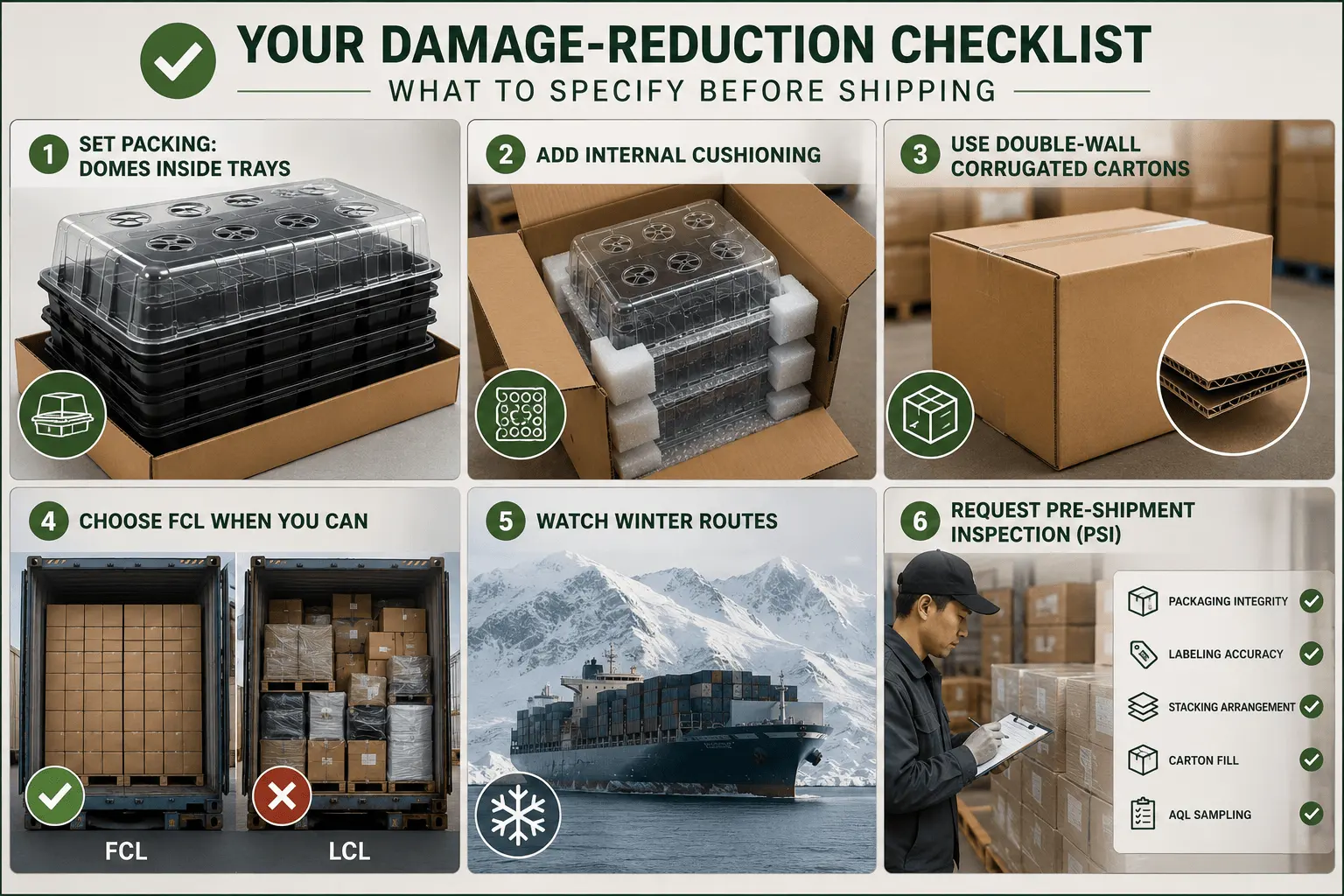
Start with set packing. If you order both domes and trays, request that domes be packed inside trays, not in separate cartons. This is the single most effective decision you can make, and it takes one line on your order specification.
For dome-only shipments, add internal cushioning. Bubble wrap, foam inserts, or honeycomb cardboard between nested dome layers absorbs vibration and prevents peak-to-peak contact. Without it, 40 domes stacked peak-to-peak in a single carton are a column of fragile points pressing on each other — one hard bump and the cracks cascade.
Specify double-wall corrugated cartons. Not single-wall. The box itself is the first line of defense, and single-wall board flexes under the weight of a stacked pallet. Double-wall holds its shape — and holds the products inside in place.
Choose FCL when you can. For PS products, FCL’s lower handling count makes it the safer choice. If your order does not fill a container, consider whether consolidating with your next order would reach FCL threshold. If LCL is necessary, specify “do not stack” on your bill of lading — it creates a documented instruction that supports a damage claim if things go wrong.
Watch winter routes. If your shipment crosses a cold-weather sea route — Northern Pacific in January, for example — PS domes face their worst-case conditions: low temperatures that increase brittleness, plus the normal bumps of sea transit. Some shipping lines offer container dressing (liner bags, insulation layers) that moderate internal temperature swings. These are not standard for every shipment, but they are available and worth asking about for cold routes.
Request a pre-shipment inspection (PSI). A third-party inspector checks packaging integrity, labeling accuracy, stacking arrangement, and carton fill before the container is sealed. This is standard practice for B2B shipments from China, and it catches problems before they become your problems. For large orders, specify AQL sampling (ASQ/ANSI Z1.4) — it gives you a defined threshold for deciding whether a shipment is good enough to release, not a gut feeling.
Beyond physical damage, improper tray selection and transit delays contribute to higher total cost of ownership; explore this in [Why That Low Quote Doesn't Tell the Whole Story].
What your PSI inspector should verify
| Check point | What to verify | Why it matters |
| Carton integrity | Double-wall board, no dents or crushed corners | Box strength determines whether internal products survive transit |
| Internal packing | Set packing for dome-tray sets; void fill for gaps | Empty space = product shifting = damage |
| Stacking arrangement | Cartons upright on pallet, not flat-stacked | Vertical edges bear weight better than flat surfaces |
| Labeling | “Fragile — Polystyrene” visible on two sides | Increases handling awareness at warehouse and dock |
| Nesting count | Domes: max 40/carton; Trays: per agreed spec | Over-nesting concentrates pressure on weakest points |
| Pallet configuration | Cartons aligned, not overhanging pallet edges | Overhang = cartons unsupported = crush risk during strapping |
None of these checks are complicated. They take 15 minutes to specify on an order and 30 minutes for a PSI inspector to verify. But they are the difference between assuming your packaging is fine and actually knowing it is — and for a product that cracks from a 30-inch drop, that difference matters.
Next Step: Review Your Shipping and Packaging Plan
Shipping damage to PS products is not random. It follows predictable patterns — brittle material meets concentrated force, and something breaks. The good news is that those patterns have predictable solutions: set packing shields the dome peak, FCL reduces handling touches, and pre-shipment inspection catches packaging gaps before they cost you money.
If you are planning a humidity dome and nursery tray order, here is what you can do next:
Get samples. Order a set of humidity domes and nursery trays packed as a set, and test the nesting fit yourself. See how the dome sits inside the tray, check whether the peak is truly enclosed, and verify that the combination packs efficiently into a carton. Real products in your hands tell you more than any spec sheet — and a sample order is a low-risk way to confirm that set packing works for your specific product dimensions before you commit to a full shipment.
Review your packaging specifications. If you have an upcoming order, send us your product list, quantities, target market, and current packaging requirements. We can review whether your specs cover the five checklist points above — and if they do not, we can help you adjust them before the order goes into production.
You focus on selling. Scarecrow Garden Supplier can help you source, verify, organize, and ship — and that includes making sure your humidity domes and nursery trays arrive intact.
See What a Set-Based Order Could Look Like
Send us your product list and seasonal demand pattern, or share your previous purchasing records. We'll map your current separate-SKU approach against a mixed packing alternative.
Get a clearer view of set composition, carton count, estimated CBM, and potential inventory savings.
• Seasonal demand pattern
• Tray / dome / insert requirements
• Previous order history