










Updated 3 months ago
How Mixed Packing Reduces Excess Inventory of Trays, Inserts and Domes
SCARECROW GARDEN SUPPLIER
Mixed Packing Nursery Supplies: Reduce Tray & Dome Inventory Risk | Scarecrow Garden Supplier
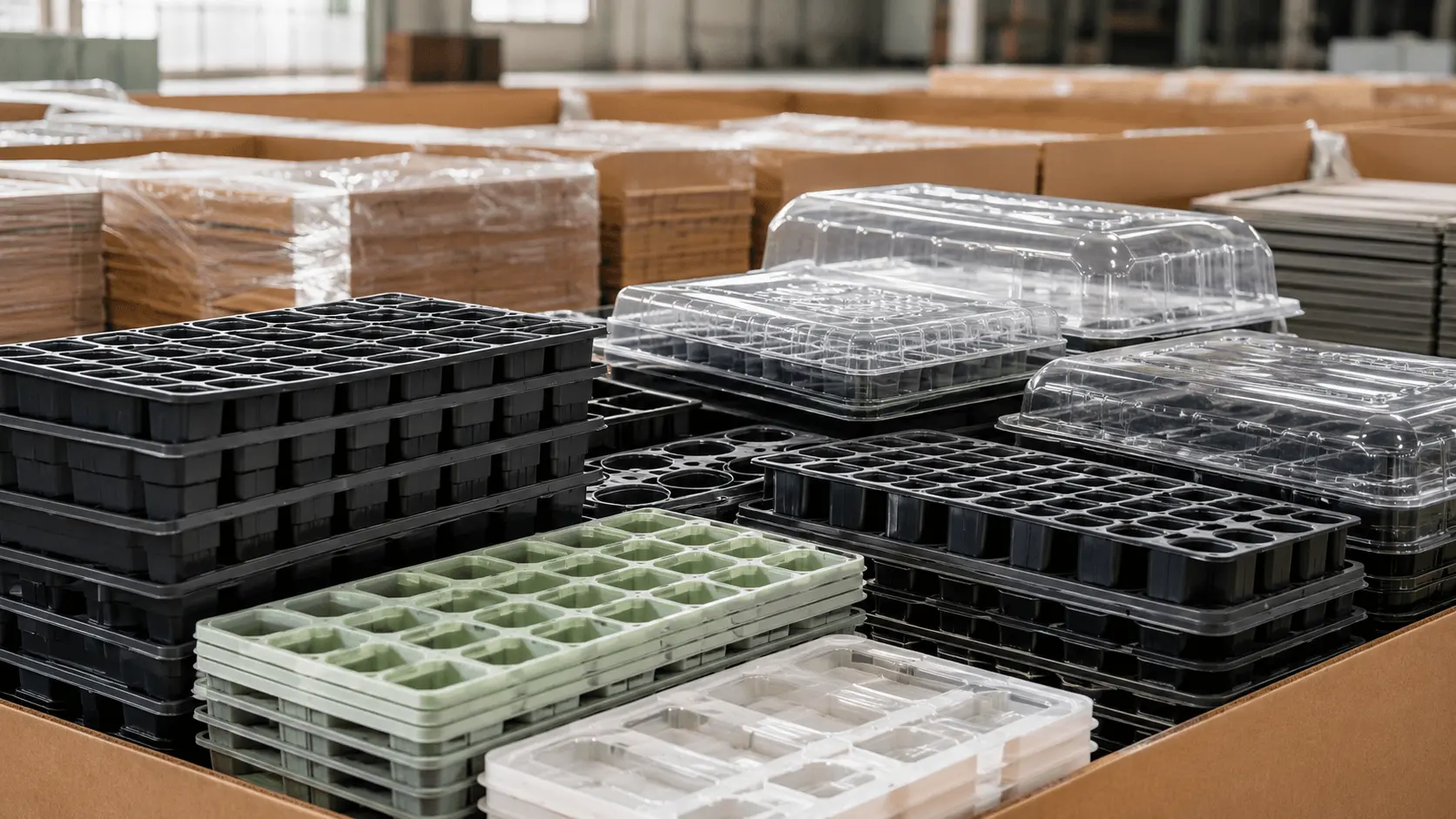
Picture this: spring seeding season is over. Your 128-cell trays did their job, the seedlings are transplanted, and those tall humidity domes — the 7 cm ones you ordered in bulk — are sitting in your warehouse with no immediate use. Summer calls for 72-cell trays and low domes for cuttings, but you already committed your budget to the spring lineup. Now you’re carrying dead stock that eats up shelf space and ties up cash until next spring — if it even survives UV degradation by then.
This is the inventory trap that single-SKU purchasing creates in the nursery supply business. And it’s more common than most buyers admit.
In this article, we walk through why ordering trays, inserts, and domes as separate SKUs leads to excess inventory, how mixed packing — bundling these items into functional sets — reduces that risk, and what it takes on the supply side to actually deliver mixed packing orders.
Why Single-SKU Purchasing Creates Dead Stock
Most nursery supply buyers order trays, inserts, and domes from separate product listings. Each item has its own MOQ, its own carton count, its own shipping calculation. That feels normal — it’s how most suppliers structure their catalogs.
But here’s the problem: trays, inserts, and domes are not independent products. They function together. A tray holds the growing medium. A dome controls humidity during germination. An insert supports root development for cuttings. When you buy them separately, you’re managing three independent inventory risks instead of one coordinated one.
Seasonal demand shifts make this worse.
Nursery operations follow a clear seasonal cycle:
- Spring (February–April): Peak seeding. Demand concentrates on high-cell-count trays (128, 200, 288 cells) paired with tall domes (7–10 cm) for seed germination.
- Summer (May–July): Cutting and transplanting season. Demand shifts to lower-cell-count trays (72, 105 cells) with short domes (3–5 cm) and inserts for propagation.
- Fall (August–October): Reduced activity. Some second-cycle seeding, but volumes drop.
- Winter (November–January): Minimal outdoor propagation. Only greenhouse operations maintain demand.
When the season changes, the SKU that was your top seller last month can become dead stock this month. That 7 cm dome you ordered 2,000 units of in March? By June, it’s occupying warehouse space with zero throughput — and PS plastic domes stored under fluorescent lights or near windows gradually lose flexibility due to UV degradation, based on industry experience.
The cost of carrying that dead stock is not just shelf space.
Inventory carrying costs include:
| Cost Component | What It Means for Nursery Supplies |
| Storage space | Trays nest efficiently, but domes do not — they occupy volume without stacking |
| Capital tied up | Low per-unit price, but high total value when you’re holding thousands of unused units |
| Product degradation | PS domes age under UV exposure; long storage reduces usability |
| Management overhead | Three separate SKUs mean three inventory records, three reorder points, three things to track |
A UK survey of online retailers found that 43% of DIY and gardening sellers reported excess inventory — and while that figure reflects the online retail channel rather than the full industry, the seasonal pressure pattern is consistent across North American nursery operations based on industry experience.
The core issue is this: when you buy three separate SKUs that function as one unit, you take on three separate inventory risks. If any one of those three items misses its seasonal window, you’re holding dead stock — while the other two might still be in active use.
If you’re sitting on seasonal excess right now, send us your product list and current inventory situation. We can help you figure out a mixed packing plan that aligns with your actual seasonal demand — instead of guessing at separate MOQs for each item.
What Mixed Packing Means for Nursery Supplies
Mixed packing is not a new concept in B2B supply chains. Kitting, set packing, combo packs, and buyer’s consolidation are all established practices across industries. The idea is simple: instead of shipping and managing every product as an independent SKU, you bundle functionally related items into a single package unit.
In the nursery supply world, this means grouping trays, inserts, and domes into sets that match how growers actually use them.
Here’s what that looks like in practice.
The tray + dome combination is already standard in the industry. A 1020 flat tray paired with a clear humidity dome is one of the most common commercial propagation setups. Suppliers like YUBO offer tray + lid combinations (such as the YB-72S, a 72-cell tray with a matching dome), and most catalog listings present trays and domes as paired items.
But the full three-piece set — tray + insert + dome — is rarely sold as a single B2B package. Most suppliers list each component separately. Buyers select a tray, then scroll to find the matching dome, then check whether an insert exists for that tray configuration. The buyer does the matching work that the supplier could have done upfront.
This is where mixed packing creates real value: by turning a three-step purchasing process into a one-step decision.
Common nursery supply set combinations:
| Set Type | Components | Primary Use Season |
| Seed starter set | 128-cell tray + 7 cm dome | Spring seeding |
| Cutting propagation set | 72-cell tray + insert + 3–5 cm dome | Summer cuttings |
| General propagation set | 105-cell tray + 5 cm dome | Spring to early summer |
| Transplant support set | 32-cell tray + insert | Summer transplanting |
Each set is a functional unit. The buyer doesn’t need to figure out which dome height fits which tray, or whether a particular insert works with their tray model. The set is designed to work together — because the components were designed to work together.
How Set Packing Reduces Inventory Risk
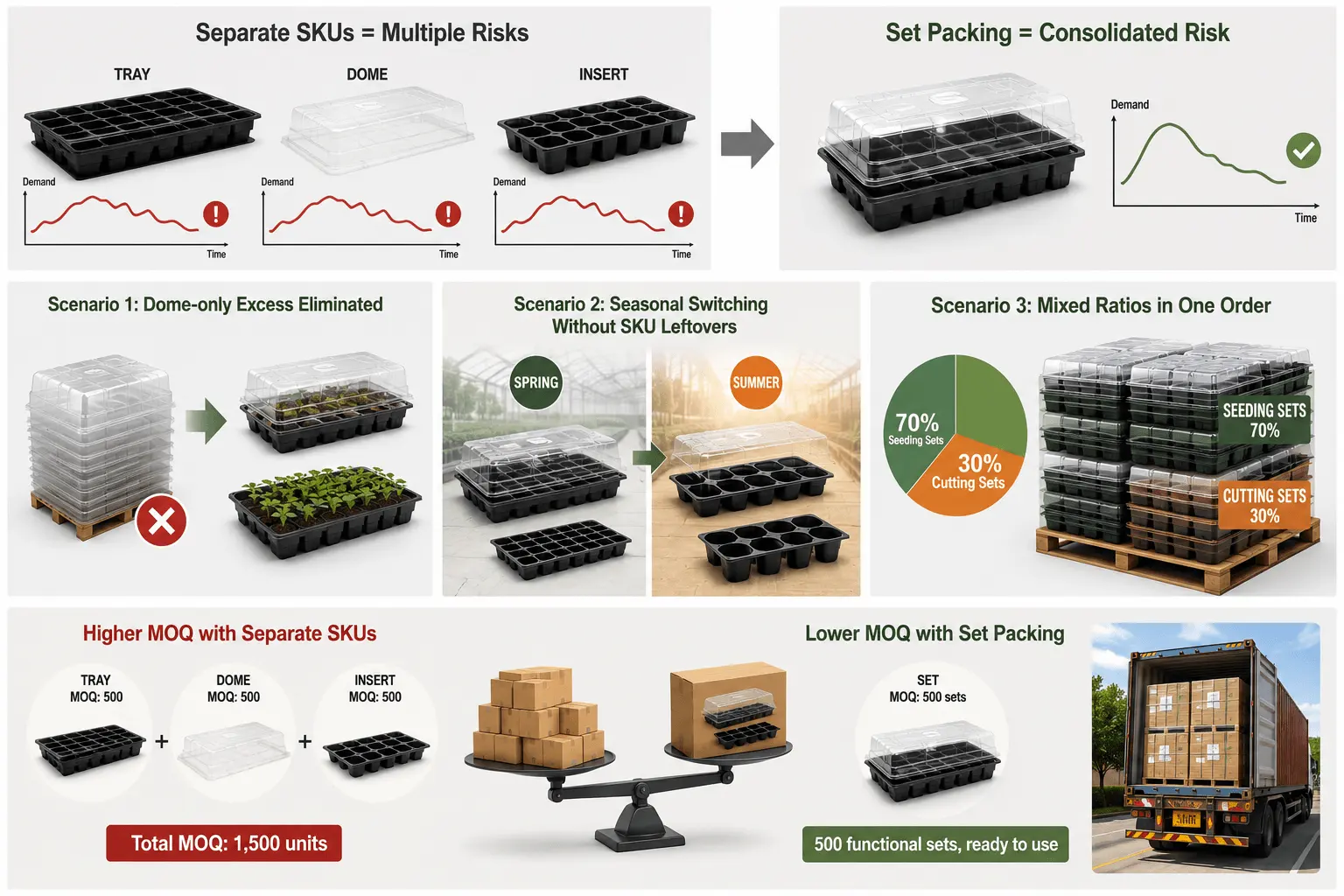
The core advantage of set packing is not about price. It’s about risk consolidation.
When you purchase three separate SKUs, you carry three independent demand risks. Each item has its own seasonal demand curve, its own reorder point, its own potential to become dead stock. If the dome demand drops but tray demand holds, you’re stuck with dome excess — even though the tray is still selling.
Set packing changes the math. Instead of three independent risks, you manage one combined risk: the set’s seasonal demand. Because trays and domes are used together, their demand is correlated. When tray demand drops, dome demand drops too. The risk doesn’t multiply — it consolidates.
Three practical scenarios where set packing prevents excess inventory:
Scenario 1: Dome-only excess eliminated. A nursery orders 1,000 sets of “128-cell tray + 7 cm dome” for spring seeding. After germination, the domes come off the trays — but they arrived as part of a set, not as a standalone bulk order. There’s no separate “dome inventory” bucket sitting in your system. The trays continue in use for seedling holding before transplanting. When the season ends, there are no orphaned dome units tied to a standalone SKU. The domes came with the trays, served their purpose, and the nursery orders a new set configuration for the next season — not more standalone domes.
Scenario 2: Seasonal switching without SKU leftovers. Spring: the nursery runs “128-cell tray + 7 cm dome” sets. Summer: they switch to “72-cell tray + insert + 3 cm dome” sets. Each set is a complete functional unit for its season. No leftover 128-cell trays sitting idle while 72-cell trays are in active use. No tall domes taking up shelf space during cutting season. The set defines the season’s inventory, and when the season ends, the set ends.
Scenario 3: Mixed ratios in a single order. A nursery knows their spring demand is 70% seeding sets and 30% cutting sets. Instead of placing two separate orders with two separate MOQs, they order one mixed packing shipment: 700 seeding sets + 300 cutting sets, packed and shipped together. One order, one shipment, one inventory intake — with the right ratio built in from the start.
Set packing also lowers the MOQ threshold.
Separate purchasing means: tray MOQ (e.g., 500 units) + dome MOQ (e.g., 500 units) + insert MOQ (e.g., 500 units) = a minimum commitment of 1,500 individual units before you can even start. MOQs vary by supplier and product type; the figures above are illustrative.
Set packing means: one set MOQ (e.g., 500 sets) = 500 functional units, each containing the right tray, dome, and insert. The threshold is lower because the unit of purchase matches the unit of use.
For smaller nurseries or first-time importers, this difference is significant. You don’t need to commit to a thousand of each component to get started — you commit to a manageable number of complete, ready-to-use sets.
Want to see how a mixed packing order works in practice? Tell us your seasonal demand pattern — which tray configurations you use in spring vs. summer, and your typical volumes — and we’ll build a sample combo plan that shows you the set breakdown, carton count, and estimated landed cost.
CBM and Shipping: Does Mixed Packing Save Space?
Imagine you’ve just received a shipment of 1,000 trays and 1,000 domes, packed separately. Your warehouse team is breaking down 30+ cartons across two SKU batches — tray cartons on one pallet, dome cartons on another, and your receiving log shows two separate entries for what is functionally one product. Now picture the same 1,000 sets arriving in roughly 10–13 cartons, each containing nested trays with their matching domes packed inside the tray cavities. One pallet, one receiving entry, one inventory line.
The short answer: usually yes, set packing saves CBM — but the savings depend on dome height and how deeply items nest.
Here’s the logic.
When trays, inserts, and domes are packed separately, each component gets its own carton series. Trays nest efficiently inside each other — a stack of nested trays occupies far less volume than the same number of trays packed flat. But domes cannot nest the same way. They can be inverted and stacked, but the height of each dome still adds to the carton’s vertical dimension. Inserts are thin and can be layered between nested trays, adding minimal volume.
When you pack a set — tray + dome + insert — in the same carton, the dome and insert can utilize the interior space of the nested trays. A dome that’s shorter than the tray’s internal depth can sit inside the tray cavity. An insert can slide between two nested trays. The result: the set carton’s CBM is close to the nested-tray-only CBM, because the dome and insert are filling space that would otherwise be empty.
Illustrative CBM comparison for 1,000 sets (128-cell tray + 7 cm dome):
| Packing Method | Estimated Cartons | Estimated Total CBM | Notes |
| Separate packing | Approximately 10–13 tray cartons + approximately 20–25 dome cartons | Approximately 1.9–2.4 CBM | Trays nest efficiently (80–100/carton); domes cannot nest and require their own cartons; dome count depends on stacking method |
| Set packing (tray + dome in same carton) | Approximately 10–13 cartons | Approximately 0.85–1.1 CBM | Domes fill tray interior space; cartons slightly taller than pure tray cartons; total CBM close to tray-only shipment |
Carton dimensions and CBM are illustrative; actual values depend on your specific product, thickness, dome height, and factory packaging standards. Tray carton count based on 128-cell tray at 80–100 units/carton (per C3-01 established data). Dome carton count estimated based on inverted stacking at approximately 40–50 units/carton.
Key variables that affect the CBM difference:
- Dome height vs. tray internal depth: If the dome is shorter than the tray cavity, it fits inside — minimal CBM increase. If the dome is taller, it protrudes above the tray stack, increasing carton height.
- Insert thickness: Inserts are thin enough to layer between nested trays with negligible volume impact.
- Carton configuration: Set packing may require slightly taller or wider cartons to accommodate the dome, but the total carton count is typically lower than separate packing.
The CBM savings from set packing are not dramatic — you’re not cutting your shipping volume by half. But the savings are real, and they compound with the inventory management benefits. Fewer cartons to receive, fewer SKU labels to track, fewer warehouse locations to manage. These are not theoretical savings — they show up in your warehouse receiving log and your freight invoice.
Before you decide on set packing vs. separate packing, here are the questions worth asking:
Does your dome fit inside the tray cavity, or will it sit above the stack? Can inserts layer between nested trays without pushing up the carton height? Do you need different set configurations for spring vs. summer, or can one set type cover your full season? Can your warehouse team handle fewer, larger cartons instead of multiple small SKU batches? If domes will be stored long-term, are they kept away from direct light and UV sources?
For a comprehensive breakdown on volumetric weight vs actual weight in container loading, check our [Nursery Tray Packaging Guide: Carton Quantity, CBM, Weight and Pallet Loading].
These are the practical questions that determine whether set packing works for your specific operation. The concept is straightforward; the execution depends on your product specs and warehouse setup.
Why Warehouse Repacking Makes Mixed Packing Possible
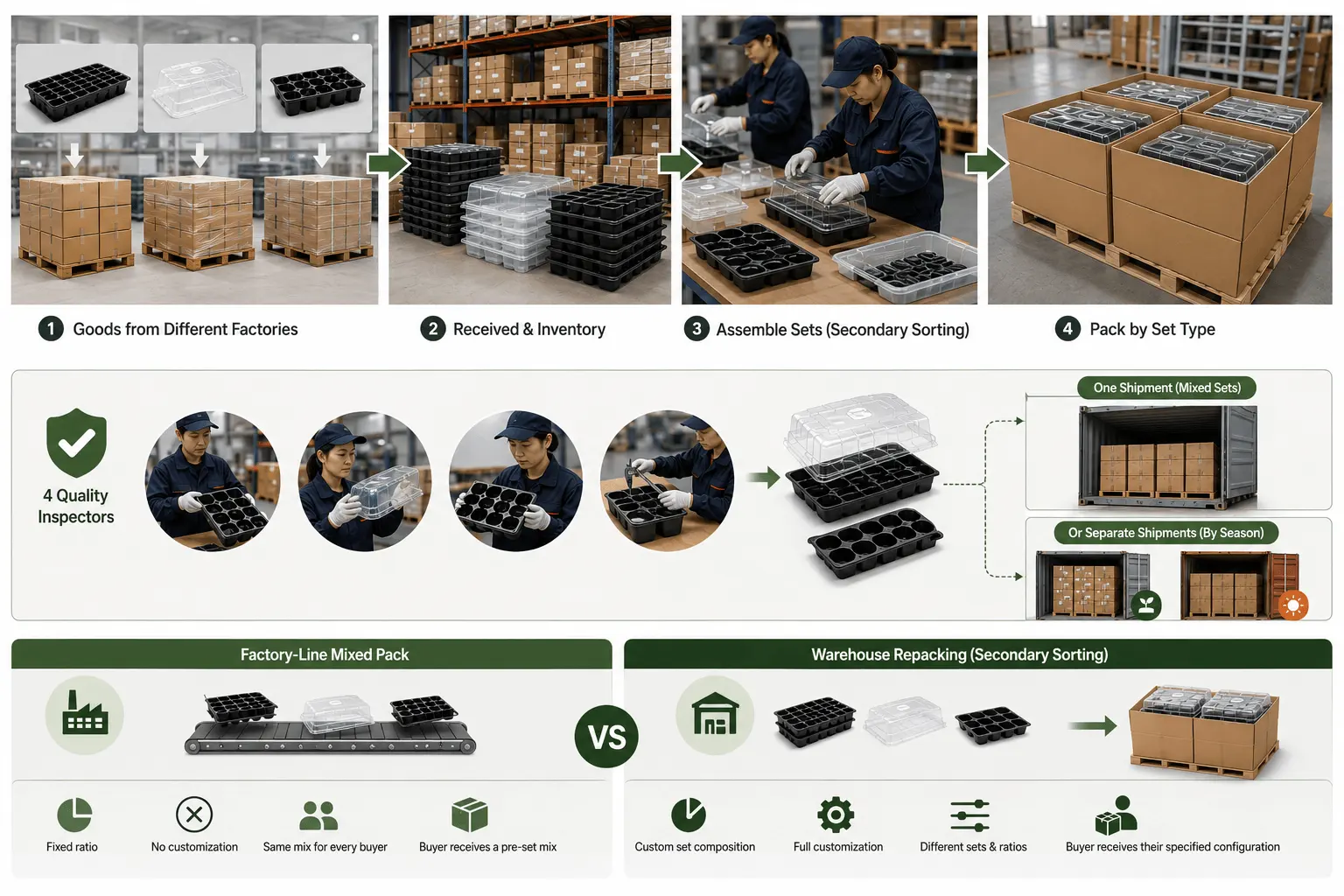
Mixed packing sounds good on paper. But here’s the practical question: who actually puts the tray, dome, and insert into the same carton?
Most factory production lines run one product at a time. A tray machine makes trays. A thermoforming line makes domes. They come off different lines, go into different cartons, and ship as different SKUs. That’s how most buyers receive their orders — three separate shipments, three separate inventory entries, three things to match up in your warehouse. The factory can do a mixed pack on the line — but that means stopping the run, changing the packing sequence, and producing a fixed mix ratio that can’t be adjusted for different buyers.
This is where warehouse repacking — secondary sorting — becomes the enabling step.
At our warehouse in Nanjing, we receive products from different factories as standard single-SKU cartons. When a buyer orders a mixed packing configuration — say, 500 seeding sets + 300 cutting sets, with specific tray models, dome heights, and insert types — our team pulls the right components from inventory, assembles them into sets, and packs them into cartons organized by set type.
Our four quality inspectors check each component against your approved reference sample before it goes into a set carton. This is not a separate inspection step — it’s built into the repacking process. When goods arrive from different suppliers, we receive them, verify them, and then organize them into the configuration you specified.
What this means in practice:
You specify your set composition. We build it. You don’t need to find a factory that runs a custom mixed-pack production line. You don’t need to accept a fixed mix ratio that doesn’t match your seasonal demand. You tell us what you need for spring, what you need for summer, and we organize the warehouse work to deliver both in one shipment — or in separate shipments timed to your season.
Factory-line mixed packing vs. warehouse repacking:
| Dimension | Factory-Line Mixed Pack | Warehouse Repacking |
| Flexibility | Fixed ratio, no customization | Custom set composition per order |
| Setup cost | Low (line change only) | Moderate (picking, sorting, repacking labor) |
| Customization | None — same mix for every buyer | Full — different sets, ratios, and packaging per buyer |
| Lead time | Faster (one production run) | Slightly longer (repacking after goods arrive) |
| Buyer experience | Buyer receives a pre-set mix | Buyer receives their specified configuration |
Most pure factory-type suppliers don’t offer warehouse repacking. They ship what the line produces. If you want a custom mix, you order the SKUs separately and do the combining yourself — which means receiving three shipments, breaking down three sets of cartons, and assembling sets in your own warehouse.
In practice, this means you don’t need to become a repacking operation yourself. You tell us what spring looks like for your nursery, what summer looks like, and we organize the work around your calendar — not the factory’s production schedule.
We handle that step for you. It’s not a complicated operation, but it’s one that requires a warehouse team, a quality check at the repacking stage, and the willingness to organize work around the buyer’s specific set configuration rather than the factory’s production schedule.
To ensure thin plastic domes aren't crushed during repackaging or transport, follow the strategies in [How to Reduce Shipping Damage to Clear Humidity Domes and Plastic Nursery Trays].
This is what makes mixed packing a deliverable service instead of a theoretical concept.
Next Step: Review Your Nursery Supply Sourcing Plan
If you’re currently ordering trays, inserts, and domes as separate SKUs — managing three inventory cycles, tracking three seasonal demand curves, and carrying three types of excess risk — mixed packing offers a simpler approach. You define the sets you need by season, and we organize the sourcing, verification, repacking, and shipping.
Three things you can do right now:
Send us your product list and seasonal demand pattern. Tell us which tray configurations you use in spring vs. summer, your typical volumes per season, and how you currently handle dome and insert purchasing. We’ll review your current approach and identify where set packing can reduce your inventory risk.
Request a mixed packing sample plan. We’ll build a set breakdown for your seasonal needs — showing you the set composition, estimated carton count, and estimated CBM per set type. This gives you a concrete comparison against your current separate-SKU ordering approach.
Compare your current separate-SKU order history against a set-based approach. Send us your last year’s purchasing records — which trays, domes, and inserts you bought separately, in what quantities, and when. We’ll map out where set packing could have cut your excess inventory, and show you the set breakdown, carton count, and estimated CBM for a mixed packing alternative.
You focus on selling and growing. Scarecrow Garden Supplier can help you source, verify, organize, and ship — in sets that match how you actually work.