







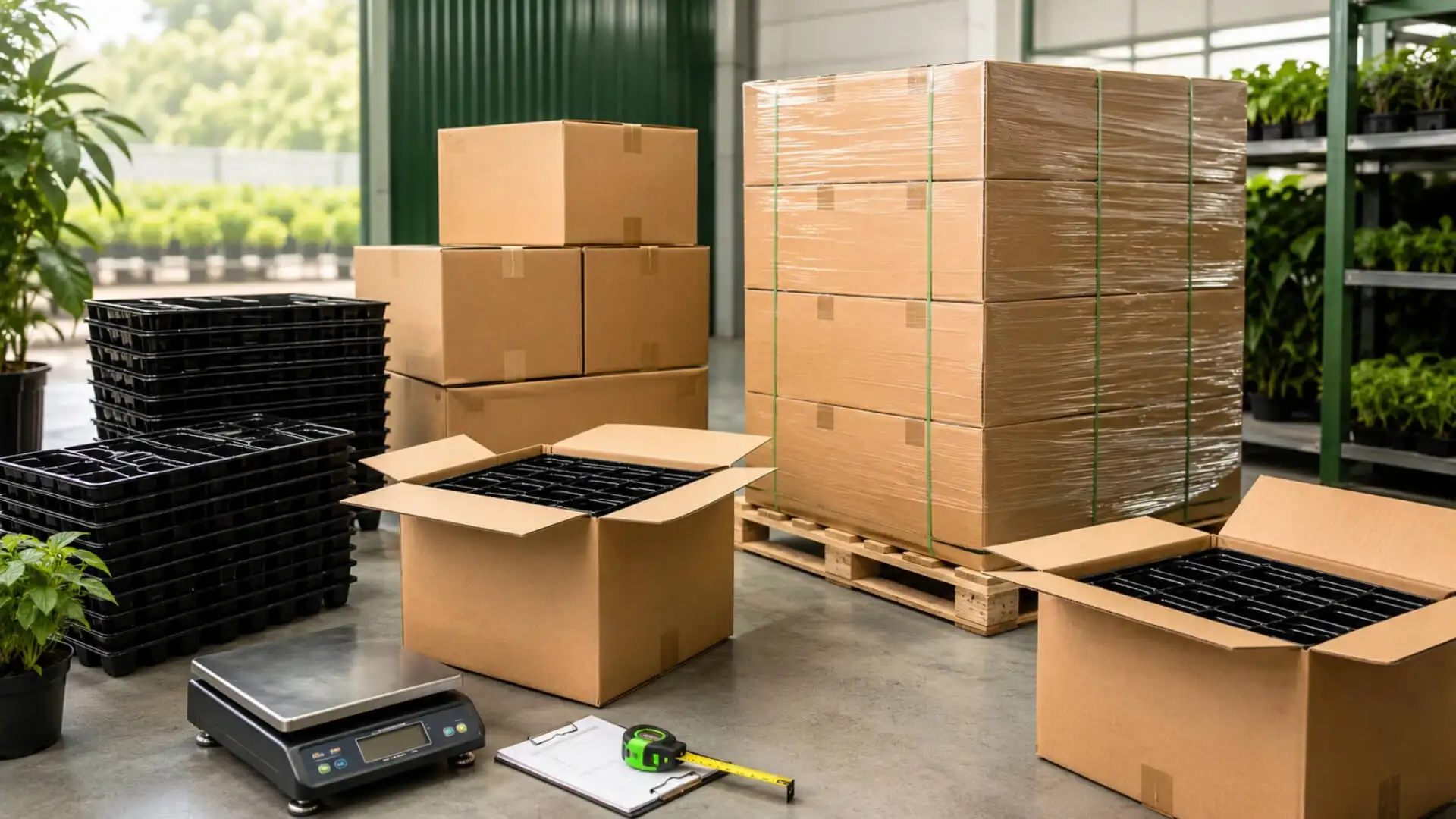
Nursery Tray Packaging & Shipping Guide: Carton Size, CBM & Pallet Rules | Scarecrow Garden Supplier
You request a quote for 5,000 nursery trays. The supplier replies with a number — “100-200 pcs/carton.” That range tells you something, but not enough. How many cartons does 5,000 trays actually produce? What does the packed carton measure? And how does nesting change the math?
If you have ever tried to calculate shipping cost from a quote that says “100-200 pcs/carton,” you know the frustration. The number depends on tray thickness, cell count, and how tightly the trays nest inside each other. Two orders of the same quantity can produce very different CBM totals — and very different freight bills.
This guide walks through the packaging details that matter when you source nursery trays in bulk: carton quantity, CBM calculation, weight terminology, pallet loading, and ISPM 15 compliance. These are the numbers your logistics team needs before you book freight.
How Many Nursery Trays Fit in One Carton
There is no single answer that covers every order. to “how many trays per carton.” The number depends on two things: tray thickness and cell depth.
A thin 200-cell tray at 0.4-0.5 mm might pack 200 pieces into one carton. A thick 128-cell tray at 1.0-1.2 mm? That same carton holds roughly 80-100 pieces. The trays are the same footprint — 540 × 280 mm is the industry-standard dimension for most plug trays — but the thicker walls and deeper cells take up more vertical space when nested.
Here is what that looks like in practice. When you order 128-cell trays at 1.0 mm thickness, each tray stands about 4-5 cm tall on its own. But when you nest them — slide one tray into the next — the stack compresses. Each additional tray adds only about 0.5-1 cm of height. That nesting compression is what makes 100 trays fit into a carton roughly 45-55 cm tall. Without nesting, the same 100 trays would need a carton over 4 meters high.
Typical carton quantity ranges (based on industry experience):
| Cell Count | Common Thickness (mm) | Typical PCS/Carton | Why This Range |
| 32-cell | 0.5-0.8 | 150-200 | Shallow cells, thin walls — more fit per carton |
| 50-cell | 0.5-1.0 | 100-200 | Wide range because thickness varies significantly |
| 72-cell | 0.6-1.0 | 100-150 | Moderate depth, moderate thickness |
| 105-cell | 0.6-1.0 | 100-150 | Similar to 72-cell in nesting behavior |
| 128-cell | 0.7-1.2 | 80-100 | Deeper cells and thicker walls — fewer per carton |
| 200-cell | 0.4-0.7 | 150-200 | Shallow cells, thin material — high pack density |
| 288-cell | 0.4-0.6 | ~200 | Very shallow, very thin — maximum nesting compression |
Note: These ranges are based on industry experience. Actual quantities depend on your specific product thickness, factory packaging standards, and carton dimensions. Always confirm packed carton details with your supplier before calculating freight.
The key takeaway: when a supplier quotes “100-200 pcs/carton,” they are giving you a range, not a commitment. You need to know which end of that range your specific order falls on. That changes everything downstream — carton count, CBM, pallet configuration, and freight cost.
How to Calculate CBM for Nursery Tray Shipments
CBM — cubic meters — is the volume measurement that determines your sea freight cost. For nursery trays, calculating CBM correctly means understanding one critical thing: nesting changes everything.
The CBM formula
The formula is straightforward:
CBM = Length (m) × Width (m) × Height (m)
Or, if you measure in centimeters:
CBM = Length (cm) × Width (cm) × Height (cm) ÷ 1,000,000
You apply this to each carton, then multiply by the total number of cartons.
Why nesting matters for CBM
Here is where nursery trays behave differently from most products. A single 128-cell tray measures roughly 54 × 28 × 4.5 cm. If you calculated CBM from that single tray, you would get 0.0068 CBM per tray — and 5,000 trays would appear to need 34 CBM, which barely fits in a 40’ HC container.
But that calculation is wrong. Because trays nest. One hundred nested 128-cell trays fit into a carton approximately 55 × 28 × 48 cm. That carton is roughly 0.074 CBM. Fifty such cartons for 5,000 trays total about 3.7 CBM — a fraction of a container.
The difference comes from nesting compression. Each additional tray in a nested stack adds only 0.5-1 cm of height, not the full 4-5 cm of a standalone tray. That compression turns what looks like a massive volume problem into something manageable.
Practical CBM calculation: a worked example
Let us walk through a real scenario. You order 5,000 128-cell trays at 1.0 mm thickness.
- Each carton holds 100 nested trays
- Packed carton dimensions (confirmed with supplier): approximately 55 × 28 × 48 cm
- Single carton CBM: 55 × 28 × 48 ÷ 1,000,000 = 0.074 CBM
- Total cartons needed: 5,000 ÷ 100 = 50 cartons
- Total shipment CBM: 50 × 0.074 = 3.7 CBM (illustrative; actual CBM depends on your specific product and packaging)
At this volume, your shipment fits easily into a 20’ GP container (approximately 33.2 CBM capacity) with plenty of room for other products. You might even ship it as LCL (less than container load) if the total order is small.
But this calculation only works if you use the packed carton dimensions — not the single tray dimensions. Many buyers make the mistake of multiplying single tray dimensions by order quantity. That overstates CBM by 5-10 times and leads to wildly inflated freight estimates.
Volumetric weight: when CBM matters more than actual weight
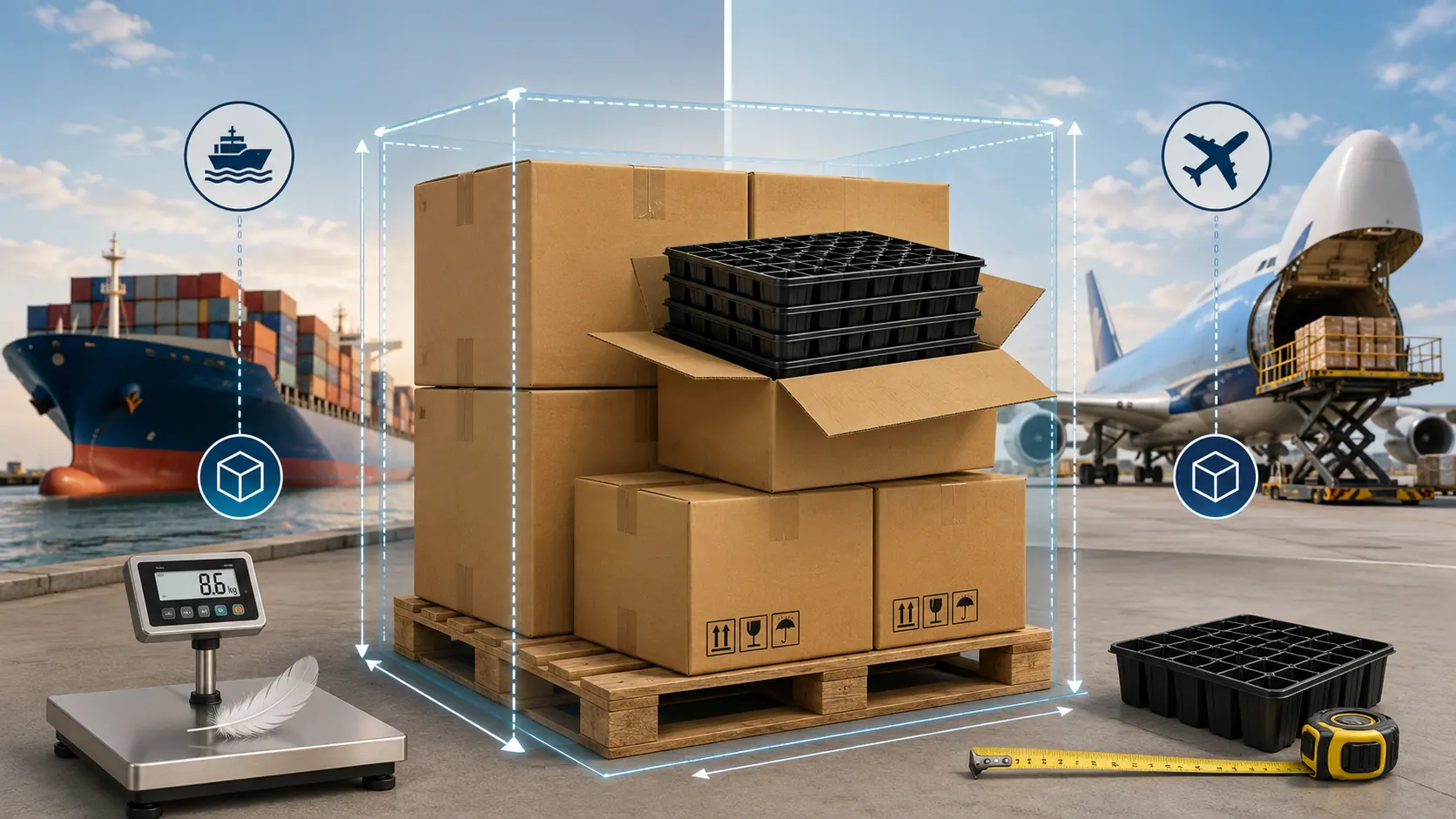
Nursery trays are light but bulky — what the logistics industry calls “light cargo” or “dimensional cargo.” Freight carriers handle this by comparing actual weight against volumetric weight:
- Sea freight: 1 CBM = 1,000 kg volumetric weight. Your 5,000-tray shipment (128-cell, 1.0 mm) has a gross weight of roughly 850-875 kg (50 cartons × ~17-17.5 kg each, using the upper end of the gross weight range), but its approximately 3.7 CBM translates to 3,700 kg volumetric weight. Freight is charged on the higher figure — in this case, volumetric weight dominates.
- Air freight: 1 CBM = 167 kg volumetric weight. The same approximately 3.7 CBM becomes roughly 617 kg volumetric weight. The gross weight of ~875 kg now exceeds volumetric weight — so air freight charges on actual gross weight. But at roughly 5-10 times the per-kilogram rate of sea freight, the total air freight cost is still significantly higher.
This is why nursery trays almost always cost less per unit by sea than by air. The volumetric weight penalty hits air freight much harder.
Net Weight, Gross Weight, Shipping Weight — Why the Difference Matters
Three weight terms appear on shipping documents, and confusing them causes real problems: incorrect customs declarations, wrong freight calculations, and compliance issues at destination.
Beyond general pallet protection, learn specific structural packing methods in our guide on [How to Reduce Shipping Damage to Clear Humidity Domes and Plastic Nursery Trays].
The three weight definitions
Net weight is the product itself — just the trays, no packaging. A single 128-cell PS tray weighs approximately 80-155 g (±5 g, based on industry experience — the range reflects different thicknesses from 0.4 mm to 1.2 mm). Net weight is what you use for customs value calculations and product cost.
Gross weight is net weight plus carton packaging. For a carton of 100 trays at ~155 g each, net weight is about 15.5 kg. The corrugated export carton adds roughly 1-2 kg, bringing gross weight to approximately 16.5-17.5 kg per carton.
Shipping weight (sometimes called transport weight) is gross weight plus pallet weight, if you palletize. A standard wooden pallet weighs approximately 15-25 kg; a plastic pallet weighs approximately 8-15 kg. If you load 20 cartons on one wooden pallet, your shipping weight for that pallet is roughly 20 × 17 kg + 20 kg = 360 kg.
Where confusion causes trouble
The most common mistake: using net weight where gross or shipping weight is required. Freight carriers charge on gross weight (or volumetric weight, whichever is higher). Customs declarations require gross weight. If you declare net weight on a customs form, the discrepancy can trigger inspection delays or penalties.
Another trap: mixing empty tray weight with planted tray weight. A 128-cell tray weighs ~155 g empty. Once filled with growing media and a seedling, that same tray can weigh 500-800 g or more. Those planted weights belong in a completely different context — greenhouse logistics, not freight calculations. Never use planted tray weights to calculate shipping cost.
Quick reference: weight at each level (128-cell 1.0mm PS tray, based on industry experience):
| Level | What It Includes | Typical Range |
| Single tray (net) | Just the tray | ~80-155 g (±5 g) |
| Carton (gross) | 100 trays + carton | ~16.5-17.5 kg |
| Pallet (shipping) | 20 cartons + pallet | ~340-360 kg (wooden pallet) |
Note: All values are approximate and based on industry experience. Actual weights depend on your specific product, factory packaging, and pallet type.
Pallet Loading: Which Pallet Size and How Many Per Container
Palletizing your nursery tray shipment makes loading and unloading faster, reduces handling damage, and simplifies warehouse receiving. But pallet size determines how many fit in a container — and that determines your per-unit freight cost.
Standard pallet sizes
If you have ever stood in a warehouse wondering why your US-bound shipment arrived on Euro pallets, you understand why this matters — the wrong format creates problems at every step downstream. Three pallet formats dominate international trade:
| Pallet Type | Dimensions | Primary Market | Typical Weight |
| GMA / US Standard | 48“ × 40” (1.219 × 1.016 m) | United States | Wood: 15-25 kg; Plastic: 8-15 kg |
| EUR / Euro | 1.2 × 0.8 m | Europe | Wood: ~20-25 kg |
| Commonly used by some Chinese exporters | 1.1 × 1.1 m or 1.2 × 1.0 m | China-origin shipments | Wood: 15-25 kg |
If your end market is the US, the GMA pallet (48“ × 40”) is the standard your warehouse and retail partners expect. European buyers work with EUR pallets. Choosing the wrong pallet format creates problems downstream — your buyer’s warehouse may not be set up to handle non-standard sizes.
How many pallets fit in a container
The number of pallets per container depends on pallet dimensions and stacking height. Here are typical configurations for a 40’ HC container (internal dimensions approximately 12.032 × 2.350 × 2.70 m, capacity approximately 76 CBM):
- GMA pallets (1.219 × 1.016 m): approximately 21 pallets per 40’ HC, stacked 4-5 carton layers high
- EUR pallets (1.2 × 0.8 m): approximately 25 pallets per 40’ HC, stacked 4-5 layers high
- China export pallets (1.2 × 1.0 m): approximately 22-24 pallets per 40’ HC
These numbers assume pallets are loaded lengthwise along the container and stacked to a height that leaves clearance for the container door area. The point is not to memorize these figures — it is to confirm the right pallet format before your supplier loads the container.
Real-world pallet loading: Shuttle Tray data
If you want to see what this looks like with real product, actual loading data from carry tray shipments gives you a sense of what palletized nursery products look like in practice:
Actual loading data from carry tray shipments gives you a sense of what palletized nursery products look like in practice:
- A 4.33“ flower pot carry tray (10-hole shuttle tray) packs approximately 4,400 pieces per pallet. A 40’ HC loaded with 21 pallets carries roughly 92,400 pieces.
- A 6-hole shuttle tray (ST150-6) packs approximately 3,440 pieces per pallet. A 40’ HC loaded with 25 pallets carries roughly 86,000 pieces.
These are real shipment figures, not theoretical calculations. They show that pallet format and product size directly determine total shipment volume. Your nursery trays will follow similar logic — but with different numbers specific to your tray dimensions and nesting depth.
Palletized vs. non-palletized: what to consider
Palletizing adds approximately 10-15% to shipment volume (the pallet itself occupies space that could hold cartons). But it also:
- Enables forklift loading and unloading — faster at both origin and destination
- Reduces carton damage from manual handling
- Simplifies inventory receiving at your warehouse
For LCL shipments (less than container load), non-palletized cartons can save volume. For FCL shipments (full container load), palletizing is typically the better choice because the container has enough volume capacity, and the handling benefits outweigh the small volume cost.
ISPM 15 Compliance for Wood Packaging — What Buyers Need to Know
If your shipment uses wooden pallets, crate materials, or dunnage, ISPM 15 compliance is not optional. It is a legal requirement for entry into the US, the EU, and most other major markets.
What ISPM 15 covers
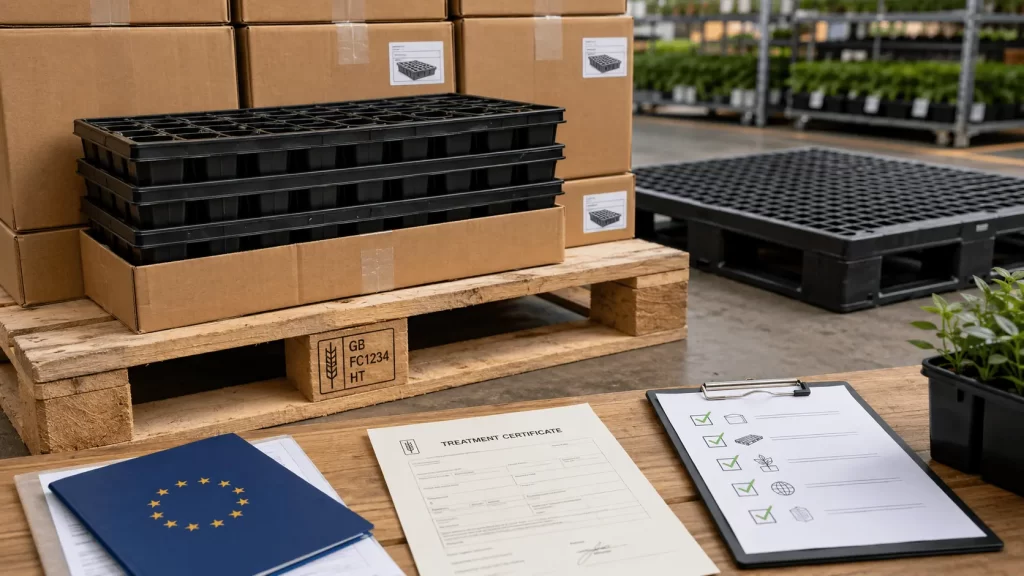
ISPM 15 (International Standards for Phytosanitary Measures No. 15) applies to all solid wood packaging material in international trade — wooden pallets, skids, crates, box sides, and dunnage. The standard exists to prevent the spread of wood-borne pests and diseases across borders.
What must be treated
Any solid wood component thicker than 6 mm must be treated and marked. Two approved treatment methods exist:
- Heat Treatment (HT): The wood core must reach at least 56°C for a minimum of 30 continuous minutes
- Methyl Bromide Fumigation (MB): The wood is fumigated in an enclosed space under specific dosage and time parameters (note: many countries are phasing out MB due to environmental concerns)
After treatment, each pallet or wood component must carry an IPPC mark — a stamp that proves compliance. The mark includes:
- The IPPC symbol (a stylized ear of wheat)
- Country code (e.g., “CN” for China, “US” for United States)
- The treatment provider’s registration number
- The treatment method code (“HT” or “MB”)
Example: [IPPC symbol] CN-12345 HT
This mark must be visible, legible, and permanent. A pallet without a valid IPPC mark may be refused entry.
What does NOT need ISPM 15 compliance
Several packaging materials are exempt:
- Plastic pallets — no wood content, no ISPM 15 requirement
- Plywood, OSB (oriented strand board), and particle board — these are manufactured under high temperature and pressure, which destroys pests. They are considered “processed wood” and exempt from ISPM 15
- Wood thinner than 6 mm — not regulated under ISPM 15
For nursery tray shipments, this means: if you choose plastic pallets, ISPM 15 is irrelevant. If you use wooden pallets, every pallet must carry a valid IPPC mark. If you use plywood-based pallets or crate materials, they are exempt — but confirm with your supplier that the material qualifies.
US enforcement: strict and mandatory
Since September 16, 2005, the US has enforced ISPM 15 on all imported wood packaging. APHIS (Animal and Plant Health Inspection Service) will refuse entry to any shipment with non-compliant wood packaging. The importer bears all costs for re-export or destruction.
This is not a theoretical risk. Non-compliant pallets get stopped regularly. The cost of returning a container because of an unmarked pallet far exceeds the cost of using compliant pallets from the start.
Canada maintains a separate arrangement for wood packaging imports — confirm requirements with your customs broker if shipping to Canadian destinations.
2026 EU PPWR: an additional layer
The EU is advancing the Packaging and Packaging Waste Regulation (PPWR), which adds environmental requirements on top of ISPM 15 phytosanitary rules. PPWR targets packaging sustainability — recyclability, reuse targets, and reduced packaging waste. For wooden pallets, this may mean:
- Documentation requirements beyond ISPM 15 marks
- Potential restrictions on certain wood treatments
- Reporting obligations for packaging materials
If your end market includes the EU, track PPWR implementation alongside ISPM 15. These requirements are still being finalized as of 2026 — confirm current obligations with your customs broker before shipping. Your supplier should provide both phytosanitary compliance documentation and packaging sustainability declarations.
Practical compliance checklist
When sourcing nursery trays with wooden pallets, confirm these points with your supplier:
- Every wooden pallet carries a valid, legible IPPC mark
- The mark includes correct country code, registration number, and treatment code (HT or MB)
- Your supplier can provide treatment certification documentation
- If shipping to the EU, your supplier is aware of PPWR requirements and can provide necessary declarations
- Consider switching to plastic pallets if ISPM 15 compliance adds complexity to your supply chain
How Packaging Choices Affect Your Freight Cost
Packaging decisions made at the factory — carton size, nesting depth, pallet format — determine your freight cost before the shipment ever leaves the port. Understanding these connections helps you make choices that reduce per-unit landed cost.
Nesting depth changes CBM, and CBM changes freight
Imagine two buyers each ordering 5,000 trays of the same cell count. One chooses 0.6 mm trays, the other 1.0 mm. The thinner trays nest tighter, and the total CBM difference can shift the shipment from LCL to FCL territory. The deeper trays nest, the shorter each carton, and the lower your total CBM. Two orders of identical quantity can have different CBM totals if the trays nest at different depths. Thinner trays nest more tightly (each additional tray adds roughly 0.5 cm). Thicker trays nest less tightly (each additional tray adds roughly 0.8-1 cm).
For a 5,000-tray order, this difference might shift your total CBM from 3.2 to 4.0 — enough to change your freight rate category or decide between LCL and FCL.
Carton dimensions: always confirm with the supplier
Factories may use different carton sizes for the same product. One factory packs 128-cell trays in a 55 × 28 × 48 cm carton; another uses 56 × 29 × 50 cm. The CBM difference per carton is small (0.074 vs. 0.081), but multiplied across 50 cartons, it shifts your total from 3.7 CBM to 4.05 CBM.
This is why you should always ask your supplier for packed carton dimensions — not product dimensions. Packed dimensions reflect the actual nesting configuration and carton size your factory uses. Product dimensions alone tell you nothing about shipping volume.
Mixed product shipments: CBM gets more complex
When you order multiple tray types — say, 2,000 72-cell trays and 3,000 128-cell trays — each product type packs into its own carton configuration. Different carton sizes mean different per-carton CBM values. You calculate total CBM by adding each product type’s volume separately.
Mixed orders also create pallet configuration challenges. Different carton sizes may not stack neatly on the same pallet. This is where your logistics team earns their keep — planning pallet layouts for mixed carton sizes is part puzzle, part Tetris.
Palletized shipments: the volume trade-off
Palletizing adds volume (the pallet itself occupies roughly 10-15% more space than loose cartons stacked directly in the container). But palletized shipments often result in lower total freight cost per unit because:
- Faster loading and unloading reduces port handling charges
- Reduced damage means fewer replacement shipments
- Warehouse receiving is faster, reducing labor cost at destination
For most nursery tray shipments going FCL, palletizing is the practical default. The small volume cost is offset by handling efficiency and damage reduction.
These are not theoretical concerns — they show up on your freight invoice.
Next Step: Confirm Your Packaging Details Before You Book Freight
If you need help translating these physical dimensions into accurate final landed estimates, read our article on [How to Calculate the Landed Cost Really Means (and Why It Matters)].
Before you finalize any nursery tray order, confirm these packaging details with your supplier:
- Packed carton dimensions (length × width × height in cm) for your specific tray type and thickness
- PCS per carton for your specific order configuration
- Gross weight per carton (not net weight — your freight carrier needs gross)
- Pallet format (GMA, EUR, or other) and pallet loading layout
- ISPM 15 compliance status if using wooden pallets — IPPC mark present and valid?
These five data points let you calculate CBM accurately, choose the right container type, and book freight with confidence. Without them, you are estimating — and estimates often miss.
Three things you can do right now:
- Get a packaging specification sheet — Send your product list (cell count, thickness, quantity) and ask for confirmed packed carton dimensions and gross weight per carton. This is the foundation for all freight calculations.
- Get a CBM comparison table — Compare shipping volume across different cell counts and thicknesses for your order quantity. See how nesting depth changes your total CBM before you commit to an order mix.
- Get nursery tray samples — Measure actual nesting depth and confirm dimensions yourself. A sample lets you verify that the supplier’s quoted dimensions match the physical product — and that nesting compression works as expected.
That is what Scarecrow Garden Supplier does — help you get the packaging details right so your trays arrive as expected, at the cost you planned for.
Get the Tray Packaging Details Right.
Your freight estimate is only reliable when the packed carton size, gross weight and actual nesting depth are confirmed.
Send Your Tray RequirementsInclude the cell count, thickness, quantity and destination.
Packaging Specification Sheet
Request confirmed packed carton dimensions and gross weight instead of calculating freight from tray dimensions alone.
CBM Comparison Table
Compare the shipping volume of different cell counts, thicknesses and order combinations before placing the order.
Nursery Tray Samples
Check the physical dimensions and measure the real nesting depth to verify the supplier’s packaging calculation.
We help you confirm the packaging details so your trays arrive as expected—at the cost you planned for.
Written by
ScarecrowGarden
💡About Scarecrow Garden Supplier Co., Ltd.
Scarecrow Garden Supplier Co., Ltd. is a China-based sourcing and wholesale partner specializing in garden tools, landscaping equipment, and outdoor supplies for international wholesalers, distributors, contractors, and brands.
With hands-on experience rooted in real garden use scenarios, we focus on durable materials, functional design, and stable large-volume supply. Our product range covers pruning tools, watering systems, hand tools, outdoor hardware, and customized garden solutions to support both retail and professional landscaping markets.
Beyond products, we help our partners navigate supplier selection, quality control, compliance requirements, and long-term sourcing strategies in China. Through our blog, we share practical insights on product selection, material comparisons, industry trends, and cost-effective purchasing—helping global buyers build stronger, more competitive supply chains.