










Air vs Sea Freight for Nursery Supplies: Cost & ROI Guide | Scarecrow Garden Supplier
You have probably heard the rule: sea freight is cheaper, air freight is faster. That is true. But when you are staring at a quote that says “$4,500 by air,$350 by sea” for the same 1,000 nursery trays, the question is not which one costs less. The question is: when does paying more actually make sense?
Because sometimes it does. If you need samples in your hands before committing to a 5,000-set order, waiting 30 days for sea freight is not a savings — it is a delay that costs you a season. If your spring inventory runs dry and your sea shipment is stuck at port, the “cheap” option becomes the expensive one when your shelves are empty during peak demand.
This article breaks down how each shipping method calculates your cost, why nursery trays behave differently from other cargo, and which scenarios justify the air freight premium. The answer is not always “go sea” — but for most bulk orders, it is.
How Sea Freight Works for Nursery Orders
Sea freight comes in two flavors: FCL (Full Container Load) and LCL (Less than Container Load).
FCL means you rent an entire container. The price is fixed per container, regardless of how full it is. A 20-foot container to North America runs approximately $2,000–$2,800 in 2026 rates (based on 2026 market conditions; actual rates vary by route, carrier, and season); a 40-foot high cube to the US, Canada, or Mexico runs approximately $2,500–$3,400. You pay the same whether you fill it to the brim or leave half empty.
LCL means your goods share space in a container with other shipments. You pay by CBM (cubic meter), typically $60–$280 per CBM depending on the route and season. LCL also uses a volumetric weight calculation: 1 CBM = 1,000 kg. If your shipment’s volumetric weight exceeds its actual weight, you pay based on the higher number.
To understand how carton stacking and CBM calculations direct these ocean freight costs, refer to our [Nursery Tray Packaging Guide: Carton Quantity, CBM, Weight and Pallet Loading].
The switch point: when your cargo reaches approximately 13–15 CBM, FCL becomes more cost-effective than LCL — based on industry experience; the exact switch point depends on current rates and your specific route. Below that, LCL is usually the better choice.
Here is what that looks like with a real order. Say you are shipping 1,000 sets of 128-cell nursery trays — roughly 3.7 CBM (illustrative; actual CBM depends on your specific product and packaging) and roughly 875 kg gross weight (using the upper end of the gross weight range for a 128-cell 1.0mm PS tray order). You are well below the FCL threshold, so this goes LCL.
The volumetric weight (3.7 × 1,000 = 3,700 kg) far exceeds the actual 875 kg. That means your shipment is charged by CBM, not by weight — and that is actually good news for you. Nursery trays are lightweight for the space they take up, but LCL rates are the same per CBM regardless of whether your cargo is dense or light. A shipment of steel brackets weighing 3,700 kg in the same 3.7 CBM would pay the same LCL rate as your 875 kg of trays.
At a mid-range LCL rate of approximately $100/CBM (illustrative; actual rates vary by route and season), the freight cost comes to roughly$370. That is the baseline. Now let’s see what air freight would charge for the same cargo.
How Air Freight Calculates Your Cost
Air freight does not charge by actual weight alone. It uses chargeable weight — the higher of your shipment’s actual gross weight and its volumetric weight.
This is where it gets real. The number on your air freight quote is not based on how much your cargo weighs. It is based on how much space it takes up relative to how much it weighs — and whichever metric produces a higher number wins.
The volumetric weight formula is set by IATA (the International Air Transport Association):
Volumetric Weight (kg) = Length × Width × Height (all in cm) ÷ 6,000
That divisor — 6,000 — is the industry standard. It means 1 CBM of cargo is treated as approximately 167 kg of volumetric weight for air freight pricing purposes. Compare that to sea freight’s 1 CBM = 1,000 kg, and you can see why the two modes treat the same shipment very differently.
Here is how that plays out with nursery trays.
For 1,000 sets of 128-cell trays packed in roughly 50 cartons (each approximately 56 × 28 × 40 cm):
- Total volumetric weight: 50 × (56 × 28 × 40 ÷ 6,000) ≈ 525 kg
- Actual gross weight: roughly 875 kg (using the upper end of the gross weight range for a 128-cell 1.0mm PS tray order)
- Chargeable weight = max(875, 525) = 875 kg
The actual weight wins. You pay by weight, not by volume. That sounds like a decent deal — until you see the per-kilogram rate.
In 2026, air freight from China to the US runs approximately $3.8–$9.5 per kg. The range is wide because rates depend on destination, cargo density, carrier availability, and fuel costs. Using a mid-range estimate of roughly $5–$6/kg (illustrative; actual rates fluctuate weekly), 875 kg of chargeable weight would cost approximately $4,375–$5,250.
That is 12–14 times the LCL sea freight cost for the same cargo.
And 2026 rates are higher than last year. Global air freight spot rates have risen significantly in 2026, with increases of approximately 30–50% on Asia-to-North America routes compared to the same period in 2025, driven by Middle East airspace closures, reduced capacity, and significantly increased jet fuel prices. The gap between air and sea freight costs has widened, not narrowed.
Why Nursery Trays Are Lightweight Cargo
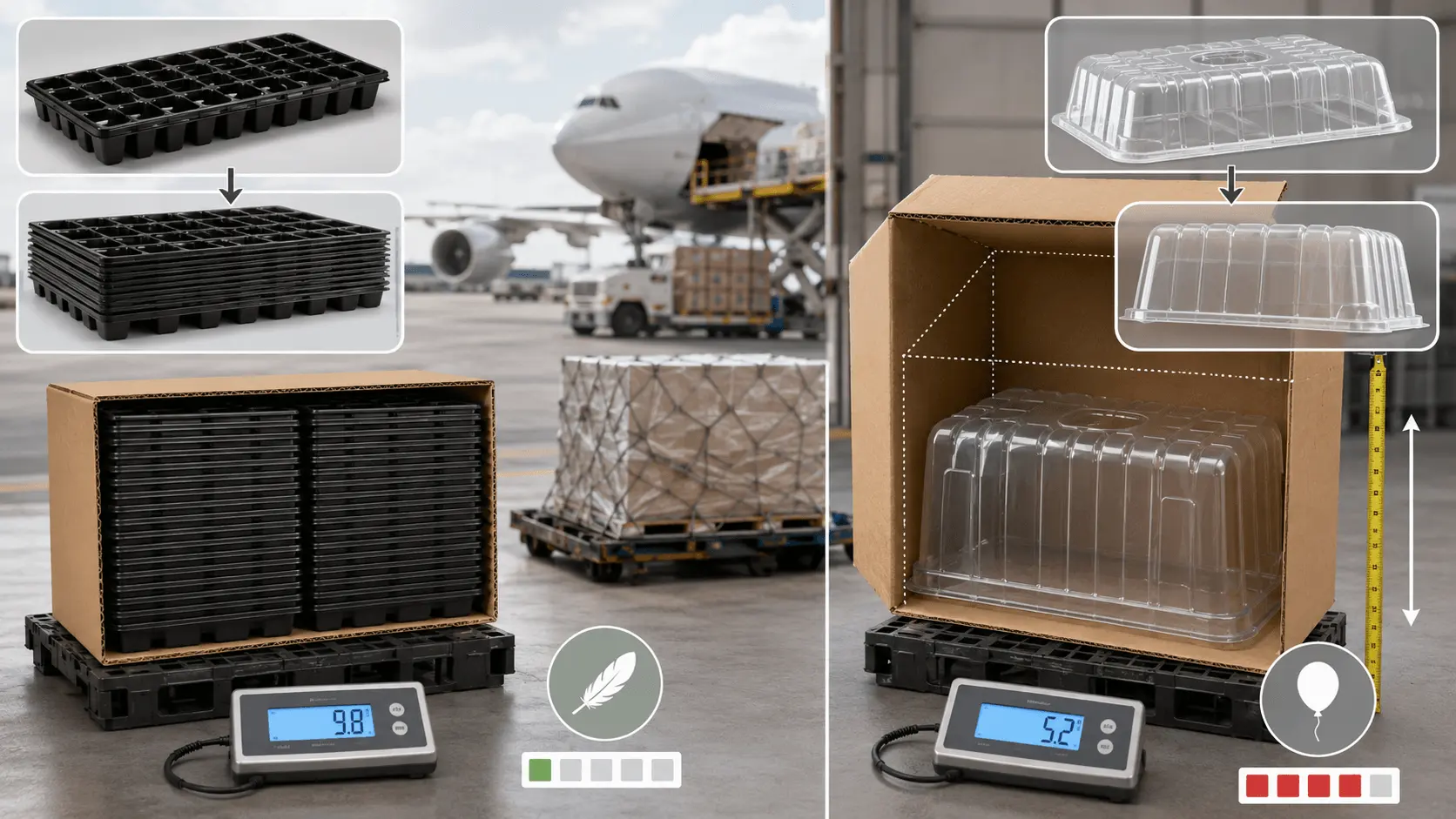
Nursery trays are what the shipping industry calls “lightweight cargo” — products that are light relative to the space they occupy. A single 128-cell PS tray weighs only 80–155 g (±5 g), but its footprint is 540 × 280 mm. Stack 100 of them in a carton and the carton is still relatively light for its size.
This matters because of how volumetric weight works. For air freight, the ÷6,000 divisor means that bulky, light products can end up with a volumetric weight higher than their actual weight — and you pay based on the higher number.
With standard nursery trays, the nesting effect helps. Trays stack into each other, compressing the total height. A carton of 100 nested trays is shorter than you might expect, which keeps the volumetric weight below the actual weight. You pay by actual weight — but at air freight rates, even that is expensive.
Humidity domes are different. Domes are tall and do not nest deeply. A carton of domes has a much larger volume relative to its weight. The volumetric weight often exceeds the actual weight, pushing the chargeable weight up. If you are shipping a mixed order of trays and domes, the dome portion of your shipment gets penalized by volumetric weight on top of already-high air freight rates.
Let’s walk through a dome example. Say you are shipping 500 clear humidity domes, each approximately 15 cm tall, packed in 25 cartons. Each carton is roughly 56 × 28 × 30 cm (domes do not compress as much as trays). The volumetric weight per carton = 56 × 28 × 30 ÷ 6,000 ≈ 7.8 kg. 25 cartons gives you roughly 195 kg volumetric weight. But the actual weight of 500 domes plus packaging might only be 120–150 kg. The chargeable weight becomes 195 kg — the volumetric weight wins. You are paying for air that fills the dome cavities.
This is not a problem for sea freight. Sea freight LCL charges by CBM, and whether your cargo is dense or light, the per-CBM rate is the same. The penalty for lightweight cargo exists in both modes, but air freight applies it on top of a per-kilogram rate that is already 5–10 times higher.
The Real Cost Comparison
Let’s put numbers on it. Here is the same 1,000-set order (128-cell trays, approximately 3.7 CBM, roughly 875 kg gross weight) shipped from China to the US:
| Dimension | Air Freight | Sea Freight (LCL) |
| Chargeable basis | roughly 875 kg (actual weight) | approximately 3.7 CBM (volumetric weight dominates; illustrative) |
| Rate | ~$5–$6/kg (illustrative) | ~$60–$150/CBM (illustrative) |
| Freight cost | ~$4,375–$5,250 | ~$222–$555 |
| Transit time | 3–4 days | 15–40 days |
| Insurance rate | Typically lower (short exposure) | Typically higher (long exposure) |
| Damage risk | Lower (fewer handling points) | Higher (more handling points, longer transit) |
Note: All costs are illustrative estimates based on 2026 market conditions. Carton dimensions and CBM are illustrative; actual values depend on your specific product and packaging. Transit times are typical ranges and vary by route, carrier, and season. Insurance rate comparison reflects general industry practice; confirm specific rates with your insurance provider. Freight rates fluctuate weekly — confirm current pricing with your freight forwarder before making shipping decisions.
The bottom line: air freight costs roughly 5–10 times more than sea freight for nursery trays (based on industry experience). For most bulk orders, that gap is hard to justify.
But cost is not the only variable. Transit time, damage risk, and insurance costs all differ. The question is whether those differences matter enough for your specific situation.
Insurance: What You Pay to Protect What You Ship
Freight insurance is not the same thing as carrier liability. Carrier liability — whether for air or sea — compensates based on weight or number of packages, not on the actual value of your goods. That means if 50 nursery trays get damaged in transit, the carrier might owe you a few dollars per kilogram, not the wholesale value of those trays. The gap between carrier liability and real loss can be significant.
To cover your cargo at full value, you need separate freight insurance. The formula we established in our landed cost guide applies regardless of shipping mode: (C&F value × 110%) × premium rate, where C&F = product cost + freight cost. The 110% markup covers the assumed profit margin on your shipment.
Air freight insurance premiums are typically lower because the transit time is short — your cargo is exposed to risk for days, not weeks. Sea freight premiums are typically higher because the cargo spends weeks in transit, passes through more ports, and gets handled more times. But even with higher premiums, the insurance cost on a sea shipment is a small fraction of the freight cost — and a much smaller fraction than the air freight premium you would pay to avoid the risk entirely.
The practical takeaway: buy freight insurance for either mode. Do not rely on carrier liability. The cost is modest relative to the coverage, and the peace of mind is worth it when your container is somewhere between Shanghai and Los Angeles for 30 days.
When Air Freight Actually Makes Sense
Most nursery supply orders should go by sea. That is not a controversial statement — the cost gap makes it obvious. But there are three scenarios where air freight is the rational choice — not because it is cheap, but because the alternative is worse.
1. Sample Confirmation
Imagine you are about to place a 5,000-set order with a supplier you have never worked with. You need to see the trays before you commit — not a photo, not a spec sheet, but the real thing in your hands. Tray dimensions, nesting depth, material feel, cell wall thickness — these are things you verify by touching, not by reading.
A sample shipment is typically 1–5 cartons, weighing 50–200 kg. At air freight rates, that runs approximately $200–$1,600. Not cheap, but manageable — and you get the product in 3–4 days instead of waiting 15–40 days for a sea shipment that costs nearly as much in LCL minimums for such a small volume.
The faster timeline means you move from evaluation to order in a week, not a month. That acceleration is worth the premium when it prevents a wrong bulk order.
One reminder from our landed cost guide: even if your supplier offers free samples, declare a reasonable commercial value on the shipping documents. Customs authorities assess duties on declared value, not on whether you paid for the goods. Under-declaring can trigger penalties or delays.
The point is not the shipping cost — it is the decision cost. Air freight for samples is an investment in confidence.
2. Emergency Restocking
Picture this: March is approaching, your sea shipment is delayed by two weeks, and your warehouse has three weeks of inventory left. If you run out of stock during peak season, the lost sales cost far more than the air freight premium.
Emergency air shipments are usually small — 100–300 sets, enough to bridge the gap until your sea freight arrives. The cost is high per unit, but the alternative (empty shelves during your busiest month) is worse.
This scenario is about timing, not cost optimization. You are paying for certainty — the certainty that your customers can buy what they need when they need it. That certainty has a price, and sometimes it is worth paying.
3. Small Trial Orders
If you are testing a new product line in your store, you do not need 1,000 sets — you need 10 to 50, fast enough to see if your customers respond before the season shifts. At that volume, even LCL sea freight has minimum charges that can make the per-unit shipping cost surprisingly high. Air freight for 10–50 sets costs more total, but the per-unit difference is smaller than you might expect — and you get the product fast enough to react to market feedback before the season shifts.
For trial orders, speed matters more than cost. You are investing in information (will my customers buy this?), not in inventory. Fast delivery means fast answers — and fast answers mean you can scale up with confidence or pivot before you are committed.
What About Regular Bulk Orders?
For any order above roughly 500 sets — which covers most commercial nursery purchases — sea freight is the clear choice. The cost gap is too large, and nursery trays are not time-sensitive in the way fresh produce or fashion inventory is. Planning your order 4–6 weeks ahead and shipping by sea is the standard approach.
Beyond the Binary — Sea-Air and Mixed Strategies
The choice between air and sea is not always binary. You do not have to pick one and stick with it for every order. Sometimes you need something in between — faster than sea, cheaper than air. That middle ground exists, and there are practical approaches worth knowing about, especially if you operate on a seasonal cycle.
Sea-Air Intermodal
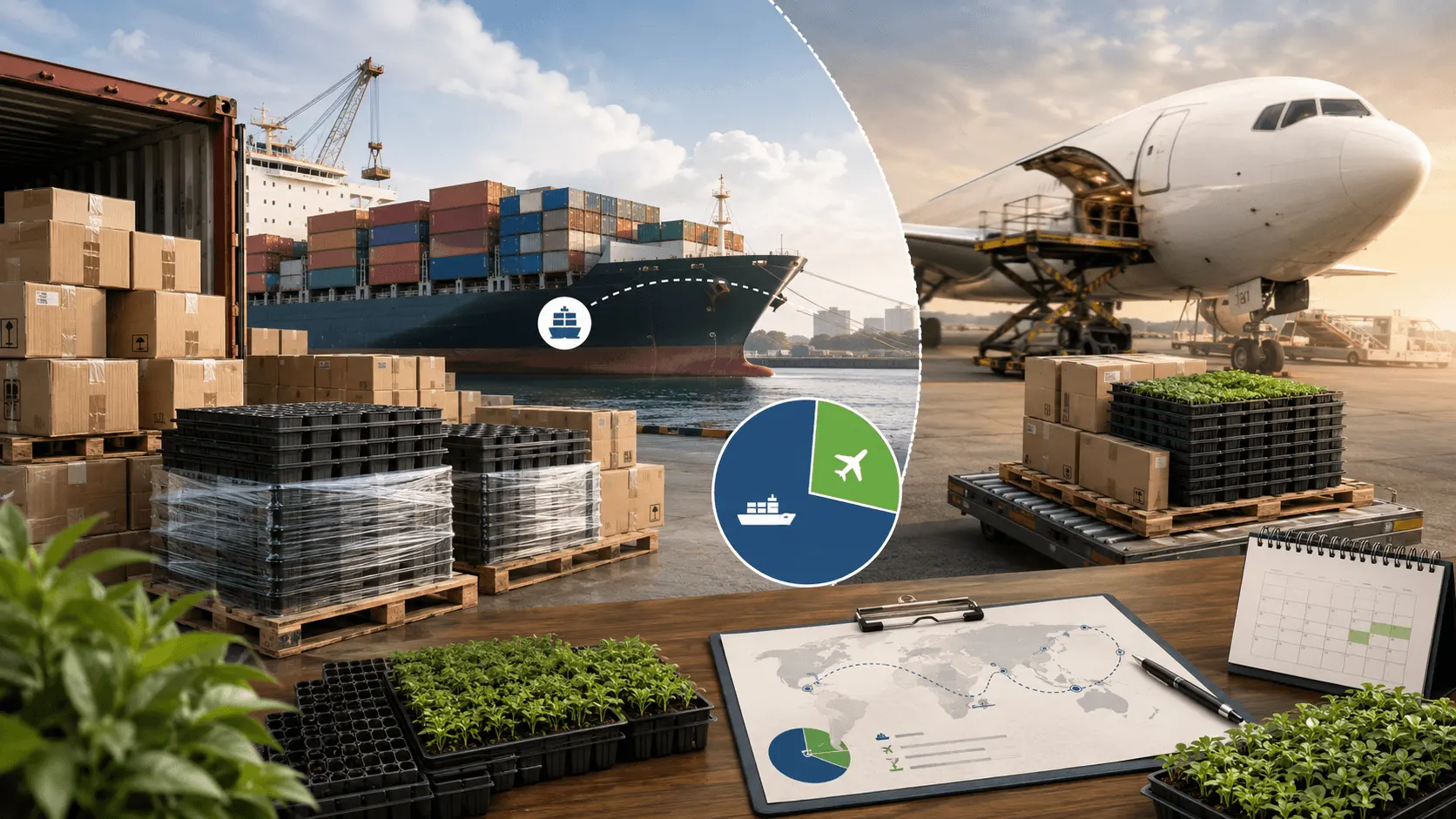
Sea-air intermodal shipping splits the journey: the first leg travels by sea, the second by air. The result is roughly half the transit time of pure sea freight, at roughly half the cost of pure air freight. The industry shorthand is “half the time, half the cost.”
This is not a new idea. It has been studied and validated on East Asia-to-North America routes, particularly through Japan as a transshipment hub. A newer development is the Dongguan sea-air intermodal project — the world’s first cross-border sea-air operation that pre-positions Hong Kong airport cargo terminal functions in Dongguan, China. Your cargo moves by sea from the Chinese factory to Dongguan, clears customs there, and then flies from Hong Kong to your destination. The sea transit from Dongguan port to Hong Kong takes only several hours — but the overall preparation process (factory pickup, inland transport, security screening, and customs clearance at the Dongguan logistics park) takes roughly 3–5 days before the air leg begins. The air leg takes 3–4 days. Total door-to-door transit: roughly 7–10 days. Not as fast as pure air, not as slow as pure sea.
For nursery buyers, sea-air is worth knowing about if you need something faster than sea but cannot justify full air freight pricing. The practical limitation: not all routes have mature sea-air programs, and execution requires a freight forwarder who can coordinate both legs seamlessly. It is an option to ask about, not a default solution.
The 80/20 Mixed Strategy
Here is a practical approach that seasonal businesses use: ship most of your inventory by sea before the season starts, and hold a small air freight budget for the surprises.
This strategy — used effectively in cross-border e-commerce — can reduce overall logistics costs by approximately 25% while keeping stockout risk below 3% (based on industry experience). The principle is straightforward: use sea freight for what you can plan, and air freight for what you cannot.
For nursery supply buyers, this translates to: order your core inventory by sea 6–8 weeks before spring, and hold a small air freight budget for last-minute additions or replacements. You do not need to choose one or the other. You use both, at the right time, for the right volume.
These are not theoretical strategies — they are practical options that experienced buyers use when one mode does not fit the whole picture.
Next Step: Review Your Shipping Plan
If you are planning a nursery supply order and want to understand the full cost picture — not just freight, but duties, port fees, insurance, and inland delivery — start with our landed cost guide. It walks through the complete formula so you can budget with confidence, not guesswork.
You can break down all hidden fees, tariffs, and inland transport charges using our step-by-step guide on [How to Calculate the Landed Cost Really Means (and Why It Matters)].
For this article, the takeaway is straightforward: sea freight is the default for nursery trays, pots, and propagation supplies. Air freight is a tool for specific situations — samples, emergencies, and small trials. Knowing when to use each is what separates a reactive buyer from a planned one.
Three things you can do right now:
- Get a sea freight vs air freight cost estimate for your nursery tray order. Send us your product list, quantity, target market, and packaging requirements — we will help you compare real numbers based on current rates, not theoretical ranges.
- Confirm your sample shipping cost. If you are evaluating a new supplier and need product in your hands fast, we can arrange sample delivery by air and give you a clear cost before you commit to a bulk order.
- Get a mixed shipping plan for seasonal inventory. Tell us your peak season timing, expected volumes, and target market — we will help you structure a plan that uses sea freight for the bulk and air freight for the gaps, so you never run empty during your busiest month.
That is what Scarecrow Garden Supplier does — help you figure out the right shipping method for each order, so your trays arrive at the cost you planned for, when you need them.
Make every tray shipment work harder.
Compare the cost, confirm sample delivery, and plan inventory coverage before your busiest month arrives.
Compare My OptionsSea vs air estimate
Actual order details in, practical cost comparison out.
Sample delivery cost
Get products in hand fast with a confirmed shipping figure.
Mixed seasonal shipping
Bulk stock by sea, urgent inventory gaps by air.

Written by
ScarecrowGarden
💡About Scarecrow Garden Supplier Co., Ltd.
Scarecrow Garden Supplier Co., Ltd. is a China-based sourcing and wholesale partner specializing in garden tools, landscaping equipment, and outdoor supplies for international wholesalers, distributors, contractors, and brands.
With hands-on experience rooted in real garden use scenarios, we focus on durable materials, functional design, and stable large-volume supply. Our product range covers pruning tools, watering systems, hand tools, outdoor hardware, and customized garden solutions to support both retail and professional landscaping markets.
Beyond products, we help our partners navigate supplier selection, quality control, compliance requirements, and long-term sourcing strategies in China. Through our blog, we share practical insights on product selection, material comparisons, industry trends, and cost-effective purchasing—helping global buyers build stronger, more competitive supply chains.