









How to Calculate Landed Cost for Nursery Trays & Pots Full Guide | Scarecrow Garden Supplier
You have the product price. You have the freight quote. You think you know what the order costs.
Then the container arrives at port — and the actual charges are 20% higher than you expected. Port handling fees you did not account for. Customs duties calculated on a value base you did not realize included freight. A “door-to-door” quote that turned out to cover transport only, not clearance or tariffs.
This is not unusual. It happens to experienced buyers too. The gap between what you think you will pay and what you actually pay is what landed cost is all about. And for nursery supplies — trays, pots, propagation inserts, humidity domes — that gap can be significant, because these products are lightweight relative to their volume, which changes how freight is calculated, and they carry specific tariff classifications that come with layered duty rates.
This article walks through every component that makes up the true cost of getting nursery supplies from a Chinese supplier to your warehouse. No shortcuts, no hidden line items.
If you want a deeper look at carton optimization and pallet loading for these shipments, see our guide on [Nursery Tray Packaging Guide: Carton Quantity, CBM, Weight and Pallet Loading]
What Landed Cost Really Means (and Why It Matters)
Landed cost is the total cost of a product from the moment it leaves the supplier’s facility to the moment it sits in your warehouse, ready for use or resale.
It is not the product price. It is not the product price plus shipping. It is every charge that accrues along the way — freight, insurance, duties, port fees, clearance, inland delivery, and the miscellaneous costs that tend to show up uninvited.
Here is the formula:
Landed Cost = Product Cost + International Freight + Insurance + Customs Duties + Port/Handling Fees + Inland Delivery + Other Charges
Each of these seven components can vary depending on your trade terms, shipping method, product classification, and destination. Ignoring any one of them means pricing your order on incomplete information.
For nursery supply buyers, three things make this especially relevant:
- Volume-to-weight ratio. Nursery trays and pots are bulky but light. Freight carriers charge by whichever is greater — actual weight or dimensional weight. This means you may pay for volume you do not fully use, or you may find that shipping costs more than the product itself on a per-unit basis.
- Layered tariff rates. Plastic nursery products fall under HTS 3926.90.90.90, which carries a base MFN duty of 5.3%. Products originating from China also face Section 301 tariffs on top of that, pushing the effective rate to 12.8% or higher. We will break this down in the duties section.
- Trade term confusion. A “door-to-door” shipping quote is not the same as DDP. One is a service description; the other is a legal obligation. The difference can cost you thousands.
Let’s go through each component.
If you are building a cost model for your next nursery supply order, send us your product list and target quantities — we can help you estimate the landed cost before you commit.
The Landed Cost Formula, Broken Down
Product Cost: FOB vs EXW
Your starting point depends on the trade term your supplier quotes.
FOB (Free on Board) means the supplier’s price includes all costs up to the goods being loaded onto the vessel at the port of departure. Export customs clearance, domestic transport to the port, and terminal handling at origin are all in the FOB price. This is a common pricing basis for nursery supply exports from China.
EXW (Ex Works) means you pick up the goods at the factory gate. Everything from there — domestic trucking, export customs, port fees — is your responsibility and your cost. EXW prices look lower, but you need to add those origin-side charges back in to compare fairly with FOB.
If your supplier quotes EXW, budget an additional 3–8% of product value for origin-side logistics, depending on how far the factory is from the departure port.
International Freight
This is the cost of moving goods from the port of departure to the port of destination. It is quoted per CBM (for LCL) or per container (for FCL), and the rate depends on the route, season, and carrier.
Freight rates fluctuate. A rate you locked in March may not hold in September. Always confirm rates close to your shipping date, and build a 10–15% buffer into your cost model for rate swings.
We cover sea vs air freight in detail later in this article.
Insurance
If your trade term is CIF, the supplier arranges insurance to the port of destination. If you are buying FOB or CFR, insurance is your responsibility.
Insurance is typically calculated as: (C&F value × 110%) × premium rate, where C&F = product cost + freight. The premium rate for general cargo runs about 0.3%–1.0% depending on the goods and route. For nursery trays and pots, it tends to be on the lower end because these are not high-risk cargo.
It is a small line item, but skipping it means bearing the full cost of loss or damage at sea.
Customs Duties
This is where the math catches people off guard. We will cover this in detail in the duties section, but the key point for now: US customs duties are calculated on the CIF value, not the FOB value. That means the dutiable amount includes the product cost plus freight plus insurance.
Port and Handling Fees
These include:
- THC (Terminal Handling Charge): The cost of moving the container on and off the vessel. Typically $100–$300 per container.
- Documentation fees: Bill of lading issuance, typically $50–$150 per shipment.
- Customs brokerage: $100–$300 per entry for standard clearance.
- MPF (Merchandise Processing Fee): 0.3464% of the customs value, with a minimum of $33.58 and a maximum of$651.50 (FY2026 rates, effective October 2025).
- HMF (Harbor Maintenance Fee): 0.125% of the customs value, applicable to ocean shipments only.
MPF and HMF are mandatory and non-negotiable. They are collected by US Customs and Border Protection on every import. These fees are small individually, but they add up — and you cannot avoid them, so factor them in from the start.
Inland Delivery
The cost of trucking or railing the goods from the destination port to your warehouse. This varies widely — $200 for a local delivery,$2,000+ for a cross-country move. If you are importing into Los Angeles and your warehouse is in Ohio, this line item matters.
Other Charges
Demurrage (storage fees if the container sits at port too long), inspection fees, warehouse handling, and any special requirements like ISPM 15 compliance for wood pallets. These are unpredictable by nature, but budgeting 2–5% of product value for miscellaneous charges is a reasonable practice based on industry experience.
Your Trade Term Decides Who Pays What
The Incoterms 2020 rules define who is responsible for each cost and risk in the shipping process. For nursery supply imports, four terms come up most often:
| Term | Seller Pays | Buyer Pays | Risk Transfers | Typical Use |
| EXW | Only makes goods available at factory | Export clearance, all transport, import clearance | At factory gate | Buyer has own logistics in China |
| FOB | Delivery + loading at departure port | Freight, insurance, import clearance | When goods are on board the vessel at origin | Most common for nursery supplies |
| CIF | Freight + insurance to destination port | Import clearance + inland delivery | When goods are on board the vessel at origin | Seller controls shipping |
| DDP | Everything including import duties and delivery | Nothing — just receive goods | At named destination | Full-service, seller bears all risk |
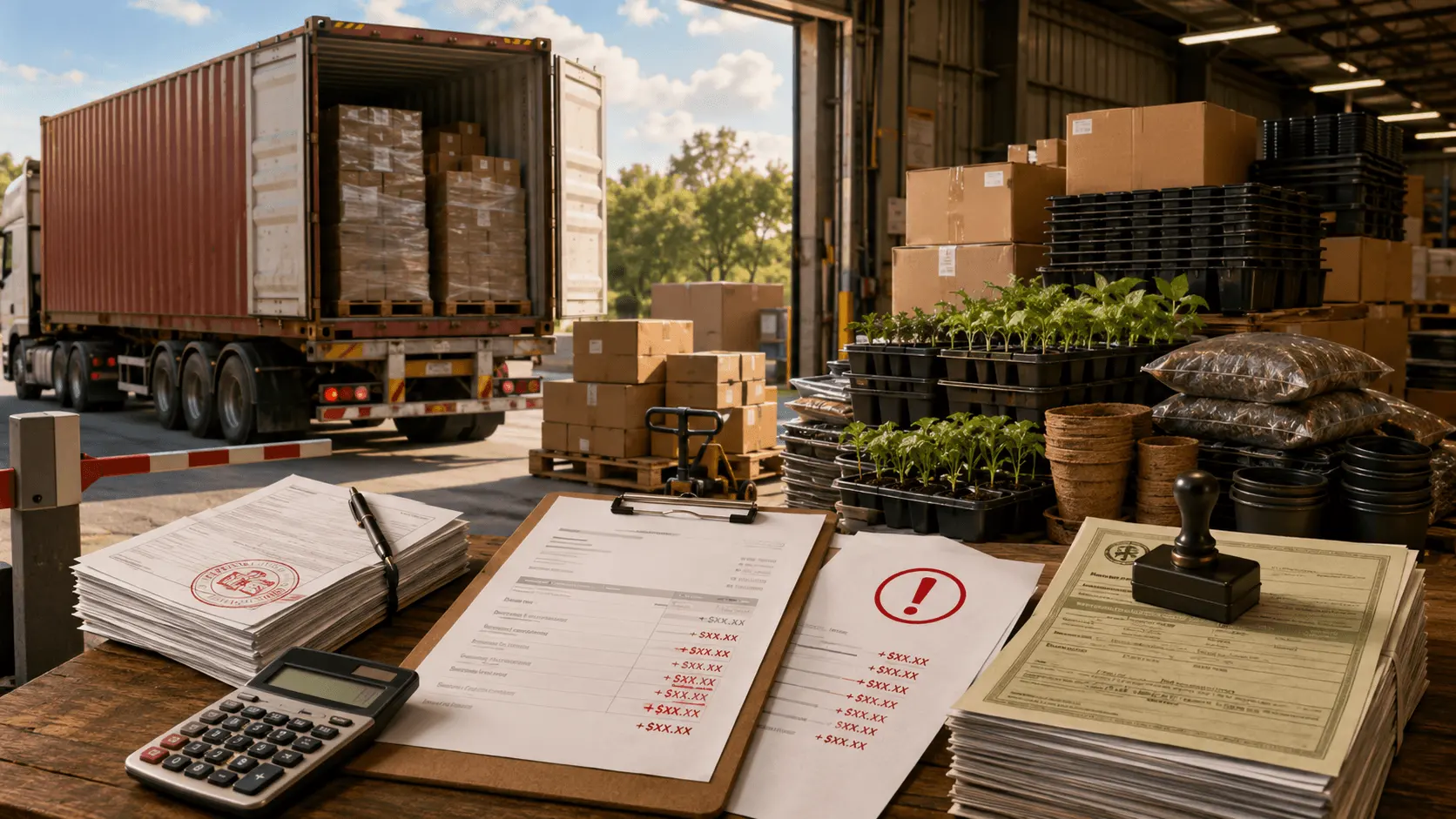
The “Door-to-Door” Trap
Here is a distinction that catches buyers regularly:
Door-to-door is a logistics industry description. It means the freight forwarder arranges pickup at the origin and delivery at the destination. It says nothing about who pays import duties, who handles customs clearance, or whether those costs are included in the quote.
DDP (Delivered Duty Paid) is an Incoterms 2020 term. Under DDP, the seller is legally obligated to pay all costs including import duties, taxes, and customs clearance. It is a contractual commitment, not a service description.
A door-to-door quote that does not explicitly state “duties included” or “customs clearance included” probably does not include them. You will receive a separate bill for those charges after the goods clear customs.
When you receive a door-to-door quote, ask three specific questions:
- Does this include import duties?
- Does this include customs clearance fees?
- Does this include inland delivery to my warehouse?
If the answer to any of these is no, add those costs to your landed cost calculation.
How US Customs Duties Work for Nursery Trays and Pots
HTS Classification
Plastic nursery trays, pots, propagation inserts, and humidity domes are classified under HTS 3926.90.90.90 — Other articles of plastics. This is the standard classification for plastic articles not specifically described elsewhere in the tariff schedule.
The corresponding Chinese HS code is 3926909090.
MFN Duty Rate
The Most Favored Nation (MFN) base duty rate for this classification is 5.3%. This is the rate that applies to imports from WTO member countries under normal trade relations.
Section 301 Tariffs
Products originating from China are subject to additional Section 301 tariffs on top of the MFN rate. For plastic articles in this category, the Section 301 rate is typically 7.5%, though it can range up to 25% depending on the specific product and which tariff list it falls under.
This means the effective duty rate for Chinese-origin nursery supplies is:
- Minimum: MFN 5.3% + Section 301 7.5% = 12.8%
- Potential maximum: MFN 5.3% + Section 301 25% = 30.3%+
Important: Section 301 tariff rates change. The rates stated here are based on the time of writing and should not be treated as fixed. In addition, other tariff layers — such as fentanyl-related tariffs or reciprocal tariffs — may apply on top of the MFN and Section 301 rates, further increasing the effective rate. Always verify the current rate and all applicable tariff layers through the US Customs and Border Protection (CBP) website or a tariff lookup tool before finalizing your cost model.
How Duties Are Calculated
US customs duties are calculated on the CIF value — that is, the product cost plus freight plus insurance, not just the product cost alone.
Example: To see how the dutiable base affects what you pay, consider this simplified example. If your FOB product cost is $10,000, sea freight is$1,200, and insurance is $55:
- CIF value = $10,000 +$1,200 + $55 =$11,255
- Duty at 12.8% = $11,255 × 0.128 = $1,440.64
If you had calculated duty on the FOB value alone ($10,000 × 0.128 =$1,280), you would have underestimated by $160.64. On larger orders, that gap grows. This calculation uses the lower-bound effective rate for illustration; your actual rate may differ.
Other Import Fees
Beyond duties, two mandatory fees apply:
- MPF (Merchandise Processing Fee): 0.3464% of the customs value. Minimum $33.58, maximum$651.50 (FY2026 rates).
- HMF (Harbor Maintenance Fee): 0.125% of the customs value. Applies to ocean shipments only.
Using the same $11,255 CIF value:
- MPF = $11,255 × 0.003464 =$38.99
- HMF = $11,255 × 0.00125 =$14.07
These are mandatory fees collected on every formal entry.
Want to see how duties affect your specific product mix? Send us your product list and quantities — we can walk you through the calculation.
How to Calculate CBM for Nursery Supply Shipments
CBM (cubic meter) is the standard unit for measuring cargo volume. It determines how much space your shipment occupies, which directly affects freight costs — especially for lightweight, bulky items like nursery trays.
The Formula
CBM = Length (cm) × Width (cm) × Height (cm) ÷ 1,000,000
For multiple identical packages: Total CBM = Single package CBM × Number of packages
If you have ever tried to fit 1,000 nursery trays into a container and wondered why the freight quote was higher than expected, CBM is why.
A Practical Example
Say you are shipping 1,000 nursery trays. If each carton holds 20 nested trays, that is 50 cartons. Each carton measures 55 cm × 28 cm × 48 cm (these are illustrative dimensions — always use your actual carton measurements):
- Single carton CBM = 55 × 28 × 48 ÷ 1,000,000 = 0.07392 CBM
- 50 cartons = 0.07392 × 50 = 3.696 CBM
Your actual total volume depends on how trays are nested and stacked inside each carton, and how cartons are arranged on a pallet. Always calculate from the actual packed carton dimensions, not the product dimensions.
Weight vs Volume: How Freight Is Charged
Here is where it gets practical. Freight carriers use the W/M (Weight or Measure) principle — they charge based on whichever is greater: the actual gross weight or the volumetric weight.
For sea freight: 1 CBM = 1,000 kg
For air freight: 1 CBM = 167 kg (equivalent to 6,000 cm³ = 1 kg of volumetric weight)
What this means in practice: if your shipment weighs 625 kg but occupies 3.7 CBM, the sea freight carrier will charge based on 3.7 CBM (equivalent to 3,700 kg), not the 625 kg actual weight. For nursery supplies, you are typically charged by volume, not weight.
Container Capacities (Reference)
| Container | Internal Dimensions (L×W×H) | Capacity | Max Payload |
| 20’ GP | 5.90 × 2.35 × 2.39 m | 33.2 CBM | Approximately 28,250 kg |
| 40’ GP | 12.03 × 2.35 × 2.39 m | 67.7 CBM | Approximately 26,880 kg |
| 40’ HC | 12.03 × 2.35 × 2.70 m | 76.2 CBM | Approximately 26,540 kg |
These are internal dimensions based on ISO standards; actual payload varies by manufacturer and container condition.
For a 1,000-set order of nursery trays, you are looking at roughly 3.7 CBM — well within LCL range, and nowhere near filling a container. That context matters when you choose between LCL and FCL.
Sea Freight vs Air Freight: What Makes Sense for Your Order
| Factor | Sea Freight | Air Freight |
| Transit time | 30–45 days (standard) / 25–35 days (express) | 5–10 days door to door |
| Cost | Typically 1/5 to 1/10 of air freight | High |
| Billing unit | Per CBM (LCL) or per container (FCL) | Per kg (actual or volumetric, whichever is greater) |
| Minimum shipment | 1 CBM for LCL; full container for FCL | Typically 45 kg |
| Best for | Bulk orders, regular replenishment, cost-sensitive shipments | Samples, urgent orders, high-value items |
| Risk factors | Port congestion, schedule changes | Capacity limits, fuel surcharges |
When to Use Which
If you are deciding between sea and air for your next nursery supply order, here is how to think about it.
For most nursery supply orders, sea freight is the clear choice. The products are relatively low unit value, the volumes are moderate to large, and the transit time is manageable if you plan ahead.
Air freight makes sense in specific situations:
- Samples. You need to check product quality before committing to a bulk order.
- Urgent replenishment. You ran out of a key SKU mid-season and cannot wait 30 days.
- High-value, low-weight items. If the product value per kg is high, the freight premium is a smaller percentage of total cost.
For a broader trade-off evaluation between air speed and sea cost across different order sizes, check out [Air Freight vs Sea Freight for Nursery Supplies: Which Option Costs Less?].
The 1,000-Set Scenario
For a shipment of 1,000 nursery tray sets weighing approximately 625 kg net (gross weight will be higher due to packaging), sea freight is typically the economical choice. At roughly 3.7 CBM, the volumetric weight for air freight would be approximately 618 kg (3.7 × 167), which is close to the actual weight — but the air rate per kg is typically 5–10x the sea rate per CBM. For sea freight, you pay for 3.7 CBM; for air, you pay for 618 kg at a much higher per-kg rate. That difference can add hundreds of dollars to a relatively small order.
LCL (Less than Container Load) works for this volume. If your total shipment fills more than 15 CBM, an FCL 20’ container may be more cost-effective and reduces handling risk.
A 1,000-Set Example: Walking Through the Numbers
Let’s put the formula to work with a realistic scenario. This is an illustrative example — actual costs depend on your specific products, routes, and rates at the time of shipping.
Scenario: 1,000 sets of nursery trays, FOB Shanghai, destination Los Angeles.
| Cost Component | Calculation | Amount |
| Product cost (FOB) | Supplier quote | $8,000 |
| Sea freight (LCL) | ~3.7 CBM × market rate | $400 |
| Insurance | ($8,000 +$400) × 110% × 0.5% | $46.20 |
| CIF value | $8,000 +$400 + $46.20 | $8,446.20 |
| Customs duty (12.8%) | $8,446.20 × 0.128 | $1,081.11 |
| MPF | $8,446.20 × 0.003464 | $29.25 |
| HMF | $8,446.20 × 0.00125 | $10.56 |
| Customs brokerage | Flat fee per entry | $200 |
| Inland delivery (port to warehouse) | Local trucking estimate | $350 |
| Landed cost | Sum of all above | $10,117.12 |
Key takeaway: The product cost was $8,000, but the landed cost is$10,117. That is a 26.5% increase over the FOB price. Duties and freight together account for roughly $1,481 of that difference.
If you had budgeted only “product + shipping” ($8,400), you would have been off by over$1,700.
A few notes on this example:
- The duty rate used (12.8%) assumes the lower Section 301 tier. If the rate is higher, the landed cost increases proportionally.
- Sea freight rate is illustrative and based on industry experience at the time of writing. Actual rates vary by carrier, season, and demand.
- Inland delivery depends entirely on your warehouse location relative to the port.
- This example does not include demurrage, storage, or inspection fees, which can add up if clearance is delayed.
- Carton dimensions and CBM are illustrative; actual values depend on your specific product and packaging.
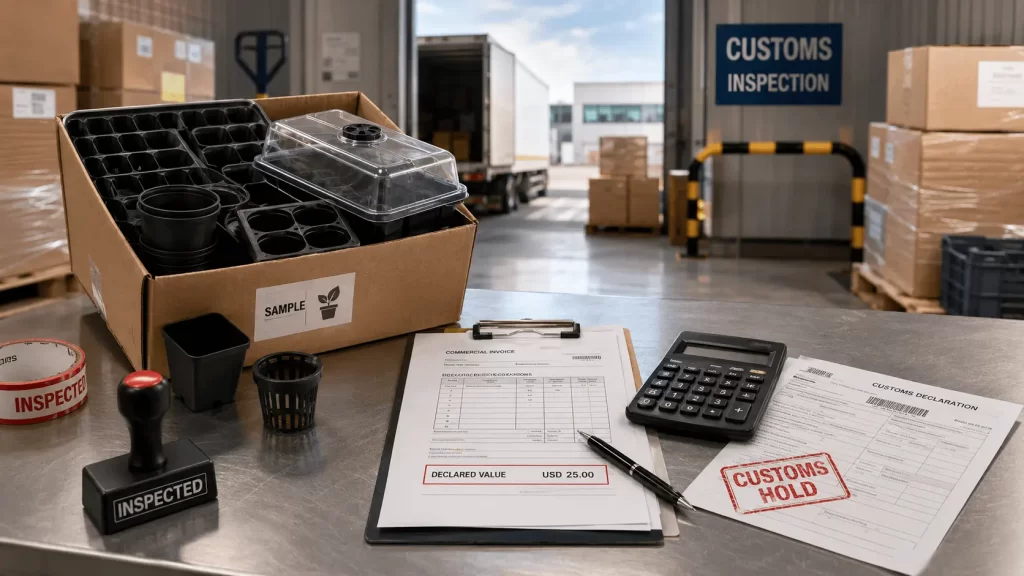
Sample Shipments: Declare Value Even When They Are Free
Many nursery supply buyers order samples before committing to a bulk order. Some suppliers offer free samples — you only pay for shipping. But “free” does not mean “zero declared value” when it comes to customs.
US Customs and Border Protection requires a declared value on all imported goods, including samples. Declaring a value of $0 or an unrealistically low amount can result in:
- Penalties for under-declaration
- Shipment holds while customs assesses the proper value
- Negative impact on your import compliance record
The correct approach: declare a reasonable value based on the production cost or market value of the goods, even if the supplier did not charge you. You can mark the customs declaration as “Sample — No Commercial Value” but still list a fair estimated value for duty calculation purposes.
This is a compliance requirement, and the risk of cutting corners here is not worth the small duty saving.
Freight Quote Checklist: What to Send Your Forwarder
Getting accurate freight quotes requires providing your forwarder with specific information. The more complete your request, the more accurate the quote. Here is a checklist you can use:
| Information | What to Provide |
| Product description | Nursery trays / pots / propagation supplies |
| HS Code | 3926.90.90.90 |
| Quantity | Number of pieces or sets |
| Net weight | In kg |
| Gross weight | In kg (including packaging) |
| Package dimensions | L × W × H per carton, in cm |
| Total CBM | Calculated from above |
| Trade term | FOB / CIF / EXW / DDP |
| Port of origin | e.g., Shanghai / Ningbo / Shenzhen |
| Port of destination | e.g., Los Angeles / New York / Savannah |
| Insurance needed? | Yes / No |
| Customs clearance included? | Yes / No |
| Duties included? | Yes / No |
| Target shipping date | Approximate week |
When you send this to a forwarder, ask specifically whether the quote includes duties and clearance. If it does not, you need to add those separately to your landed cost.
Next Step: Review Your Nursery Supply Sourcing Plan
Knowing the landed cost formula is one thing. Applying it to your actual product list is where it becomes useful.
If you are planning a nursery supply order — trays, pots, domes, inserts, or a mixed order — talk to us about your product list and sourcing plan. We can help you run the numbers before you commit.
Send us:
- Your product list with quantities
- Your target market and destination port
- Any packaging requirements
Scarecrow Garden Supplier will help you estimate the landed cost and make sure the numbers work before you place the order.
Planning a Nursery Supply Order?
Whether you need trays, pots, humidity domes, inserts, or a mixed order, talk to us about your product list and sourcing plan. We can help you estimate the landed cost and check whether the numbers work before you commit.
- Your product list and required quantities
- Your target market and destination port
- Your packaging or repacking requirements
Send your requirements directly to
queenie@gardentoolswholesale.com

Written by
ScarecrowGarden
💡About Scarecrow Garden Supplier Co., Ltd.
Scarecrow Garden Supplier Co., Ltd. is a China-based sourcing and wholesale partner specializing in garden tools, landscaping equipment, and outdoor supplies for international wholesalers, distributors, contractors, and brands.
With hands-on experience rooted in real garden use scenarios, we focus on durable materials, functional design, and stable large-volume supply. Our product range covers pruning tools, watering systems, hand tools, outdoor hardware, and customized garden solutions to support both retail and professional landscaping markets.
Beyond products, we help our partners navigate supplier selection, quality control, compliance requirements, and long-term sourcing strategies in China. Through our blog, we share practical insights on product selection, material comparisons, industry trends, and cost-effective purchasing—helping global buyers build stronger, more competitive supply chains.