









Updated 2 months ago
Pruning Snips vs Hand Pruners vs Loppers: Size, Cutting Jobs and Buyer Selection
SCARECROW GARDEN SUPPLIER
Pruning Snips vs Hand Pruners vs Loppers: B2B Buyer Guide | Scarecrow Garden Supplier
A garden center customer picks up a tool barely longer than her palm. She asks: “Is this just a smaller version of the regular pruner?” The answer matters, because if she buys it for thick branches, it will disappoint her. And if your wholesale range does not carry it at all, you lose the florist, the herb gardener and the indoor-plant buyer in one stroke.
Pruning snips, one-hand pruners and loppers are often grouped under the same “pruning tools” label, but they are not size steps on one ladder. Each group is designed around a different combination of precision, leverage, working space and user endurance. Understanding these boundaries helps wholesale buyers assign every SKU a clear role, instead of filling the shelf with random similar-looking models.
This article explains what each tool group is built to do, where the naming gets confused, and how to turn the three categories into a coordinated product range.
Why Buyers Often Confuse These Three Tool Groups
The confusion starts with language. In the US, “pruning shears” and “hand pruners” usually mean the same one-hand bypass or anvil tool. In the UK and parts of Europe, the same tool is called “secateurs.” Meanwhile, “pruning snips” and “floral snips” are sometimes labeled “small pruning shears” or “garden scissors,” which makes them sound like a downgrade rather than a different purpose.
Here is a quick way to separate them:
| Pruning Snips / Floral Shears | One-Hand Pruners / Secateurs | Loppers | |
| Hand position | Fingers and thumb, close to the blade | Full grip, one hand | Two hands on extended handles |
| Typical overall length | 140-210 mm | 180-250 mm | 500-900 mm |
| Primary advantage | Precision and access in tight spaces | Versatile cutting of live or dead branches | Leverage for thicker branches |
| Typical net weight | 40-150 g | 180-300 g | 700-1600 g |
Length alone does not define the tool. A 210 mm snip with a long, narrow blade tip is built for reaching into dense foliage, not for powering through a 20 mm branch. A 200 mm bypass pruner with a thick forged blade and a wide-opening handle is built for everyday branch cutting, not for trimming a single rose stem. The structure, blade shape, handle span and leverage ratio all matter.
Let’s look at what each group is actually built to do.
Small Pruning Snips and Floral/Harvesting Shears
What they are designed to do
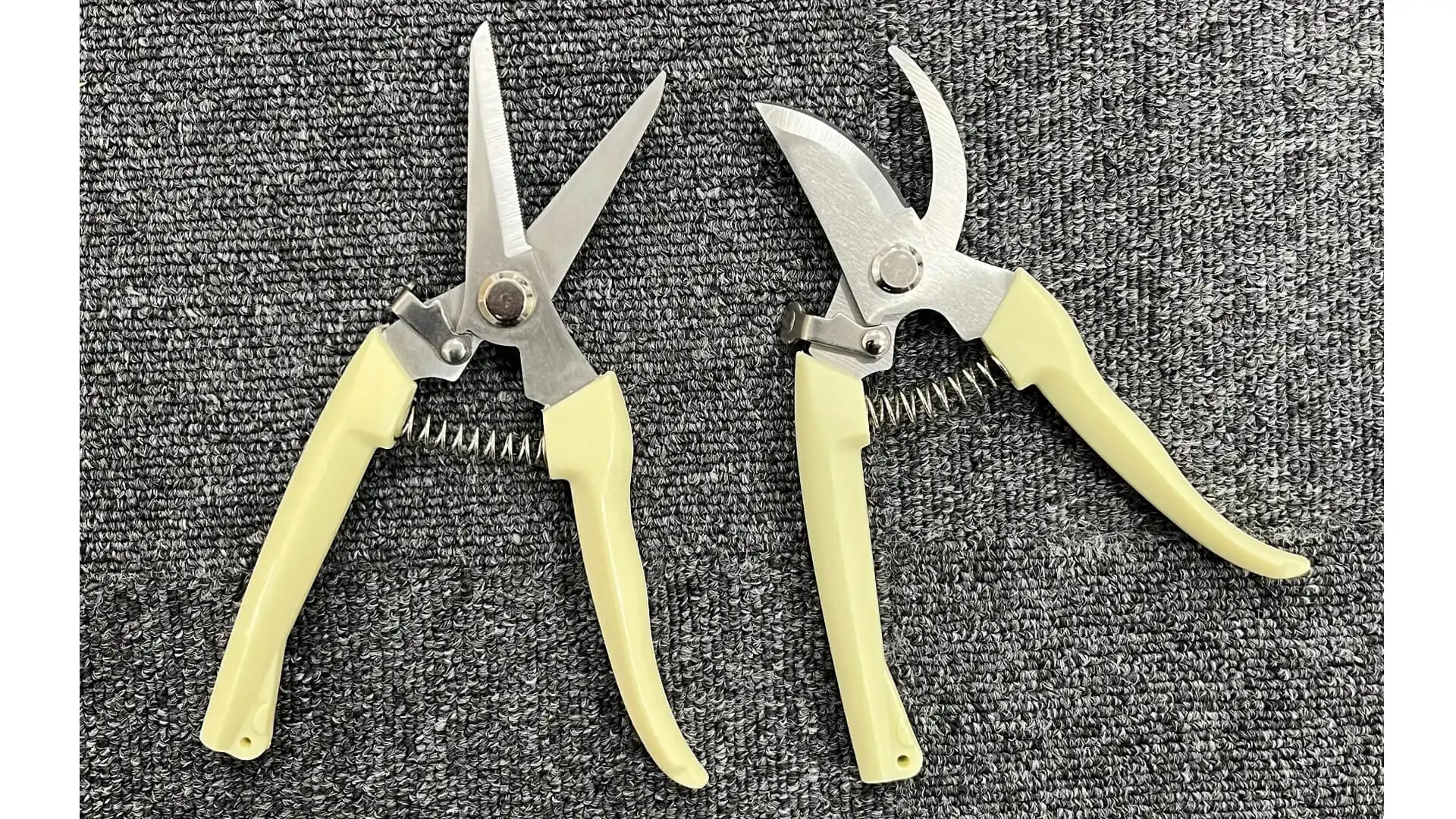
Pruning snips and floral shears prioritize control over power. Their blades are narrow, often with pointed or elongated tips that can reach between crowded stems without damaging neighboring growth. The overall weight is low, typically under 150 g, which reduces hand fatigue during repetitive fine trimming.
Common tasks include:
- Trimming flower stems for arrangement and harvest
- Snipping herbs, soft greens and tender new growth
- Shaping indoor potted plants in tight spaces
- Removing individual dead flower heads (deadheading)
- Harvesting fruit or vegetables that need a clean, close cut
These are not “light-duty pruners.” They are purpose-built for precision work where a standard bypass pruner would be too bulky, too wide at the tip and too heavy for sustained delicate cutting.
Sub-types within the snip category
Even within this small-tool group, several blade shapes create distinct SKUs:
- Straight narrow-blade snips: general floral and herb trimming
- Long-tip / needle-nose snips: reaching deep into dense foliage or between thorns
- Curved-blade snips: following the natural curve of a stem for a flush cut
- Spring-loaded snips: automatic blade return for fast repetitive snipping, common in harvesting
- Bonsai shears: wider but still short, designed for shaping small woody plants with controlled cuts
A florist channel may need two or three of these sub-types. A garden center that only stocks one “small pruner” misses the difference.
What wholesale buyers should check on snip samples
Because snip blades are thin and often pointed, quality issues show up differently than on heavy pruners:
- Blade tip alignment: even a small offset at the tip can cause missed cuts on fine stems
- Spring return reliability: weak or uneven springs make repetitive snipping tiring
- Lock position and ease: some snip locks sit where the thumb naturally rests during use, causing accidental engagement
- Sap and residue cleaning: floral work involves sticky stems; blade coatings or smooth finishes reduce buildup
- Grip comfort for extended use: snip handles are smaller, but they still need adequate texture and shape for wet or sweaty hands
Not sure whether your market needs pruning snips, bypass pruners or loppers? Send us your target customers, sales channel and expected price range. We can help organize a practical pruning tool shortlist before you compare samples.
One-Hand Pruning Shears (Secateurs)
The core everyday cutting tool
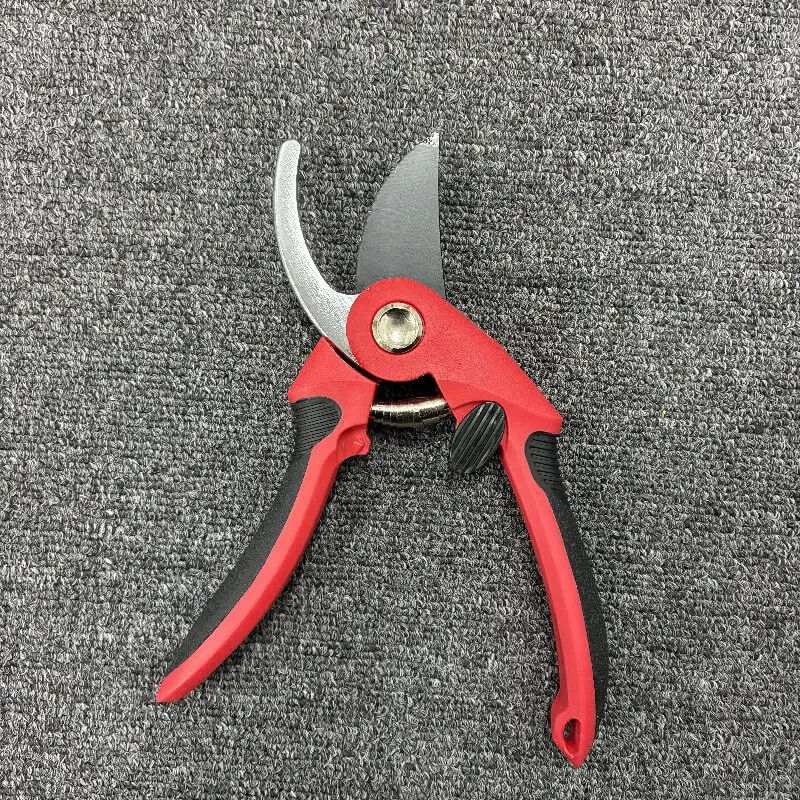
One-hand pruners, often called secateurs in the UK and Europe, are the most versatile and most widely sold tool in the pruning category. They cover the everyday tasks that most gardeners encounter: trimming live branches on roses, shrubs and small fruit trees, removing dead wood, and general landscape maintenance.
The two main structural types are:
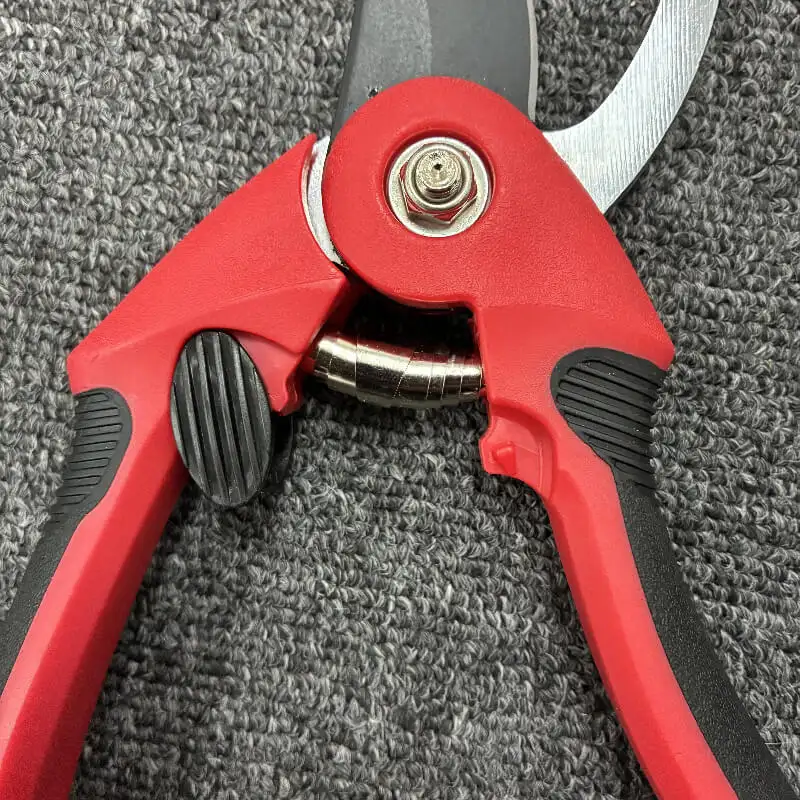
- Bypass pruners: two curved blades pass each other like scissors, producing a clean cut on live wood. The sharp cutting blade slides past a thicker, blunt “hook” blade that holds the branch. This is the most common structure for everyday live-stem pruning.
- Anvil pruners: a single sharp blade closes against a flat or slightly concave metal plate (the “anvil”). This crushing action works on dry, dead or hard wood but can bruise live stems.
Ratchet and gear-assisted mechanisms are variations built onto either bypass or anvil frames. They reduce the grip force needed per squeeze by breaking the cut into steps or multiplying leverage through a gear train. These are not a separate “type” of pruner in terms of what they cut, but they change the user experience and the cost structure.
Why one size does not fit all hands
Even within the bypass category, hand size and opening span create real product differences. FELCO, for example, offers:
- FELCO 2: 215 mm overall length, 251 g, 25 mm nominal cutting diameter, designed for large hands with a wide handle span
- FELCO 6: 195 mm overall length, 219 g, 20 mm nominal cutting diameter, designed for medium or smaller hands with a more compact handle span
Both are professional-grade bypass pruners with forged aluminum handles, hardened steel blades, adjustable pivot systems and full parts availability. The difference is not quality; it is fit. A buyer who only stocks one hand size will lose customers whose hands do not match it.
Cutting diameter claims (such as “25 mm” or “20 mm”) depend on the specific model, blade geometry, user grip strength and branch condition. They should not be treated as universal ratings that apply to every situation.
What wholesale buyers should specify for hand pruners
When comparing hand pruner quotations from different suppliers, the following specifications should be confirmed side by side, not judged by unit price alone:
- Overall length and blade length
- Net weight and handle opening span (relevant to hand fit)
- Blade material (e.g., SK5 high carbon steel, stainless steel, chrome-plated steel) and stated heat treatment
- Handle material (e.g., forged aluminum with rubber overmold, stamped steel, fiberglass-reinforced composite, PP/TPR)
- Pivot type (adjustable bolt with locking nut vs. rivet; affects maintenance and blade gap tuning)
- Spring type (coil, wire, torsion) and lock type (thumb latch, dial lock, side switch)
- Surface treatment on blade (hard chrome plating, low-friction coating, polished, raw with anti-rust oil)
- Packaging method and packed dimensions (affects shipping cost and shelf presentation)
Two pruners may look almost identical in a product photo, but differences in blade thickness, heat treatment, handle construction, spring quality, unit weight and packaging can create a meaningful cost gap. When comparing quotations, we normally place these specifications side by side rather than judging by unit price alone.
When one-hand leverage is not enough, the next step is not a bigger pruner. It is a different tool with different physics.
Different cutting tasks require different tools. Learn more in Which Pruning Shears Fit Which Job? A Use-Case Guide for Buyers and Retailers.
Loppers for Two-Hand Cutting and Extra Leverage
Why loppers are a different working level, not just bigger pruners
Loppers add handle length and a two-hand grip to generate significantly more leverage than any one-hand pruner can deliver. This is not a minor upgrade. It is a shift to a different class of cutting task.
Typical lopper specifications:
- Overall length: 500-900 mm (fixed or telescopic)
- Net weight: 700-1600 g
- Nominal cutting diameter: 25-40 mm for standard models, with some heavy-duty ratchet models claiming up to 50 mm on soft wood
- Handle types: fixed-length aluminum or steel tubes, telescopic aluminum tubes with locking collars, or fiberglass-reinforced composite
A hand pruner that occasionally cuts a 25 mm branch under ideal conditions should not be marketed as a tool for sustained work on thick wood. Loppers exist because the physics of leverage and the ergonomics of two-hand operation make them the appropriate tool for that job.
Lopper structural variations
- Bypass loppers: same scissor-like action as bypass hand pruners, extended to thicker branches. Preferred for live wood where a clean cut matters.
- Anvil loppers: single blade closing against an anvil plate. Suitable for dead or hard wood where crushing is acceptable and cutting efficiency matters more than cut cleanliness.
- Ratchet / gear-assisted loppers: step-cutting or gear-multiplying mechanisms that reduce the force needed per squeeze. Useful for users with limited grip strength or for very thick branches, but add mechanical complexity and cost.
A buyer reminder on cutting claims
A lopper labeled “35 mm cutting capacity” may achieve that diameter on soft, green wood with a strong user. On dry, hard oak at the same diameter, the same tool may struggle or fail to complete the cut cleanly. Some heavy-duty ratchet models claim up to 50 mm, but that rating typically applies only to soft wood under ideal conditions. Cutting capacity is conditional, not absolute. Wholesale buyers should test samples on branch types and diameters that match their customers’ actual tasks, not rely on catalog numbers alone.
Comparison Table: Size, Control, Power and Retail Role
| Factor | Pruning Snips | One-Hand Pruners | Loppers |
| Precision / control | High: narrow tip, close finger action | Moderate: wider blade, full grip | Low: long handles, less tip control |
| Cutting power | Low: thin stems and soft material only | Moderate: live or dead branches up to model-specific limits | High: leverage amplifies force for thicker branches |
| Working space | Tight: reaches between crowded stems | Moderate: requires some hand clearance | Open: needs space for long handle swing |
| Typical user endurance | Extended fine work, low fatigue per cut | Moderate: hand fatigue builds over many cuts | Short bursts: two-hand effort per cut, but fewer cuts per session |
| Transport / storage volume | Very compact | Compact | Larger; telescopic models reduce stored length |
| Retail display role | Specialty or impulse add-on near floral/houseplant sections | Core category anchor | Extension category, often displayed with long-handle tools |
| Typical wholesale price band | Entry (based on industry experience) | Entry to professional (wide range) | Mid to premium (based on industry experience) |
This table is a framework, not a rigid classification. Some heavy-duty snips with thick short blades sit closer to the pruner end. Some compact loppers overlap with large hand pruners in cutting capacity. The point is that each group has a primary strength, and a product range should cover all three rather than doubling down on one.
Recommended Product Combinations for Different Buyers
Different sales channels need different tool mixes. Here are practical starting points:
Florist / floral supply channel
- 2-3 snip sub-types (straight, long-tip, spring-loaded)
- 1 lightweight bypass pruner for occasional thicker stems
- No loppers (florists rarely cut branches above 15 mm)
Garden center (general retail)
- 1-2 snip models (floral + general fine trimming)
- 1 entry-level bypass pruner
- 1 mid-range comfortable bypass pruner
- 1 anvil pruner for dead wood
- 1 ratchet or ergonomic option for reduced grip strength
- 1 bypass lopper (fixed or telescopic)
- Optional: left-hand model or small-hand model if local demand exists
Nursery / orchard / vineyard supply
- 1 harvesting snip or grape shear
- 1 professional bypass pruner with replaceable parts (high-frequency daily use)
- 1 anvil lopper or heavy-duty bypass lopper for orchard pruning
- Spare parts kits (blades, springs, shock absorbers) as add-on sales
E-commerce / online retail
- Structure variants by use case (flowers, herbs, roses, general pruning, dead wood, thick branches), not just by color
- Each listing should clearly state: blade type, hand fit, recommended cutting material and whether replacement parts are available
- Avoid creating five color variants of the same bypass pruner while offering zero snips or loppers
Building a complete pruning range? Share your target market, sales channel, price levels and preferred packaging. Scarecrow Garden Supplier can prepare compact snips, one-hand pruners and loppers as a coordinated mixed-SKU sourcing plan, instead of sending random models that all look similar.
What to Ask Suppliers Before Comparing Prices
Before evaluating unit prices across these three tool groups, confirm the following for each model:
Overall length, blade length and net weight: these define the tool’s working category and user fit
Nominal cutting capacity and conditions: ask the supplier what branch type (live, dry, species) and diameter the rating was tested on
Blade material, thickness and surface treatment: SK5, stainless, chrome-plated and raw steel each carry different cost and performance profiles
Handle material, grip construction and hand-fit span: forged aluminum, stamped steel, composite and overmolded rubber differ in durability, weight and cost
Spring, lock and pivot specifications: these small parts affect daily use comfort and long-term reliability
Packed dimensions and gross weight: a lightweight snip in a bulky blister pack may cost more to ship than a heavier pruner in a compact sleeve
Target user and task: confirm whether the model is designed for fine trimming, general branch cutting or heavy leverage work before comparing it to models in a different category
Comparing a 150 g snip at $1.50 with a 250 g bypass pruner at$5.00 is not a fair price comparison. They solve different problems for different users. The right question is: does each model’s cost structure match its intended retail price, use frequency and customer expectations?
Next Step: Review Your Pruning Tool Size Range
A small snip, a hand pruner and a lopper may all be sold under “pruning tools,” but they serve different cutting jobs, different hand positions and different customer groups. Stocking only one size category leaves gaps in your product range and creates mismatched expectations that lead to returns.
Share your target market, current product list, quantity plan and packaging direction with Scarecrow Garden Supplier. We can compare suitable models across snips, pruners and loppers, prepare different price levels for each category, arrange consolidated samples from multiple verified supplier partners, and help organize a mixed-SKU sourcing plan that covers the full cutting-task spectrum from fine trimming to thick-branch leverage.
Retailers expanding their assortment should also read How Wholesalers Should Build a Pruning Shears Product Range.
FAQ
Are pruning snips the same as pruning shears? No. Pruning snips (also called floral snips or harvesting shears) are shorter, lighter tools with narrow blades designed for fine trimming, flower stems and soft material. Pruning shears or hand pruners are larger one-hand tools built for cutting live or dead branches. The naming overlap causes confusion, but the tools serve different purposes.
What are small pruning shears used for? Small pruning shears and snips are used for tasks that require precision and access in tight spaces: trimming flower stems, harvesting herbs and vegetables, deadheading spent blooms, shaping indoor potted plants and making arrangement cuts in floral work. They are not designed for cutting thick or hard branches.
When should customers use loppers instead of hand pruners? When the branch diameter exceeds what a one-hand pruner can cut cleanly and consistently. Loppers provide leverage through extended handles and a two-hand grip, making them appropriate for thicker branches on fruit trees, landscape shrubs and maintenance clearing. Using a hand pruner on branches beyond its working range risks blade damage, incomplete cuts and hand fatigue.
Does a larger pruner always cut thicker branches? Not necessarily. Cutting capacity depends on blade geometry, pivot design, leverage ratio, user grip strength and branch condition (live, dry, species). A well-designed compact bypass pruner may outperform a larger but poorly constructed model. The practical way to judge is to test on branch samples that match your customers’ actual tasks, rather than relying on catalog diameter claims alone.
How should wholesalers choose pruning shear sizes? Start by mapping your customer groups to their typical cutting tasks. Florists and indoor-plant buyers need snips. General gardeners need one-hand bypass or anvil pruners in at least two hand-fit sizes. Orchard and landscape customers need loppers. Size selection should follow task and hand fit, not just overall length.
Build Your Pruning Shear Collection With Confidence
Looking for reliable pruning shear models for your customers? Send us your market information, order quantity, packaging ideas, and reference images. Our team can help select models, compare pricing options, arrange samples, and create a complete sourcing plan.
📩 Get Model Recommendations View Garden Tools