









Updated 2 months ago
Which Pruning Shears Fit Which Job? A Use-Case Guide for Buyers and Retailers
SCARECROW GARDEN SUPPLIER

How Wholesalers Build a Pruning Shears Range | Sourcing Guide | Scarecrow Garden Supplier
A wholesaler who stocks only one pruning shear model is leaving gaps in every customer group that walks through the door. The flower-arranging customer needs a different tool than the orchard worker. The homeowner with three rose bushes needs a different size than the landscaper who prunes 200 branches before lunch. And the customer with small hands or reduced grip strength needs a different mechanism entirely.
This is not about “which pruner is best.” It is about matching the tool to the job — and helping wholesale buyers understand why their shelves should carry more than one model, not because more is always better, but because different jobs genuinely require different tools.
Start with Five Questions Before Choosing a Pruner
Before comparing models or quotations, answer these questions about the end user:
What are they cutting? Soft stems, live green branches, dry dead wood, or thick branches? The material determines the blade structure — bypass for live tissue, anvil for dry, snips for fine work, loppers for thick.
Where are they working? Indoor pots, dense shrubs, orchard rows, or open landscape? The space determines the blade shape — narrow tips for tight foliage, wider jaws for open pruning.
How often? A few times per season, weekly, or hundreds of cuts per day? Frequency determines the build quality and service-life strategy the tool needs.
Who is using it? Hand size, handedness, grip strength, and experience all affect which handle shape, span, and mechanism works — or does not.
Where is it being sold? Gift channel, garden center, hardware store, professional trade, or e-commerce? The sales channel determines the price tier, packaging, and how much education the customer needs at the point of purchase.
If you cannot answer these questions before choosing a model, you are selecting by photo — and that is where most buying mistakes start.
Not sure which pruning tool types your market actually needs? Send us your sales channel, customer groups and target price range. Scarecrow Garden can recommend a use-case-based product shortlist before you start comparing quotations.
Flowers, Herbs, Houseplants and Harvesting
Soft stems, thin foliage, and delicate tissue require precision, not power.
What the user is cutting: Flower stems, herb sprigs, houseplant shoots, harvesting vegetables and cut flowers. Stem diameter is typically under 5 mm. The material is soft, often herbaceous, and easily damaged by crushing or tearing.
What the tool needs to do: Reach into dense foliage without damaging neighboring stems. Make a clean, flat or angled cut that does not crush the stem — crushed stems do not absorb water well, which shortens vase life for cut flowers and slows healing on living plants. Stay light enough for repeated snipping over an hour or more.
The right tool category: Pruning snips and floral / harvesting shears. These are shorter than standard hand pruners (typically 150–200 mm overall, blade length 3–5 inches, weight under 150 g), with narrow or pointed blades that fit between crowded stems. Two common blade shapes serve different sub-tasks: straight blades for floral arranging (clean flat cuts on flower stems for insertion into foam or water), and curved blades for bonsai and dense shrub work (the curve helps the tip reach deeper into foliage without blocking the user’s view).
Why a standard bypass pruner is a poor substitute: The wider jaws and thicker blade cannot reach between closely spaced stems without accidentally cutting the wrong one. The heavier weight becomes noticeable after 30 minutes of fine snipping. And the larger handle span may be too wide for the precision grip that flower work requires.
Buyer mistake to avoid: Stocking anvil pruners for flower channels. Anvil mechanisms crush soft stems rather than slicing them — the single blade presses the stem against a flat plate, and the result is a bruised, uneven cut that reduces vase life and invites infection on living tissue.
Roses, Fresh Stems and Everyday Shrub Pruning
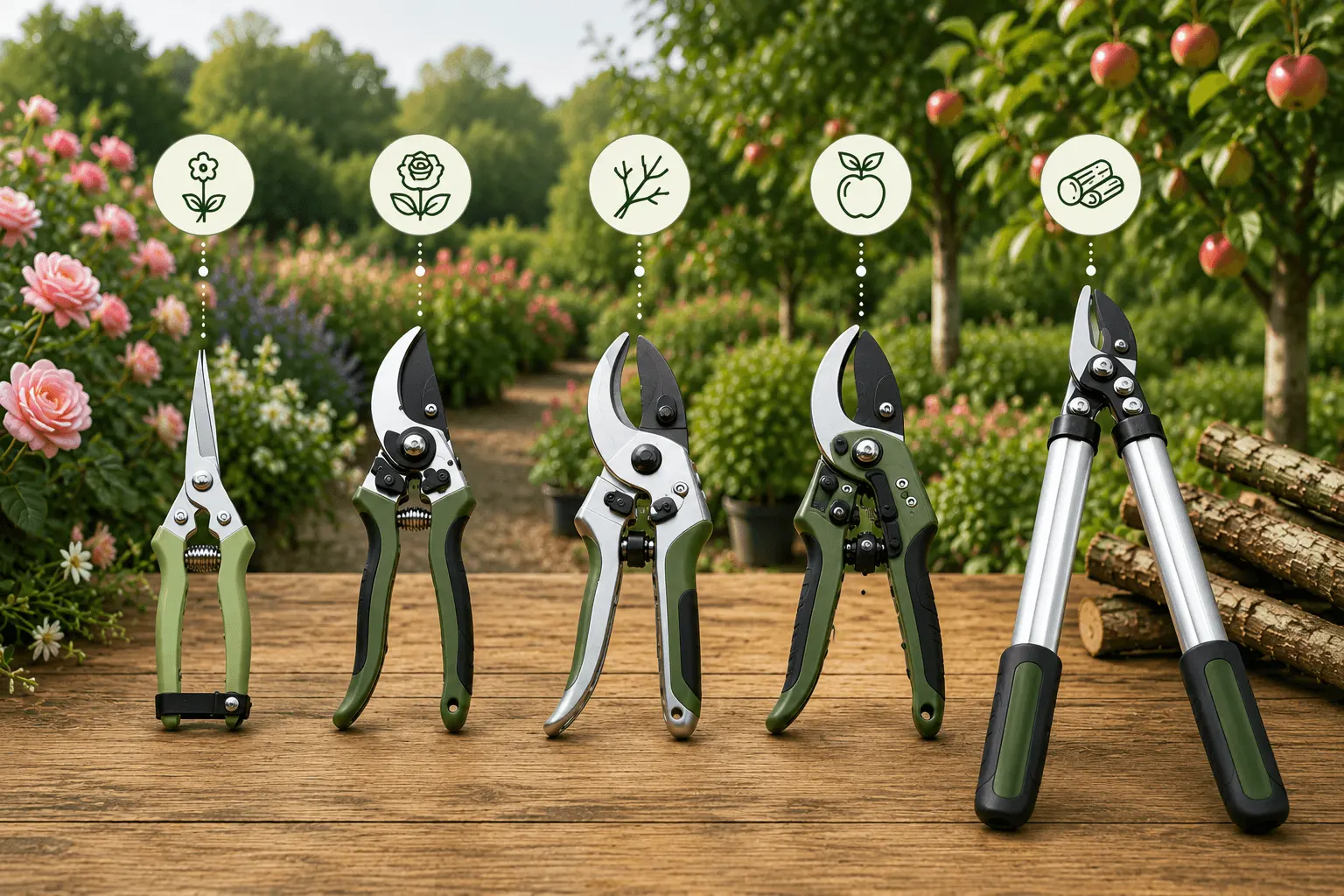
Move from the flower arranging table to the rose bed, and the cutting challenge shifts from precision to power — the stems are thicker, the tissue is fibrous, and the wrong cut invites disease. This is the most common pruning task for home gardeners and the reason bypass hand pruners are the best-selling category in most garden tool ranges.
What the user is cutting: Live green branches, rose canes, fresh shrub stems. Diameter typically ranges from 5 mm up to 20–25 mm for mature rose canes. The tissue is living, fibrous, and needs a clean slice — not a crush — to heal properly and resist disease.
What the tool needs to do: Make a clean, overlapping cut that slices through the branch without crushing the cambium layer. Academic research confirms that dual-blade (bypass) tools cause less mechanical damage to living tissue and produce faster healing compared to single-blade (anvil) tools. For roses specifically, the cut should be made at approximately 45 degrees, angled outward above a bud, so that water drains away from the wound rather than pooling on it.
The right tool category: Bypass hand pruners. Two blades that overlap like scissors — the cutting blade passes beside the hook blade, producing a clean slice. This is the only structure appropriate for live green wood. Garden Design and multiple horticultural sources explicitly state: bypass blades overlap and make a clean cut; anvil blades meet and can crush or damage canes.
Why anvil pruners are wrong for this job: An anvil blade presses the live branch against a flat plate. The result is a crushed, uneven cut that damages the cambium layer and creates an entry point for disease — particularly canker and dieback on roses.
What to look for in a bypass pruner for this segment:
- Blade quality that holds an edge through a full season of weekly use (SK5 or equivalent high-carbon steel with proper heat treatment)
- A handle span that fits the target hand size — too wide for small hands means the user cannot close the tool in one motion; too narrow for large hands means cramped, fatiguing grip
- A reliable lock that stays closed in storage and opens easily with one hand
- Optional: a sap groove on the hook blade to reduce buildup during cutting
Buyer mistake to avoid: Recommending an anvil pruner to customers who primarily prune live green branches. The structure is designed for dry wood, and using it on live tissue causes damage that bypass avoids.
Dry, Dead or Harder Wood
When the branch is already dead, dry, and hard, the cutting challenge changes.
What the user is cutting: Dead branches, dried canes, hard woody stems that have lost their flexibility. The fibers are rigid, and the branch does not compress under the blade — it resists.
What happens when you use bypass on dry wood: The two overlapping blades try to slice, but a dry, hard branch can slide between them instead of being cleanly cut. The result is a partial cut, a jammed blade, or a torn branch end that looks rough and takes longer to clean up.
The right tool category: Anvil pruners. A single blade presses the branch straight down onto a flat plate (the anvil). The branch cannot slide between the blades because there is only one blade — it is trapped against the plate and cut by direct pressure. This works well on dry, hard material that bypass struggles with.
What to watch for: An anvil pruner with a dull blade does not cut — it crushes. When the blade edge is no longer sharp enough to slice, the tool presses the stem against the plate and flattens it instead of cutting through. Regular blade replacement or resharpening is essential for anvil pruners in active use. Some professional anvil models offer replaceable blades, which is a practical advantage for channels that serve landscape maintenance crews.
The core principle for buyers: Bypass for live, anvil for dead. This is not a preference — it is a structural difference that directly affects cutting performance and plant health. Stock both, or half your customers are using the wrong structure for their material.
Fruit Trees, Vineyards and Orchard Work
Orchard and vineyard pruning is professional work: high frequency, large volume, and specific requirements that go beyond what a home-gardening pruner can deliver.
What the user is cutting: Live fruit tree branches (10–25 mm), dead wood that needs removal, and grapevine canes that are thin but cut in massive volume. A single apple tree may require dozens of cuts during annual pruning; a vineyard worker may make hundreds of cuts per day during the pruning season.
What the tool needs to do: Hold up under hundreds of cuts per day without blade degradation, handle fatigue, or pivot loosening. Provide a clean cut on live tissue (bypass structure) while also offering a way to handle the occasional dead branch (anvil or a second tool). Stay serviceable — when the blade dulls or the spring breaks, a professional user needs to replace that part and keep working, not discard the entire tool.
The right tool combination for this segment:
- A professional-grade bypass pruner with replaceable parts (blade, spring, buffer, pivot nut) for daily live-branch work. Models designed for medium and large hands, with forged aluminum handles and adjustable pivot tension.
- An anvil pruner for dead wood removal — or a bypass pruner with enough cutting capacity to handle moderately dry material without jamming.
- A lopper for branches beyond the hand pruner’s comfortable range (typically above 25 mm).
- For high-volume operations: electric pruners that can cut up to 30–40 mm diameter, reducing hand fatigue over long work sessions. Battery-powered models typically offer 6–8 hours of runtime per charge.
Critical risk that many buyers overlook: disease transmission between plants. Pruning tools can carry pathogens from one cut to the next. Fire blight (Erwinia amylovora) is a well-documented example — research on disinfectants for pruning shears confirms that tool sanitation between cuts is a real disease management practice, not optional hygiene advice. For orchard and vineyard channels, this is a reason to stock pruners with smooth, easy-to-clean blade surfaces (hard chrome plating or similar) and to recommend that customers sanitize blades between trees or between rows. Some professional models (such as FELCO 8P) integrate a disinfectant spray system that applies sanitizer at each cut — a feature that is genuinely relevant for commercial orchard use, not a marketing gimmick.
Buyer mistake to avoid: Supplying only one tool type to orchard/vineyard channels. These users encounter both live and dead material, both thin canes and thicker branches, and they need a tool combination — not a single model that is “almost right” for half of the work.
Want to see how a professional bypass pruner with replaceable parts performs against a standard model on the same orchard branches? Send us your target cutting diameter and work intensity. Scarecrow Garden can arrange a side-by-side sample test with documented results.
Thick Branches and Landscape Maintenance
When the branch diameter exceeds what a hand pruner can handle comfortably and safely, the user needs a different class of tool — not a bigger hand pruner, but a tool with more leverage.
What the user is cutting: Landscape tree branches, thick shrub limbs, hedge restructuring cuts. Diameter ranges from 25 mm to 50 mm and above. These are branches that a hand pruner might occasionally cut on a good day with a strong user — but cannot cut consistently, safely, or without damaging the blade over time.
Why forcing a hand pruner beyond its range is the wrong approach: A hand pruner designed for 20 mm cutting capacity that is repeatedly used on 30 mm branches will develop blade nicks, pivot loosening, and handle stress. The cut quality degrades — the branch end is torn rather than sliced, which slows healing and increases disease risk. And the user’s hand absorbs the extra force, producing fatigue and potential injury over a work session.
The right tool categories for this range:
- Loppers (500–900 mm overall length, 980–1600 g): Two-hand operation provides leverage that a one-hand pruner cannot match. Bypass loppers for live thick branches, anvil loppers for dead thick wood — the same structural principle applies at this scale.
- Gear-assist or compound-leverage loppers (such as FISKARS PowerGear): Mechanisms that multiply the user’s grip force, allowing cleaner cuts on hard material with less effort. Force-multiplication claims are brand-specific marketing statements based on the brand’s own testing conditions — they are not independently verified industry benchmarks, but the mechanism itself genuinely reduces the effort required for thick cuts.
- Pruning saws for branches above 35–50 mm: When the diameter exceeds what even a lopper can handle cleanly, a saw is the appropriate tool — not a pruner being pushed past its design limit.
Buyer mistake to avoid: Stocking only hand pruners for a landscape maintenance channel and expecting customers to “just use the biggest one” for thick branches. This leads to damaged tools, torn cuts, and customers who conclude that your pruners are not good enough — when the real problem is that they were given the wrong tool class for the job.
Users with Small Hands, Limited Grip or Repetitive Tasks
So far, every scenario has been about the branch. But the person holding the tool matters just as much — and this is where most wholesale ranges have their biggest blind spot.
Small hands: A pruner with a handle span that is too wide cannot be closed in one smooth motion. The user either struggles to complete the cut, uses two hands (which reduces control), or avoids the tool entirely. Professional lines like FELCO offer models specifically sized for smaller hands (FELCO 6 at approximately 210 g, 195 mm overall, compared to FELCO 2 at approximately 251 g, 215 mm for larger hands). This is not a “women’s version” — it is a different tool geometry for a different hand size, and it performs just as well within its intended range.
Limited grip strength: Users with reduced hand strength — whether from age, arthritis, injury, or simply smaller hands — cannot generate enough force to close a standard bypass pruner on a 20 mm branch in one motion. Two tool categories address this:
- Ratchet pruners: The ratchet mechanism allows the user to close the tool in stages — squeeze, release, squeeze again — accumulating cutting force across multiple steps without requiring a single strong grip. This genuinely works for harder material that a one-squeeze bypass pruner cannot handle with limited grip strength.
- Rotating-handle pruners (such as Bahco ERGO): The lower handle rotates during the closing motion, reducing friction between the handle and the user’s fingers. This helps prevent blisters and fatigue during long repetitive sessions — a real practical benefit for vineyard workers and landscape crews who make hundreds of cuts per day. Research on occupational health in vineyard pruning confirms that hand and wrist musculoskeletal strain is a documented risk in this work, and tool ergonomics is part of the mitigation.
Left-handed users: Standard bypass pruners are designed for right-hand closing motion. A left-handed user operating a right-handed pruner must reverse the grip, which reduces cutting precision and can cause the blade to misalign over time. FELCO 9 is the left-handed version of FELCO 2 — same quality, same parts availability, mirrored blade orientation. This is a small but real segment in any customer base, and carrying at least one left-handed model prevents the “we do not have anything for you” gap.
Buyer mistake to avoid: Assuming that one handle size and one mechanism type covers all users. Small hands, reduced grip, and left-handedness are not edge cases — they are normal variations that affect tool performance and user safety. A range that includes at least one compact model, one ratchet or rotating-handle option, and one left-handed model covers the majority of these needs without requiring a massive SKU expansion.
Buyer Matrix: Match the Customer to the Right Tool
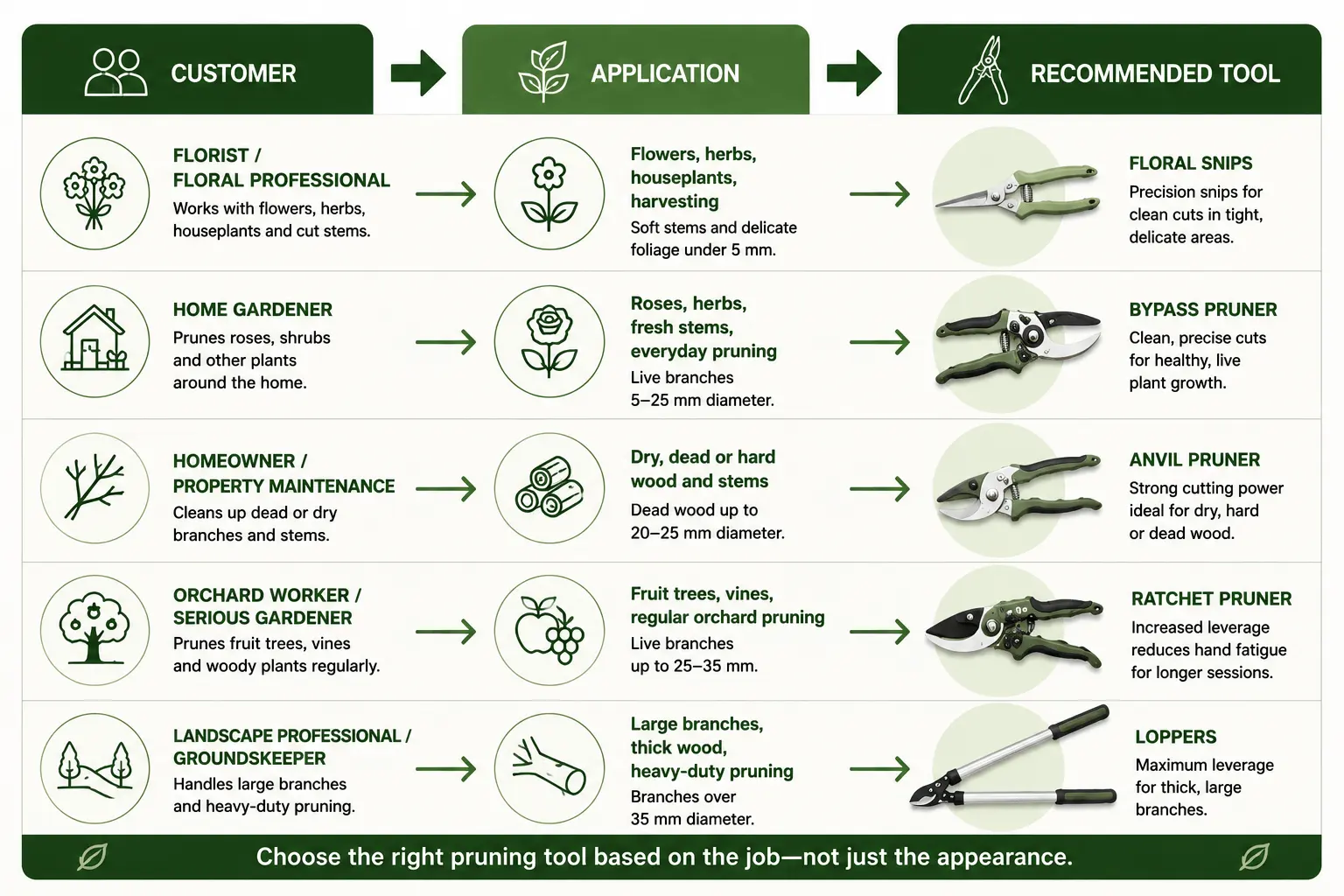
Instead of stocking random models that look different in the photo, build the range around clear product roles. Each role exists because a specific customer group has a specific job that a specific tool structure handles better than any alternative.
| Customer Group | Primary Job | Recommended Primary Tool | Recommended Secondary Tool | Tool to Avoid Recommending |
| Florist / flower arranger | Cutting flower stems, trimming foliage for arrangements | Straight-blade floral snip | Lightweight bypass snip for woody stems | Anvil pruner (crushes soft stems) |
| Indoor plant owner | Trimming houseplant shoots, deadheading | Small curved-blade snip | — | Large bypass pruner (too heavy, too wide for indoor precision) |
| Home gardener with roses and shrubs | Weekly pruning of live branches | Mid-range bypass pruner (SK5 blade, aluminum handle with overmold) | Anvil pruner for occasional dead wood | Anvil as the only option (wrong for the majority of their cuts — based on industry experience, most home gardener pruning involves live green branches) |
| Orchard / vineyard professional | Daily high-frequency pruning, live and dead material | Professional bypass with replaceable parts | Anvil for dead wood, lopper for thicker branches | Entry-level pruner without replaceable parts (fails under daily use) |
| Landscape maintenance crew | Mixed live and dead branches, some thick | Professional bypass + anvil pair | Gear-assist lopper for thick branches | Single bypass model expected to handle everything |
| Customer with small hands or reduced grip | Light to moderate pruning, limited hand strength | Compact bypass pruner or ratchet pruner | Rotating-handle model for repetitive work | Standard-size bypass with wide handle span |
| Garden center general range | Serving all of the above | Good-better-best bypass tier + snip + anvil + lopper | Ratchet option, left-handed option | Only one bypass model in one size |
This matrix is a starting framework, not a fixed formula. The exact models and SKU count should match the channel, the shelf space, and the customer mix. But the principle is consistent: each row exists because a real customer group has a real job that a specific tool type handles better. Removing a row means leaving that customer group without the right tool — and that gap shows up as returns, complaints, and customers who shop elsewhere.
For buyers building a range around use cases rather than appearance, we can recommend specific models for each row in this matrix — based on your channel type, your target retail price, and your customer demographics. Tell us which customer groups walk through your door, and we can prepare a matched sample set that covers those groups rather than guessing from a catalog.
If you're unfamiliar with the product categories, begin with Types of Pruning Shears: Wholesale Guide to Uses, Price & Quality.
How to Turn Use Cases into a Wholesale Assortment
The matrix above shows why different tools are needed. The next step is turning that understanding into a practical product range — not 20 random models, but 6–10 tools with clear roles.
A compact starter range might include:
Floral / harvesting snip (straight blade)
Entry bypass pruner (carbon steel blade, plastic handle — for occasional home use)
Core bypass pruner (SK5 blade, aluminum handle with overmold — for regular gardeners)
Anvil pruner (for dead wood across all user levels)
Lopper (bypass, for thick live branches beyond hand pruner range)
A broader range adds: 6. Professional bypass pruner with replaceable parts (for orchard/vineyard/landscape trade) 7. Ratchet pruner (for reduced grip strength) 8. Compact bypass pruner (for small hands) 9. Left-handed bypass pruner 10. Gear-assist lopper (for landscape crews handling hard thick wood)
Each addition should be justified by a customer group and a job that the existing range does not cover. If a proposed SKU does not serve a clear role that is currently missing, it is redundancy — not range depth.
Different customers need different pruning tools. Share your customer groups, target retail prices, preferred packaging and quantity plan. We can match each customer group to the right tool type, prepare samples from different price levels for a side-by-side cutting comparison, and help build a use-case-based pruning range instead of offering random similar-looking models.
FAQ
What pruning shears are best for roses and live stems?
Bypass pruners. The two overlapping blades make a clean slice through live tissue, which promotes faster healing and reduces disease risk. Anvil pruners crush live stems — they are designed for dead wood, not green branches. For roses specifically, choose a bypass pruner with a blade that holds its edge through a full season, a handle span that fits your hand size, and a sap groove to reduce buildup during cutting.
Which pruning tool is suitable for flowers and herbs?
Pruning snips or floral shears. These are shorter and lighter than standard hand pruners, with narrow or pointed blades that reach between closely spaced stems. Straight-blade snips are best for floral arranging (clean flat cuts for vase insertion); curved-blade snips are better for trimming within dense foliage. Do not use anvil pruners on soft flower stems — they crush rather than slice.
Are anvil pruners suitable for dead wood?
Yes — that is what they are designed for. The single blade presses the dry, hard branch against a flat plate, trapping it so it cannot slide between the blades. Bypass pruners struggle with dry wood because the hard branch can slip between the two overlapping blades. The key rule: bypass for live, anvil for dead. Stocking both types gives customers the right tool for both conditions.
What should orchard and vineyard buyers look for in professional pruners?
Three priorities: replaceable parts (blade, spring, buffer — so the tool stays in service rather than being discarded when one component wears out), a blade surface that is easy to clean and sanitize between trees (hard chrome plating or similar smooth finish), and a handle size and shape that fits the worker’s hand for hundreds of cuts per day. Orchard and vineyard pruning also requires a tool combination — bypass for live wood, anvil for dead, and a lopper for thicker branches. One model cannot cover all the material these users encounter.
When should a customer switch from hand pruners to loppers?
When the branch diameter exceeds the hand pruner’s comfortable and consistent cutting range — typically around 20–25 mm, depending on the specific model and the user’s grip strength. A practical test: if the user has to use two hands or rock the blade back and forth to complete a cut, the branch is beyond the hand pruner’s range — and that is the moment to switch to a lopper. Forcing a hand pruner beyond its range produces torn cuts, blade damage, and hand fatigue. Loppers provide the leverage that hand pruners cannot, and they are the right tool for branches in the 25–50 mm range. Beyond that, a pruning saw is the appropriate choice.
Which pruning shears are suitable for small hands or limited grip strength?
Two categories: compact bypass pruners with a narrower handle span (such as FELCO 6, designed for smaller hands at approximately 210 g and 195 mm overall), and ratchet pruners that accumulate cutting force across multiple squeezes so the user does not need one strong grip. Rotating-handle models (such as Bahco ERGO) reduce finger friction during repetitive work. Do not assume that a standard-size pruner with a wide handle span will work for every user — it will not, and the result is poor cutting performance and potential hand strain. For garden center ranges, carrying at least one compact model and one ratchet option covers the majority of these needs without doubling the SKU count — see the Buyer Matrix above for the exact placement.
mporters building a complete assortment should also read How Wholesalers Should Build a Pruning Shears Product Range.
Create A Smarter Pruning Tool Line
Send us your target market, quantity expectations, packaging requirements and reference photos. GardenToolsWholesale can help compare models, prepare different price levels, arrange samples, and build a complete pruning SKU sourcing plan.
📩 Start Your Inquiry Explore More Products