









Updated 2 months ago
How Wholesalers Should Build a Pruning Shears Product Range
SCARECROW GARDEN SUPPLIER
How Wholesalers Build a High-Profit Pruning Shears Range | Scarecrow Garden Supplier
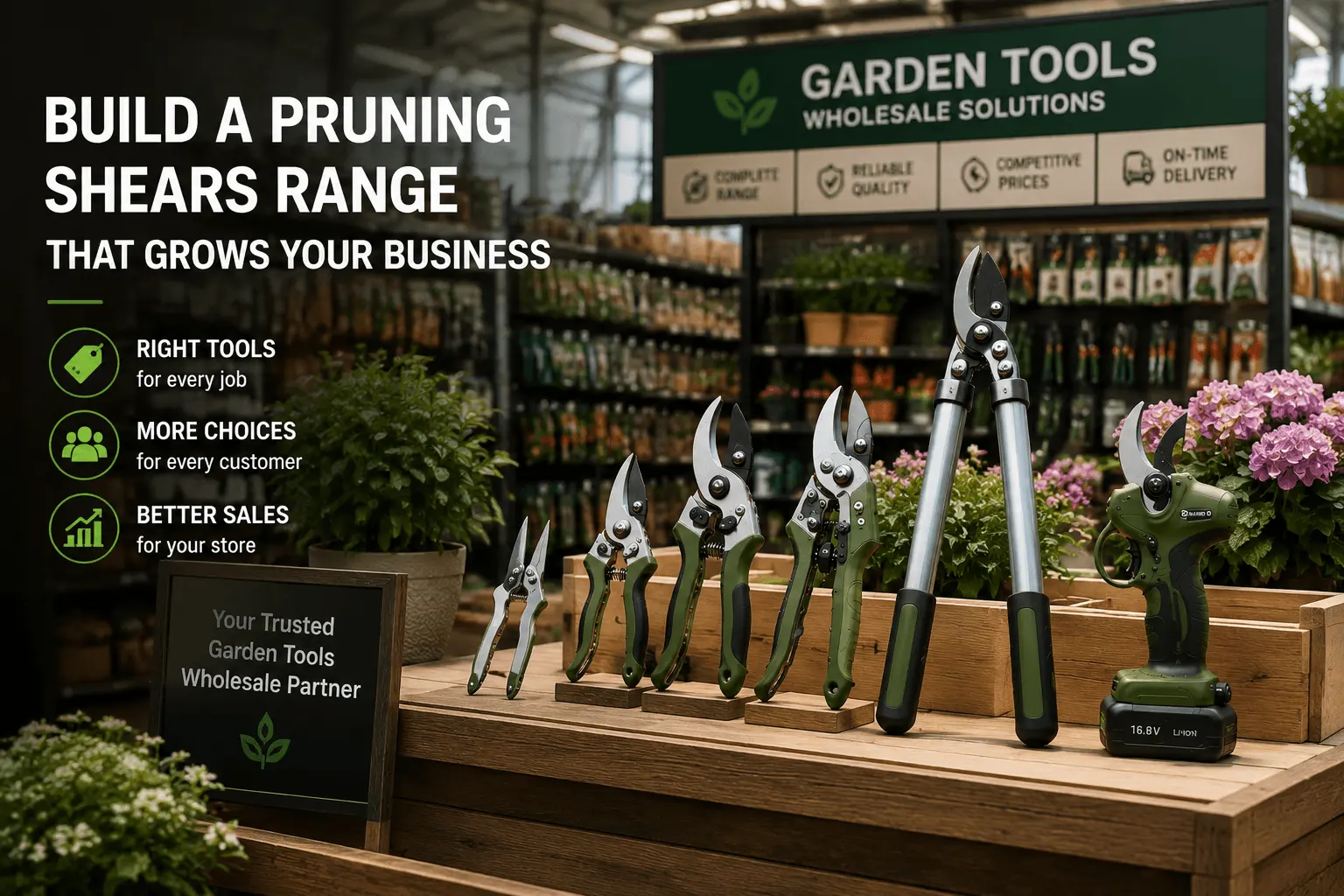
A pruning shear category with only one model is not a category — it is a placeholder. The customer who walks in looking for a tool to deadhead her roses, the orchard worker who needs a pruner that can be serviced rather than discarded, and the landscape crew member who cuts 200 branches before lunch all need different tools. One SKU cannot serve all three.
This article explains how to build a pruning shear range that covers real customer needs without creating inventory chaos. The goal is not “more SKUs” — it is “every SKU has a clear role, and every role covers a real customer group with a real job.”
Why a One-SKU Pruning Category Leaves Sales Gaps
Three gaps appear when a wholesaler carries only one pruning shear model:
A scenario gap. A single bypass pruner cannot handle dry dead wood (which needs an anvil structure), fine flower stems (which need narrow snip blades), thick branches (which need a lopper’s leverage), or a user with small hands or reduced grip strength (who needs a different handle span or mechanism). The customer who needs any of these tools walks out — or buys the wrong one and returns it.
A price gap. The entry-level buyer who wants a $5 tool for occasional use and the professional who expects a$50 tool with replaceable parts are not the same customer. A single SKU priced at $15 loses the entry buyer (too expensive) and the professional buyer (not durable enough). The price point that works for one group leaves the other group unserved.
A channel gap. A garden center that wants depth — multiple models, multiple price tiers, and specialty options — gets none of that from a single SKU. A hardware store that wants a simple Good-Better-Best selection in three models gets a range that is either too thin or too confusing. An e-commerce seller who needs bundle-ready SKUs gets one product with no complementary options to attach.
The result is not just lost sales. It is lost customers — because the buyer who cannot find the right tool at your store will find it at the next one.
If you carry only one pruning shear model and want to expand, send us your current best-seller’s specs, your channel type and target price range. Scarecrow Garden can recommend which structural roles your range is missing and provide samples to fill those gaps.
Build the Range by Product Role, Not by Random Style
The most common mistake in pruning shear ranges is adding SKUs that look different but do the same job. Three bypass pruners in three colors at three slightly different prices are three SKUs filling one role. The customer who needs an anvil pruner for dead wood, a snip for flower stems, or a ratchet pruner for reduced grip strength still finds nothing that matches their job.
A productive range assigns each SKU a structural role — a different tool type that covers a different cutting scenario, and a commercial role — a job within the business. Based on industry experience, the typical mix looks like this: roughly 10% traffic-driving models priced low to attract new customers, roughly 20% high-margin models where the margin justifies deeper support, roughly 60% mainstream daily sellers that generate consistent revenue, and roughly 10% promotional bundles or seasonal items that drive conversion at specific moments. These proportions are a planning framework, not a fixed formula — the exact mix depends on the channel and the customer base.
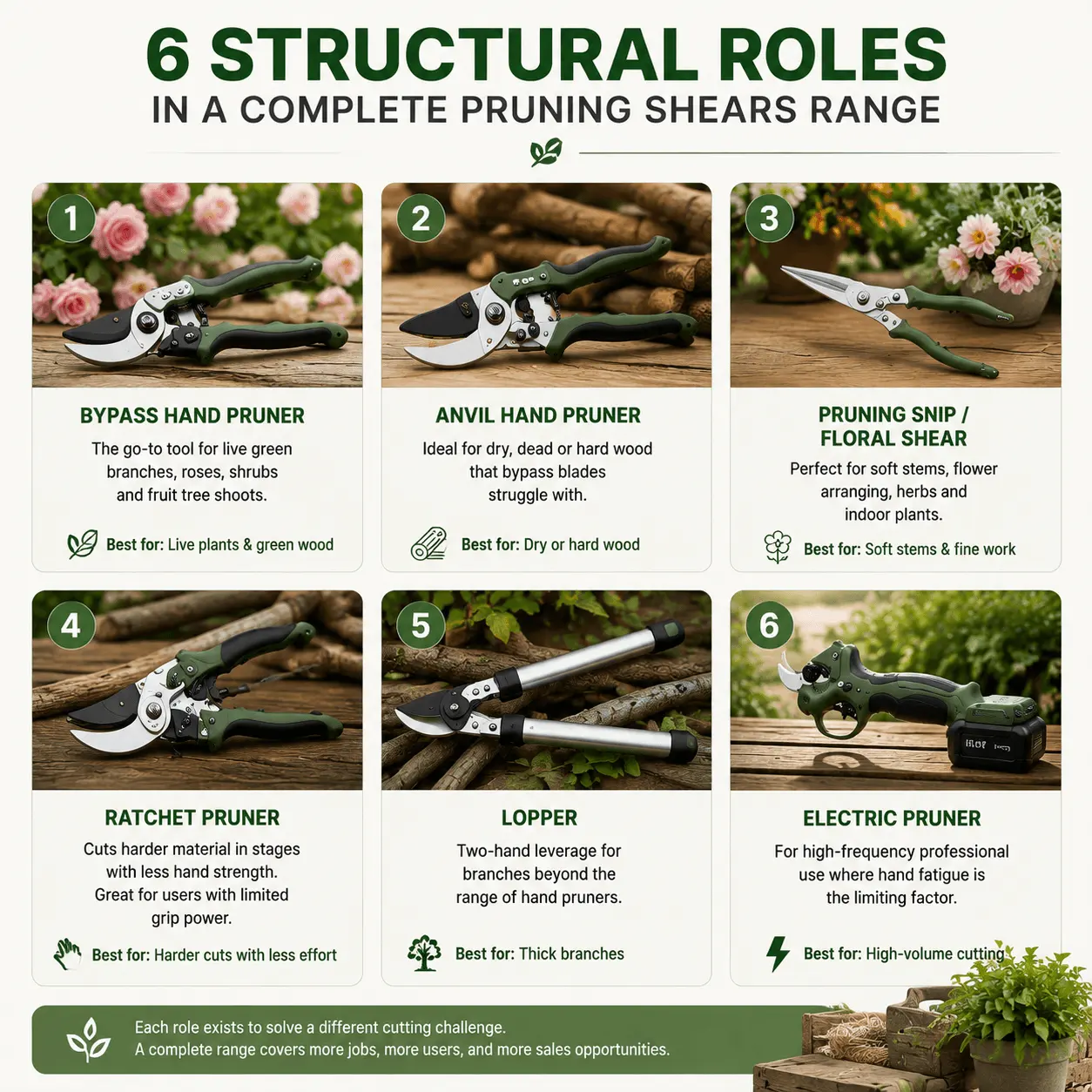
The six structural roles that a complete pruning shear range should consider:
Bypass hand pruner — the primary tool for live green branches (roses, shrubs, fruit tree shoots). This is the core SKU in almost every range.
Anvil hand pruner — for dry, dead, or hard wood where bypass blades struggle. A different cutting mechanism for a different material.
Pruning snip / floral shear — for soft stems, flower arranging, herb harvesting, and indoor plant trimming. Shorter, lighter, narrower blades for precision work in tight spaces.
Ratchet pruner — for users with reduced grip strength who need to cut harder material in stages rather than one squeeze. A different mechanism for a different user.
Lopper — for branches beyond the hand pruner’s range. Two-hand leverage for a different scale of work.
Electric pruner — for high-frequency professional use (orchards, vineyards, landscape crews) where hand fatigue is the limiting factor. A different power source for a different work intensity.
Each role exists because a specific customer group has a specific job that this tool type handles better than any alternative. Removing a role means that customer group has no matching product in your range. Adding a second SKU within the same role (same structure, same target user, different color) increases inventory without increasing coverage.
Start by understanding the different Types of Pruning Shears: Wholesale Guide to Uses, Price & Quality before selecting products.
Use a Good-Better-Best Structure
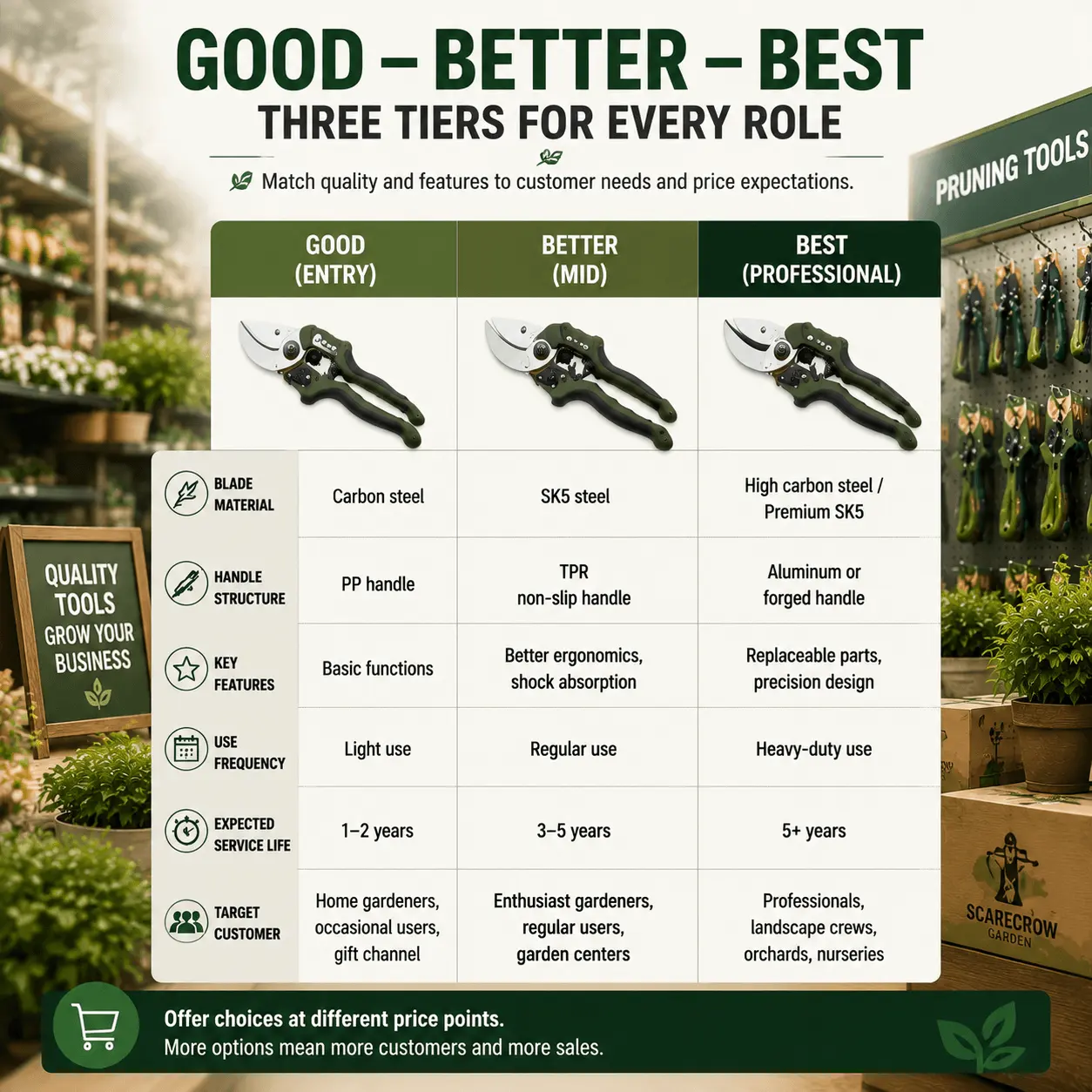
Within each structural role, most wholesale ranges use a three-tier pricing model. This is not about “cheap, medium, expensive” — it is about matching the tool’s build quality, service life, and feature set to the customer’s use frequency and budget expectation.
| Tier | Typical Wholesale Price Range | Blade Material | Handle Structure | Key Features | Expected Service Life | Target Customer |
| Good / Entry | $3–8 | 65Mn or basic carbon steel, HRC ~53 | Stamped steel or cast aluminum, PVC/plastic grip | Simple rivet pivot, wire spring, basic lock, no replaceable parts | 1–2 seasons of occasional use | Occasional home gardener, impulse buyer, gift channel |
| Better / Mid | $15–30 | SK5 with proper heat treatment, HRC 55–62 | Forged aluminum handle with TPR/PVC overmold | Adjustable pivot, volute or buffer spring, reliable lock, replaceable blade available | 3–5 years of regular use | Frequent gardener, garden center mainstream, semi-professional |
| Best / Professional | $50–100+ | SK5 or stainless, precision-ground, hard chrome plating | Forged aluminum or full steel, rotating handle option | Full parts availability, precision pivot, professional lock, ergonomic shaping | 10+ years with parts replacement | Daily professional user, orchard/vineyard/landscape trade |
Each tier is a legitimate product for a legitimate customer. The Entry-tier pruner at $3 wholesale is not defective — it is built for a different use frequency and a different budget. The Professional-tier pruner at$50+ is not overpriced — it is built for daily use over years, with a service-life strategy that replaces individual parts instead of discarding the whole tool.
The mistake is not choosing the Entry tier. The mistake is choosing the Entry tier and expecting it to perform like the Professional tier, or stocking only the Professional tier and expecting impulse buyers to pay that price. A Good-Better-Best structure gives each customer group a product that matches their needs — and it gives the retailer a natural upsell path from Good to Better when the customer is ready to upgrade.
Match the Assortment to the Sales Channel
The number of SKUs and the depth of each tier should match the channel. A garden center needs a different range than a hardware store, and both need a different range than an e-commerce seller.
| Channel | Recommended SKU Depth | Range Focus | Typical Core Models |
| Garden center / specialty retailer | 8–10+ | Full scenario coverage with professional options | 2 bypass tiers (Good + Better) + 1 anvil + 2 snips (straight + curved) + 1 ratchet + 1 lopper + 1 professional bypass (Best) |
| Hardware store / DIY retailer | 3–5 | Simple Good-Better-Best with clear labels | 2 bypass tiers (Good + Better) + 1 anvil + 1 lopper |
| E-commerce (Amazon, Shopify) | 3–5 hero SKUs + bundles | Best-selling models plus complementary bundles | 1 bypass hero (Better tier) + 1 snip + 1 bundle set (bypass + snip + gloves) |
| Supermarket / big-box seasonal | 2–3 | Entry-level plus seasonal promotion | 1 Entry bypass + 1 seasonal gift set |
| Orchard / vineyard / landscape supply | 6–10 | Professional-grade with service-life strategy | 1 Pro bypass + 1 Pro anvil + 1 lopper + 1 electric option + replacement parts |
| Florist / flower supply | 3–4 | Precision snips plus light bypass | 2 snips (straight + curved) + 1 light bypass |
The principle is consistent: the range should cover the customer groups that walk through that specific door. A garden center customer expects to see options and compare — giving them only one bypass model feels incomplete. A hardware store customer expects a quick decision between three clear choices — giving them ten models feels overwhelming. An e-commerce customer expects a bundle that solves their problem in one click — giving them individual SKUs without a combined option misses the conversion opportunity.
A complete pruning range does not need dozens of random models. Tell us your channel, target customers and price levels, and we can help assign each SKU a clear role before you invest in inventory — then consolidate orders from multiple suppliers, inspect and repack at our warehouse, and ship the full range together rather than managing five separate factory shipments.
Product Range Examples: Starter, Standard and Professional
Instead of listing every possible SKU, here are three concrete range configurations that match three common buyer situations.
5-SKU Starter Range — for hardware stores, small garden retailers, or e-commerce sellers testing the category:
| Role | Tool Type | Tier | Why This Role Exists |
| Core daily seller | Bypass pruner, SK5 blade, forged aluminum handle with overmold | Better ($15–25) | The model that most customers actually buy — not the cheapest, not the most expensive, but the one that matches regular gardeners |
| Traffic driver | Bypass pruner, 65Mn blade, plastic handle | Good ($5–8) | Low price attracts new customers and covers the occasional-user segment |
| Scenario supplement | Anvil pruner, SK5 blade | Better ($12–20) | Covers the dead-wood scenario that the bypass pruner cannot handle well |
| Precision supplement | Floral snip, stainless steel blade | Good ($5–10) | Covers flower, herb and houseplant users who need a different tool class |
| Scale supplement | Bypass lopper, SK5 blade, 60 cm | Better ($25–35) | Covers thick branches beyond hand pruner range |
Five roles, five SKUs, no duplication. This is the minimum range that covers the most common customer groups without leaving gaps.
8-SKU Standard Range — for garden centers and mid-size retailers that want depth:
When the channel demands more depth, three additions fill three specific gaps — not three more bypass models in three more colors.
The 5-SKU starter plus three additions:
| Role | Tool Type | Tier | Why This Role Exists |
| Upsell / margin driver | Bypass pruner, SK5 precision-ground, rotating handle option | Best ($40–60) | The professional-grade model that serves daily users and creates a natural upsell from the Better-tier bypass |
| Special user | Ratchet pruner, carbon steel blade | Better ($15–25) | Covers users with reduced grip strength who cannot close a standard bypass in one squeeze |
| Seasonal conversion | 3-piece set (bypass + snip + gloves) in unified packaging | Good (set price $12–18) | Bundle that simplifies the buying decision for gift shoppers and first-time gardeners |
10+ SKU Professional Range — for orchard/vineyard supply, landscape trade, and large specialty retailers:
For professional channels, the range extends further — but every addition still answers the same question: which customer group does this serve that the current range does not?
The 8-SKU standard plus additions based on channel demand:
| Role | Tool Type | Tier | Why This Role Exists |
| High-frequency professional | Electric pruner, 30 mm cutting capacity | Best ($80–150) | Replaces hand fatigue with battery power for workers making hundreds of cuts per day |
| Small-hand professional | Compact bypass pruner, forged aluminum, ~210 g | Best ($50–70) | Same professional quality as the full-size model, sized for smaller hands |
| Left-handed option | Left-handed bypass pruner, mirrored blade | Best ($50–70) | Same quality, mirrored geometry — prevents the “nothing here fits my hand” gap |
| Extension options | Pruning saw, grafting tool, hedge shears | Various | Adjacent cutting tools that round out the pruning category for comprehensive retailers |
Each addition should be justified by a customer group and a job that the existing range does not cover. If a proposed SKU does not serve a clear role that is currently missing, it is redundancy — not range depth.
Different customers require different tools. See Which Pruning Shears Fit Which Job? A Use-Case Guide for Buyers and Retailers.
Cross-Selling and Bundles
A pruning shear range generates more revenue per customer when the tools are sold in combination rather than only as individual items. Three bundle models work well in this category:
Scenario bundles — “everything you need for one job.” A rose pruning kit (bypass pruner + floral snip + puncture-resistant gloves + pruning sealant) lets the rose gardener buy a complete solution in one decision. A orchard work kit (professional bypass + anvil + lopper + blade sanitizer) lets the orchard buyer equip a worker for all the material they will encounter. The bundle simplifies the purchase and increases the average order value — the customer gets more utility, and the retailer gets more revenue per transaction.
Tier bundles — “cover the basics at every level.” An entry-level starter set (Entry bypass + Entry anvil + Entry snip in a unified package) gives the first-time buyer three tools that cover their most common scenarios without requiring them to research and select individually. The bundle price is typically lower than buying the three items separately, which drives conversion for price-sensitive customers.
Professional bundles — “equip the trade.” A professional package (Pro bypass + replacement blade + replacement spring + holster) gives the daily user a service-life strategy in one purchase. The initial tool plus the parts that will keep it running for years — this is not a discount bundle, it is a maintenance strategy sold as a package, and it creates recurring parts revenue for the retailer.
Cross-selling triggers that work in this category: a customer buying a bypass pruner should see the anvil option for dead wood nearby; a customer buying a lopper should see the matching hand pruner for smaller branches; any pruning tool purchase should display gloves and a sharpening tool as natural companions.
Packaging and Shelf Architecture
Packaging is not just a cost layer — it is the architecture that makes a multi-SKU range look like a coordinated product line rather than a random assortment.
Visual consistency across the range. When a customer sees five pruning tools on a shelf, they should immediately recognize that these products belong to the same family — not five different brands in five different color schemes. Unified packaging colors, consistent label layout, and a shared visual language (same font, same icon style, same tier indicators) make the range feel intentional and professional. This is not about making packaging look pretty — it is about making the customer feel confident that these tools were selected to work together, not thrown together by accident.
Tier visibility. Good-Better-Best should be visible at a glance. The customer should be able to identify which tier they are looking at without reading the fine print — through packaging color coding (entry in one color, mid in another, professional in a third), clear price positioning on the label, and feature callouts that match the tier’s value proposition (“For occasional use” on the Entry pack, “Replaceable blade” on the Better pack, “Full parts availability, 10+ year service life” on the Professional pack).
Scenario labeling. Each SKU’s packaging should state what it is for — not just what it is. The label should answer the customer’s real question, not the engineer’s. “Bypass pruner for live branches” is more useful than “8-inch pruner.” “Anvil pruner for dead wood” is more useful than “Heavy-duty pruner.” “Floral snip for stems and arrangements” is more useful than “Mini pruning shear.” When the packaging answers the customer’s real question (“Which tool fits my job?”), the selection process becomes faster and more confident.
Packaging format by channel. Blister cards work for hardware stores and supermarkets — the tool is visible, the card hangs on a peg, and the format is cost-effective. Full-color boxes with inner trays work for garden centers and professional channels — the packaging protects the tool, presents it as a quality product, and provides space for feature information and usage guidance. Oxford pouch or holster combos work for professional trade — the packaging is part of the product (a working holster that the user carries on their belt), and it adds real utility rather than just display value.
Reduce Inventory Risk with Mixed-SKU Testing
Timing matters as much as quantity. Spring is the peak season for bypass pruners and snips (live-branch pruning and flower work). Autumn and winter shift demand toward anvil pruners and loppers (dead-wood clearing and dormant-season pruning). A range that launches in spring should front-load bypass and snip inventory; a range that launches in autumn should front-load anvil and lopper inventory. This seasonal context shapes the trial batch strategy below.
The biggest risk in building a new pruning shear range is not choosing the wrong models — it is ordering too much of each model before knowing which ones sell. A wholesaler who commits to 5,000 units of a SKU that sells 500 in the first season is paying for inventory that sits in storage for months or years, tying up capital and warehouse space that could be used for better-selling products.
Three practices reduce this risk:
Start small, then scale. Order a mixed trial batch — 50–100 units across 5 SKUs (10–20 units per model) — and track which models sell, which generate returns, and which sit on the shelf. The data from the first season tells you which roles are real demand and which are assumptions. Then scale the proven SKUs and drop or replace the slow ones.
Consolidate across roles. When multiple SKUs come from the same supplier or the same supply coordination team, they can be ordered together, shipped together, and managed together. This reduces the logistics cost per SKU and makes it practical to carry a wider range with smaller per-model quantities — because the warehouse and shipping overhead is shared across the whole order, not duplicated for each individual SKU.
Test with samples before committing to bulk. Before ordering any production quantity, request samples from the proposed range and test them against real branch material. This is where the specification sheet, the cutting test, and the packaging check become practical tools — not theoretical checklists. A sample that fails the cutting test, has a lock that sticks, or arrives with packaging that does not protect the blade should not become a bulk order regardless of how good the photo looked.
When multiple SKUs come from different suppliers, we can consolidate samples at our warehouse — receive them, check each one against its spec sheet, photograph key details, and ship them together to you. This means one sample shipment instead of five, and one set of comparison notes rather than separate evaluations arriving at different times.
Information to Send Scarecrow for a Range Proposal
Before we can recommend specific models, we need to understand your situation. The more you tell us, the more targeted the proposal:
- Your country or region — different markets have different pruning seasons, different plant types, and different retail price expectations.
- Your sales channel — garden center, hardware store, e-commerce, professional trade, or mixed. This determines the SKU depth and the packaging format.
- Your customer groups — who walks through your door or visits your site? Home gardeners, flower arrangers, orchard workers, landscape crews, or a mix? This determines which structural roles your range needs.
- Your target retail price bands — what do your customers expect to pay for a pruning tool? This determines which tiers to stock and which to skip.
- Your quantity plan — how many units per SKU in the first order? This determines whether we recommend a starter trial or a full-season commitment.
- Your packaging direction — blister card for peg display, color box for shelf presentation, holster combo for professional trade, or mixed? This affects both the unit cost and the retail presentation.
- Any reference photos or current best-sellers — if you already carry pruning tools that sell well, tell us which ones and why. We can build around your proven models rather than starting from zero.
Send us your current product list, market, target retail prices, order quantity and packaging direction. Scarecrow Garden Supplier can prepare a compact starter range or a broader pruning assortment, compare samples and coordinate mixed-SKU purchasing from China.
FAQ
How many pruning shear models should a wholesaler carry?
It depends on the channel. A hardware store or e-commerce seller can start with 3–5 models that cover the core structural roles (bypass, anvil, snip, lopper, and one tier variation). A garden center that wants depth should consider 8–10 models including professional options and specialty tools. An orchard or landscape supply channel needs 6–10 professional-grade models with parts availability. The number is not the point — the point is that every model serves a clear role that no other model in the range duplicates. If two models do the same job for the same customer, one of them is redundancy.
What is a Good-Better-Best pruning shear range?
Three tiers within each structural role, matched to three customer groups. Good/Entry ($3–8 wholesale, basic materials, occasional use) serves the impulse buyer and the budget-sensitive customer. Better/Mid ($15–30, SK5 blade, forged aluminum handle, replaceable blade) serves the regular gardener who uses the tool weekly. Best/Professional ($50–100+, full parts availability, ergonomic design, 10+ year service life) serves the daily professional who expects the tool to last and be serviceable. Each tier is a legitimate product — the mistake is stocking only one tier and expecting it to serve all three customer groups. A practical test: if your best-selling model accounts for more than 60% of pruning shear revenue, your range is probably under-serving the other tiers. The Good-Better-Best structure works when each tier has its own customer group buying at its own frequency — not when one tier dominates and the others sit on the shelf.
Which pruning tools are essential for a garden center?
A garden center customer expects to see options. The minimum range that covers the most common scenarios: two bypass pruners (Entry and Mid tier), one anvil pruner, two snips (straight blade for floral arranging and curved blade for dense foliage), one lopper for thick branches, and optionally one ratchet pruner for customers with reduced grip strength. This 6–7 model range covers five structural roles and three price tiers — enough depth for a garden center without overwhelming the shelf.
How can retailers avoid carrying too many similar pruning shear SKUs?
Assign each SKU a structural role — a different tool type for a different cutting scenario. If two SKUs share the same structure (both bypass, both targeting the same hand size and use frequency), they are filling the same role, and one should be dropped. The range should expand by adding new roles (anvil, snip, ratchet, lopper) — not by adding new colors or minor variations within the same role. A 5-SKU range that covers five roles is more useful to customers than a 10-SKU range that covers two roles in five colors.
What products can be bundled with pruning shears?
Three natural bundle types: scenario bundles (bypass + snip + gloves for rose pruning, or bypass + anvil + lopper for landscape work), tier bundles (Entry bypass + Entry anvil + Entry snip as a starter set), and professional bundles (Pro bypass + replacement blade + replacement spring + holster as a service-life package). Gloves, sharpening tools, blade sanitizer, and tool pouches are the most common cross-sell items. The bundle should solve a complete job for the customer, not just combine random products at a discount.
Can different pruning shear models be combined in one mixed order?
Yes — and this is one of the practical advantages of working with a supply coordination team rather than sourcing each model from a separate factory. When multiple SKUs come from the same supplier network, they can be ordered together, inspected together, and shipped together. This reduces the per-SKU logistics cost and makes it practical to carry a wider range with smaller per-model quantities, because the warehouse and shipping overhead is shared across the whole order rather than duplicated for each individual SKU. For the buyer, this means a 5-SKU starter range does not require five separate supplier relationships, five separate quality checks, and five separate shipping arrangements — it can be managed as one coordinated sourcing plan.
Wholesale Pruning Shear Sourcing Made Easier
Whether you are a retailer, distributor or importer, share your product requirements with us. We can recommend suitable pruning shear models, compare costs, prepare samples and combine different SKUs into one efficient purchasing solution.
📩 Request Wholesale Quote