










Updated 2 months ago
Types of Pruning Shears: Wholesale Guide to Uses, Price & Quality
SCARECROW GARDEN SUPPLIER
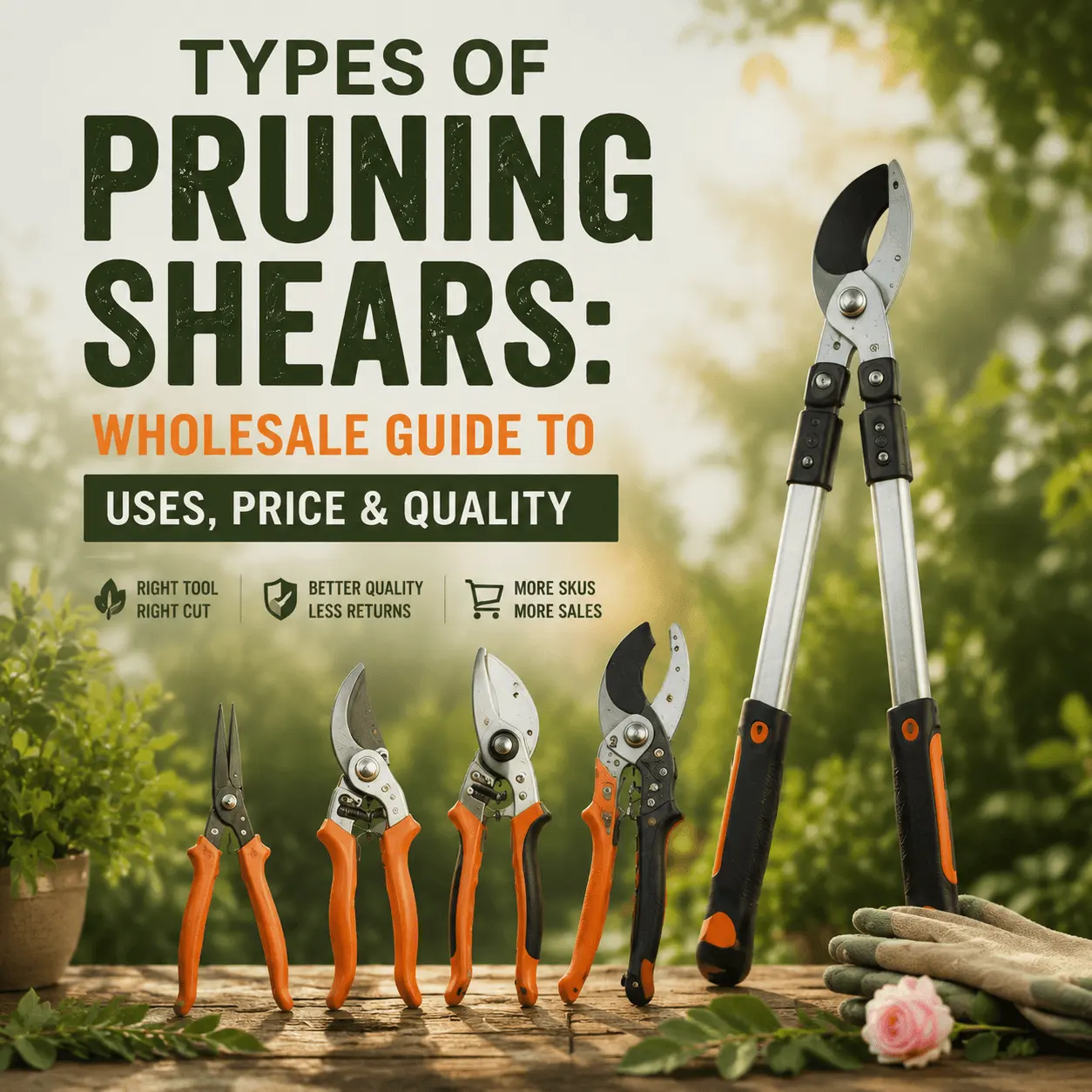
Types of Pruning Shears: Wholesale Guide to Uses, Price & Quality | Scarecrow Garden Supplier
Pruning shears is an umbrella category, not one single tool design. When wholesale buyers search for “pruning shears,” they are looking at a group of cutting tools that range from delicate floral snips shorter than your palm to two-hand loppers that handle branches too thick for any single-hand pruner. Understanding this range is the first step to building a product assortment that actually matches what your customers prune — and avoids the costly mismatch that drives returns and negative reviews.
This guide explains the main types of pruning shears and related cutting tools, why similar-looking models can carry very different prices, why wholesalers need more than one SKU, and what to specify and test before placing an order. Each section includes a clear buyer takeaway, and deeper coverage links to dedicated cluster articles.
Why “Pruning Shears” Covers More Than One Tool
The term “pruning shears” means different things in different markets. In the US, buyers say hand pruners. In the UK and much of Europe, the same tool is called secateurs. “Garden scissors” or “pruning scissors” can refer to anything from floral snips to hedge shears — and that ambiguity is where many sourcing mistakes start.
This guide covers manual pruning tools — the ones your customers hold in one hand or two. Electric pruning shears are a different category, worth considering for orchard buyers who need high-frequency cutting, but they are not what we are sorting out here.
The reason “pruning shears” is a category, not a single product, is simple: no one tool can handle every cutting task well. A short, narrow-blade snip gives you precision on soft stems and tight spaces, but it cannot cut a 20 mm live branch without straining the blade and the user’s hand. A bypass hand pruner handles live branches cleanly, but its curved blades cannot reach into dense foliage the way a thin-tip snip can. An anvil pruner crushes rather than slices, which makes it wrong for live wood but effective on dry, hard material. A ratchet mechanism reduces effort per squeeze, which helps users with limited grip strength but adds parts, weight and cost. Loppers add leverage and reach for thicker branches, but they require two hands and are not designed for the detailed shaping work that hand pruners do.
Each design solves a specific problem. The wholesale buyer’s job is to understand which problems their customers actually face, and then stock the tools that solve those problems — rather than offering one “universal” model and hoping it works for everyone.
From floral snips and harvesting shears to bypass pruners, anvil pruners, ratchet models, ergonomic options, left-handed versions, compact models for small hands, and loppers for thicker branches — we can source the full pruning tool range rather than just one or two models. Different plants, different branch diameters, different user preferences, and different sales channels all need different tool types, and a range that covers those differences serves more customers than a single SKU ever could.
The Main Types of Pruning Shears and Related Cutting Tools
Pruning Snips / Floral and Harvesting Snips
Pruning snips are the smallest and lightest tools in the pruning category. Typical overall length ranges from 140 to 210 mm, with narrow blades — straight, angled, or long-tipped — designed to reach into dense foliage, flower arrangements, and tight spaces between stems. Net weight is usually under 150 g.
These tools are built for precision on soft material: flower stems, herb stalks, tender vegetable shoots, fruit harvesting, and indoor plant trimming. They are not designed for live branches or woody stems, and should not be marketed for those tasks. A snip that is asked to cut a 15 mm branch will either fail, damage the blade, or hurt the user’s hand — and that mismatch is a direct route to customer complaints and returns.
Within snips, several sub-types exist: straight-blade snips for clean cuts on soft stems, long-tip snips for reaching into dense growth, spring-loaded snips that auto-open for repetitive light cutting, and angled-head snips that keep the hand above the work surface. Each sub-type can serve as a separate SKU for florist channels, indoor-plant retailers, and harvesting suppliers.
Bypass Hand Pruners
Bypass pruners are the most common and versatile single-hand pruning tool. Two curved blades cross like scissors: a sharp cutting blade slides past a blunt “hook” blade, creating a clean slicing cut on live wood. This structure minimizes crushing of the stem, which matters for plant health — crushed tissue heals slowly and invites disease.
Bypass pruners are the core SKU for most wholesale pruning ranges. They handle everyday pruning of roses, shrubs, fruit trees, and ornamental plants where the branch is alive and a clean cut is important. Typical overall length is 180–220 mm, net weight 150–260 g, and cutting capacity varies by model — from 15 mm on compact versions to 25 mm on larger professional models. Actual cutting performance depends on blade geometry, steel quality, pivot precision, and the user’s hand strength, not just a labeled number.
Within bypass pruners, there are meaningful differences in size, weight, handle shape, blade angle, and hand-fit. For example, FELCO 2 (215 mm, 251 g, large-hand fit) and FELCO 6 (195 mm, approximately 210 g, medium-hand fit) are both professional bypass pruners from the same manufacturer, but they serve different hand sizes and working preferences. This is not a “better or worse” distinction — it is a “different task, different user” distinction.
For a deeper comparison of bypass vs. anvil structures, see our dedicated bypass vs. anvil pruners article.
Anvil Pruners
Anvil pruners use a single straight blade that closes against a flat “anvil” surface. The cutting action is closer to a knife hitting a chopping block than to scissors — it presses and crushes as it cuts.
This makes anvil pruners effective on dry, hard, or dead wood, where a clean slice is less important and the material is already stiff. They are not recommended for live branches, because the crushing action damages the stem tissue and creates a wound that heals poorly. Most horticultural guidance recommends bypass pruners for live wood and reserves anvil tools for clearing dead material.
Anvil pruners typically have a wider jaw opening and can feel more stable on hard material, but they are bulkier and harder to maneuver in tight spaces. For wholesale buyers, anvil pruners serve as a supplementary SKU — not the primary model, but a useful addition for customers who clear dead wood, maintain landscapes, or work with hard dried branches.
So far, every tool we have covered is about what you cut. The next two categories shift the question: who is cutting, and how much effort it takes.
Ratchet or Power-Assisted Pruners
Ratchet pruners use a step-by-step mechanism: each squeeze advances the blade a small distance through the branch, and the ratchet holds progress between squeezes. This allows the user to cut thicker or harder material with less force per hand movement.
Some models also use gear or compound-leverage mechanisms (such as FISKARS PowerGear) that multiply the cutting force through a gear ratio. These are different from ratchet in mechanism but similar in purpose: reducing the effort required per cut. They are particularly useful for users with limited grip strength, repetitive pruning tasks, or material that is harder than what a standard bypass pruner handles comfortably.
Ratchet and power-assisted pruners can be built on either bypass or anvil structures. They add moving parts, which increases manufacturing complexity, assembly precision requirements, and cost. They also add weight. For wholesale buyers, these are specialty SKUs — valuable for specific customer segments, but not the default choice for every channel.
It is important to note that force-multiplication claims from brands (such as “0.8 kg grip becomes 3.2 kg cutting force”) are marketing statements based on the brand’s own testing conditions, not independently verified industry benchmarks. Buyers should treat these as product-specific claims and test actual performance with their own samples.
Professional / Ergonomic Pruners
If you prune 200 branches before lunch, every gram of weight and every millimeter of handle shape matters. That is where professional pruners start.
Professional pruners are designed for users who prune for hours every day — orchard workers, vineyard teams, landscape maintenance crews, and serious horticulturists. What makes them “professional” is not just the steel grade, but a combination of features that reduce fatigue, increase durability, and allow maintenance:
- Forged aluminum handles that are lighter and stronger than cast or stamped alternatives, with rubber or elastomer coatings for grip and shock absorption (FELCO’s forged aluminum components carry a lifetime warranty on the aluminum parts; blades, springs, and buffers are wear items).
- Rotating or rolling lower handles that reduce friction against the fingers during repetitive opening and closing, helping prevent blisters and fatigue over long work sessions.
- Adjustable pivot systems that let the user fine-tune blade gap and tension as the tool wears, maintaining cutting precision over years of use.
- Full parts availability — blades, springs, buffers, lock catches, and even handles can be replaced individually, extending the tool’s working life far beyond what disposable models achieve. FELCO is the industry benchmark here: every component is available as a spare part, and some users report 30-year service life.
- Hand-size and handedness options — professional lines often offer models for small, medium, and large hands, plus left-handed versions. A pruner that fits the hand correctly reduces fatigue and increases control.
Professional pruners occupy the highest price tier in a wholesale range, and they are not for every customer. But for channels that serve orchard, vineyard, or landscape professionals, they are essential — and their replaceable-parts design creates a long-term parts and service revenue stream that cheap disposable models cannot match.
Loppers
Everything above is one-hand territory. Loppers are where you need two hands — and where branches get too thick for any single-hand tool to handle consistently.
Loppers are two-hand cutting tools with long handles (typically 400–900 mm) and larger cutting heads. The extra handle length creates leverage that allows cutting branches thicker than what any hand pruner can handle consistently — typically 25–35 mm, depending on the model and structure.
Loppers are an extension category, not a replacement for hand pruners. They are used for fruit-tree pruning, landscape clearing, and thick branches where hand pruners would struggle, damage the blade, or exhaust the user. But they require two hands, cannot work in tight spaces, and are not designed for the shaping and detail work that hand pruners perform.
Loppers come in bypass, anvil, and gear-assisted structures, and some models have telescoping handles for adjustable reach. For wholesale buyers, loppers extend the pruning range into thicker material — but they should not be stocked without understanding which customers actually need that capability. See our bypass loppers for thicker branches category for product options.
Hedge Shears and Grafting Tools
Hedge shears (long, straight or wavy-blade two-hand tools for shaping shrubs and hedges) and grafting tools (specialized cutting and joining tools for plant propagation) are adjacent categories within pruning tools. They are not pruning shears in the narrow sense, but they appear in the same product section and are often bought alongside hand pruners.
This guide does not cover them in depth. Hedge shears are covered on our garden pruning tools category page, and grafting tools have their own section. The key point for wholesale buyers: these are separate tools for separate tasks, and adding them to a pruning range makes sense only when your customers actually do hedge shaping or grafting work.
Match the Tool to the Plant, Branch and Working Environment
Choosing the right pruning tool starts with four questions, not with “which model is best”:
What material is being cut? Soft stems, live green branches, dry hard wood, or thick branches — each requires a different blade structure and cutting action.
Where is the work happening? Indoor pots, dense shrubs, orchard rows, or open landscape — space constraints affect blade length, tip shape, and handle design.
How often is the tool used? Occasional home pruning, weekly garden maintenance, or daily professional work — frequency determines the required durability, ergonomics, and maintenance level.
Who is using it? Hand size, handedness, grip strength, and experience all affect which model feels right and works safely.
The table below gives a quick mapping. For detailed use-case recommendations, see our pruning shears for different jobs guide.
| Plant / Branch Material | Recommended Tool Type | Key Buyer Consideration |
| Soft stems, flowers, herbs, harvesting | Pruning snips / floral shears | Precision, narrow blade, light weight; do not market for woody stems |
| Live green branches (roses, shrubs, fruit trees) | Bypass hand pruners | Clean cut for plant health; match hand size and cutting capacity to actual branch diameter |
| Dry, dead, or hard wood | Anvil pruners | Effective on stiff material; not for live wood where clean cuts matter |
| Thicker branches or repetitive hard cutting | Ratchet / power-assisted pruners | Reduce effort per cut; add cost, weight and parts — stock for specific needs |
| Daily professional pruning (orchards, vineyards, landscape) | Professional ergonomic pruners | Durability, replaceable parts, hand-fit options, and long service life justify the higher price |
| Branches beyond hand-pruner range (25+ mm) | Loppers | Two-hand leverage for thick material; not a substitute for detail pruning |
A common wholesale mistake: stocking only one bypass pruner model and expecting it to serve every customer. A garden center customer who prunes roses needs a different size and feel than an orchard worker who cuts 200 branches before lunch. A florist who snips stems at a worktable needs a tool that a landscape crew would find too small and too light. One SKU cannot cover all of these, and trying to force it leads to mismatched expectations, complaints, and returns.
Why Similar-Looking Pruning Shears Can Have Very Different Prices
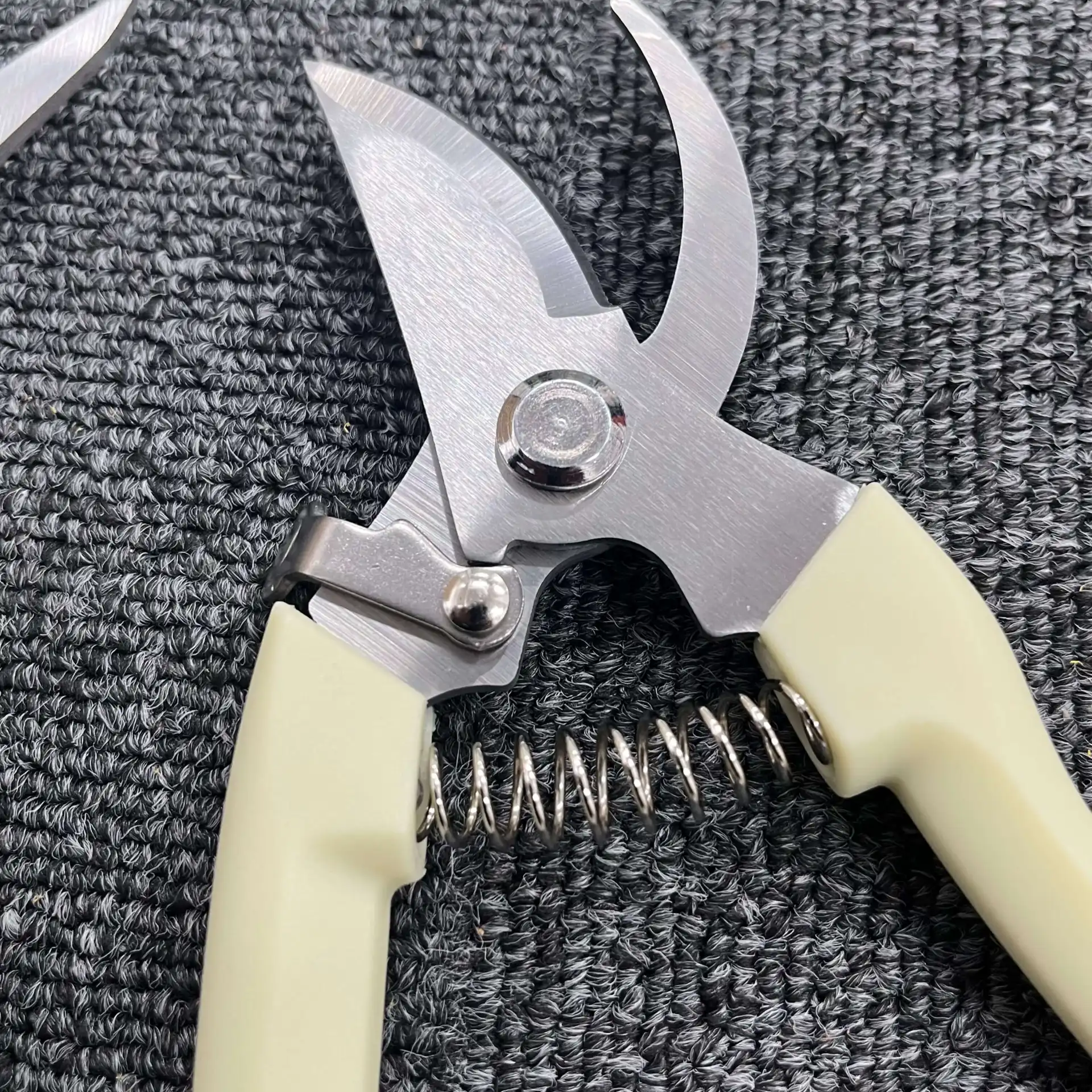
Two pruning shears that look almost identical in a product photo can carry prices that differ by 3x, 5x, or more. The difference is not arbitrary — it comes from a stack of choices in materials, processes, and specifications that are invisible in a catalog image but directly affect cutting performance, durability, user experience, and after-sale cost.
Here is what drives the price gap, layer by layer:
Blade Steel and Material Verification
The blade material is the first cost factor, but the name alone does not tell the whole story. SK5 high-carbon steel (a Japanese JIS-standard tool steel with approximately 0.85% carbon content) is the most common blade material in mid-range and professional pruning shears. After proper heat treatment, SK5 reaches hardness of HRC 55–62, which provides good edge retention and wear resistance. Stainless steel blades resist corrosion better, especially in humid or wet conditions, but typically do not hold an edge as long as well-treated high-carbon steel. Some premium models use hardened chrome-plated blades or titanium-coated surfaces for additional surface durability and rust resistance.
The key point for buyers: “SK5” or “stainless steel” on a spec sheet is a starting reference, not a performance guarantee. The actual cutting behavior depends on whether the material is genuine, how it was heat-treated, what the blade geometry is, how precisely the edge was ground, and how well the blade aligns with the counter-blade or anvil. Two products both labeled “SK5” can perform very differently if one was properly hardened and precision-ground while the other received minimal treatment.
Heat Treatment, Hardness and Blade Geometry
Heat treatment — quenching and tempering — determines whether a blade holds its edge or dulls quickly, whether it resists chipping or cracks under stress, and whether it can be resharpened effectively. Professional-grade blades typically undergo multi-stage heat treatment with documented hardness results. Entry-level blades may receive basic treatment that leaves the steel softer or less consistent.
Blade geometry also matters. Professional pruning shears typically use edge angles of approximately 12°–18° (based on industry experience; specific angles vary by manufacturer and blade geometry) — a narrow angle cuts more easily into fibrous plant tissue but requires harder steel and more precise grinding. Wider angles are more durable but tend to crush rather than slice. The interaction between cutting blade and hook blade (or anvil surface) — their contact zone, gap, and overlap — determines whether the tool actually cuts cleanly or just bends and tears the stem.
Body Construction: Forging, Stamping, Casting and Composites
The main body and handle structure affects strength, weight, feel, and cost. Forged steel or aluminum bodies are shaped under high pressure, which produces a denser, stronger grain structure — this is why professional pruners like FELCO use forged aluminum handles. Stamped steel components are cut from flat sheet and bent into shape — faster and cheaper to produce, but generally less strong than forged equivalents. Cast aluminum is poured into molds — affordable for complex shapes but more porous and brittle than forged aluminum. Composite or fiberglass-reinforced plastic handles can be lightweight and weather-resistant, but their long-term durability under heavy repetitive use varies.
No single construction method is universally “better.” The right choice depends on the target price tier, use frequency, and customer expectations. A stamped-steel entry pruner at $3 wholesale is not defective — it is built for a different use case than a forged-aluminum professional model at$30.
Surface Treatment and Coatings
Surface treatments affect appearance, corrosion resistance, sap adhesion, and cleaning ease. Common options include:
- Hard chrome plating — used on professional blades (ARS, FELCO) for wear resistance and easy cleaning
- Electroplating or black oxide — basic anti-corrosion treatment on entry-level products
- Mirror polishing — attractive finish on stainless steel models, but can show scratches more visibly
- Low-friction / non-stick coatings (PTFE or similar) — reduce sap buildup and make cleaning easier, but coating durability varies and may wear off with heavy use
- Basic anti-rust oil — the lowest-cost option; requires user maintenance to prevent corrosion, especially on high-carbon steel
Coatings are a real cost factor, and they are a real performance factor — but they must be verified by sample testing, not assumed from a catalog description.
Handle Materials, Grip and Ergonomics
Handle choices range from bare stamped steel to forged aluminum with rubber overmold, to full plastic with TPR/PVC grip zones, to composite structures with ergonomic shaping. The cost differences are significant, and the performance differences are equally significant:
- TPR/PVC overmold on aluminum provides grip, shock absorption, and comfort for mid-range and professional models
- Plain plastic handles are lightweight and low-cost, but offer less grip when wet and less shock absorption
- Rotating handles (as on Bahco ERGO and some ARS models) reduce finger friction during repetitive work but add mechanism complexity and cost
- Handle shape and span must match the target hand size — a handle that is too wide for small hands or too narrow for large hands creates discomfort and control problems
Pivot, Spring, Lock and Power-Assisted Mechanisms
The pivot bolt or rivet, the spring, and the safety lock are small components that have large effects on cutting feel, safety, and longevity:
- Precision pivot with adjustment nut (FELCO, Corona professional) allows the user to fine-tune blade gap and maintain performance as the tool wears — a feature that costs more to manufacture but extends service life
- Simple rivet pivot is adequate for entry-level tools but cannot be adjusted and may develop looseness over time
- Volute / torsion springs (common on Japanese brands like Okatsune) provide more consistent return force than basic wire springs, which can lose tension with use
- Thumb lock / dial lock / latch mechanisms keep the tool safely closed when not in use; ease of operation varies, and some designs are easier for one-hand use than others
- Ratchet, gear, or compound-leverage mechanisms add multiple moving parts, each with its own tolerance, lubrication, and wear requirements — this increases both manufacturing cost and the precision needed for reliable assembly
Weight, Balance and Product Feel
Weight is often misunderstood. A heavier pruner is not automatically better, and a lighter one is not automatically inferior. What matters is what the weight is made of and where it sits:
- A forged-aluminum professional pruner at 250 g feels balanced and controlled because the weight is distributed between a strong blade head and a solid handle
- A stamped-steel entry pruner at the same weight might feel clumsy because the mass is concentrated in thin steel stampings without ergonomic shaping
- A 150 g snip feels right for precision work on soft stems, but the same weight in a hand pruner would likely indicate thin blade stock and a basic structure that cannot handle woody branches consistently
Weight must be evaluated alongside blade thickness, handle structure, pivot quality, and the intended use frequency. It is one factor, not the deciding factor.
Replaceable Parts, Adjustment and Service Life Strategy
Professional pruners with full parts availability (FELCO, Corona professional, Bahco) cost more at purchase but offer a different economic model: the blade, spring, buffer, lock catch, and even the handle can be replaced individually, keeping the tool in service for years. For channels that serve professional users, this is a selling point that justifies the higher initial price and creates a recurring parts business.
Entry-level pruners without replaceable parts are cheaper to produce and cheaper to buy, but when a component fails, the whole tool is discarded. This is appropriate for promotional, gift, or low-frequency channels, but it should not be presented as equivalent to a professional tool.
Quality Control and Batch Consistency
Two samples that perform identically can come from factories with very different batch consistency. One factory may inspect incoming steel, test hardness on each batch, check blade alignment on every unit, and reject pieces with visible defects. Another may produce visually acceptable samples but allow wider tolerance in blade gap, pivot tightness, coating uniformity, and handle overmold consistency in bulk production.
QC is a real cost — inspection labor, testing equipment, rejection rates, and documentation all add expense. But weak QC creates real downstream costs for the buyer: returns, complaints, and brand damage. The price gap between “same-looking” products often includes a QC difference that is invisible in the sample but becomes visible in the bulk order.
Packaging, Branding, MOQ and Order Structure
Packaging is the final cost layer, and it is more significant than many buyers assume:
- Bulk / bare / tie-wrap — lowest cost, no retail presentation, suitable for wholesale-to-trade channels
- Blister card / clamshell with card — retail-ready hanging display, moderate cost, good for garden center and hardware shelves
- Full-color box with inner tray — premium presentation, higher material and printing cost, best for professional and gift channels
- Tool pouch / holster combo — adds accessory value and professional image, but increases unit cost and packaging complexity
Beyond the packaging format, costs also come from: logo application method (laser engraving, silk screening, pad printing — each with different MOQ and permanence), barcode and labeling, instruction sheet language and printing, inner protection (blade sleeve, rust inhibitor, foam insert), and outer carton specification.
MOQ structures also affect the effective unit price. Standard colors and standard packaging have lower MOQs. Custom handle colors, custom logo engraving, and custom-printed boxes each carry their own minimum order quantities — typically 2,000 units for laser logo, 5,000 for custom-printed packaging — and these thresholds affect how quickly a buyer can test a new SKU.
For a full breakdown of price factors with real sample comparisons, see our dedicated guide on why pruning shears prices differ.
When comparing quotations that look similar on paper, we normally place specifications side by side — blade thickness, heat treatment documentation, handle construction method, unit weight, spring type, packaging format — rather than judging by unit price alone. Two “SK5 bypass pruners” at different prices may have different blade thickness, different pivot precision, different overmold quality, and different packaging protection, and those differences become visible when you hold both samples and cut the same branch.
Why Wholesalers Need More Than One Pruning Shear SKU
A single bypass pruner model cannot serve every customer, every task, and every price point. Here is why a well-structured pruning range needs multiple models:
Cover Entry, Mainstream and Professional Price Tiers
| Tier | Target Customer | Expected Use | Typical Characteristics | Wholesale Role |
| Entry / Good | Occasional home gardener | Low frequency, light tasks | Carbon steel or basic stainless blade, plastic handle, simple spring, basic lock | Traffic-builder and impulse-buy SKU |
| Core / Better | Regular gardener and enthusiast | Medium frequency, varied tasks | SK5 blade, aluminum handle with PVC/TPR grip, buffer stop, reliable lock | Mainstream volume SKU — the “workhorse” |
| Professional / Best | Daily professional user | High frequency, demanding conditions | Hardened steel blade, forged aluminum handle, adjustable pivot, replaceable parts, professional packaging | Margin and reputation SKU — justifies premium positioning |
Each tier serves a different customer segment and a different price expectation. Removing any tier leaves a gap — either losing entry-level traffic or failing to serve professional buyers who will go elsewhere for the tool they need.
Cover Different Tasks and User Needs
Beyond price tiers, a pruning range should cover the main task categories:
- Precision / snips for flowers, herbs, harvesting, and indoor plants
- General live-branch cutting / bypass pruners in at least two hand sizes
- Dead-wood handling / anvil pruners for clearing and landscape maintenance
- Effort reduction / ratchet or power-assisted pruners for users with limited grip or harder material
- Thick-branch handling / loppers for branches beyond hand-pruner range
Each task category corresponds to a real customer need. When a customer asks “which pruner should I use on my roses?” and the only answer is a single bypass model that is too large for their hand, that customer leaves disappointed — or buys the wrong tool and later returns it.
Reduce Returns from Wrong Tool Use
One of the most common sources of pruning shear returns and negative reviews is tool-task mismatch: a customer who bought an anvil pruner for live roses, a snip for a thick branch, or a single general model that does not fit their hand. A range that covers the main task categories, with clear labeling about what each model is for, directly reduces this mismatch risk.
Create Cross-Selling Opportunities
Pruning shears pair naturally with other products:
- Pruners + garden gloves (especially thorn-proof or long-cuff gloves for rose pruning)
- Pruners + sharpening tools and maintenance oil
- Pruners + tool pouches, holsters, or carrying bags
- Pruners + garden tool sets (trowel, transplanter, fork — a starter or gift combination)
- Pruning sets: snip + bypass pruner + lopper as a coordinated 3-piece range
These combinations increase average order value and give the customer a more complete solution. They also differentiate a wholesale range from competitors who offer only loose, uncoordinated models.
For a practical framework on building a pruning shear product range by channel and price tier, see our wholesale pruning shears product range guide.
Curious why similar products vary in price? See Why Pruning Shears Prices Differ: Materials, Weight, QC & Packaging.
What Wholesale Buyers Should Specify Before Asking for a Quote
A quotation that only says “bypass pruner, SK5, $X per unit” is missing the information needed to compare options fairly. Before requesting quotes, buyers should specify:
- Target market and sales channel — which country, which retail format (garden center, hardware, e-commerce, florist, orchard trade), and what the end customer expects
- Target consumer and use task — who will use the tool, what they will cut, and how often
- Key specifications — overall length, net weight, cutting capacity range, blade material, handle material, surface treatment, spring type, lock type, and hand-size fit
- Target procurement and retail price bands — what the buyer needs to pay and what the end customer needs to pay, so the supplier can propose the right cost structure rather than just the lowest figure
- Quantity and MOQ expectations — initial order quantity, projected reorder volume, and whether mixed-SKU or mixed-color orders are needed
- Customization requirements — handle color, logo method and position, packaging format, instruction sheet language, barcode, and any special labeling (such as “for left-hand use” or “for small hands”)
- Accessories and service items — whether the range should include replacement blades, springs, sharpening tools, holsters, or display fixtures
The more specifically a buyer defines these requirements, the more precisely a supplier can propose matching options — and the less likely the buyer is to receive quotes for products that look similar but are built for entirely different expectations.
Not sure which models your market needs? Send us your target customers, sales channel and expected price range. We can organize a practical pruning tool shortlist before you compare samples.
How to Compare Samples Before Bulk Purchasing
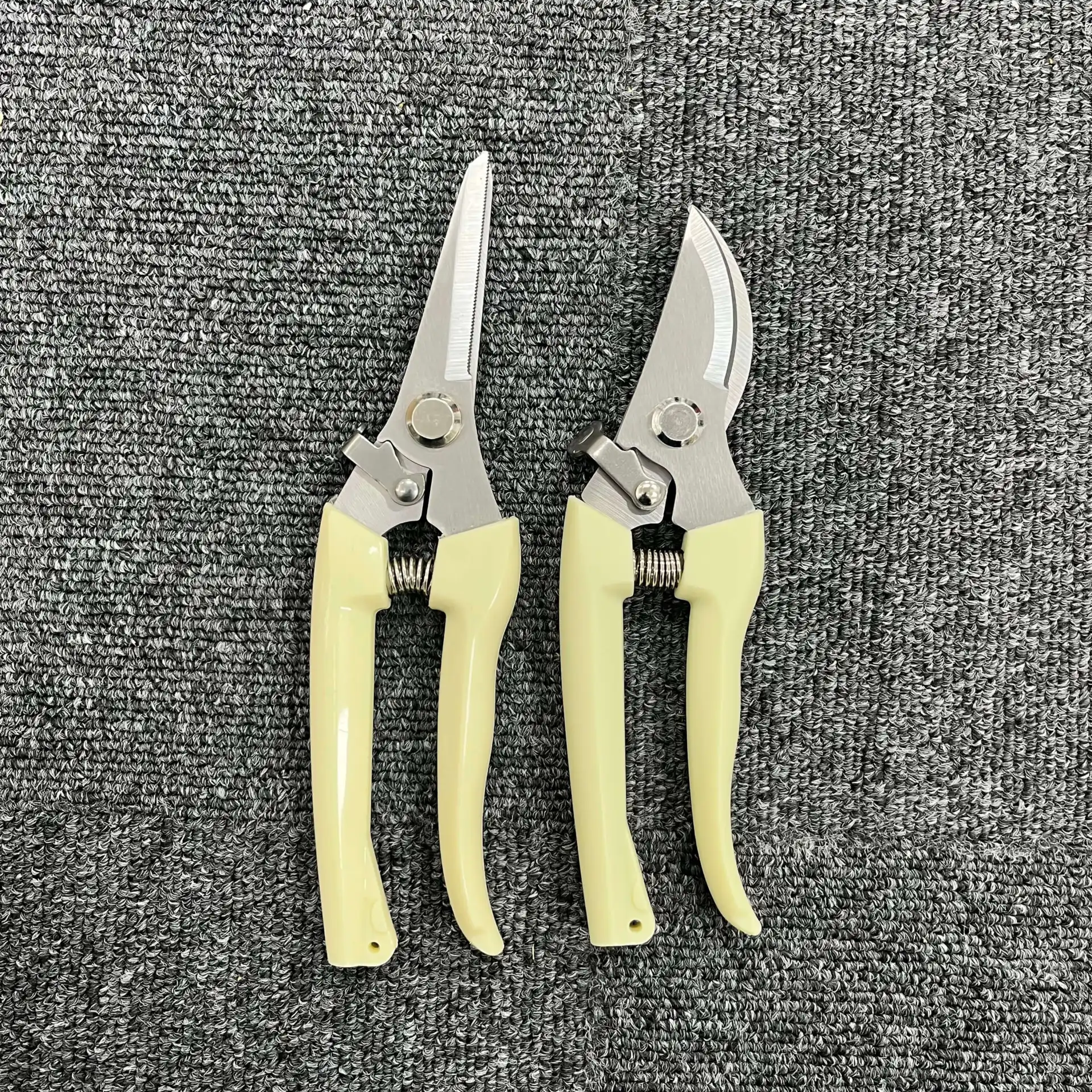
A sample that looks good and cuts one branch successfully is not enough to approve a bulk order. Reliable sample evaluation requires a structured check that covers appearance, dimensions, mechanics, cutting performance, and packaging — not just a quick visual inspection.
What to Check on a Pruning Shear Sample
| Check Category | What to Examine | Why It Matters |
| Visual and dimensional | Symmetry, blade tip condition, burrs, rust spots, coating uniformity, overmold quality, logo clarity, color consistency | Surface defects reveal process control quality |
| Overall length, blade length, net weight, handle span — compare against the specification sheet | Dimensions must match what was quoted; deviations indicate spec inconsistency | |
| Blade alignment and pivot | Bypass: cutting blade and hook blade contact zone, overlap, lateral play at pivot | Misaligned blades tear rather than cut; loose pivots worsen with use |
| Anvil: blade centering on anvil surface, contact consistency | Uneven contact reduces cutting effectiveness | |
| Pivot tightness, smoothness of opening/closing action | Stickiness or wobbling signals assembly tolerance problems | |
| Spring return and safety lock | Spring return speed and consistency, spring retention during use | Weak or dislodging springs make the tool hard to use and potentially unsafe |
| Lock engagement, single-hand operation ease, secure closure | A lock that disengages accidentally is a safety hazard; one that is hard to operate frustrates the user | |
| Grip, hand fit and balance | Handle span vs. target hand size, grip texture, edge comfort, weight distribution | A tool that does not fit the hand causes fatigue and control problems — especially under repeated use |
| Cutting performance | Test on consistent branch material (same species, similar diameter, same moisture condition) | Fair comparison requires controlled test material, not random branches of varying hardness |
| Record cut quality, effort required, any sticking or blade damage | Clean cuts with reasonable effort indicate proper blade geometry and alignment | |
| Test both live green wood and dry hard wood separately | A bypass pruner that also cuts dry wood does not mean it should be used that way — test the right material for the right tool type | |
| Repeated opening and cutting | Open and close 50+ times; check pivot, spring, lock, overmold, and blade edge after cycling | Early looseness or degradation signals durability problems |
| Coating and cleaning | Cut sap-rich material, then clean; check coating adhesion and residue | Sap adhesion and coating durability affect real-world maintenance |
| Packaging and transport readiness | Blade secured during shipping? Lock stays closed in transit? Product does not shift inside packaging? | Damage during shipping creates returns before the customer even uses the tool |
| Barcode, instruction sheet, warning labels, inner protection, outer carton condition | Missing or incorrect packaging details create retail and compliance problems |
Golden Sample and Bulk Consistency
When a sample passes all checks, it should be documented, photographed, and sealed as the golden sample — the reference standard against which bulk production is measured. The golden sample record should include: model identification, approved specifications, date, photographs of key details, and any accepted deviations noted during evaluation.
Bulk inspection then checks whether production units match the golden sample within agreed tolerances — not whether they look “about right.” Critical defects (blade cannot lock closed, structural fracture risk, severe blade misalignment) should be defined and agreed before the order, not discovered after delivery.
For a complete sample testing and QC checklist, see our pruning shears quality inspection checklist.
How Scarecrow Helps Build a Pruning Tool Range
When you need a mid-range bypass pruner, we compare options across several verified supplier partners — checking blade material, heat treatment, body construction, handle design, spring and lock quality, weight, packaging, and MOQ side by side, rather than forwarding one factory’s quote and stopping there. Eight people manage relationships with over 200 cooperating supplier partners across garden tool categories, and that network is what makes a multi-SKU pruning range practical without you having to coordinate five separate factories yourself.
For the same functional requirement — say, “bypass pruner for live branches, 20 mm cutting capacity, mid-range price” — we can prepare Entry, Core, and Professional options with a clear comparison of what each tier offers and what it does not. This lets you choose the cost structure that matches your target retail price and customer expectations, instead of settling for whatever single quote comes back first.
When samples arrive at our warehouse, four dedicated quality inspectors pull each unit from its packaging, check it against the specification sheet, photograph key details, and report findings before you commit to bulk. Blade alignment, pivot tightness, spring return, lock operation, grip fit, coating uniformity, and packaging readiness — all checked and documented, not just visually glanced at.
Packaging and labeling are confirmed before shipment. Blade protection, lock retention during transit, barcode placement, instruction sheets, and carton specifications are all verified against what was agreed — and issues are flagged before the container leaves, not after it arrives at your door.
Pruning snips, bypass pruners, anvil pruners, ratchet models, loppers, and accessories from different suppliers can be consolidated in our warehouse, inspected, repacked if needed, and shipped together. This reduces your logistics cost and coordination burden compared to managing separate factory shipments for each SKU — and it means your customers receive a coordinated range, not a random collection of products from five different origins.
A pruning shear range should not be built from appearance alone. Share your target market, quantity plan, packaging requirements and any reference photos with us. We can compare suitable models, prepare different price levels, arrange samples, and help combine multiple pruning SKUs in one sourcing plan.
Before placing bulk orders, don't miss our Pruning Shears Quality Inspection Checklist: Samples, Cutting Tests and Packaging.
FAQ
What is the difference between pruning snips, pruning shears and loppers?
Pruning snips are short, narrow-blade tools for soft stems, flowers, herbs, and harvesting. Pruning shears (hand pruners or secateurs) are single-hand tools for live branches and general garden pruning, typically 180–220 mm long. Loppers are two-hand long-handle tools for thicker branches beyond hand-pruner capacity. They serve different tasks and are not interchangeable — a range that includes all three covers more customer needs than any single type.
Are bypass pruners better than anvil pruners?
Neither is universally better. Bypass pruners produce cleaner cuts on live wood and are recommended for most pruning of living plants. Anvil pruners are more effective on dry, hard, or dead material. Using an anvil pruner on live branches crushes the stem tissue, and using a bypass pruner on very hard dead wood may strain the blade. The right choice depends on what material is being cut. For a full comparison, see our bypass vs. anvil pruners article.
Why do two similar pruning shears have different prices?
The visible shape is only the surface. Underneath, differences in blade steel grade and heat treatment, blade geometry and grinding precision, body construction (forged vs. stamped vs. cast), surface coatings, handle materials and ergonomics, pivot and spring quality, lock design, replaceable-parts availability, QC intensity, and packaging format all affect cost. Two products that look similar in a photo can be built on entirely different cost structures. For a detailed breakdown, see why pruning shears prices differ.
How many pruning shear models should a garden center carry?
A practical starter range for a garden center typically includes 5–8 models (based on industry experience; the exact number should be driven by customer demand and sales data): 1–2 pruning snips, 2 bypass pruners (entry and mid-range or small-hand and standard-hand), 1 anvil pruner, 1 ratchet or power-assisted model, and 1 lopper. This covers the main task categories without creating shelf confusion. For assortment strategy, see how wholesalers should build a pruning shears product range.
Can pruning shears be supplied with custom logos and retail packaging?
Yes. Common customization options include handle color selection, laser-engraved logo on the blade or handle (MOQ typically 2,000 units), silk-screened or pad-printed logo, and custom-printed packaging from blister cards to full-color boxes. Each customization option has its own MOQ and lead time. When requesting customization, specify the logo method, position, color, and packaging format so the supplier can quote accurately rather than assuming.
What should buyers test before approving a pruning shear sample?
A complete sample check covers: visual and dimensional inspection against the specification sheet, blade alignment and pivot quality, spring return and safety lock operation, grip fit and balance, cutting performance on consistent test material, repeated opening/closing cycling, coating and cleaning behavior, and packaging readiness for transport and retail display. Approving a sample based on appearance alone risks discovering problems in bulk that should have been caught at the sample stage. For a full checklist, see pruning shears quality inspection checklist.
From Single Model Selection To Complete Sourcing Plans
Your pruning shear range needs more than attractive designs. Tell us your market, volume requirements, packaging needs and reference photos. We will evaluate suitable models, provide price options, arrange samples and help organize multiple pruning SKUs efficiently.
📩 Contact Our Sourcing Team Visit Website