






Updated 4 months ago
Managing One Garden Sourcing Partner vs. 10 Factories: The Cost-Reduction Logic for Small and Mid-Sized Garden Product Wholesalers
ScarecrowGarden
💡About Scarecrow Garden Supplier Co., Ltd.
Scarecrow Garden Supplier Co., Ltd. is a China-based sourcing and wholesale partner specializing in garden tools, landscaping equipment, and outdoor supplies for international wholesalers, distributors, contractors, and brands.
With hands-on experience rooted in real garden use scenarios, we focus on durable materials, functional design, and stable large-volume supply. Our product range covers pruning tools, watering systems, hand tools, outdoor hardware, and customized garden solutions to support both retail and professional landscaping markets.
Beyond products, we help our partners navigate supplier selection, quality control, compliance requirements, and long-term sourcing strategies in China. Through our blog, we share practical insights on product selection, material comparisons, industry trends, and cost-effective purchasing—helping global buyers build stronger, more competitive supply chains.
One-Stop Garden Product Sourcing vs. 10 Factories: Cut Wholesale Costs | Scarecrow Garden Supplier
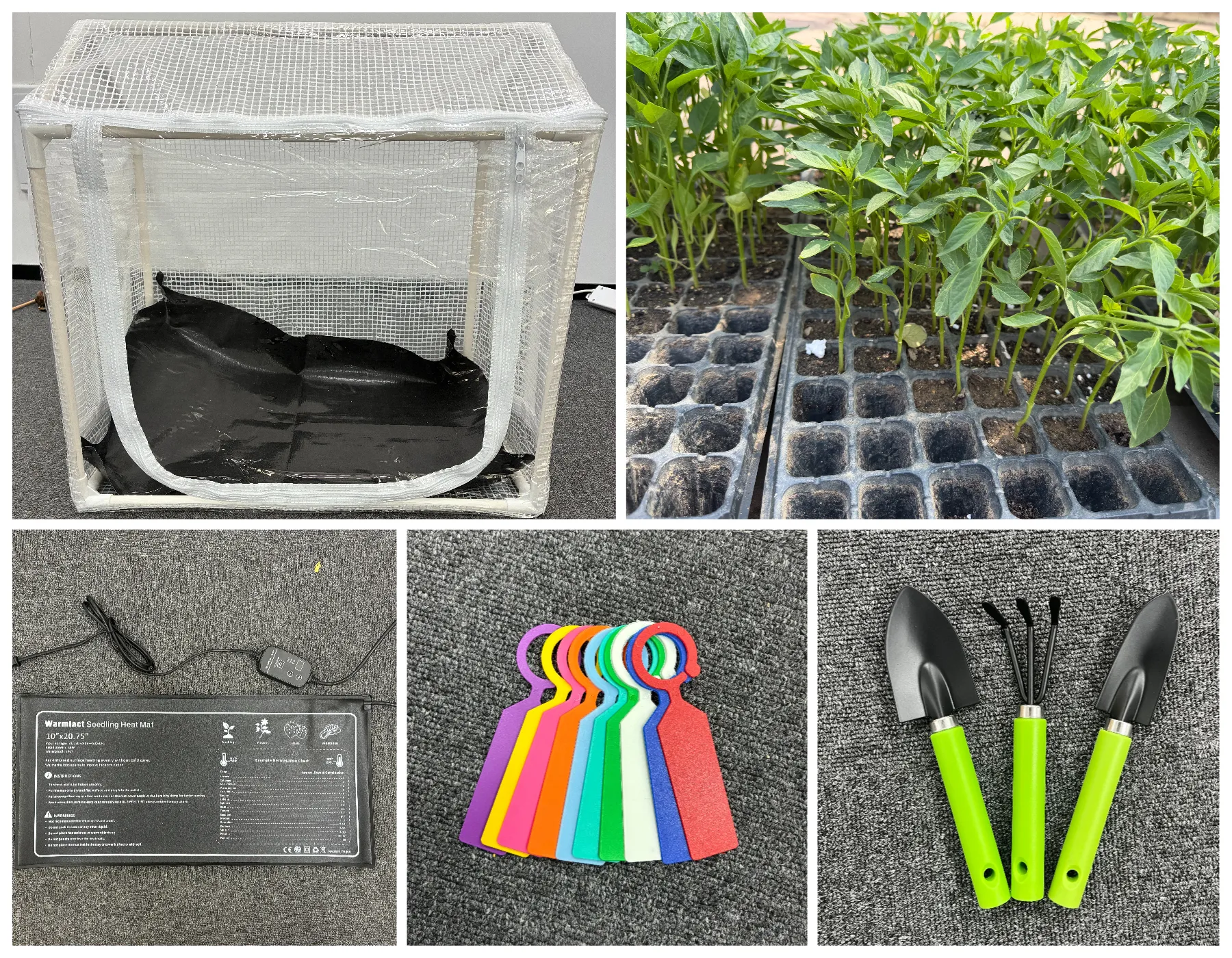
One of the most common purchasing approaches among small and mid-sized garden product wholesalers is this: greenhouses from Factory A, heat mats from Factory B, plant labels from Factory C, trowels from Factory D—every category seems to come from the “cheapest source.”
However, when the numbers are reviewed at the end of the year, total procurement costs often have not decreased at all. In many cases, they are actually higher than those of competitors.
The problem is not that your factories are not cheap enough. The problem is that you may be overlooking the cost of supplier management itself.
This article breaks down the real costs of managing multiple suppliers, what a one-stop sourcing approach can save, and when managing multiple suppliers yourself may still make more sense.
The Real Cost of Managing Multiple Suppliers
Most buyers calculate only product cost plus freight cost, while overlooking the hidden costs below.
Communication Costs
Managing a Chinese supplier is far more than spending 2–4 hours per month following up.
From supplier selection, sample confirmation, and sample revisions to production monitoring, quality inspection coordination, and shipment arrangements, the total time investment throughout a purchasing cycle is often much higher than expected.
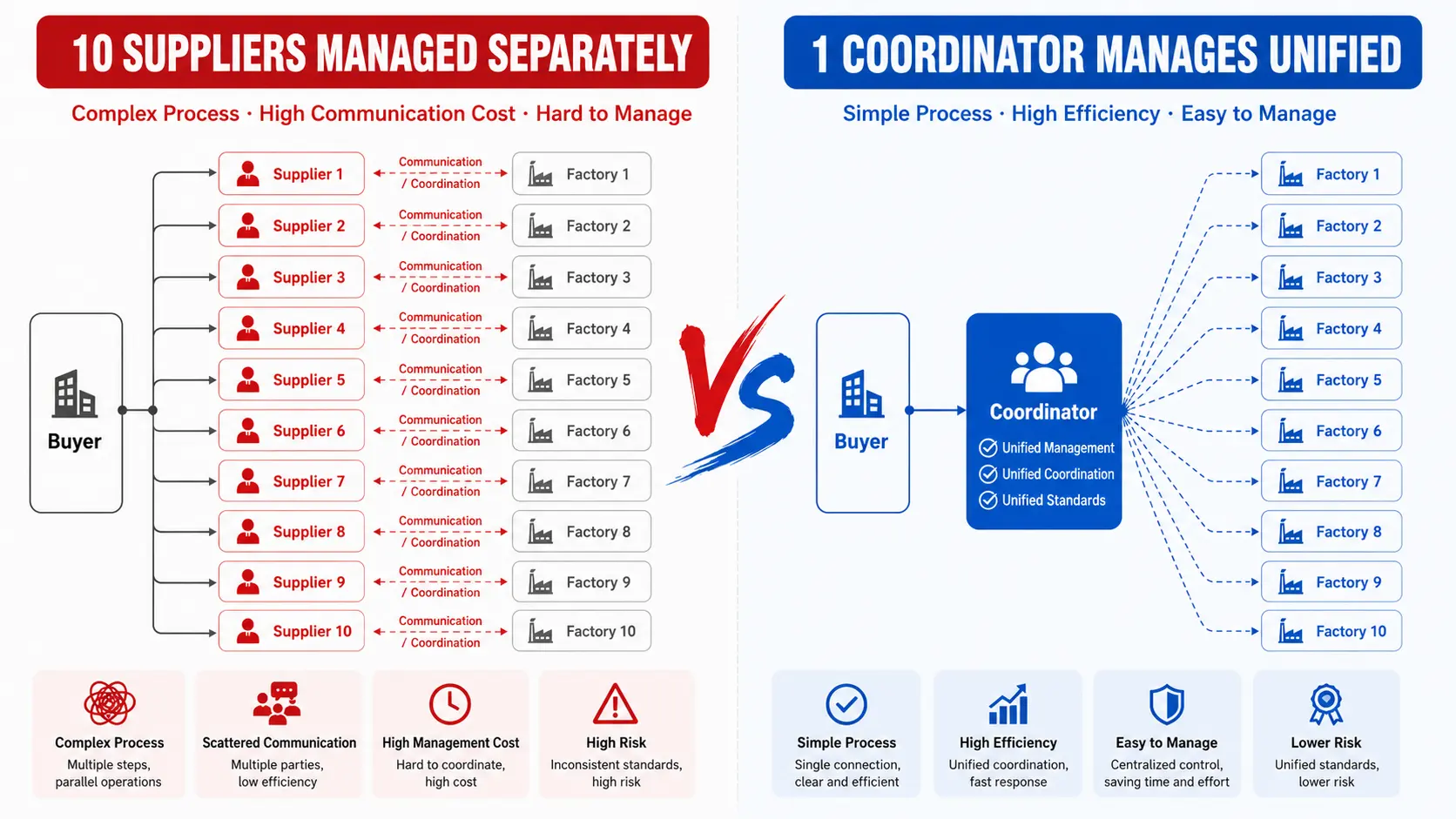
Based on industry experience, a full-time buyer can effectively manage only 5–8 suppliers. Beyond that number, communication quality and management efficiency typically begin to decline significantly.
If 10 suppliers require attention at the same time, it is almost impossible for a procurement team of one or two people to manage everything effectively.
Why Are 5–8 Suppliers Not Enough?
Because gardening is an extremely diverse industry.
Even excluding live plants, hard goods alone cover 10–15 major categories, including:
- Hand tools
- Long-handle tools
- Pruning tools
- Watering and irrigation products
- Planting containers
- Seed starting supplies
- Grow lights and heat mats
- Protective equipment
- Garden decorations
- Outdoor structures
Each category may contain 5–15 subcategories.
For example, flower pots and seed trays alone can include more than 500 SKUs.
A medium-sized garden wholesaler's catalog often contains 500–2,000 SKUs.
Meanwhile, most factories specialize in only one or two categories.
A pruning shear factory does not manufacture flower pots.
A watering can factory does not manufacture greenhouses.
A grow light factory does not manufacture garden gloves.
As a result, covering 10–15 major garden hard-goods categories generally requires working with at least 10–15 different factories.
A buyer can effectively manage only 5–8 suppliers, but a complete garden product range often requires 10–15 factories. This is the gap. →Learn more about the superiority of one coordinator
For small and medium-sized garden centers, distributors, and e-commerce sellers, that gap either means an incomplete product line or an overloaded purchasing team.
| Activity | Time Required Per Supplier | Total for 10 Suppliers |
| Initial screening (qualification checks, export records, first communication) | 3–5 hours | 30–50 hours |
| Sample communication and approval (sample shipment, feedback, revisions, reconfirmation) | 5–8 hours | 50–80 hours |
| Production follow-up and inspection coordination | 3–5 hours/month | 30–50 hours/month |
| Shipment arrangement and logistics coordination | 2–3 hours/shipment | 20–30 hours/shipment |
| Quality issue communication and after-sales handling | Unpredictable | May take weeks |
Sample Shipping Costs
Assume sample freight from China to your location is approximately USD 50 per shipment.
If 10 suppliers send samples separately:
- 10 individual sample shipments = approximately USD 500
- Samples consolidated and shipped together = approximately USD 50
- Difference = approximately USD 450
MOQ Accumulation
| Product Category | Typical Factory MOQ | Actual Quantity Needed | Excess Quantity |
| Small greenhouse | 500 pcs | 100 pcs | 400 pcs |
| Heat mats | 1,000 pcs | 200 pcs | 800 pcs |
| LED seed starters | 500 pcs | 100 pcs | 400 pcs |
| Plant labels | 5,000 pcs | 1,000 pcs | 4,000 pcs |
| Garden trowels | 2,000 pcs | 300 pcs | 1,700 pcs |
After combining the MOQs from only five categories, your total purchase quantity may become four to five times higher than your actual demand.
Excess inventory ties up cash, occupies warehouse space, and may eventually become unsold stock.
Shipment Coordination Costs
Different factories have different lead times.
For example:
- Greenhouse: 35 days
- Plant labels: 15 days
- LED grow lights: 40 days
You must follow up with each supplier separately, coordinate logistics around different completion dates, and deal with inconsistent packaging standards.
If one category is delayed, the entire consolidation plan may need adjustment.
What Can a One-Stop Sourcing Approach Save?
Supplier Screening: Do It Once Instead of Ten Times
Finding a reliable factory typically requires:
- Qualification verification
- Export record review
- Sample evaluation
- Factory audit
- Trial orders
Each step may take one to two weeks.
For ten factories, supplier screening can easily consume 10–20 weeks.
Through a sourcing coordinator focused on the gardening industry, supplier screening has already been completed.
Such coordinators may maintain partnerships with 200+ verified suppliers covering:
- Garden tools
- Watering and irrigation products
- Planting containers
- Garden decorations
- And other major categories
Samples: Receive Everything Once Instead of Waiting Ten Times
All samples can be sent to the coordinator's warehouse and consolidated into a single shipment.
You receive everything at once, compare products side by side, and make purchasing decisions more efficiently.
Double-Sample System
Two identical samples are prepared:
- One sample is sent to you for approval.
- One sample is labeled and retained in the warehouse.
During mass production, the retained sample serves as the inspection reference to ensure consistency between approved samples and production goods.
MOQ: Buy What You Need Instead of What Factories Require
A sourcing coordinator specializing in garden products may purchase hundreds of thousands of garden trowels annually from the same factory.
As a major customer, the coordinator may secure better pricing than an individual buyer.
Because multiple customer orders can be combined, the coordinator can also balance factory MOQs with your actual purchasing requirements.
Shipping: One Arrival Instead of Ten Separate Customs Clearances
Products from different categories are collected in a warehouse, inspected individually, and consolidated into a container.
This creates:
- One shipment
- One arrival schedule
- One customs clearance process
If problems are discovered during warehouse inspection, defective products can be intercepted before shipment without affecting other categories.
Secondary Packaging: Product Bundling Completed in the Warehouse
A dedicated warehouse can also provide secondary packaging services.
For example:
- Trowel + gardening mat + gloves gift set
- Retail-ready product bundles
- Customized packaging configurations
Most sourcing agents do not offer this capability.
When Is Managing Multiple Suppliers Yourself More Cost-Effective?
A one-stop sourcing model is not the best option for every buyer.
Managing suppliers directly may be more suitable if:
- You purchase only 2–3 categories and each category has very large volume.
- You already have stable supplier relationships with proven quality and delivery performance.
- Your team has enough manpower to manage multiple suppliers simultaneously.
- You maintain your own purchasing office or QC team in China.
A simple guideline:
If supplier management costs account for less than 5% of total product value, managing suppliers yourself may be more economical.
If supplier management costs exceed 5%, a one-stop sourcing model is often more efficient.
Key Details to Confirm Before Purchasing
| Evaluation Point | What Buyers Should Confirm | Why It Matters |
| Industry specialization | Does the coordinator specialize in gardening products or handle all categories? | Garden-focused coordinators understand supplier resources, seasonal demand, and product assortment strategies. |
| Warehouse capability | Is there a dedicated warehouse for receiving, inspection, issue interception, and secondary packaging? | Without a warehouse, products may be consolidated directly at ports without proper inspection. |
| Double-sample system | Is one sample retained as the production reference? | Sample-to-production inconsistency is one of the most common sourcing risks. |
| OEM coordination capability | Can the coordinator manage OEM projects across multiple categories? | Multiple product categories often require unified branding and coordinated execution. |
| Supplier information transparency | Are supplier qualifications, records, and inspection results available after evaluation? | The coordinator's role is to verify suppliers for buyers, not simply endorse them. |
Recommended Product Combination Programs
Program 1: Spring Seed Starting Essentials
Target Buyers: Small and medium-sized wholesalers purchasing seed-starting products from China for the first time.
| Product | Recommended Quantity | Purchasing Considerations |
| Desktop mini greenhouse | 50–100 pcs | Foldable design to reduce shipping volume |
| Standard heat mats | 100–200 pcs | Waterproof, standard 10" × 20.75" size |
| Seed trays (48-cell & 72-cell) | 200–300 pcs each | Stackable design saves shipping space |
| Plant labels | 1,000–2,000 pcs | Waterproof labels plus chalk labels |
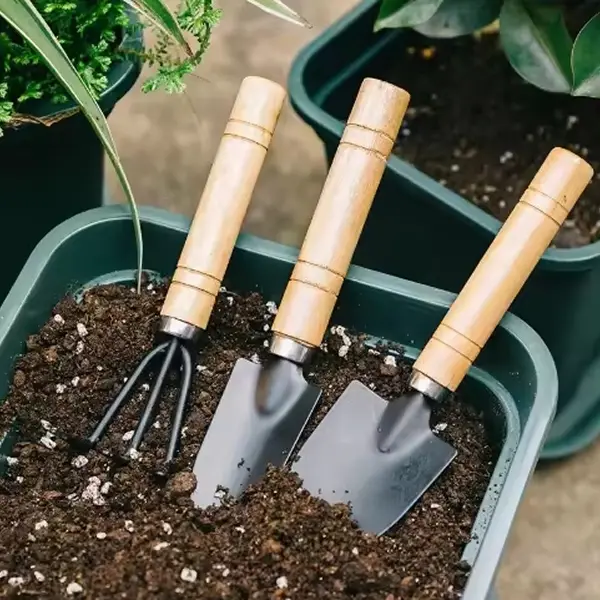
| Garden trowels | 200–300 pcs | Mirror-polished stainless steel with ergonomic handle |
One-Stop Value: If purchased separately from five factories, combined MOQs may reach four to five times your actual demand.
Through consolidated sourcing, you purchase only the quantities you actually need.
When your volume is not enough to fill a container, you can easily add other products—such as aprons, labels, gloves, or pruning tools—to maximize container utilization and lower shipping cost per unit.
Program 2: Complete Garden Tool Range
Target Buyers: Regional distributors looking to expand product lines.
| Product | Recommended Quantity | Purchasing Considerations |
| Pruning Shears (SKU2509003) | 200–300 pcs | 105g lightweight model, safety lock, mirror finish |
| Pruning Shears (SKU2509010) | 100–200 pcs | Up to 30mm cutting capacity |
| Garden Trowels (SKU2509008) | 200–300 pcs | 4mm blade thickness, multiple weight options |
| Gloves (SKU2509108) | 500–1,000 pairs | Nitrile coating, anti-slip palm, breathable lining |
| Aprons | 200–300 pcs | Oxford fabric/canvas, multiple pockets, customizable logo |
| Tool Sets (3-piece/5-piece) | 200–300 sets | Higher margins than individual tools |
One-Stop Value: Different materials and manufacturing processes often require different factories.
For example:
- Manganese steel tools
- Stainless steel tools
- Nitrile-coated gloves
- Latex gloves
Managing each material type separately can quickly increase supplier numbers beyond ten.
A specialized coordinator has already screened suppliers according to materials and production capabilities.
Program 3: Indoor Gardening Accessories
Target Buyers: E-commerce sellers and independent garden retailers.
| Product | Recommended Quantity | Purchasing Considerations |
| Gardening mats | 100–200 pcs | Waterproof with corner snap buttons |
| Indoor watering cans | 200–300 pcs | Long-spout design, BPA-free |
| Plant labels | 2,000–3,000 pcs | OEM printing available |
| Gloves | 300–500 pairs | Breathable and touchscreen compatible |
| Aprons | 100–200 pcs | Custom logo available |
One-Stop Value: These products are lightweight and compact.
When shipped separately, freight often represents a high percentage of product value.
Consolidation significantly reduces freight cost ratios and also enables bundled retail sets such as:
- Indoor Repotting Kits
- Balcony Gardening Sets
Common Purchasing Risks and How to Reduce Them
| Risk | Why It Happens | How to Reduce It |
| Focusing only on unit price | Factory A's heat mat is USD 0.20 cheaper, but MOQ is 1,000 pcs when you need only 200 | Calculate total ownership cost, not just product cost |
| Chasing factory-direct sourcing for every category | Factory-direct is not always the cheapest option; some export factories work through trading companies anyway | Large-volume coordinators may secure better pricing |
| Changing suppliers too frequently | Every new supplier requires sample approval and communication adjustments | Stable supplier relationships improve quality consistency and delivery reliability |
| Underestimating OEM coordination costs | Logo printing, color changes, and custom packaging all require separate communication | Centralized OEM management reduces workload and keeps branding consistent |
Frequently Asked Questions
Q: Is one-stop sourcing more expensive than finding factories myself?
Not necessarily.
A garden-focused sourcing coordinator may purchase hundreds of thousands of units annually from the same factories and therefore secure better pricing.
In addition, you save communication costs, sample freight, excess inventory caused by MOQs, and shipment coordination expenses.
These hidden costs often exceed differences in product pricing.
Q: Will a sourcing coordinator hide supplier information?
No.
The coordinator's role is to evaluate suppliers on behalf of buyers, not simply endorse them.
After inspection and evaluation, buyers can receive supplier qualifications, cooperation records, and inspection results.
You may also request supplier information after sample approval.
Q: Can suppliers be changed if I am dissatisfied with a product category?
Yes.
The coordinator maintains relationships with 200+ verified supplier partners.
If a supplier fails inspection or quality requirements, alternative suppliers can be arranged and new samples provided.
Q: What order size is suitable for one-stop sourcing?
Typically buyers with annual purchasing volumes between USD 50,000 and USD 500,000 benefit the most.
Larger buyers often have their own procurement and QC teams.
For buyers below USD 50,000 annually, product variety may be too limited for one-stop sourcing advantages to be significant.
Q: What are the MOQs for OEM customization?
MOQ depends on the product and customization type.
Examples include:
- Plant label printing: approximately 1,000–2,000 pcs
- Apron logo embroidery: approximately 200–500 pcs
- Custom packaging boxes: approximately 500–1,000 pcs
Actual requirements depend on your specific project.
Q: If I buy only one or two product categories, do I still need one-stop sourcing?
If you purchase only one or two categories and volumes are large, factory-direct sourcing may be more cost-effective.
The advantages of one-stop sourcing become most apparent when product variety is high and volumes per category are relatively small.
How We Support Buyers
Scarecrow Garden Supplier helps garden distributors, nurseries, and retail buyers organize mixed garden product ranges from China. We focus on practical garden products, seasonal product combinations, packaging coordination, product checking, and consolidated shipment support.
If you are evaluating whether reducing the number of suppliers would benefit your business, we can help by:
- Organizing a one-stop sourcing plan — Send us your product requirement list, and we can help coordinate supplier matching, sample approval, OEM customization, and consolidated shipping.
- Arranging sample evaluation — Through our double-sample system, all samples are consolidated and shipped together. Small items can be sent by UPS or FedEx international express, while larger items can be shipped through door-to-door logistics services.
- Assessing your current sourcing structure — Tell us how many suppliers you currently manage, your product categories, and your annual purchasing volume. We can help evaluate whether a one-stop sourcing model is suitable for your business. No pressure—just practical reference information to support your decision.
Simplify Your Garden Product Sourcing from China
We help you combine multiple product categories into one sourcing flow with supplier matching, sample verification, and consolidated shipping.
Written by
ScarecrowGarden
💡About Scarecrow Garden Supplier Co., Ltd.
Scarecrow Garden Supplier Co., Ltd. is a China-based sourcing and wholesale partner specializing in garden tools, landscaping equipment, and outdoor supplies for international wholesalers, distributors, contractors, and brands.
With hands-on experience rooted in real garden use scenarios, we focus on durable materials, functional design, and stable large-volume supply. Our product range covers pruning tools, watering systems, hand tools, outdoor hardware, and customized garden solutions to support both retail and professional landscaping markets.
Beyond products, we help our partners navigate supplier selection, quality control, compliance requirements, and long-term sourcing strategies in China. Through our blog, we share practical insights on product selection, material comparisons, industry trends, and cost-effective purchasing—helping global buyers build stronger, more competitive supply chains.