







Updated 4 months ago
Why Aren’t Your Plant Grow Lights Selling? Try Adding a “Mini Grow Light Demonstration Zone”

ScarecrowGarden
💡About Scarecrow Garden Supplier Co., Ltd.
Scarecrow Garden Supplier Co., Ltd. is a China-based sourcing and wholesale partner specializing in garden tools, landscaping equipment, and outdoor supplies for international wholesalers, distributors, contractors, and brands.
With hands-on experience rooted in real garden use scenarios, we focus on durable materials, functional design, and stable large-volume supply. Our product range covers pruning tools, watering systems, hand tools, outdoor hardware, and customized garden solutions to support both retail and professional landscaping markets.
Beyond products, we help our partners navigate supplier selection, quality control, compliance requirements, and long-term sourcing strategies in China. Through our blog, we share practical insights on product selection, material comparisons, industry trends, and cost-effective purchasing—helping global buyers build stronger, more competitive supply chains.
Why Garden Center Grow Lights Don't Sell & How to Fix It | Scarecrow Garden Supplier
Plant grow lights are one of the most frustrating product categories for garden centers. You know they work, and customers have heard they work—but they simply don’t sell well.
The reason is simple: customers stand in front of a shelf full of LED grow lights and think, “What exactly will this light do for my plants?” Yet nothing on the shelf answers that question.
Grow lights are an effect-driven product. Customers need to see results before they buy. However, most garden centers display them as rows of LED bars hanging on a wall with a specification sheet beside them. Customers see terms like “Full Spectrum,” “15W,” and “PPF Value XX.” To most growers, these numbers mean very little.
This article helps garden centers understand:
- The three main reasons plant grow lights do not sell well
- How to create a “Mini Grow Light Demonstration Zone” that allows customers to see results
- Which products sell best alongside grow lights
- How buyers can avoid selecting LED lights that look bright but do not provide adequate plant growth performance
Market Data: The global plant grow light market reached USD 7.04 billion in 2025, with a CAGR of 17.5%. Europe is the largest market, accounting for 31.4% of global revenue. Demand is growing, yet conversion rates for grow lights in many garden centers remain low. The problem is not demand—it is presentation.
Why Plant Grow Lights Don’t Sell Well — Three Main Reasons
1. Customers Cannot See the Results
This is the biggest reason.
Most gardening products have obvious functions. A trowel digs soil. A watering can waters plants. Pruners cut branches.
The benefit of an LED grow light is invisible. You must use it for 7–14 days before seeing a difference in seedling growth. Customers cannot determine whether the light is worth buying while standing in the store.
2. Technical Specifications Mean Little to Most Customers
PPF, PAR, color temperature, spectral distribution—these metrics matter to professional growers.
However, for most garden center customers, especially beginners and intermediate gardeners, they are simply confusing numbers.
Customers want answers to practical questions such as:
“Will this light prevent my tomato seedlings from becoming leggy?”
They do not want to analyze PPF values.
3. Grow Lights Are Displayed Without a Usage Scenario
Most garden centers place grow lights in the tools section or electronics section alongside other hardware products.
But customers do not walk into the tools aisle thinking, “I need a grow light.”
They realize they need supplemental lighting when:
- Starting seedlings
- Growing indoors
- Seeing seedlings become weak and stretched
Grow lights belong inside a seed-starting environment, not an electronics display.
How to Build a “Mini Grow Light Demonstration Zone”
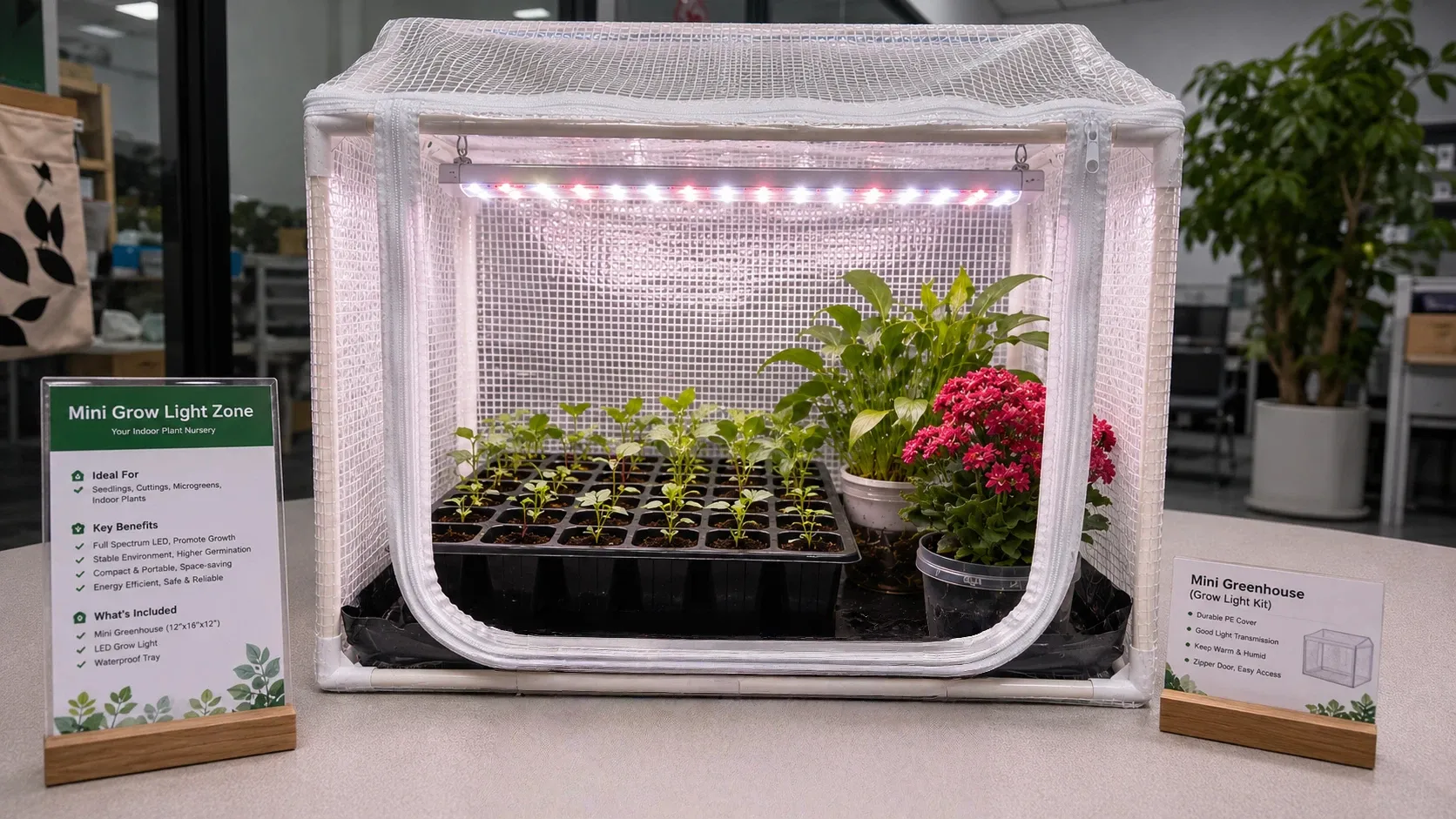
A Mini Grow Light Demonstration Zone is a small 1–2 square meter display area that allows customers to directly see the effects of LED grow lighting.
Basic Setup
| Component | Purpose | Selection Recommendation |
|---|---|---|
| LED Seed Starting Kit (powered on) | Demonstrates actual lighting effect | Full-spectrum model with timer |
| Seed Tray + Real Seedlings | Demonstrates growing results | Fast-germinating varieties such as basil and lettuce |
| Mini Greenhouse | Creates a complete seed-starting environment | Tabletop model with flat-pack display |
| Heat Mat | Demonstrates temperature and light combination | Standard model placed under greenhouse |
| Information Card | Explains why supplemental lighting is needed | Explain seasonal lighting requirements |
Information Card Content
Do not focus on specifications.
Focus on real-world situations.
| Instead of Writing This | Write This |
| Full-spectrum LED, PPF XX | “Natural light is often insufficient during February and March. Supplemental lighting 14–16 hours per day helps seedlings stay compact and healthy.” |
| Blue 630nm + Red 660nm | “Blue light promotes leafy growth while red light supports flowering and fruiting. Full-spectrum lighting provides both.” |
| 15W Power Consumption | “Running 14 hours per day costs less than $1 per month in electricity.” |
| IP44 Waterproof | “Safer for humid seed-starting environments.” |
Four Effective Display Methods
Display Method 1: Side-by-Side Comparison
Place two seed trays next to each other:
- One under LED grow lights
- One under natural light only
After 7–10 days, the differences become obvious.
Seedlings under grow lights are:
- Compact
- Dark green
- Strong
Seedlings under natural light often become:
- Leggy
- Pale
- Weak
This comparison is more convincing than any specification sheet.
Display Method 2: Live Demonstration
Place an active LED seed-starting kit in the display area.
Customers can observe:
- Light brightness
- Spectrum appearance
- Plant condition
in real time.
Display Method 3: Time-Lapse Video
Install a small display screen showing time-lapse videos.
Compress 7–10 days of seedling growth into a 1–2 minute video showing:
- Germination
- Early growth
- Transplant readiness
Display Method 4: Succulent Comparison Display
Place two succulent trays side by side.
One receives LED supplemental lighting.
One relies only on natural light.
Under LED lighting:
- Colors become red, purple, and pink
- Leaves become thick and compact
- Plants resemble colorful gemstones
Without supplemental lighting:
- Colors fade to green
- Leaves become thinner
- Stems stretch excessively
The visual impact is immediate.
Customers can see the difference instantly.
Why Succulent Comparisons Work So Well
Succulent coloration and compact growth depend heavily on strong lighting.
Red, purple, and pink colors are produced by anthocyanins.
Under insufficient light:
- Anthocyanin production decreases
- Colors fade to green
- Plants become stretched and weak
Healthy succulents typically require 300–600 µmol/m²/s PPFD.
Most indoor environments provide only 50–200 µmol/m²/s.
The difference is significant and easy to demonstrate.
Comparison Table
| Comparison Point | 🔆 With LED Grow Light | 🌑 Natural Light Only |
| Shape | Compact rosette growth | Stretched and leggy |
| Leaves | Thick, firm, healthy | Thin, soft, prone to dropping |
| Color | Rich reds, purples, pinks | Mostly green |
| Display Value | High, jewel-like appearance | Low ornamental value |
Recommended Succulent Varieties
- Jelly Bean Sedum (Sedum rubrotinctum)
- Aeonium 'Zwartkop'
- Echeveria 'Chihuahua'
These varieties show dramatic color and growth differences under supplemental lighting.
From Selling One Light to Selling a Complete Growing System
Selling grow lights alone often results in:
- Lower conversion rates
- Lower transaction values
Bundling products creates a complete solution.
| Bundle | Included Products | Average Basket Increase | Target Customer |
| Basic Supplemental Lighting Kit | LED grow light + seed tray + plant labels | +50% | First-time indoor growers |
| Complete Growing System | LED grow light + mini greenhouse + heat mat | +200% | Serious seed starters |
| Indoor Gardening Station | \LED grow light + gardening mat + gloves + watering can | +150% | Indoor gardeners and repotting enthusiasts |
China’s LED Grow Light Manufacturing Cluster — Where Your Products Come From
More than half of the world's LED lighting products are manufactured in Guzhen, Zhongshan, Guangdong Province, China.
This town covers less than 50 square kilometers but hosts:
- Over 30,000 lighting-related businesses
- Annual industry output exceeding RMB 100 billion
- Exports to more than 130 countries and regions
The Guzhen Lighting Fair has been held for 34 editions and attracts buyers from over 100 countries every year.
What the Manufacturing Cluster Means for B2B Buyers
| Advantage | Explanation |
| Concentrated Supply Chain | LEDs, drivers, heat sinks, and housings are sourced locally |
| Fast Sampling | New samples can often be completed within 1–2 weeks |
| Flexible Customization | OEM and ODM projects are easier to support |
| Rapid Innovation | New products enter the market quickly due to competition |
The Challenges of Buying Directly from Lighting Factories
| Challenge | Explanation |
| Only Sell Lights | No greenhouses, heat mats, seed trays, or related products |
| High MOQ | Often 500–1,000 units per model |
| No Consolidation | Buyers must coordinate logistics themselves |
| Limited Inspection Support | Factory QC may not match destination market expectations |
| No Gift Box Integration | Most factories ship products individually |
This is why buyers often benefit from working with a garden-product sourcing coordinator rather than dealing directly with lighting factories.
Why Source Plant Grow Lights Through Scarecrow Garden Supplier
We source selected LED grow lights from the Guzhen lighting cluster and combine them with greenhouses, heat mats, and hygrometers in our warehouse.
One order.
One inspection process.
One shipment.
| Scarecrow Advantage | Details |
| Multi-Category Consolidation | Grow lights, greenhouses, heat mats, hygrometers, seed trays, labels, gloves, and more |
| Multiple Sizes and Mixed SKUs | Different grow light styles can be mixed from as low as 50 units per SKU |
| Gift Box Assembly | Complete bundled systems assembled in-house |
| Stricter Product Inspection | Light spectrum, power output, heat management, cables, and appearance checked individually |
| Continuous New Product Recommendations | Ongoing monitoring of new products from the Guzhen industry cluster |
Key Details to Confirm Before Purchasing
| Inspection Point | What Buyers Should Confirm | Why It Matters |
| Spectrum Test Report | PPF data and spectrum charts | Some lights appear bright but provide poor plant growth |
| Timer Reliability | Test 12-hour on/off cycles | Seedlings require consistent daily lighting |
| Power Cord Temperature | Check after continuous operation | Overheating can become a safety concern |
| Safety Certifications | CE, RoHS, FCC, etc. | Required in many target markets |
| Seed Starting Kit vs Clamp Light | Integrated kit versus DIY installation | Beginners usually prefer integrated systems |
| Display Maintenance Plan | Regular watering and plant care | Necessary for keeping displays effective |
Common Purchasing Risks and How to Reduce Them
| Risk | Why It Happens | Solution |
| Bright But Ineffective Lights | Poor spectrum quality | Request spectrum reports and PPF data |
| Unreliable Timers | Poor manufacturing quality | Test multiple timer cycles |
| Overheating Cables | Weak electrical design | Confirm certifications and thermal performance |
| Display Contains Lights But No Plants | Customers cannot visualize results | Always include live plants |
| No Distinction Between Seedling and Flowering Lights | Incorrect light selection | Full-spectrum LEDs are generally the safest choice |
Frequently Asked Questions
Q: How do we maintain the seedlings in the display area?
Choose fast-germinating crops such as basil, lettuce, or radish microgreens. Assign staff to check watering once or twice per week. Replace mature seedlings with newly planted trays to keep the display active.
Q: Do grow lights consume a lot of electricity?
Most tabletop grow light kits consume 15–30W. A 15W light operating 14 hours daily typically costs less than $1 per month in electricity at average U.S. electricity rates.
Q: How does OEM customization work?
Packaging can usually be customized first. Light housing colors may also be customized. Most LED grow light OEM projects require higher MOQs, so packaging customization is often the best starting point.
Q: What should be checked during sample evaluation?
- Spectrum test report
- Timer performance
- 168-hour continuous operation test
- Power cord temperature
- Waterproof rating
Q: Which is better for garden centers—LED seed-starting kits or clamp grow lights?
Integrated LED seed-starting kits are generally better. Customers can simply plug them in and start growing immediately. Clamp lights are better suited for experienced growers with existing setups.
Q: What if the display grow light fails?
Keep one or two backup units. Long-term operation itself becomes proof of product durability.
Q: Which succulent varieties create the best comparison display?
Jelly Bean Sedum, Aeonium 'Zwartkop', and Echeveria 'Chihuahua' provide highly visible differences under supplemental lighting.
Q: What is the difference between buying from a Guzhen lighting factory and buying from Scarecrow?
Lighting factories only produce lights. They generally cannot provide greenhouses, heat mats, packaging integration, mixed-SKU consolidation, or coordinated quality inspection. Scarecrow combines these services into a single sourcing solution.
How We Support Buyers
Scarecrow Garden Supplier helps garden centers and retail buyers source garden grow light products from China. We focus on practical garden products, seasonal product combinations, packaging coordination, product checking, and consolidated shipment support.
If you are sourcing LED grow lights and related demonstration-zone products, we can help with:
- Developing Grow Light Product Programs — Tell us about your display design and target customer group. We will select suitable grow lights from the Guzhen supply base and coordinate spectrum confirmation, sample evaluation, and consolidated shipping.
- Mixed-SKU Orders in Small Quantities — LED seed-starting kits, clamp grow lights, LED panels, and full-spectrum light bars can be mixed from as low as 50 units per SKU to reduce testing risk.
- Secondary Packaging Coordination — We can assemble “Golden Triangle + 1” gift sets (greenhouse + grow light + heat mat + hygrometer) or succulent grow-light gift kits in our warehouse.
- Sample Evaluation Support — Through our dual-sample process, small items can be shipped via UPS/FedEx, while larger products can be arranged through door-to-door logistics. After receiving samples, buyers should focus on spectrum reports, timer reliability, and long-term operating stability.
Simplify Your Garden Product Sourcing from China
We help you combine multiple product categories into one sourcing flow with supplier matching, sample verification, and consolidated shipping.
Written by
ScarecrowGarden
💡About Scarecrow Garden Supplier Co., Ltd.
Scarecrow Garden Supplier Co., Ltd. is a China-based sourcing and wholesale partner specializing in garden tools, landscaping equipment, and outdoor supplies for international wholesalers, distributors, contractors, and brands.
With hands-on experience rooted in real garden use scenarios, we focus on durable materials, functional design, and stable large-volume supply. Our product range covers pruning tools, watering systems, hand tools, outdoor hardware, and customized garden solutions to support both retail and professional landscaping markets.
Beyond products, we help our partners navigate supplier selection, quality control, compliance requirements, and long-term sourcing strategies in China. Through our blog, we share practical insights on product selection, material comparisons, industry trends, and cost-effective purchasing—helping global buyers build stronger, more competitive supply chains.