











Updated 5 hours ago
Solar Garden String Lights: Wire-Joint Sealing, End-to-End Output and Controller-Behavior Checks

ScarecrowGarden
💡About Scarecrow Garden Supplier Co., Ltd.
Scarecrow Garden Supplier Co., Ltd. is a China-based sourcing and wholesale partner specializing in garden tools, landscaping equipment, and outdoor supplies for international wholesalers, distributors, contractors, and brands.
With hands-on experience rooted in real garden use scenarios, we focus on durable materials, functional design, and stable large-volume supply. Our product range covers pruning tools, watering systems, hand tools, outdoor hardware, and customized garden solutions to support both retail and professional landscaping markets.
Beyond products, we help our partners navigate supplier selection, quality control, compliance requirements, and long-term sourcing strategies in China. Through our blog, we share practical insights on product selection, material comparisons, industry trends, and cost-effective purchasing—helping global buyers build stronger, more competitive supply chains.
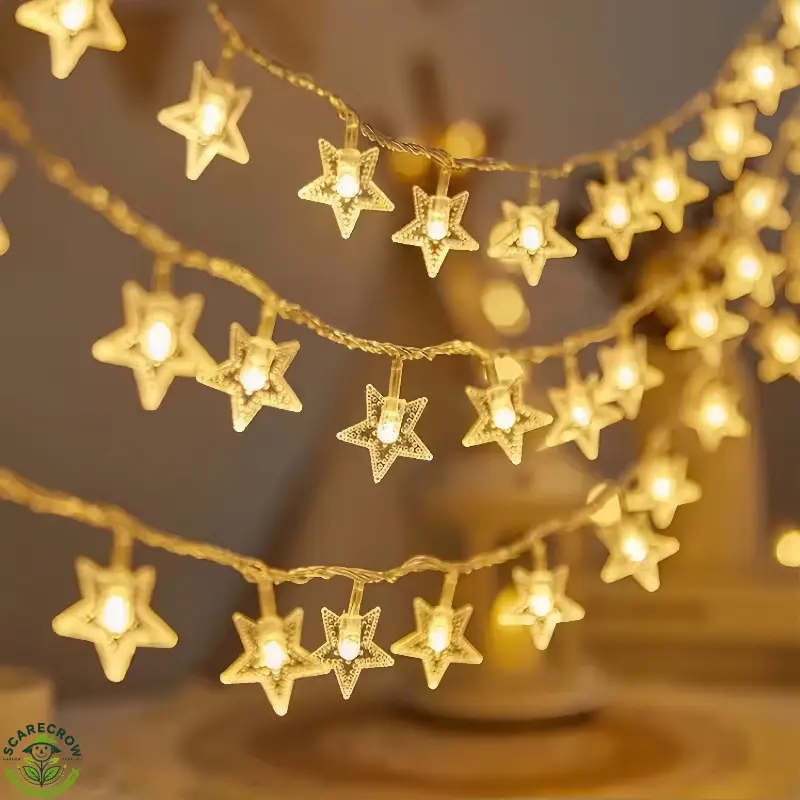
Warm-lit star-shaped decorative string lights joined by flexible wire
With a solar string-light set, the useful buyer checks happen along the cable: at the entries and joints, at the first, middle and far-end LEDs, and at any documented power-control or mode behavior. Panel and battery labels alone do not establish those details.
For the linked solar LED string-light set, the complete panel, battery housing and controller are not established by the available product documentation. Treat them as open items until exact model documents identify them, and do not fill gaps from a different solar-light product.
Start With the Exact String-Light Configuration
A string light is a system of parts, and each one has to belong to the exact product.
Which components belong to this product?
Record only the panel, battery or controller housing, sensor, cable, light nodes and connectors that are actually shown or documented for the exact set. The product listing mentions battery/solar power, a DC 6V/12V/24V range, an IP65 claim and star/round shapes, but it does not establish string length, node count, controller type, mode count, sensor type or wire construction. Treat those as listing-level claims or open fields; the voltage range may represent different configurations rather than one device.
A stake-mounted, radiating-branch firework string light is a different architecture and must not be used to fill any panel, battery, controller, wiring, connector, mode or runtime detail for this product. Bottle-cork string lights, long Christmas-tree strings and enclosed solar lanterns are likewise different products with different power and layout configurations, and none of their specifications transfer here.
Wire Entries, Joints and Strain Relief
This is where water and handling stress reach the electrical path.
Where can water or mechanical movement reach the electrical path?
Map only the cable entries, nodes, junctions and end termination that are actually present on the supplied set. If a panel/controller connection is not visible or documented, leave it unverified rather than drawing or describing a hidden connection.
Are joints supported against ordinary handling?
Inspect the strain relief, the bend concentration and the visible seal continuity under normal, permitted set-up. Do not turn this into an arbitrary pull test. The question is whether ordinary handling concentrates bending at a joint, and whether the seal is continuous where the cable enters a housing or a node.
End-to-End Output Along the String
An even-looking marketing image does not verify output along the full string, so compare defined positions on the actual sample.
Do start, middle and far-end nodes behave consistently in the same mode?
Observe the illumination at defined positions — start, middle and far end — after the same charge state and the same startup sequence. Note any flicker, dimming or non-functioning nodes at those positions. Take time-stamped photos or video. Any lighting comparison is qualitative unless a measurement method is defined, so label a visual check as a visual check.
How should a buyer record a difference without guessing the cause?
Record the location and the condition first. Voltage drop, a poor joint, a controller limit or normal LED variation are all possible, and each requires measured evidence before you assign a cause. Without electrical measurements, do not state a root cause; note the symptom and the location instead.
Documented Power-Control and Automatic-Lighting Behavior
If the exact set has selectable modes or a user control, check that behavior separately from LED output.
If selectable modes are documented, what happens after a normal user power cycle?
Use only the documented user sequence. Record whether the selected mode resumes, resets or changes. If selectable modes are not documented for the exact set, do not run or describe a mode-memory test.
What does the automatic night-lighting claim actually establish?
The listing describes automatic lighting at night. Verify the actual sensor/control for the selected set and record observed behavior under a repeatable light/dark setup. Do not infer a dawn shutoff point, a lux threshold, an all-night runtime or a specific controller mechanism.
Pack Completeness and Any Documented Segments or Connectors
If the exact set is segmented or detachable, the connector set becomes part of the specification.
If segments or detachable connectors are supplied, can they be identified and assembled correctly?
Record only the connectors, polarity/orientation and end caps actually supplied. If the exact set is not segmented or detachable, make no connector claim. Use the packing list, manual and trial assembly where available.
Does packaging protect cable bends, panel leads and LED nodes?
Inspect the actual retail and export pack for forced bends, crushed nodes or missing accessories. Do not invent transit standards; simply record what the pack does to the cable and nodes.
Document the Power Components Needed to Reproduce the Test State
Panel, battery and controller identities matter only when they are documented for the exact set and needed to reproduce the comparison condition.
Which power-component identities are needed for a repeatable comparison?
Record only the verified identifiers and charge/start condition used for the sample. General panel, lumen and IP selection principles are covered in the wholesale garden lights buyer guide, and battery/enclosure concepts are discussed in the solar lanterns wholesale guide. Neither page verifies this product's components.
What needs to be recorded for repeat orders?
Record the panel, controller and battery identities only if verified, plus the string length/node count if documented, wire/joint construction, documented modes or sensor behavior, any connectors, ingress evidence and packaging. A home water spray does not certify an IP rating, and the listing's IP65 claim should not be treated as verified without matching test evidence.
Start by pinning down the exact light set before you compare output or control behavior. Review the current solar LED string-light listing, then send the required string format, installation environment, power/charging configuration, any selectable modes and destination market. If a controller or mode is not documented for the chosen set, leave it out of the approval specification rather than borrowing it from another solar light.
Written by
ScarecrowGarden
💡About Scarecrow Garden Supplier Co., Ltd.
Scarecrow Garden Supplier Co., Ltd. is a China-based sourcing and wholesale partner specializing in garden tools, landscaping equipment, and outdoor supplies for international wholesalers, distributors, contractors, and brands.
With hands-on experience rooted in real garden use scenarios, we focus on durable materials, functional design, and stable large-volume supply. Our product range covers pruning tools, watering systems, hand tools, outdoor hardware, and customized garden solutions to support both retail and professional landscaping markets.
Beyond products, we help our partners navigate supplier selection, quality control, compliance requirements, and long-term sourcing strategies in China. Through our blog, we share practical insights on product selection, material comparisons, industry trends, and cost-effective purchasing—helping global buyers build stronger, more competitive supply chains.