











Updated 5 hours ago
Garden Swing Chairs: Suspension Hardware, Frame Squareness and Seat-Balance Checks Before Sourcing

ScarecrowGarden
💡About Scarecrow Garden Supplier Co., Ltd.
Scarecrow Garden Supplier Co., Ltd. is a China-based sourcing and wholesale partner specializing in garden tools, landscaping equipment, and outdoor supplies for international wholesalers, distributors, contractors, and brands.
With hands-on experience rooted in real garden use scenarios, we focus on durable materials, functional design, and stable large-volume supply. Our product range covers pruning tools, watering systems, hand tools, outdoor hardware, and customized garden solutions to support both retail and professional landscaping markets.
Beyond products, we help our partners navigate supplier selection, quality control, compliance requirements, and long-term sourcing strategies in China. Through our blog, we share practical insights on product selection, material comparisons, industry trends, and cost-effective purchasing—helping global buyers build stronger, more competitive supply chains.
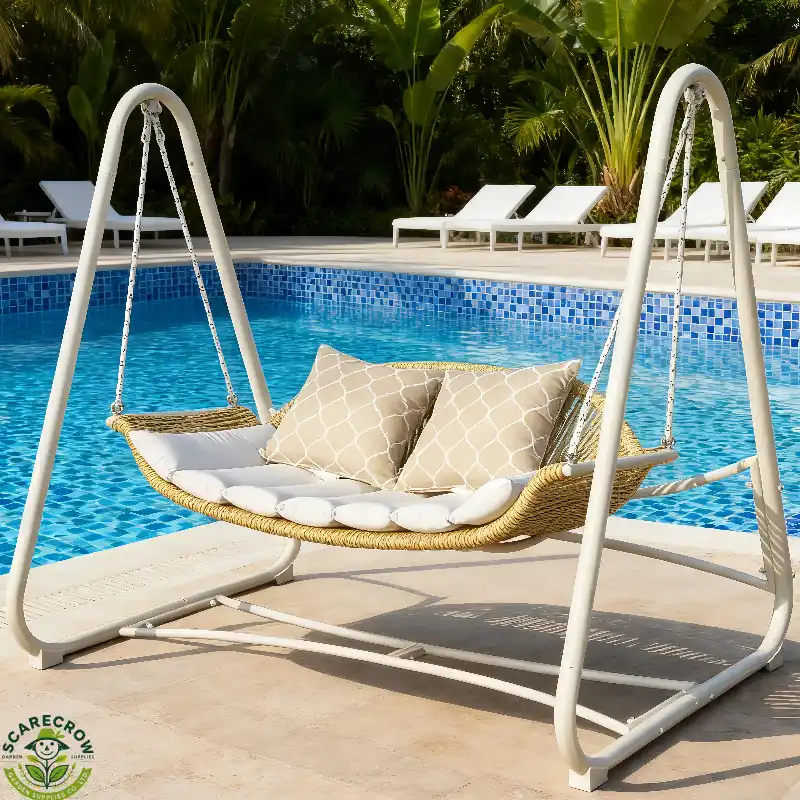
Two-seat outdoor swing chair with cushions and visible cord suspension hardware
At rest, a swing chair can hide assembly issues that only appear when the seat is moved: uneven hanging, frame twist, joint play or rubbing at the suspension points. Those checks depend on the actual suspension system and frame geometry, not on a generic outdoor-furniture material list.
For the linked two-seat swing chair with cushions, the visible reference configuration uses rope or cord suspension with metal ring/hook connections and separate cushions. An integrated canopy is not verified for the configuration shown, and a parasol in one scene should be treated as a separate item. Confirm the final BOM/assembly before naming suspension materials, colors or supplied accessories.
Assemble the Exact Swing Before Approval
Any motion or balance discussion has to come after a full, correct assembly of the exact model. Otherwise you are testing your own assembly error.
Which parts form the load path?
Map the base or frame, the suspension attachment points, the seat frame, the cushions and the fasteners. Build this list from the exact model's manual, BOM and a full sample assembly. Mention a top cross-member only if the exact assembly proves one exists. Identify the suspension attachment points on the bench and on the frame, and record what hardware connects them.
Is the assembled frame square and level?
Before judging how the seat swings, check the base. Confirm that the feet make contact and that the frame sits square, using diagonals or the model's own geometry, and check that the fasteners seat properly. A frame that is out of square can affect how the seat hangs, so correct the assembly before judging suspension balance.
Suspension Hardware and Attachment Points
The suspension is what carries the seat, so it deserves its own check.
What actually carries the seat?
Identify the visible suspension arrangement first, then confirm its material and grade from the BOM or hardware documentation. The reference imagery shows rope or cord elements with metal ring/hook connections; exact material and finish remain documentary fields. Do not infer a load rating from appearance, and do not describe chain or spring suspension unless the exact configuration proves it.
Are left and right suspension lengths and attachment positions symmetrical?
Measure the setup as assembled and inspect ordinary movement for twisting or unequal travel between the two sides. Symmetry here is a set-up and assembly check; record the measurements and any visible difference, and keep the observation to a controlled, no-person setup.
Seat Balance, Clearance and Motion
With the frame square and the suspension symmetric, the seat itself can be assessed.
Does the unloaded or approved test configuration hang level?
Record the seat height and angle and the side-to-side balance, using the manufacturer's set-up as the reference. Do not use a person as a proof load. Use the manufacturer's permitted test configuration, and note any measured difference from side to side.
Does permitted motion contact the frame or suspension structure?
Observe clearance through the manufacturer-permitted range of travel only. Do not exceed stops and do not apply improvised loads. Record whether the seat, suspension or soft goods contact the frame within normal movement, because contact during motion is a fit issue that static inspection misses.
Frame, Fasteners and Joint Alignment
Assembly quality shows up in how the joints behave.
Do bolt holes and brackets align without forcing?
Record cross-threading, elongated holes, forced alignment or distortion that appears after tightening. A joint that has to be forced into place is telling you something about the frame's dimensional control, so note it during assembly rather than after.
Does ordinary permitted cycling change visible joint play?
Compare joint play before and after ordinary permitted cycling, and record it as sample screening. There is no universal cycle count and no fatigue life to quote, so do not invent one. What you are checking is whether normal use visibly changes the joints on the samples in hand.
Cushion Fit and Soft-Goods Identity, Separate From Structural Claims
The cushions are a soft-goods question, not a structural one, and the two should not be mixed.
Do the supplied cushions fit and remain positioned on the verified seat geometry?
Record the cushion count, shape, and the attachment or anti-slip method only if one is actually supplied. Do not infer the textile material, weather resistance or fixation method from appearance.
What cushion material or weather claims are actually supported?
Require exact textile, fill and coating documentation before repeating any weather claim. An “outdoor” name does not prove UV resistance, waterproofing or fade resistance. If the documentation is not available, leave the claim out.
An integrated canopy, canopy support or canopy adjustment mechanism has not been verified for the configuration shown and must not be listed as supplied without matching BOM/assembly evidence. Treat the separate parasol in scene imagery as a different item. Keep the safety boundary: no improvised overload or drop tests, no person as a proof load, and no root-cause diagnosis from sound alone.
Load Evidence, Packaging and Repeat Orders
The final step is evidence and repeatability.
What evidence supports any stated seating or load capacity?
If a listing or quotation states a seating or load capacity, require exact structural test or engineering evidence for that configuration before repeating the figure. Visual screening cannot create a safe load rating.
Can the carton reproduce the approved assembly?
Record the suspension hardware counts, fastener packs, frame protection, seat/cushion identity and instructions against the approved assembly so the repeat order can be compared with the same specification.
Carry that configuration record into repeat-order quality control before comparing later deliveries.
For broader material-selection context, see choosing garden furniture materials. For assortment and trend context, see benches and swings trends. Neither page replaces the exact swing-chair assembly or load documentation.
For a swing-chair order, reconcile the assembled sample with the frame drawing, suspension hardware, fastener pack and any load evidence before you approve the carton. Review the current two-seat swing chair with cushions, then send the seating format, installation setting, packaging needs and any required load documentation. Do not add an integrated canopy unless the matching configuration is documented.
Written by
ScarecrowGarden
💡About Scarecrow Garden Supplier Co., Ltd.
Scarecrow Garden Supplier Co., Ltd. is a China-based sourcing and wholesale partner specializing in garden tools, landscaping equipment, and outdoor supplies for international wholesalers, distributors, contractors, and brands.
With hands-on experience rooted in real garden use scenarios, we focus on durable materials, functional design, and stable large-volume supply. Our product range covers pruning tools, watering systems, hand tools, outdoor hardware, and customized garden solutions to support both retail and professional landscaping markets.
Beyond products, we help our partners navigate supplier selection, quality control, compliance requirements, and long-term sourcing strategies in China. Through our blog, we share practical insights on product selection, material comparisons, industry trends, and cost-effective purchasing—helping global buyers build stronger, more competitive supply chains.