











Updated 5 hours ago
Freestanding Garden Fountains: Pump Documentation, Cascade Behavior, Water-Level and Leak Checks

ScarecrowGarden
💡About Scarecrow Garden Supplier Co., Ltd.
Scarecrow Garden Supplier Co., Ltd. is a China-based sourcing and wholesale partner specializing in garden tools, landscaping equipment, and outdoor supplies for international wholesalers, distributors, contractors, and brands.
With hands-on experience rooted in real garden use scenarios, we focus on durable materials, functional design, and stable large-volume supply. Our product range covers pruning tools, watering systems, hand tools, outdoor hardware, and customized garden solutions to support both retail and professional landscaping markets.
Beyond products, we help our partners navigate supplier selection, quality control, compliance requirements, and long-term sourcing strategies in China. Through our blog, we share practical insights on product selection, material comparisons, industry trends, and cost-effective purchasing—helping global buyers build stronger, more competitive supply chains.
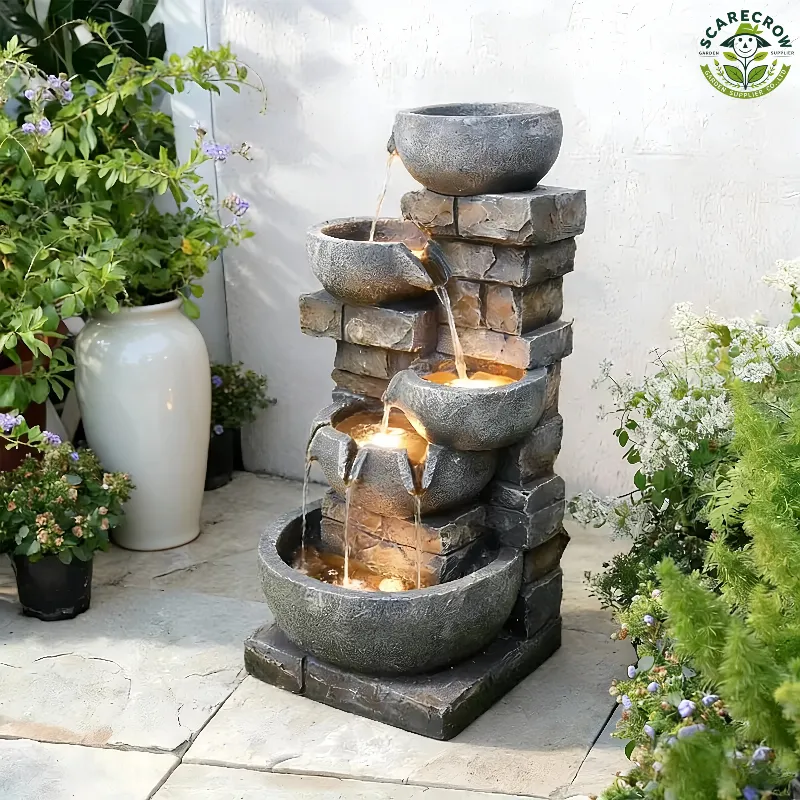
Five-tier freestanding cascading-bowl garden fountain
A product image can show the tier layout and decorative finish, but it cannot establish the exact pump, water path, operating water level or electrical configuration. For the linked five-tier freestanding fountain, those technical details need matching model documents before pump-specific checks become executable.
Start the approval process by separating what is visible from what is documented. The five-tier/LED appearance can identify the product family; pump, tubing, internal water connections, transformer or adapter and electrical protection remain unverified until the exact BOM or manual is available.
Confirm the Water-Circulation Architecture First
If exact model documentation confirms a recirculating system, map the basin or reservoir, pump, tubing or channels, vertical lift and return path from those documents. If the documents do not show that architecture, record the gap instead of reconstructing hidden water routes from the exterior.
What water path is actually documented?
Use the assembly manual, BOM or pump/tubing drawing to identify only the components and joints shown for the exact model. A page-level recirculating claim is not enough to establish the pump model or internal routing.
Which components are removable or sealed?
Record service access and joint locations only as they actually exist. An exploded view or BOM is the right source here. Do not assume a hidden internal connection from the outside appearance of the body.
Pump-to-Fountain Matching
Pump matching is only possible after the exact pump data and the actual lift path are known.
Does the pump data support the actual lift and desired operating point?
If the exact pump curve or manufacturer data and the actual lift are available, compare the operating point against them. Maximum head is not the same as operating flow; for the general concept, see pump head versus flow rate. Without exact pump data, stop at the documentation gap rather than borrowing a curve from another fountain.
Does assembled flow produce the intended cascade without overflow or dry channels?
After the exact sample is assembled and operated according to its manual, record the visible cascade at the documented water level and any documented pump setting. Note dry channels, unintended overflow or uneven tier flow as observations of that configuration, not universal pass/fail thresholds.
Water-Level Stability and Low-Water Behavior
For a confirmed recirculating configuration, the operating water level needs a documented reference before low-water behavior can be compared.
What water level does the manufacturer specify?
Use only the exact fill marks or manual guidance. If the manual gives a minimum level, record it, and note how quickly ordinary splash and evaporation move the system toward that limit. Without a manufacturer figure, do not state a universal minimum water level.
What happens when water falls within the permitted operating range?
Observe noise, flow continuity or pump exposure only within the manufacturer-permitted range. Do not deliberately run the pump dry unless the manual explicitly allows it, because dry-running can damage the pump and is not a valid buyer test.
Splash Loss and Return-Path Control
Splash is not a leak, and the difference matters when you are diagnosing a sample.
Where does water leave the intended catchment area?
Map the splash points, the bowl alignment and the return path under the documented setup. Photograph and mark where water leaves the catchment area. If useful and safe, record a refill or collection observation over a defined period, but treat it as an observation of this configuration, not a rated splash-loss figure.
Does leveling change the result?
Install the fountain level, per the instructions, and note how sensitive the result is to assembly alignment. A fountain that splashes because it is out of level is an installation issue, not a product performance result, so do not normalize a faulty installation as a performance finding.
Assembly Leaks, Seams and Internal Connections
Leak checks begin only after the assembly map identifies the water-contact joints.
Which documented seams or water-path joints need inspection?
Inspect only the seams, plugs, tubes, stacked sections or other water-contact joints shown for the exact model. If a hidden connection is not documented or accessible, mark it unverified rather than assuming it exists or is sealed.
Is observed water from leakage or splash?
Use dry markers or isolated observation points, where it is safe to do so, to distinguish a leak from splash. Do not disassemble energized parts to find a leak. Any part of this check that involves electrical components follows the manufacturer's instructions and a qualified procedure.
Electrical/LED Boundary, Packaging and Repeat Orders
Treat the electrical side separately from the water-path review, and use only documents that match the exact configuration and destination market.
What electrical parts are included and approved for this configuration?
If an LED, transformer or cable is included, require the exact model documentation and confirm it applies to the target market before making any waterproof or electrical claim. Do not infer a wet-location rating, a waterproof level or a mains-versus-battery architecture from appearance. Until the exact electrical documents are in hand, leave these as open items.
Can the packed fountain reproduce the approved assembly?
Record the component count, the pump, tube and LED identities if known, the fragile-surface protection, and the assembly sequence, so the carton can reproduce the approved build. Use the BOM, packaging photos and a trial assembly.
Include this assembly record in repeat-order quality control for later fountain deliveries.
Before approving a fountain on appearance, ask for the documents that make the water-system review possible: the exact pump or model data, assembly or water-path information, operating water-level guidance and electrical documents for the destination market. Review the current five-tier freestanding fountain, then send the installation country, desired cascade effect and documentation requirements for that exact configuration.
Written by
ScarecrowGarden
💡About Scarecrow Garden Supplier Co., Ltd.
Scarecrow Garden Supplier Co., Ltd. is a China-based sourcing and wholesale partner specializing in garden tools, landscaping equipment, and outdoor supplies for international wholesalers, distributors, contractors, and brands.
With hands-on experience rooted in real garden use scenarios, we focus on durable materials, functional design, and stable large-volume supply. Our product range covers pruning tools, watering systems, hand tools, outdoor hardware, and customized garden solutions to support both retail and professional landscaping markets.
Beyond products, we help our partners navigate supplier selection, quality control, compliance requirements, and long-term sourcing strategies in China. Through our blog, we share practical insights on product selection, material comparisons, industry trends, and cost-effective purchasing—helping global buyers build stronger, more competitive supply chains.