











Updated 2 days ago
Retractable Outdoor Awnings: Cassette Closure, Arm Alignment and Fabric-Tension Checks Before Sourcing

ScarecrowGarden
💡About Scarecrow Garden Supplier Co., Ltd.
Scarecrow Garden Supplier Co., Ltd. is a China-based sourcing and wholesale partner specializing in garden tools, landscaping equipment, and outdoor supplies for international wholesalers, distributors, contractors, and brands.
With hands-on experience rooted in real garden use scenarios, we focus on durable materials, functional design, and stable large-volume supply. Our product range covers pruning tools, watering systems, hand tools, outdoor hardware, and customized garden solutions to support both retail and professional landscaping markets.
Beyond products, we help our partners navigate supplier selection, quality control, compliance requirements, and long-term sourcing strategies in China. Through our blog, we share practical insights on product selection, material comparisons, industry trends, and cost-effective purchasing—helping global buyers build stronger, more competitive supply chains.
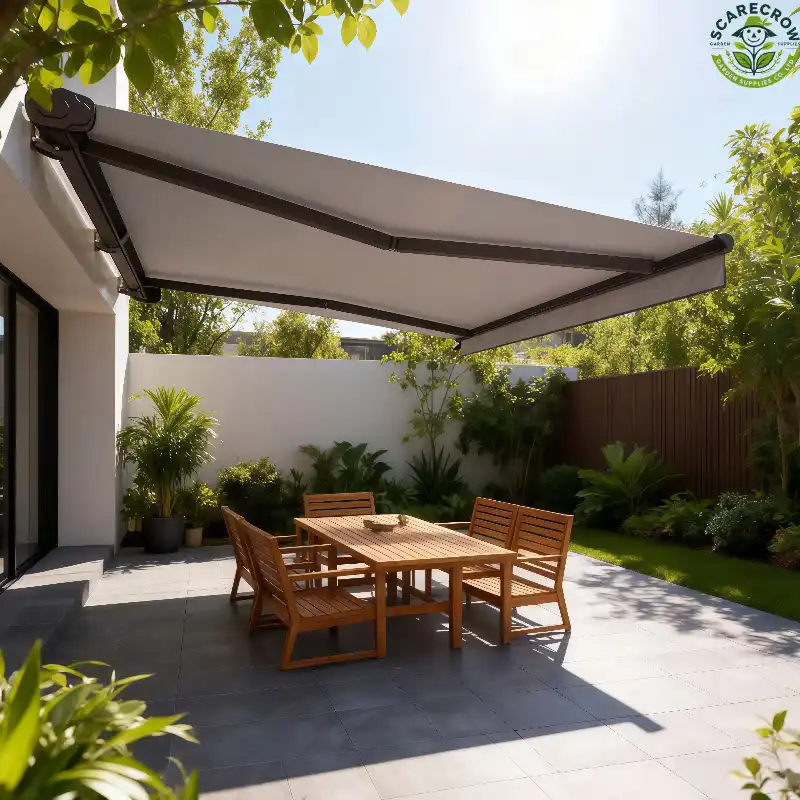
automatic retractable awning
Product image from the linked product page; confirm specifications for the selected model.
A retractable awning looks correct when fully open. The fabric extends, the arms are straight, and the front bar sits level. But the awning may still fail through uneven arm travel, incomplete cassette closure, fabric tracking that drifts to one side, bracket misalignment or wind claims that have no engineering basis. These failures appear during the open-close cycle and at the installation interface, not in a static photo of the open position.
This guide covers what to inspect on a retractable awning sample: the actual architecture, cassette closure and front-bar alignment, folding-arm symmetry and joint play, fabric tension and tracking, pitch and stop settings with installation interface, and wind and weather claims.
Identify the Actual Awning Architecture
Which Cassette, Drive and Bracket Configuration Is Supplied?
Full cassette, half cassette, arm count, manual or motor drive, front bar and bracket system must come from the exact SKU. A full cassette awning encloses the fabric and arms when retracted. A half cassette protects the fabric but leaves the arms exposed. A manual awning uses a crank handle. Motorized awnings may use a tubular motor; confirm the exact drive configuration from the SKU manual.
Do not assume motorized or manual features from category labels. Require exact drawing and manual evidence for full or half cassette and manual or motor operation. Neither “automatic” in a product title nor category copy confirms the tested configuration. If the sample is manual, do not test it as if it has a motor. If it is half-cassette, do not evaluate cassette closure as if it were full-cassette.
Cassette Closure and Front-Bar Alignment
Does the Front Bar Seat Evenly in the Cassette?
Cycle open and close and measure or observe end gaps, rubbing, incomplete seating and side-to-side skew. When the awning retracts, the front bar should seat evenly into the cassette. If one end enters the cassette before the other, uneven closing may relate to fabric tracking, arm symmetry or other factors; observe and record without asserting a unique cause.
Use the permitted open and close sequence and record corresponding end gaps and seating photographs. The front bar is the component that closes the cassette. Record closure gaps and the manufacturer's intended enclosure arrangement; do not infer complete loss of protection from an uneven seat alone.
Does Fabric Tracking Explain an Uneven Closing Observation?
Check whether the fabric rolls evenly onto the tube. Fabric should track straight onto the roller tube during retraction. Record roll position and front-bar skew together without diagnosing internal causes or adjusting live mechanisms. Further diagnosis requires access to the internal mechanism.
Folding-Arm Symmetry and Joint Play
Do the Arms Travel Symmetrically Without Growing Play?
Compare arm extension angles, elbow joints and fastener play before and after cycles. Folding arms should extend and retract symmetrically. Record arm extension angles, elbow joint positions and front-bar gap together; if one arm leads and the other lags, refer the observation for model-specific investigation.
Observe jerking or asymmetric travel without diagnosing internal causes unless verified. Use matching before and after angles and joint observations during approved operation. Stored-energy maintenance or adjustment belongs to qualified personnel following the manual. The folding arms contain springs under tension. Do not attempt to adjust, disassemble or service the arms without the manufacturer's procedure and appropriate safety equipment.
Fabric Tension, Tracking and Edge Curl
Where Do Wrinkles, Drift or Edge Curl Appear During Travel?
Check wrinkles, lateral drift, seam alignment and tension across partial and full extension. Fabric should maintain even tension from partial to full extension. Record wrinkles alongside roll position, fabric tension and extension state; wrinkles alone do not identify the cause. Edge curl, where the fabric's selvedge lifts or curls, may indicate fabric construction or tension issues.
UV, water and fade claims require exact fabric evidence. Document partial and full extension and actual fabric and seam position. The fabric behavior on a retractable awning is about how the material rolls and unrolls, not about canopy fit on a frame.
Pitch and Stop Settings and Installation Interface
Which Pitch, Stop and Mounting Settings Are Authorized?
Verify the adjustment range only from the actual system. The pitch, the angle at which the awning slopes downward from the wall, affects water runoff and shade coverage. The stop positions limit how far the awning extends. Check bracket spacing, fastener set and substrate requirements from installation documentation.
Use exact installation and adjustment instructions and approved fasteners. Do not tamper with stops or expose energized mechanisms. If the awning is motorized, the stops may be set electronically. If it is manual, the stops are mechanical. Either way, the manufacturer's procedure governs adjustment.
What Evidence Establishes the Building-Side Support?
Separate product hardware from building-structure suitability. The brackets and fasteners are part of the awning system. The wall that the brackets attach to requires separate structural assessment by qualified parties. A sample that closes smoothly does not verify that the wall can support the awning's load, especially when extended and exposed to wind.
Separate hardware fit from substrate and structural suitability. The wall structure, anchor type and load capacity require separate engineering evidence.
Wind and Weather Claims Need Engineering Evidence
Does the Claimed Rating Match Size, Mounting and Method?
Do not infer wind resistance from arm size or aluminum construction. An awning's wind resistance depends on the frame geometry, fabric area, mounting configuration and installation. Any rating must state the tested or configured dimensions, mounting and the standard or method used.
Require exact engineering or test records and current applicable scope before using any wind or weather rating. Do not present a sunshade as a weatherproof building envelope. A retractable awning is designed to provide shade. It is not a structural element designed to resist wind loads in the same way as a permanent roof.
If you are sourcing retractable outdoor awnings, compare cassette closure, arm symmetry and fabric tracking on a fully assembled sample.
Written by
ScarecrowGarden
💡About Scarecrow Garden Supplier Co., Ltd.
Scarecrow Garden Supplier Co., Ltd. is a China-based sourcing and wholesale partner specializing in garden tools, landscaping equipment, and outdoor supplies for international wholesalers, distributors, contractors, and brands.
With hands-on experience rooted in real garden use scenarios, we focus on durable materials, functional design, and stable large-volume supply. Our product range covers pruning tools, watering systems, hand tools, outdoor hardware, and customized garden solutions to support both retail and professional landscaping markets.
Beyond products, we help our partners navigate supplier selection, quality control, compliance requirements, and long-term sourcing strategies in China. Through our blog, we share practical insights on product selection, material comparisons, industry trends, and cost-effective purchasing—helping global buyers build stronger, more competitive supply chains.