











Updated 2 days ago
Adjustable-Louver Garden Gazebos: Louver Alignment, Drainage Paths and Opening-Mechanism Checks

ScarecrowGarden
💡About Scarecrow Garden Supplier Co., Ltd.
Scarecrow Garden Supplier Co., Ltd. is a China-based sourcing and wholesale partner specializing in garden tools, landscaping equipment, and outdoor supplies for international wholesalers, distributors, contractors, and brands.
With hands-on experience rooted in real garden use scenarios, we focus on durable materials, functional design, and stable large-volume supply. Our product range covers pruning tools, watering systems, hand tools, outdoor hardware, and customized garden solutions to support both retail and professional landscaping markets.
Beyond products, we help our partners navigate supplier selection, quality control, compliance requirements, and long-term sourcing strategies in China. Through our blog, we share practical insights on product selection, material comparisons, industry trends, and cost-effective purchasing—helping global buyers build stronger, more competitive supply chains.
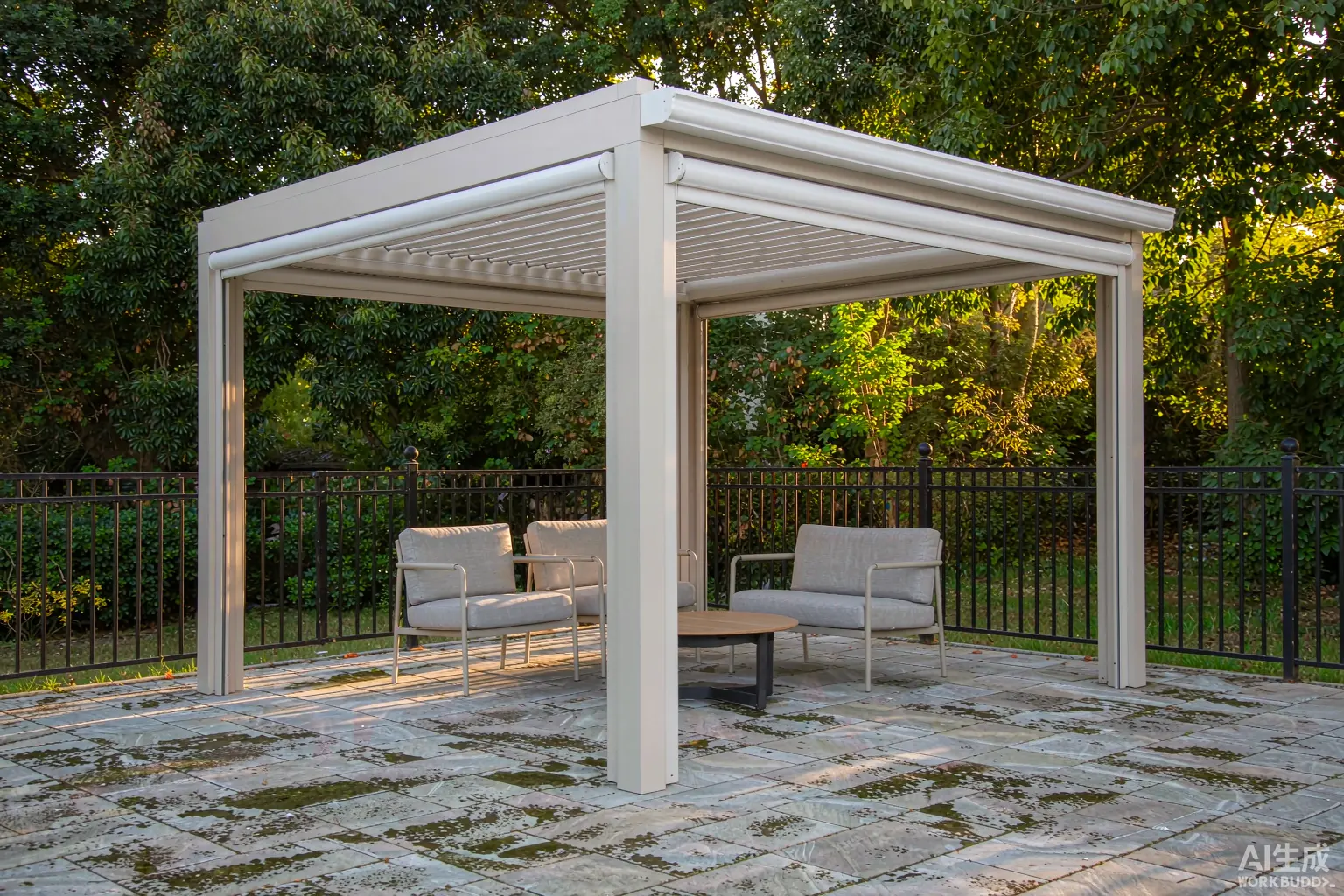
Aluminum garden gazebo with adjustable louvered roof over garden furniture
AI-generated editorial illustration; not a product photograph.
A louver-roof gazebo with adjustable blades offers shade when closed and open sky when the blades rotate apart. The concept is straightforward. The execution is not. A gazebo with acceptable frame materials can still fail through misaligned louvers, jammed drive linkages, uncontrolled runoff, loose columns or installation-dependent leakage. These issues may become apparent after full assembly and mechanism cycling; component photographs alone may not reveal them.
This guide covers what to inspect on an adjustable-louver gazebo sample: full assembly before approval, louver parallelism and synchronized motion, the drive and opening mechanism, rainwater paths, column and base-plate alignment, coating and fastener corrosion, and packaging of long profiles.
Full Assembly Before Approval
Does the Complete Assembly Match the Roof and Drainage Map?
Map the columns, beams, louvers, drive linkage, gutters, downpipes and base plates on the exact model. Every component in a louver-roof gazebo is part of a system. The columns support the beams. The beams carry the louvers and the drive linkage. Confirm from the exact roof, channel and outlet drawing whether gutters, downpipes or other drainage components are included and trace the actual water route.
Do not rely on component photos for alignment approval. Use the exact column, beam, louver, linkage, gutter BOM and installation drawings. Component photographs cannot establish synchronization or drainage continuity. A photo of a louver blade tells you the blade exists. It does not tell you whether that blade aligns with the adjacent blade when closed or whether the drive linkage moves all blades together.
Louver Parallelism, Gaps and Synchronized Motion
Are Gaps and Blade Positions Consistent Across the Roof?
Measure blade alignment at closed and open positions. Check for rubbing, uneven gaps and one-side lag. When the louvers are closed, the gaps between blades should be consistent across the roof. A blade that sits lower than its neighbor may create a gap; the effect depends on the louver overlap design, sealing system and rain intensity; use model-specific geometry rather than a universal dimension. When the louvers are open, the blades should be parallel.
Record corresponding closed and open measurement locations on the assembled model. Observed asymmetry or lag in blade movement may indicate linkage play or pivot binding; record the observation without asserting an internal diagnosis.
Do All Louvers Move Together Through the Permitted Travel?
Cycle the mechanism and record repeatability. Use the manufacturer's safe cycle procedure and repeat the same observations. Keep hands and instruments outside moving pinch points. The drive linkage should move all louvers simultaneously. If one blade lags, record its position and the operating conditions and refer the observation for model-specific investigation; lag alone does not identify the cause.
Drive and Opening Mechanism and Stops
Which Drive, Linkage and Stops Are Actually Fitted?
Identify manual crank, motor or linkage only after exact product confirmation. Some louver gazebos use a manual hand crank that rotates a shaft connecting all blades. Others use a motorized drive that responds to a switch or remote. The drive type affects how the mechanism is tested and what failure modes are possible.
Confirm manual or motor operation and permitted travel from the exact model manual before evaluation. Do not assume motorized operation from a product title that says “automatic.”
What Stop or Jam Behavior Can Be Evaluated Safely?
Check documented stops and permitted recovery behavior only by the manufacturer's safe procedure. Record observed jamming without forcing over-travel or inducing a dangerous fault. Do not infer an internal failure cause. If the mechanism jams at a specific point in the travel, record the position and the conditions. Do not force the mechanism past the jam.
Document normal stops and approved recovery only. No forced overtravel, dangerous induced jam, live disassembly or safeguard bypass to create evidence. The mechanism's stops are designed to prevent over-travel. Bypassing them to test what happens is not a safe evaluation.
Rainwater Path: Louver to Gutter to Downpipe
Where Does Water Pass From Louvers to Gutters and Downpipes?
Use controlled water input to trace pooling, overflow and leakage at beam and column interfaces. When the louvers are closed, trace the actual water route from the confirmed roof, channel and outlet drawing. If water pools on the beams, overflows the channels or leaks at the beam-to-column joints, the drainage path has a problem.
Trace the real assembled channels using controlled, appropriate water input and annotated observations. A component photo alone cannot verify assembled flow continuity.
Which Roof Position and Input Produced the Observed Leakage?
Do not use “waterproof” unless the exact test or claim supports it. Record the louver angle or configuration, water delivery and exit or overflow locations. This supplies a bounded screening record, not universal waterproofing. A product title that includes “waterproof” is a marketing claim, not test evidence.
Column, Base Plate and Fastener Alignment
Does Assembly Alignment Match the Anchoring Design?
Check diagonal and squareness, hole alignment and assembly-induced stress. The columns must be square to each other and to the beams. If the base plates are misaligned, the columns may not sit vertical, which affects the entire roof structure.
Anchoring substrate and structural load requirements must come from engineering or installation documents. Record diagonals, base-plate and hole locations against the exact drawings. Substrate, anchors and structural loads require separate engineering evidence. A gazebo that assembles smoothly on a concrete pad may not perform the same way on a deck or paver base.
Coating and Fastener Corrosion and Drainage Maintenance
What Materials Are Exposed Along the Actual Drainage Route?
Verify actual material, coating and fastener grades before discussing corrosion resistance. Water flows through the gutters and downpipes on every rain. Record the actual metals, coatings, isolation methods and contact configurations along the drainage route. If the gutter is aluminum and the downpipe fasteners are steel, record the contact configuration and environment; obtain compatibility and maintenance guidance from the supplier or a qualified engineer for that assembly. Do not infer a specific corrosion direction, service life or SKU performance from material names alone.
Can Gutters and Outlets Be Maintained by the Approved Method?
Check access to gutters and drains for cleaning. Depending on site exposure, leaves and debris may accumulate in the gutters over time. If the design does not allow access for cleaning, overflow may occur during heavy rain. Record access and permitted cleaning steps for the assembled system without dismantling energized or loaded components.
Packaging Long Profiles and Louver Blades
Can Long Profiles and Louvers Arrive Ready for the Prescribed Assembly?
Inspect scratch protection, end protection, hardware labeling and carton or pallet sequence for assembly. Louver gazebo components are long and slender. Aluminum profiles can scratch or bend during transit. Hardware must be labeled and organized so that the assembler can identify which fastener goes where.
Use packing photographs, component labels and alignment checks tied to the actual carton or pallet order.
If you are sourcing adjustable-louver garden gazebos, review a fully assembled sample, louver-cycle check and drainage-path test.
Written by
ScarecrowGarden
💡About Scarecrow Garden Supplier Co., Ltd.
Scarecrow Garden Supplier Co., Ltd. is a China-based sourcing and wholesale partner specializing in garden tools, landscaping equipment, and outdoor supplies for international wholesalers, distributors, contractors, and brands.
With hands-on experience rooted in real garden use scenarios, we focus on durable materials, functional design, and stable large-volume supply. Our product range covers pruning tools, watering systems, hand tools, outdoor hardware, and customized garden solutions to support both retail and professional landscaping markets.
Beyond products, we help our partners navigate supplier selection, quality control, compliance requirements, and long-term sourcing strategies in China. Through our blog, we share practical insights on product selection, material comparisons, industry trends, and cost-effective purchasing—helping global buyers build stronger, more competitive supply chains.