











Updated 2 days ago
Metal Garden Deck Boxes: Lid Alignment, Hinge Load and Water-Ingress Checks Before Bulk Orders

ScarecrowGarden
💡About Scarecrow Garden Supplier Co., Ltd.
Scarecrow Garden Supplier Co., Ltd. is a China-based sourcing and wholesale partner specializing in garden tools, landscaping equipment, and outdoor supplies for international wholesalers, distributors, contractors, and brands.
With hands-on experience rooted in real garden use scenarios, we focus on durable materials, functional design, and stable large-volume supply. Our product range covers pruning tools, watering systems, hand tools, outdoor hardware, and customized garden solutions to support both retail and professional landscaping markets.
Beyond products, we help our partners navigate supplier selection, quality control, compliance requirements, and long-term sourcing strategies in China. Through our blog, we share practical insights on product selection, material comparisons, industry trends, and cost-effective purchasing—helping global buyers build stronger, more competitive supply chains.
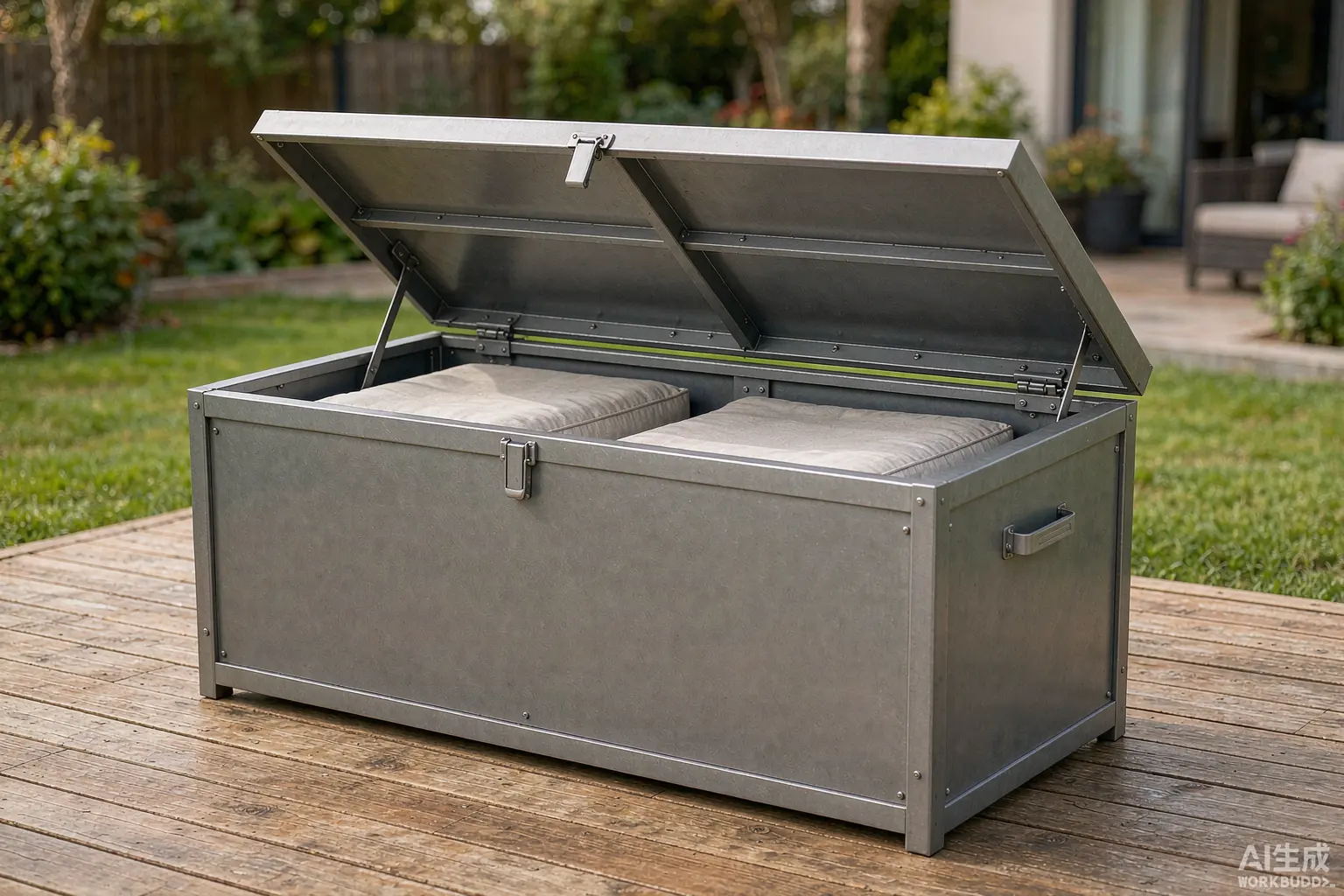
Metal garden deck storage box with hinged lid open on a wooden patio
AI-generated editorial illustration; not a product photograph.
A metal deck box is described by its capacity in gallons and its frame material. These specifications tell you what the box holds and what it is made of. They do not tell you whether the lid stays aligned after assembly, whether the hinges survive repeated opening, whether water enters through seams during rain, or whether the bottom sags under stored load. These are the failure modes that drive returns, and they require a physical sample to evaluate.
This guide covers what to inspect on a metal garden deck box sample: the load path through lid, frame and base, lid alignment and gap consistency, hinge and strut hardware, water-ingress paths and drainage, bottom and panel deflection, and flat-pack assembly and carton protection.
Define the Load Path: Lid, Frame, Panels and Base
Which Parts Carry Lid Weight and Stored Contents?
Map where lid weight, stored-item load and lifting forces enter the structure. The lid transfers weight through hinges or struts to the frame. Stored contents sit on the base panel, which transfers load to the frame and then to the ground. Lifting forces, if the box has handles, transfer through the frame to the base.
Verify the exact frame and panel construction rather than assuming aluminum or steel details from the product title. A product listed as an “aluminum frame” deck box may have aluminum frame members with steel panels, plastic connectors or mixed material hardware. Use the exact assembled drawing or BOM and sample photographs. An aluminum-frame title is not proof of every panel material.
Lid Alignment and Gap Consistency
Does the Assembled Lid Stay Square and Free-Moving?
Measure diagonal or squareness, lid-to-frame gaps and latch alignment after full assembly. A lid that is square on the drawing may not be square after assembly if panel tolerances accumulate. Check whether the lid rubs or binds through repeated opening and closing cycles.
Record diagonals, gap positions and latch fit after the specified assembly sequence and permitted opening cycles. If one corner sits higher than another, the lid may not seal properly and the latch may not engage; record the measured difference and compare against the model's specification.
Hinges, Struts and Opening Control
Are Hinges, Struts or Soft-Close Parts Actually Fitted?
Identify the actual hinge, strut or soft-close hardware before testing. A product page may mention “soft-close lid” without specifying whether this is a gas strut, a hydraulic damper or a friction hinge. The hardware type determines replacement parts, service life and failure mode.
Identify hardware from the exact BOM or manual before assigning a function. Do not promise soft-close, load capacity or child-safety features unless the SKU has them and they are verified.
Does Repeated Permitted Opening Change the Attachments?
Cycle open and close within the manufacturer's permitted range. Inspect fastener loosening, mounting-hole elongation and asymmetry. Use before and after photographs and measured play at the same mounting points.
No seating, child-safety or soft-close claim follows from this observation. A hinge that survives 50 open and close cycles is not certified for child-safety compliance. A strut that holds the lid open is not a load rating. What you can record is whether the hardware shows visible change after the defined cycles.
Water-Ingress Paths and Drainage
Which Seams or Openings Admit the Defined Water Input?
Inspect lid overlaps, seams, fastener holes, corners and base or floor contact. Water enters deck boxes through the paths where panels meet, where fasteners penetrate and where the lid meets the frame. A box that looks sealed on the outside may have gaps at internal seams.
Plan a repeatable rain or water-screening comparison appropriate to the exact model and safe setup. Record the water delivery method, duration and entry locations. Do not label the box waterproof unless evidence supports that precise claim. This is a screening test, not an IP certification.
Document box orientation, water delivery, duration and entry points in a manufacturer-appropriate screening setup. The result tells you where water enters on this sample, not whether the box meets any specific ingress protection standard.
Bottom and Panel Deflection Under Stored Load
Does a Permitted Stored Load Leave Permanent Deflection?
Use documented, manufacturer-permitted distributed stored loads representative of intended contents. Record permanent deformation and latch or door function after unloading. Do not overload or perform a sitting test. The product page may claim a seating capacity, but a stored-load comparison does not establish seating, child-safety or structural certification.
No universal kg capacity is supplied without supplier or engineering evidence. Use representative contents within verified design guidance and record distributed mass and post-unloading geometry. Do not sit on or improvise overloads of the sample.
Flat-Pack Assembly and Carton Protection
Do Assembly and Packing Changes Alter Lid Fit?
Check panel identification, fastener count, scratch protection and whether assembly tolerance changes lid fit. Flat-pack deck boxes rely on the user to assemble the panels correctly. If panel IDs are unclear, fasteners are missing or the assembly sequence forces panels into misalignment, the final lid fit suffers.
Match panel IDs, fasteners and protection to the exact flat-pack BOM. Retain assembled gap photographs before and after relevant packing or handling evaluation. If the sample arrives with scratched panels or bent edges, the packaging needs improvement before bulk shipment.
If you are sourcing metal garden deck boxes, compare assembled lid fit, water screening and hardware on samples.
Written by
ScarecrowGarden
💡About Scarecrow Garden Supplier Co., Ltd.
Scarecrow Garden Supplier Co., Ltd. is a China-based sourcing and wholesale partner specializing in garden tools, landscaping equipment, and outdoor supplies for international wholesalers, distributors, contractors, and brands.
With hands-on experience rooted in real garden use scenarios, we focus on durable materials, functional design, and stable large-volume supply. Our product range covers pruning tools, watering systems, hand tools, outdoor hardware, and customized garden solutions to support both retail and professional landscaping markets.
Beyond products, we help our partners navigate supplier selection, quality control, compliance requirements, and long-term sourcing strategies in China. Through our blog, we share practical insights on product selection, material comparisons, industry trends, and cost-effective purchasing—helping global buyers build stronger, more competitive supply chains.