











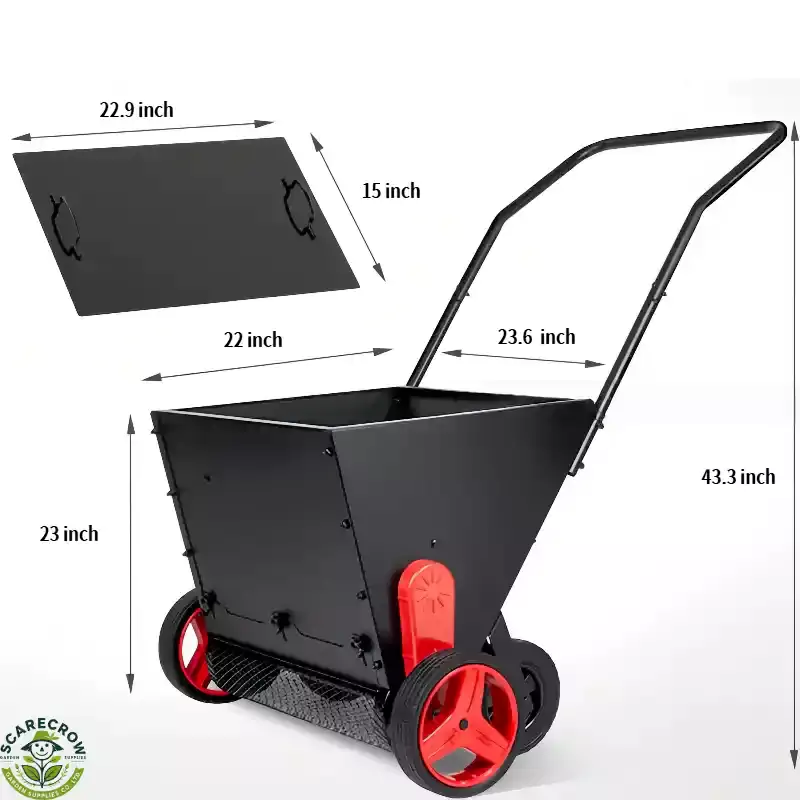
steel lawn drop spreader
Product image from the linked product page; confirm specifications for the selected model.
A drop spreader dispenses seed or fertilizer through a slot that runs the full width of the hopper. The opening size is controlled by a gate or metering lever. On a wheel-driven drop spreader, the feed mechanism connects to the wheel axle; confirm the actual drive and gate relationship for the exact model. Hopper capacity tells you how much material the spreader holds. It does not tell you whether the gate opens consistently at each setting, whether the feed tracks wheel movement accurately, or whether material distributes evenly across the drop width.
This guide covers what to inspect on a lawn drop spreader sample: the drop-metering architecture, gate calibration and repeatability, wheel-drive synchronization, feed uniformity testing, bridging and shutoff leakage, and wheel and frame stability.
Drop Spreader vs Broadcast Spreader: Set the Product Boundary
Is the Sample Really a Drop-Metering Design?
A drop spreader deposits material in a band equal to the hopper width. A broadcast spreader flings material outward with a spinning disc. The two designs have different distribution patterns, different calibration methods and different uniformity challenges.
Confirm the outlet and drive architecture from the exact product drawing or sample. Category naming alone does not establish how granules are metered. A product listed as a “drop spreader” may have variations in gate design, agitator presence or drive mechanism that affect calibration.
Do not give agronomic application rates without the exact material and product label. The spreader is a dispensing tool. The correct rate depends on the material being spread and the target application, which are defined by the product label, not by the spreader.
Gate Opening and Calibration Repeatability
Does Each Setting Produce the Same Gate Opening?
The gate or metering lever controls the size of the opening through which material flows. If the same setting produces different openings on different occasions, the spreader cannot deliver a consistent application rate.
Measure gate positions at several control settings and check left and right uniformity across the width. The gate may not open equally across the full hopper width if the linkage is asymmetric or the gate bar is bent.
Cycle open and close and check whether the same setting returns to the same opening. If the same setting produces different openings after cycling, the calibration is not repeatable. Record the measured setting-to-opening relationship across the width and repeat the same control movement. Do not infer application rate from an opening dimension alone.
Wheel-Drive Synchronization
What Starts and Stops Feed as the Wheels Move?
Use the model drawing to distinguish wheel-driven agitation or metering from gravity flow through an open gate. Record discharge while stationary, during starting and during steady travel at stated speeds and gate settings. A stopped wheel does not by itself prove that discharge has stopped. Compare restart output rather than assuming that it returns to the previous rate.
Identify how wheel rotation drives the feed mechanism and whether one wheel can slip or freewheel. Some spreaders drive from both wheels. Others drive from one side only, which means the spread rate may differ when turning.
Check feed stop and start when the user stops moving. Record actual wheel and feed engagement using the mechanism drawing and a defined travel sequence. A wheel-driven agitator that stirs material in the hopper is not assumed to be fitted. Confirm its presence from the product documentation before attributing flow behavior to an agitator.
Feed Uniformity Test With a Defined Granule
What Particle and Travel Conditions Define the Comparison?
Use a specified seed, fertilizer or surrogate material with documented particle size and flowability. The material you test with affects the results. Particle size, shape, moisture content and cohesion all affect flow behavior; document these properties for the test material rather than relying on general rules about particle type and flow.
Document particle size, moisture, flowability, travel speed and gate setting. A surrogate is not automatically equivalent to real seed or fertilizer. If you test with rice and your customer spreads coated urea prills, the calibration results may not transfer.
Where Across the Drop Width Does Output Differ?
Collect output across the full width and compare zones. Drop spreaders can deliver uneven distribution across the hopper width due to gate bar irregularity, hopper slope or agitator position. A spreader that delivers more material on the left third than the right third creates visible striping in the lawn.
Use identified collection zones and weighed output for the same pass conditions. Retain the method and variability rather than inventing a universal pass percentage. No universal pass or fail threshold is supplied unless a relevant standard or project specification is adopted.
Bridging, Residual Material and Shut-Off Leakage
Does Material Bridge or Continue Falling After Shutoff?
Inspect hopper slope, corners and the agitator if present. Material can bridge across the hopper opening, creating a void that stops flow even though the gate is open. Granules can continue dropping after shutoff if the gate does not seal completely or if residual material in the chute falls by gravity.
Document cleaning access and corrosion exposure. Photograph residual locations and record shutoff leakage with the defined granules. Discuss an agitator only if documented in the product specifications. Follow material and cleaning instructions from the product label or manual.
Wheel, Frame and Handle Stability
Does the Filled Configuration Change Tracking or Stability?
A drop spreader handles differently empty and full. A full hopper adds weight that changes wheel load, tipping tendency and turning behavior. Check wheel runout, axle play, handle joint looseness and tipping while turning or stopping.
Keep load limits sample-specific. Record fill mass, wheel and axle condition, and ordinary turning and stopping observations within manufacturer limits. Do not create a load rating. What you can observe is whether the filled spreader tracks straight, turns without excessive tipping and stops without the handle joint loosening.
If you are sourcing lawn drop spreaders, specify the material you intend to spread and compare gate and feed uniformity on a sample.

Written by
ScarecrowGarden
💡About Scarecrow Garden Supplier Co., Ltd.
Scarecrow Garden Supplier Co., Ltd. is a China-based sourcing and wholesale partner specializing in garden tools, landscaping equipment, and outdoor supplies for international wholesalers, distributors, contractors, and brands.
With hands-on experience rooted in real garden use scenarios, we focus on durable materials, functional design, and stable large-volume supply. Our product range covers pruning tools, watering systems, hand tools, outdoor hardware, and customized garden solutions to support both retail and professional landscaping markets.
Beyond products, we help our partners navigate supplier selection, quality control, compliance requirements, and long-term sourcing strategies in China. Through our blog, we share practical insights on product selection, material comparisons, industry trends, and cost-effective purchasing—helping global buyers build stronger, more competitive supply chains.