











Updated 2 days ago
Electric Pruning Shears: Motor-Driven Closure, Control States and Documented Safety-Function Checks

ScarecrowGarden
💡About Scarecrow Garden Supplier Co., Ltd.
Scarecrow Garden Supplier Co., Ltd. is a China-based sourcing and wholesale partner specializing in garden tools, landscaping equipment, and outdoor supplies for international wholesalers, distributors, contractors, and brands.
With hands-on experience rooted in real garden use scenarios, we focus on durable materials, functional design, and stable large-volume supply. Our product range covers pruning tools, watering systems, hand tools, outdoor hardware, and customized garden solutions to support both retail and professional landscaping markets.
Beyond products, we help our partners navigate supplier selection, quality control, compliance requirements, and long-term sourcing strategies in China. Through our blog, we share practical insights on product selection, material comparisons, industry trends, and cost-effective purchasing—helping global buyers build stronger, more competitive supply chains.
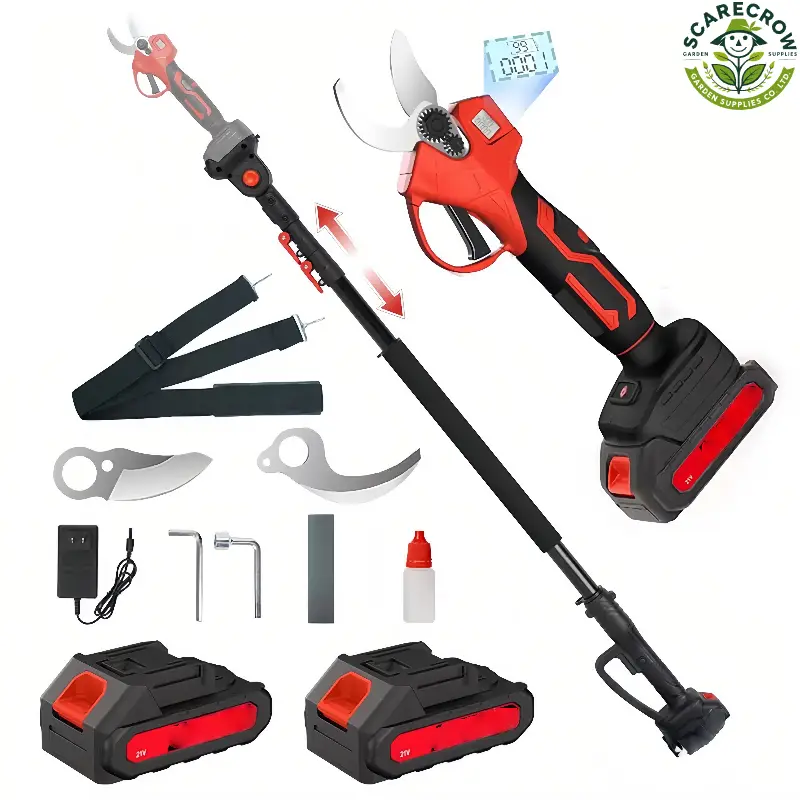
cordless electric pruning shears
Product image from the linked product page; confirm specifications for the selected model.
Manual pruning shear inspection covers blade alignment, edge sharpness, spring tension and lock function. Electric pruning shears add a motor, gearbox, controller, battery and charger to the mechanical blade system; these powered components require additional checks beyond manual-pruner inspection. The questions that matter are different: Does the blade reach its commanded end state on every cut? How does the tool enter and leave a cutting-enabled state? What safety functions are documented for the exact model, and can they be verified?
This guide covers what to inspect on a cordless electric pruning shear sample: the electric-specific approval scope, motor-driven closure and cut completion, documented stop and restart states, safety-function verification, mechanical play, battery and charger configuration, and listing-claim traceability.
Define the Electric-Specific Approval Scope
Which Powered Components and States Need Evidence?
List the motor, gearbox, controller, blade, battery and charger elements that are unique to powered shears. These are the components that manual-pruner inspection does not address. The motor drives the blade closure. The controller governs trigger response, cutting speed and safety states. The battery and charger determine runtime and recharge behavior.
Reference manual-pruner geometry only when needed to assess the finished cutting system. Blade edge, anvil alignment and cutting geometry are baselines for powered closure. Use the model BOM, manual and supplier records to distinguish the powered components from the mechanical baseline.
Motor-Driven Opening, Closure and Cut Completion
Does the Blade Reach the Commanded End State?
Record full-open and closed blade positions, overlap or gap, and return repeatability against the documented electric operating state. On a manual pruner, the user controls closure force. On an electric pruner, the motor controls closure. Whether the blade reaches the documented commanded end state for the exact model is the key check; the specific end state depends on the model's design and may not require full closure on every cut. If the motor does not drive the blade to the documented commanded end state, the tool fails in a way that manual inspection cannot detect.
Link observed opening and closure to the documented control state. No universal electrical behavior is assumed. The blade's end state depends on the motor, gearbox and controller working together within the model's designed parameters.
Does the Cut Complete Within the Confirmed Use Scope?
Use isolated measurements and manufacturer-permitted guarded cutting observations on the exact configuration. Record whether a commanded cut completes and whether the blade reaches the documented end state. No generic gap or cutting-diameter limit is supplied by this guide.
Use the same documented branch set and permitted guarded procedure. Dimensions are measured while isolated, not with hands near a live blade. The cutting capacity claim on a product page, whether expressed in millimeters or inches, requires verification against the model's actual specification and the tested branch material.
Documented Stop, Cutoff and Restart States
Which Stop or Cutoff States Are Documented?
Electric pruners may stop or cut power under several conditions: blade jam, motor overload, battery depletion, idle timeout or safety trigger release. Use defined branch materials and diameters only within a verified manufacturer scope and its approved evaluation procedure. Do not deliberately overload or jam the tool to create a stall.
Use the exact manual and supplier records to separate a normal stop from a permitted fault evaluation. Unsupported states remain research questions, not test protocols.
What Sequence Restores the Tool to the Documented State?
For a stop or cutoff encountered in permitted operation, or during a manufacturer-approved qualified test, record cut completion, trigger response, displayed state and the prescribed restart sequence. Does the tool require a two-step restart? Does it return to a safe state automatically? Does the trigger need to be released and re-pressed?
Record only manufacturer-prescribed recovery observed during permitted evaluation. Never invent a jam or overload to force a response. If the manual specifies a restart procedure, follow it. If the manual does not address a particular stop condition, that condition is a document question, not an experiment to run.
Verify Only the Safety Functions Documented for the Model
What Enables or Disables Cutting on This Model?
Create a model-specific state map of documented cutting enable and disable actions. Some electric pruners require a two-step trigger sequence to activate cutting. Others enter an idle mode after a set period without use. A mechanical storage lock that prevents accidental activation is not automatically an electrical safety interlock.
Map documented inputs, indicator or display state, and blade response before any qualified function check. The question is: what does this specific model do when the trigger is pressed, released, held or ignored?
Which Claimed Safety Functions Are Actually Supported?
A two-step start, lockout, idle mode or interlock may be discussed only if supported by the exact manual and configuration evidence. Do not assume that a model includes a safety function because the category commonly features one. Unsupported functions are marked unconfirmed, not shown as fitted or safe.
Require model-specific instructions and relevant evidence. Absence of documentation is not proof that an interlock exists or that the product is compliant. If the product page claims a safety feature that the manual does not document, that is a discrepancy to resolve with the supplier, not a feature to list.
Gearbox Play, Fasteners and No-Load Vibration
Does Mechanical Play Affect Powered Closure?
Keep blade-pivot, gearbox and head play, and housing-fastener checks brief and tied to observed powered closure or control behavior. If the blade wobbles during motor-driven closure, gearbox play may be the cause. If the housing vibrates excessively during no-load operation, a fastener or motor mount may be loose.
Use relative sample comparison. No invented life-cycle count is supplied. Use isolated fit measurements and permitted no-load or cutting observations on the actual pruner.
Battery and Charger Boundary
Is the Supplied Battery and Charger Configuration Identified?
Record the exact battery pack and charger supplied with the SKU. Note whether replacement packs are uniquely keyed or interchangeable. Some electric pruners use proprietary battery packs that only fit one brand's tools. Others use standard packs shared across a product platform.
Only document what is needed to approve this pruner configuration. Record model and part numbers and documented keying or compatibility information. Do not turn nominal voltage or a few successful cuts into a platform-compatibility or runtime claim.
What Can Be Printed on the Listing
Can Each Listing Claim Be Traced to Exact Evidence?
Only publish cutting-capacity, cycle, run-time or safety-function claims supported by the exact tested SKU and applicable market requirements. Map the proposed wording to model, manual or report version, test scope and destination-market applicability.
Unsupported safety, capacity or runtime claims remain excluded. A product page that states “21 V, 450 W, SK5 blade, cutting capacity 20 to 30 mm” is making specific claims. Each one requires verification: the voltage from the battery specification, the motor power from the motor datasheet, the blade material from the blade supplier record, and the cutting capacity from a documented test with defined branch material and diameter.
If the product page lists cutting capacity in both millimeters and inches, verify that the two values are consistent. A conversion that does not match may indicate a source error that needs resolution before either unit range is published.
If you are sourcing cordless electric pruning shears, confirm the model manual, supplied battery and charger, permitted branch set and documented control and safety functions before comparing samples.
Written by
ScarecrowGarden
💡About Scarecrow Garden Supplier Co., Ltd.
Scarecrow Garden Supplier Co., Ltd. is a China-based sourcing and wholesale partner specializing in garden tools, landscaping equipment, and outdoor supplies for international wholesalers, distributors, contractors, and brands.
With hands-on experience rooted in real garden use scenarios, we focus on durable materials, functional design, and stable large-volume supply. Our product range covers pruning tools, watering systems, hand tools, outdoor hardware, and customized garden solutions to support both retail and professional landscaping markets.
Beyond products, we help our partners navigate supplier selection, quality control, compliance requirements, and long-term sourcing strategies in China. Through our blog, we share practical insights on product selection, material comparisons, industry trends, and cost-effective purchasing—helping global buyers build stronger, more competitive supply chains.