











Updated 3 days ago
Manual Rotary Cultivators: Tine Geometry, Shaft Alignment and Rolling Resistance Buyers Should Check

ScarecrowGarden
💡About Scarecrow Garden Supplier Co., Ltd.
Scarecrow Garden Supplier Co., Ltd. is a China-based sourcing and wholesale partner specializing in garden tools, landscaping equipment, and outdoor supplies for international wholesalers, distributors, contractors, and brands.
With hands-on experience rooted in real garden use scenarios, we focus on durable materials, functional design, and stable large-volume supply. Our product range covers pruning tools, watering systems, hand tools, outdoor hardware, and customized garden solutions to support both retail and professional landscaping markets.
Beyond products, we help our partners navigate supplier selection, quality control, compliance requirements, and long-term sourcing strategies in China. Through our blog, we share practical insights on product selection, material comparisons, industry trends, and cost-effective purchasing—helping global buyers build stronger, more competitive supply chains.
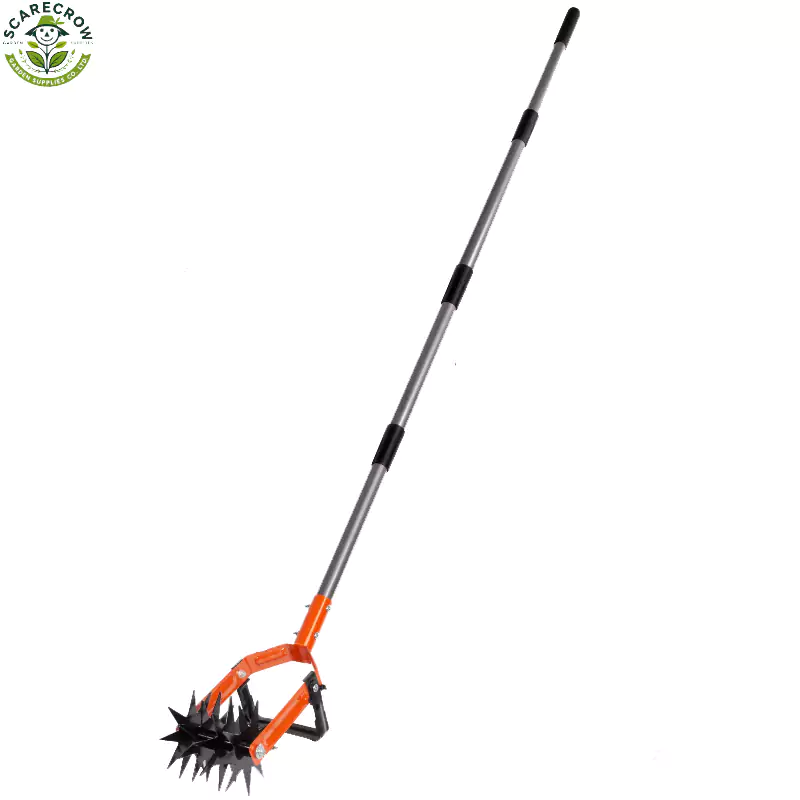
stainless steel rotary cultivator
Product image from the linked product page; confirm specifications for the selected model.
Two manual rotary cultivators can look nearly identical in a product photo and perform completely differently in soil. The visible parts, tine count and head width, do not reveal whether the head tracks straight, whether the shaft is aligned with the rotation axis, or whether the bearing or bushing arrangement will develop play after a season of use. These are the mechanical details that separate a tool that rolls smoothly through prepared soil from one that skips, wobbles and fatigues the user.
This guide covers what to inspect on a manual rotary cultivator sample: the rotating head as a mechanical system, tine geometry and soil engagement, shaft straightness and bearing play, rolling resistance, head-to-shaft joint integrity, and soil packing and corrosion control.
Define the Rotary Head as a Mechanical System
Which Parts Rotate and Which Parts Transmit Force?
A manual rotary cultivator engages soil through rotating tines or discs. The rotation axis, drive connection and force path from handle to head vary by model and must be confirmed from the product drawing or manual before attributing observations to a specific construction. Identify the tine or disc count, head width, rotation axis and the confirmed drive path from the product documentation.
Use a labeled manufacturer drawing and sample photographs to identify the actual axis and moving parts. Do not infer a bearing design from the category name. Some rotary cultivators use a simple steel shaft running through a steel sleeve. Others may use ball bearings or polymer bushings. The construction determines how the head rotates, how much friction it generates, and how it wears.
Separate design description from claims about aeration or weeding effectiveness. A cultivator that rotates smoothly is not automatically better at aerating soil. That comparison requires defined soil conditions and measured results, which are outside the scope of a mechanical inspection.
Tine Geometry and Soil Engagement
What Tine Dimensions Define the Soil Contact?
Record tine length, cross-section, spacing, tip shape and orientation from the actual sample or supplier drawing. These dimensions determine how deeply the tines engage the soil and how much soil they move per rotation.
Measure corresponding tine locations on each sample under the same reference orientation. If you are comparing two cultivators, measure tine length and spacing at the same positions relative to the rotation axis. Even small dimensional differences (for example, in the range of a few millimeters in tine length or spacing — illustrative example only, not a performance threshold) may not be visible in a photo but can change how the head engages compacted soil.
Does the Head Track, Skip or Dig Unevenly?
Test whether the head tracks straight, skips or digs unevenly in defined soil beds. Run repeated passes in the same prepared soil at the same depth. Keep observations separate from aeration or crop-performance claims.
A head that tracks straight leaves a consistent furrow. A head that skips may bounce off compacted spots, leaving uneven cultivation. A head that digs unevenly may pull to one side, requiring the user to correct constantly. All three behaviors are observable in controlled passes, and all three are more useful than a supplier's “smooth operation” claim.
Shaft Straightness, Bearing or Bushing Play and Rotation
Where Is Wobble, Rubbing or Axis Play Observed?
Check axial and radial play, visible wobble and rubbing through a full rotation. Rotate the head by hand and observe whether the tines describe a consistent circle or whether the axis shifts during rotation. Record the observation point and measurement method over a permitted full rotation.
Wobble can originate from a bent shaft, a loose bearing or bushing, or an asymmetric head. The observation tells you where the problem appears, not necessarily what causes it. But the location and magnitude of wobble are measurable and repeatable across samples.
Is the Bearing or Bushing Arrangement Confirmed?
If bearings or bushings are used, identify the actual construction before discussing service life. A ball bearing and a steel-on-steel sleeve have different friction characteristics, different wear rates and different maintenance requirements.
Use an exact drawing or manufacturer-permitted isolated inspection to confirm the bearing or bushing type. Discuss bearing life only with relevant evidence. A sample that rotates smoothly when new tells you nothing about how the bearing will perform after 50 hours of soil contact.
Rolling Resistance and User Force
Does Starting Resistance Differ From Steady Travel?
Rolling resistance changes between the first rotation and steady travel. A cultivator that requires significant force to start may roll more easily once the tines are engaged and soil is moving. Or it may not. The only way to know is to compare starting force and steady rolling feel under the same soil, depth and moisture conditions.
Use relative sample comparison rather than a universal acceptable torque number. Keep the soil, depth, moisture, travel procedure and force-recording approach identical for both samples. A relative comparison supplies no universal torque threshold, but it does tell you whether one sample requires noticeably more effort than another under the same conditions.
Head-to-Shaft Joint and Handle Durability
Does Joint Movement Disturb the Rotating Head?
Inspect welds, pins, fasteners or threaded joints at the head-to-shaft connection. Run pull and twist checks appropriate to the design. The question is not whether the joint is strong enough in general, but whether joint movement during permitted rotary use disturbs the head's alignment or tracking.
Limit the joint record to alignment change or movement during permitted rotary use. Obtain the actual fastening drawing. Use the product drawing to distinguish the handle shaft from the rotor axle and record the specified relationship between them. Record any joint movement alongside changes in rotor position or tracking; do not assume the two axes must be collinear.
Cleaning, Soil Packing and Corrosion Control
Does Packed Soil Interfere With Rotation or Cleaning?
Soil packs around the rotating axis, between tines and in the bearing or bushing area. Check whether packed soil interferes with rotation after use and whether the head can be rinsed or cleared effectively.
Photograph the axis before and after the same soil exposure and permitted cleaning method. Verify the actual material and finish before writing corrosion claims. Rinsing observations alone do not establish corrosion resistance. What you can record is whether soil packs in a way that affects rotation, and whether the design allows access for cleaning.
If the cultivator uses bare steel at the rotation interface, corrosion may develop after soil exposure and washing. If it uses a coated or stainless component, the coating or grade needs to be confirmed from supplier records, not assumed from appearance.
If you are sourcing manual rotary cultivators, compare rotary-head geometry and rolling behavior on actual samples.
Written by
ScarecrowGarden
💡About Scarecrow Garden Supplier Co., Ltd.
Scarecrow Garden Supplier Co., Ltd. is a China-based sourcing and wholesale partner specializing in garden tools, landscaping equipment, and outdoor supplies for international wholesalers, distributors, contractors, and brands.
With hands-on experience rooted in real garden use scenarios, we focus on durable materials, functional design, and stable large-volume supply. Our product range covers pruning tools, watering systems, hand tools, outdoor hardware, and customized garden solutions to support both retail and professional landscaping markets.
Beyond products, we help our partners navigate supplier selection, quality control, compliance requirements, and long-term sourcing strategies in China. Through our blog, we share practical insights on product selection, material comparisons, industry trends, and cost-effective purchasing—helping global buyers build stronger, more competitive supply chains.