











Updated 5 days ago
Long-Handle Weed Pullers: Claw Geometry, Foot-Lever Action and Root Release Tests for Buyers

ScarecrowGarden
💡About Scarecrow Garden Supplier Co., Ltd.
Scarecrow Garden Supplier Co., Ltd. is a China-based sourcing and wholesale partner specializing in garden tools, landscaping equipment, and outdoor supplies for international wholesalers, distributors, contractors, and brands.
With hands-on experience rooted in real garden use scenarios, we focus on durable materials, functional design, and stable large-volume supply. Our product range covers pruning tools, watering systems, hand tools, outdoor hardware, and customized garden solutions to support both retail and professional landscaping markets.
Beyond products, we help our partners navigate supplier selection, quality control, compliance requirements, and long-term sourcing strategies in China. Through our blog, we share practical insights on product selection, material comparisons, industry trends, and cost-effective purchasing—helping global buyers build stronger, more competitive supply chains.
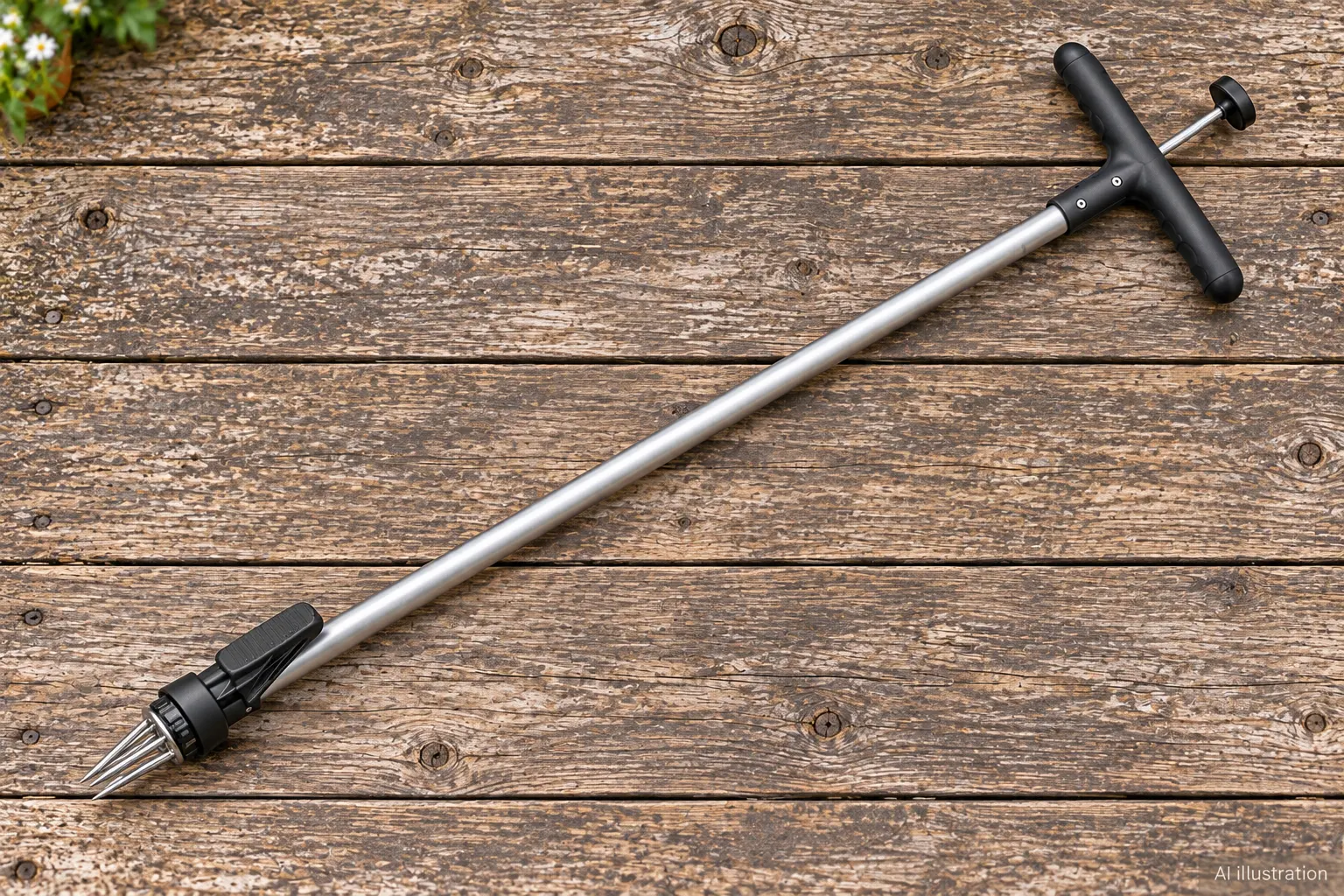
Long-handle weed puller with T grip, foot pedal and metal prongs lying on a wooden workbench
AI-generated editorial illustration; not a product photograph.
A stand-up weed puller lets gardeners remove roots without bending. That is the sales pitch. But the tool's actual performance depends on whether the claw grips the root, whether the foot lever transfers force efficiently, and whether the root releases from the claw after extraction. A long handle and a claw head do not answer those questions. Only a controlled extraction sequence on defined soil and weed types does.
This guide focuses on what buyers should measure and observe on weed puller samples: the engage, lever and release sequence, claw geometry and root capture, load-path and fit prerequisites, soil condition control, and root-release failure recording.
Map the Extraction Sequence Before Comparing Samples
Engage: How the Claw Enters Around the Weed or Root
The extraction sequence starts with engagement. Record where the measured claw tips enter relative to the root, how the claw penetrates the soil, and whether the root is captured. Use the documented model procedure for the tool being tested. If the sample requires the user to position the claw around the weed stem and step down, record the entry angle, tip spacing at the soil surface and the depth reached before levering begins.
Engagement behavior changes with soil type and root structure. A claw that enters cleanly in loose loam may bounce off compacted clay. Document the soil condition for every engagement observation.
Lever: How the Foot Plate or Handle Transfers Force
Where a pedal or foot lever is confirmed on the model, record the prescribed force-transfer and lift sequence. The foot plate converts downward leg force into a lifting or tilting motion at the claw head. Where the root breaks or slips during this phase tells you something about both the tool and the weed type.
Do not infer the exact mechanism from a long handle alone. Some weed pullers use a sliding jaw that closes around the root as the handle is pulled back. Others use a fixed claw with a foot pedal that levers the entire head upward. The model drawing or manual must confirm which mechanism the sample uses before you assign observations to a specific construction.
Release: How Soil and Root Are Cleared From the Claw After Extraction
After the root is lifted, the claw may hold a plug of soil, an intact root, a broken root fragment, or a mixture of soil and debris. Record whether the documented release action clears the root and soil, how many actions are needed, and what remains trapped.
Retain failures in your record. If the root breaks during lifting and the lower portion stays in the ground, that is an extraction failure. If the root comes out but stays wedged in the claw and requires manual clearing, that is a release failure. Both matter, and they tell you different things about the tool's geometry and the weed type.
Evidence for the full sequence should be video or observed sample trials in defined soil conditions, with the documented model procedure followed throughout.
Claw Geometry and Root Capture
Which Claw Dimensions Change Root Contact?
Record claw count, opening width, claw length, tip geometry and spacing from the actual sample or supplier drawing. These dimensions determine how the claw engages the root and how much soil is captured with it.
Measure tip spacing, opening and contact geometry on the exact model. Relate those dimensions to the observed entry and capture sequence. A wider claw opening may capture more soil but grip the root less precisely. Narrower tips may penetrate hard soil more easily but miss fibrous root systems that spread laterally.
Does Capture Differ by the Defined Root Type?
Ask whether the geometry fits taproots, fibrous roots or shallow weeds. Do not claim one head works for every weed type. The geometry may suit different root types differently; confirm with the buyer's target weed species. A wider claw may capture shallow-rooted weeds but leave deep taproots broken.
Keep root type and soil condition matched between samples. If you are comparing two weed pullers, both need to work in the same soil batch with the same weed types. Retain both successful and failed attempts in the record. A tool that extracts 8 out of 10 dandelions but fails on all creeping buttercup is not universally effective, and the record should reflect that.
Keep Load-Path and Fit Checks as Test Prerequisites
Is This Configuration Ready for a Fair Extraction Comparison?
Before running extraction comparisons, use the exact construction drawing to identify where foot or handle force enters the tool and where bending or torsion stress concentrates. Inspect the foot-plate attachment, shaft-to-head joint and any welds or fasteners before and after the extraction sequence. Note looseness only as it affects claw engagement or release.
Handle length, grip diameter, foot placement and representative user stance are setup variables, not a separate ergonomics comparison. The model drawing and manual must confirm the pedal, lever and release parts before observations are assigned to a specific product.
Soil Condition Changes the Result
Are the Samples Working in Equivalent Soil?
Soil condition affects every stage of the extraction sequence. A tool that works well in loose, moist soil may fail in dry, compacted ground. Comparing one tool in soft wet soil with another in dry hard soil produces misleading results.
Compare samples within the same defined soil batch and moisture or compaction condition first. Then repeat with separately documented loose, compacted or moist conditions if you need to understand how each tool performs across soil types. Record soil batch, moisture, compaction and root selection with each run. Comparisons across different beds need a stated limitation.
Which Stage Fails Under the Same Conditions?
Record penetration effort, soil plug size, extraction success and root breakage alongside claw dimensions, action sequence and release outcome. Keep root type and operator procedure comparable across samples.
Link penetration, lifting and release observations to the same attempt ID. This prevents extraction success from hiding a release failure. A tool that extracts the root cleanly but requires three additional actions to clear the claw is not as efficient as one that releases automatically, and the record should make that visible.
Record Root-Release Failures Separately From Extraction Failures
Was the Root Captured, Broken or Left in the Claw?
For each attempt, distinguish four outcomes:
1. Root never captured by the claw
2. Root broken during lifting, lower portion left in soil
3. Root captured and extracted but retained in the claw
4. Soil and root plug not cleared by the documented release action
Use close photographs or video and a per-attempt failure code. No success percentage is supplied by this guide. The value is in the pattern: if a tool consistently fails at release rather than extraction, the pattern of release failures may point to claw geometry, release mechanism, soil condition, root type or operation as factors to investigate.
Does the Documented Release Action Clear the Head?
Record repeat release actions, residual soil or root material, and any need to stop for manufacturer-approved clearing. Do not promise reduced strain, ergonomic benefit or a universal no-bend outcome without suitable evidence. The tool may reduce bending in principle, but that claim requires human-factors evidence specific to the model and user population.
Record incomplete clearing and repeat actions in the same soil and root scenario. Stop for safe clearing as the manual requires. Never improvise around a loaded mechanism.
Repeat-Order Approval Record
Can a Repeat-Order Sample Reproduce the Approved Sequence?
Lock claw and shaft dimensions, joint construction, material and finish, foot lever configuration, handle and grip specifications, and packaging protection in the approved sample record.
Retest extraction and joint looseness on repeat-order samples. Retain the original geometry, joint condition, soil and root setup and release-failure fields. Changed outcomes require investigation rather than a blanket durability conclusion. If the repeat-order sample has a different claw tip spacing or a looser shaft joint, the extraction sequence may produce different results.
If you are evaluating long-handle weed pullers for your inventory, send your target weed and soil scenario for sample extraction comparison.
Written by
ScarecrowGarden
💡About Scarecrow Garden Supplier Co., Ltd.
Scarecrow Garden Supplier Co., Ltd. is a China-based sourcing and wholesale partner specializing in garden tools, landscaping equipment, and outdoor supplies for international wholesalers, distributors, contractors, and brands.
With hands-on experience rooted in real garden use scenarios, we focus on durable materials, functional design, and stable large-volume supply. Our product range covers pruning tools, watering systems, hand tools, outdoor hardware, and customized garden solutions to support both retail and professional landscaping markets.
Beyond products, we help our partners navigate supplier selection, quality control, compliance requirements, and long-term sourcing strategies in China. Through our blog, we share practical insights on product selection, material comparisons, industry trends, and cost-effective purchasing—helping global buyers build stronger, more competitive supply chains.