











Updated 2 days ago
Landscape Staples for Fabric and Netting: Wire Diameter, Coating, Crown Width and Pull-Out Testing

ScarecrowGarden
💡About Scarecrow Garden Supplier Co., Ltd.
Scarecrow Garden Supplier Co., Ltd. is a China-based sourcing and wholesale partner specializing in garden tools, landscaping equipment, and outdoor supplies for international wholesalers, distributors, contractors, and brands.
With hands-on experience rooted in real garden use scenarios, we focus on durable materials, functional design, and stable large-volume supply. Our product range covers pruning tools, watering systems, hand tools, outdoor hardware, and customized garden solutions to support both retail and professional landscaping markets.
Beyond products, we help our partners navigate supplier selection, quality control, compliance requirements, and long-term sourcing strategies in China. Through our blog, we share practical insights on product selection, material comparisons, industry trends, and cost-effective purchasing—helping global buyers build stronger, more competitive supply chains.
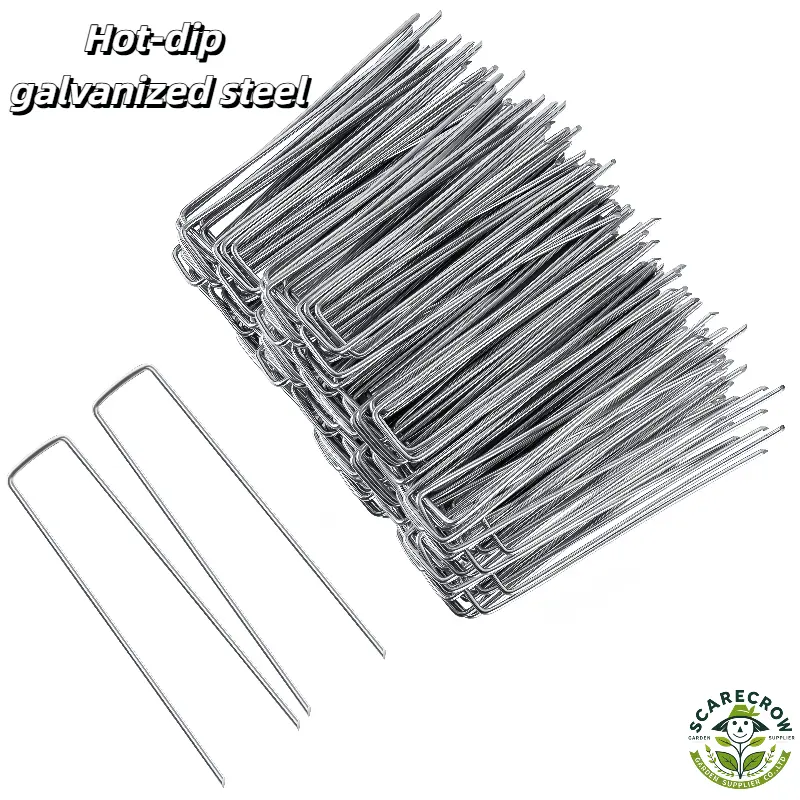
Galvanized Landscape Staples 6-inch (50 Pack) | Scarecrow Garden Supplier
Product image from the linked product page; confirm specifications for the selected model.
Landscape staples are simple products: U-shaped wire pins that hold weed fabric, netting or drip tubing against the soil. Because they are simple, buyers tend to evaluate them by pack count and nominal length. But the wire diameter, coating quality, crown width, tip condition and leg straightness all determine whether the staple actually penetrates the target soil, holds the specified material and stays in place. A staple that bends on insertion or rusts after one season is not a bargain at any price.
This guide covers what to check on landscape staple samples: geometry matching, wire diameter and gauge systems, straightness and penetration, pull-out retention, corrosion protection, and pack count and carton condition.
Match Staple Geometry to the Material Being Secured
What Is Being Held Against Which Soil?
Landscape staples secure different materials in different conditions. Weed fabric lies flat against the soil surface. Netting may span hoops or arches and exert upward tension. Drip tubing sits on or just below the surface and needs staples that hold without crushing the tube. Light landscape mesh may require closer spacing than heavy woven fabric.
Identify the specific fabric, netting, tubing or mesh sample and the soil condition before selecting staple dimensions. A staple that works in loose sandy soil may not penetrate compacted clay. A crown width that holds woven fabric may be too narrow for folded netting.
Do Crown and Leg Dimensions Fit That Interface?
Define leg length, crown width and tip shape from the actual SKU. Leg length determines how deep the staple anchors. Crown width determines how much material the staple holds down. Tip shape affects penetration: a pointed tip enters hard soil more cleanly than a flat-cut end.
Use measured leg length, crown width and tip profile from the exact staple. The comparison does not establish suitability for all installations. A 15 cm leg may be adequate for weed fabric in loose soil but insufficient for netting in compacted ground.
Wire Diameter and Gauge Need a Defined System
What Is the Measured Wire Diameter?
Measure the actual wire diameter with a caliper and state it directly in millimeters or inches. Wire diameter determines stiffness, bending resistance and ultimately whether the staple penetrates without deforming.
Keep the measurement locations and instrument record with the supplier drawing. Wire diameter can vary slightly along a production run, and measuring at multiple points on multiple staples gives you a more reliable picture than a single reading.
Which Gauge System Does the Supplier Mean?
If gauge is used, identify the gauge system and its source. American Wire Gauge (AWG), Standard Wire Gauge (SWG) and other systems assign different diameters to the same gauge number. Require the supplier to name the gauge system before using a conversion.
Do not publish a universal gauge-to-mm conversion without verification. Require the supplier to name the gauge system before using a conversion. When gauge is ambiguous, retain direct measured dimensions. The caliper reading is the fact; the gauge number is a label that needs context.
Straightness, Tip Formation and Penetration
Do the Legs and Tips Start in Comparable Condition?
Inspect the sample for bent legs, unequal leg lengths, burrs and inconsistent tip formation. These are manufacturing variations that affect penetration. Record unequal leg lengths and burrs before insertion. Compare penetration and any resulting angle under the same documented soil and insertion conditions; these observations do not identify a universal dimensional failure threshold.
Use photographs and dimensional checks to separate manufacturing variation from bending caused during insertion. If you receive a sample with bent legs, the question is whether that is a production issue or a transit issue. Both need to be addressed, but the corrective action differs.
What Happens During Insertion in the Target Soil?
Run insertion trials in defined soil conditions. Record bending and penetration behavior for each staple. The soil type, moisture, depth and insertion method all affect the result.
A staple that penetrates cleanly in moist loam may bend in dry clay. Record the soil, depth, insertion method and visible deformation for each trial. Do not infer rock penetration capability or universal strength from a few successful insertions in soft soil.
Pull-Out Retention Is Soil-Dependent
Can Pull-Out Results Be Compared on the Same Basis?
Pull-out force is the measure of how well a staple holds once installed. But pull-out results are meaningless unless they are compared on the same basis. Soil type, moisture, insertion depth, secured material and pull direction all affect the result.
Design a comparison test using the same soil type, moisture, insertion depth and secured material for every staple. Report relative pull-out results for compared samples. Do not create a universal holding-force threshold. Pull-out resistance varies with soil type, moisture and insertion depth; compare samples under the same conditions rather than relying on absolute numbers.
Keep the soil batch, moisture, insertion depth, secured material and pull direction consistent. Document the force-recording method. Limit conclusions to that specific setup.
Galvanizing or Other Corrosion Protection
What Coating Evidence Covers Bends and Cut Ends?
Galvanizing protects the wire from corrosion, but the protection is not uniform across the staple. The bends at the crown and the cut ends at the tips may have thinner coating or exposed bare metal. Inspect these areas for coating integrity.
Confirm the coating process and, if relevant, coating mass or thickness from supplier evidence. Check cut ends and bends where coating condition may differ. Do not convert “hot-dip galvanized” into a fixed outdoor-life claim. Galvanizing extends corrosion resistance, but the actual service life depends on soil chemistry, moisture exposure and coating integrity at the high-risk points.
Match supplier coating records and any relevant testing to the actual staple. Localized inspection of a few staples does not predict outdoor service years for an entire production batch.
Pack Count and Carton Deformation
Did Packing Preserve Count and Leg Straightness?
Verify pieces per inner pack, bundle restraint and whether legs arrive bent after transit. Staples are typically bundled and packed in bags or boxes. If the bundle is loose, staples can shift and bend during transport. If the count is weight-based rather than piece-counted, piece-weight variation affects accuracy.
Reconcile the actual inner pack against its approved count. Photograph arrival deformation. Weight-based counts require demonstrated piece-weight variability before they can replace a direct count.
If you are sourcing landscape staples for fabric and netting installation, specify the fabric or netting and soil condition you need to secure for sample comparison.
Written by
ScarecrowGarden
💡About Scarecrow Garden Supplier Co., Ltd.
Scarecrow Garden Supplier Co., Ltd. is a China-based sourcing and wholesale partner specializing in garden tools, landscaping equipment, and outdoor supplies for international wholesalers, distributors, contractors, and brands.
With hands-on experience rooted in real garden use scenarios, we focus on durable materials, functional design, and stable large-volume supply. Our product range covers pruning tools, watering systems, hand tools, outdoor hardware, and customized garden solutions to support both retail and professional landscaping markets.
Beyond products, we help our partners navigate supplier selection, quality control, compliance requirements, and long-term sourcing strategies in China. Through our blog, we share practical insights on product selection, material comparisons, industry trends, and cost-effective purchasing—helping global buyers build stronger, more competitive supply chains.