











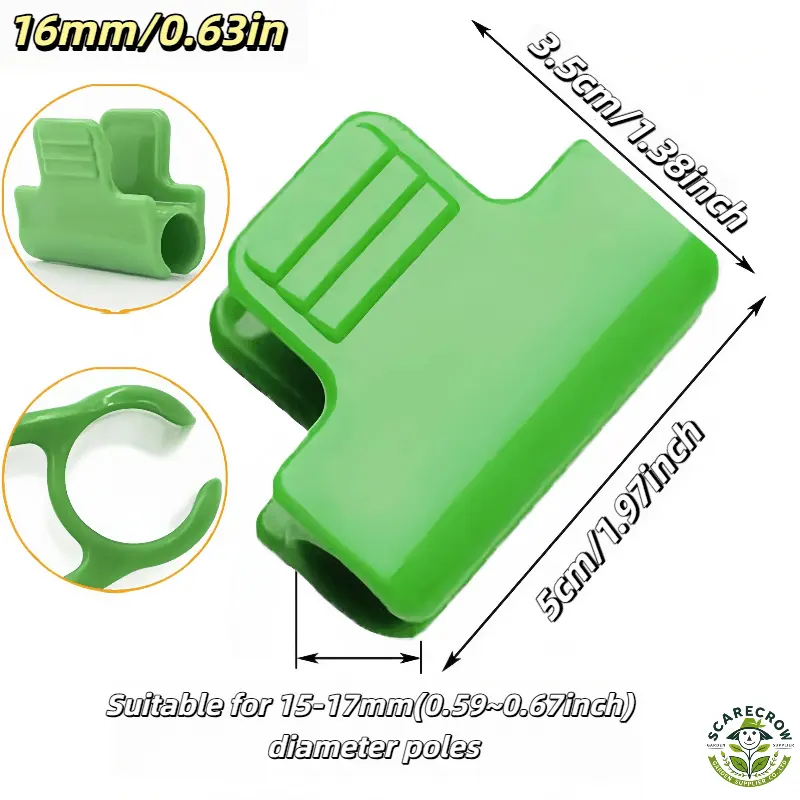
16mm Greenhouse Netting Clamps | Scarecrow Garden Supplier
Product image from the linked product page; confirm specifications for the selected model.
A greenhouse netting clamp is a small plastic fitting that holds film, shade cloth or insect netting against a hoop tube. The nominal size, 16 mm for example, suggests it fits standard PVC pipe. But nominal size does not account for pipe OD tolerance, clamp wall variation, cover thickness between clamp and hoop, temperature changes or repeated installation cycles. A clamp that is too tight cuts the cover. A clamp that is too loose lets the cover slip or rotate. The fit matrix between pipe, cover and clamp is what determines whether the system works.
This guide covers what to check on greenhouse netting clamp samples: measured hoop and clamp dimensions, grip retention versus cover damage, opening force and repeated cycles, temperature and weathering effects, spacing as a project variable, and pack-count and size-marking control.
Nominal Hoop Size Is Not Enough
Which Hoop OD and Clamp Opening Are Actually Measured?
Measure the actual hoop outside diameter and the clamp's internal geometry on the sample. A “16 mm” hoop may measure 15.8 mm or 16.2 mm depending on the manufacturer and material. A “16 mm” clamp may have an internal opening that differs from the hoop OD by enough to matter.
Measure the rigid tube and clamp on the same reference basis. Nominal size is not a verified fit range. The only way to confirm fit is to measure both components and test them together.
How Does Cover Thickness Change the Fit?
The cover material sits between the clamp and the hoop. Different cover materials add different thicknesses to the stack. Use a pipe-OD × cover-thickness × clamp-variant matrix with the actual sample materials to observe fit. This is not a living-stem diameter calculation. The variables are rigid tube OD, cover thickness and clamp geometry, and all three are measurable on the actual components.
Grip Retention Without Cutting the Cover
Does the Cover Slip or Rotate Before It Is Damaged?
Test resistance to sliding and rotation while checking for concentrated pressure marks or tears. A clamp that grips tightly may hold the cover securely but create stress points where the cover tears after wind exposure or repeated handling.
For the same tube and cover pair, record movement and pressure marks together using a documented, safe comparative setup. The question is not just “does it hold?” but “does it hold without damaging the cover?”
Is Stronger Retention Bought at the Cost of Tears?
Separate holding force from cover damage. A tighter clamp is not automatically better. If the clamp's internal edges are sharp or the clamp wall is thick relative to the cover, the cover may tear at the contact point even though the clamp holds firmly.
Photograph cover marks and edge damage after equivalent handling. Do not rank the tightest clamp as best without a cover-damage comparison. The goal is retention without damage, not maximum grip at any cost.
Opening Force and Repeated Install or Remove Cycles
Does Reinstallation Change This Pipe-and-Cover Fit?
Greenhouse covers are installed and removed seasonally. Each cycle stresses the clamp and the cover. Record whether users can install and remove the clamp without cracking it or overstretching the cover.
Cycle count is a buyer screening variable unless a relevant product standard is identified. Record installation force or behavior, fit and cover damage before and after a defined permitted sequence. The cycling here is specific to the rigid hoop, cover and clamp interface.
Temperature and Weathering Change Fit
Does Conditioning Change Retention or Cover Damage?
Greenhouse environments cycle between cool nights and warm days. Clamps and covers expand and contract at different rates. A clamp that fits well at 20°C may grip differently at 5°C or 35°C.
If outdoor or greenhouse durability is claimed, confirm resin and additive information from the supplier. Relevant weathering evidence, if available, should be tied to this exact clamp material.
Test warm and cool samples for fit change only as defined screening. Do not translate accelerated weathering hours into outdoor years. Tie material and weathering documentation to this exact fit matrix.
Clamp Spacing Is a Project Variable
What Project Evidence Is Needed Before Specifying Spacing?
Clamp spacing along a hoop depends on hoop diameter, cover material, wind exposure and the greenhouse structure. Closer spacing provides more retention points but increases material cost and installation time. Wider spacing reduces cost but may allow the cover to flap or lift in wind. Do not publish a universal spacing rule without engineering evidence. Require the actual hoop, cover and installation assumptions. A clamp screening result cannot supply a wind-speed rating or universal spacing rule.
Pack-Count, Size Marking and Mixed-SKU Control
Can Similar Clamp Sizes Be Kept Separate?
Greenhouse clamps are produced in closely spaced sizes. Verify the actual size identification system, as clamps with similar nominal dimensions may look alike but fit different hoop systems. If they are mixed during packing, the customer receives the wrong size and cannot install the cover.
Define size identification, pack count and color or variant segregation so similar clamps are not mixed during packing. Use a size or variant label and a sample-fit reference for this clamp family. This is a practical packing control for maintaining size segregation.
If you are sourcing greenhouse netting clamps, provide your hoop OD and cover material for sample-fit comparison.

Written by
ScarecrowGarden
💡About Scarecrow Garden Supplier Co., Ltd.
Scarecrow Garden Supplier Co., Ltd. is a China-based sourcing and wholesale partner specializing in garden tools, landscaping equipment, and outdoor supplies for international wholesalers, distributors, contractors, and brands.
With hands-on experience rooted in real garden use scenarios, we focus on durable materials, functional design, and stable large-volume supply. Our product range covers pruning tools, watering systems, hand tools, outdoor hardware, and customized garden solutions to support both retail and professional landscaping markets.
Beyond products, we help our partners navigate supplier selection, quality control, compliance requirements, and long-term sourcing strategies in China. Through our blog, we share practical insights on product selection, material comparisons, industry trends, and cost-effective purchasing—helping global buyers build stronger, more competitive supply chains.