








Updated 4 months ago
Seed Starting Trays Bulk: A Grower's Guide to Matching Cell Configurations to Different Propagation Scenarios

hqt
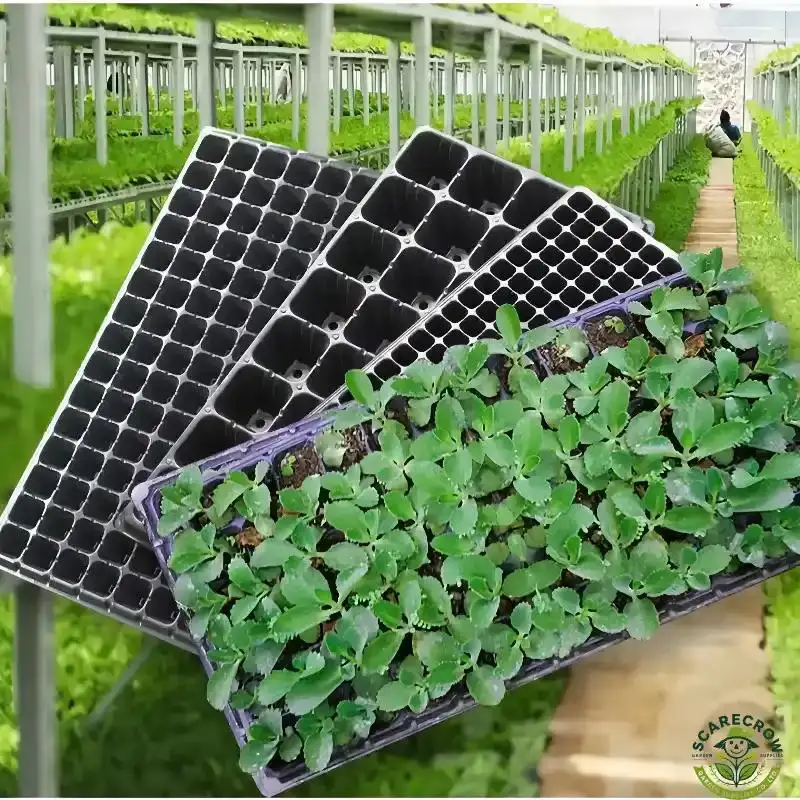
Seed Starting Trays Bulk
Choosing a propagation tray cannot be simplified to a single criterion. For wholesalers and distributors, recognizing the impact of various cultivation environments on tray selection is critical to satisfying your customer base. When buying bulk seed starting trays, the focus should be on matching propagation cell dimensions and the characteristics of the tray material and designed drainage system to the specifics of the cultivation scenario. We analyze the growing versatility of Scarecrow Garden Supplier's durable seedling trays available in 21, 32, 50, 72, 105, 128, and 200 cell configurations.
Design Elements Critical to All Scenarios
The first consideration when establishing scenario-specific approaches is the baseline design of the trays. Scarecrow Garden Supplier has built a number of beneficial design elements into each tray:
•Constructed of PET Composite plastic: Stable and durable for repeated handling during transport and seasonal use without cracking.
•Uniform round drainage holes: Creates even aeration for roots and eliminates water pooling at the bottom of the cell.
•Designed with moisture water guide channels: Directs excess moisture away from the root zones and minimizes waterlogging and damping-off disease.
•Standardized tray size (54cm x 28cm): accommodates most commercial greenhouse bench systems, automatic tray fillers, and shipping carts.
•Lightweight but sturdy: Trays are 0.140 kg and 400 trays fit in a carton of size 55cm x 29cm x 38cm for efficient bulk transport.
These design elements will remain constant but the growing modality will dictate the usage. We will analyze the best use of the trays for five propagation scenarios.
Scenario 1: Propagating Vegetables and Flowers in a Greenhouse
A greenhouse relies on a consistent, uniform demand for a product. Greenhouse operators emphasize efficient use of space and speed of turnover. For large-scale production of vegetable seedlings (tomatoes, peppers, lettuce) and flowering annuals, they typically prefer medium to high cell counts.
•Every cell tray can accommodate 72, 105, or 128 cells.
•Explanation: These particular sizes maximize space efficiency, whilst providing adequate growing room for the roots. A tray count of 128 cells is ideal for seedlings of leafy greens and flowering plants. A tray count of 72 cells is ideal for seed starts of larger vegetables.
•The primary benefit of a Squires Garden Supplier tray is a water guide channel. This mitigates the problem of overwatering in a high humidity greenhouse and helps in the prevention of fungus.
•Ordering trays in bulk: Ordering trays in bulk gives the greenhouse the ability to use the same or two cell counts in the majority of their planting cycles, resulting in higher consistency in the greenhouse and a simplified stock.
�� Trick for a distributor: Greenhouse operators who propagate both vegetables and flowers will appreciate a mixed pallet of 72 and 105-cell trays.
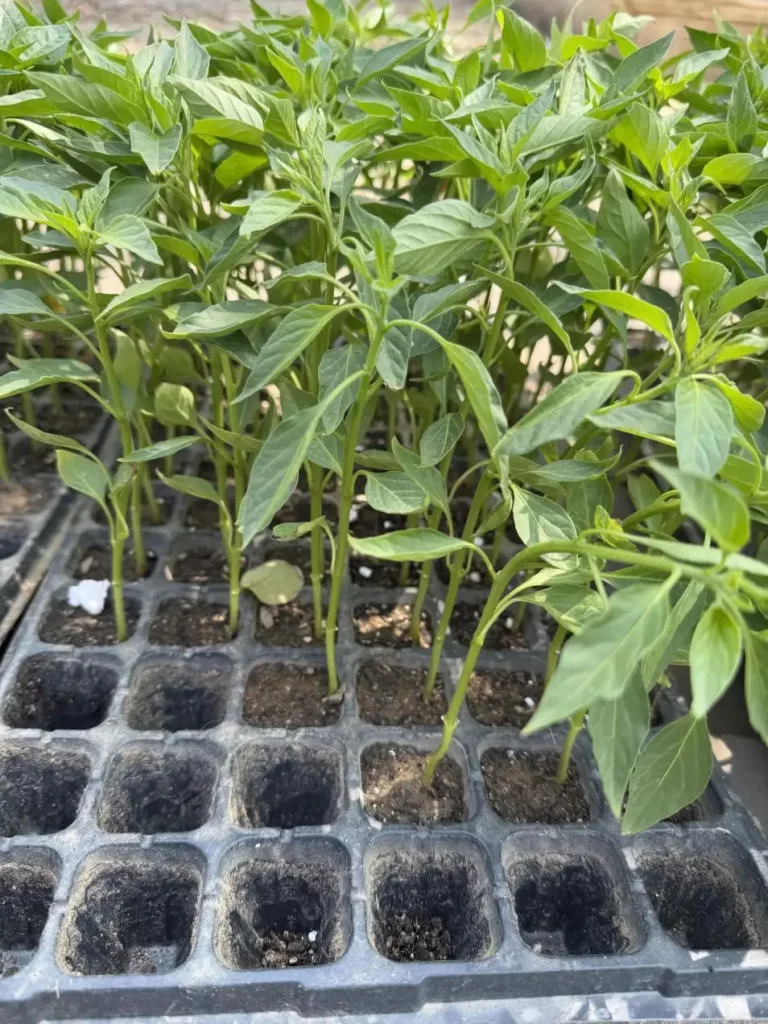
Scenario 2: Crop Rotation at a Commercial Farm
Large-scale field farms use seedling trays to grow crops at different times of the year or to optimize growing conditions for uniformity of crop yield. The main focus is on the structural integrity of the tray to withstand mechanical transplanting or sun exposure and not cracking.
•Recommended cell counts are: 32, 50, and 72.
•Justification: 72 cells/tray; 32-50 cells/tray; and 72 cells/tray were established because cell trays for Cucurbits/Brasicas and onions prefer a different cell density. Typically cell trays for Cucurbits and Brassicas prefer a cell density of 32-50 cells/tray. Onions are more densely populated and have cell trays usually with 72 cells/tray.
•Design Advantage: A tray made with a PET composite is UV stable, maintains field rigidity, and can be reused after field washing.
•Logistical advantage: Tray stacks reduce the risk of breakage in transport from the nursery to the fields, even in cases of prolonged transport.
When purchasing bulk seed starting trays from farm clients, note the option to reuse. After many uses, cost drops to approximately $0.30 per season with only the original purchase cost of the trays.
Scenario 3: Growing Tree Seedlings
Healthy tree seedlings, whether they are pine, eucalyptus, or oak all require deep root zones. Due to this, more emphasis is placed on root health in forestry nurseries than cell count.
•Recommended cell counts are 21 or 32 cells per tray.
•Rationale: Lower density results in less circling and provides adequate space for a taproot with less circling.
•Technical fit: Round drainage holes in the tray promote even drainage and prevent waterlogging.
•Handling benefit: Due to the rigidity and lightweight of the trays, large volumes of tree starts can be easily carried and transplanted.
Typically, bulk orders of seed starting trays placed by forestry distributors contain a lower number of trays than orders placed by other distributors, but the value is higher. Scarecrow Garden Supplier's 200 piece minimum order quantity allows even the smallest of forestry operations to test the product before placing a larger order.
Scenario 4: Nursery and Garden Centers
For retail nurseries and garden centers, trays that are visually uniform and elegant are important. They also need trays that can tolerate outdoor display and customer handling.
•Recommended cell counts: 50, 72, and 105 cells.
•Rationale: These sizes are easily understood by the home gardener.
•Customization options: A minimum order quantity of two pieces for OEM logo printing and of 10,000 pieces for custom packaging are offered by Scarecrow Garden Supplier.
•Eco-friendly: The recyclable PET material is a plus to retail buyers of the product.
This section describes how bulk purchasing seed starting trays combines the three most popular cell count trays, and includes a sample pack of 128 cell trays, for herb and flower customers.
Scenario 5: Research Institutes and Seed Trials
Research studies require precision, and often, smaller, more reproducible, sample sizes. This can mean that institutional buyers need orders with different cell counts to conduct research studies.
•Recommended cell counts: 21, 32, 50, 72, 105, 128, 200 (all counts)
•Rationale: Investigating the impact of cell geometry on the growth of roots, seeds, and the water absorption.
•Trial element: Consistency in the design of drainage holes and cell structure.
•Sample availability: Scarecrow Garden Supplier has sample trays, and therefore good option for research institutions that want a sample prior to having a large order.
Distributors that support research customers should have all cell counts and a lead time of 7 days for orders up to 200 units.
Bulk Purchasing Considerations for Wholesalers
Purchasing seed starting trays from Scarecrow garden Supplier has these logistical benefits:
•Trays can be x400 per carton (Carton Size (cm): 55×29×38 and perfectly sized for bulk orders).
•MOQ: 200 units for bulk trays, smaller are for samples.
•Lead time: Up to 7 days for ≤200. Longer for larger orders.
•Payment: T/T, L/C, but for samples, PayPal or Western Union are accepted.
•Shipping methods: FOB, CIF, DDP - by sea, air, or express, depending on order urgency.
Reasons Why Scarecrow Garden Supplier's Design Produces Results
There are many factors that separate these trays from the generic design throughout the design process:
•Water Guide Channel Design: Each cell will have even moisture without the formation of dry corners, which greatly reduces surface tension and will not channel.
•Evenly spaced circular drainage holes: Design will lead to air pruning and encourage roots to branch inwards to fill the container.
•Reinforced PET: Will be steam and chemical cleaning safe and not brittle when compared to polystyrene.
•Cost-effective standardization: One tray size (54×28 cm) fits all cell configurations, so greenhouses do not need multiple bench layouts.
Final Recommendations for Distributors
To serve your customers effectively, stock seed starting trays bulk in a tiered strategy: high-volume commodity cells (72/105) for vegetable and flower propagators, specialty low-density cells (21/32) for forestry and large transplants, and medium cells (50/72) for nurseries. Always include sample availability and customization options (logo, packaging) in your sales pitch.
Scarecrow Garden Supplier's trays offer a practical balance of durability, drainage performance, and logistics-friendly packaging. For a detailed quote or to request samples, use the contact options on the product page. Whether your client runs a research greenhouse or a reforestation nursery, there is a cell configuration ready to match.
FAQs
Q1. What is the maximum order quantity?
A. An example can be requested if you need less than an order of 200 trays.
Q2. Is it possible to order a certain range of cell counts?
A. Absolutely. The sales team will accept orders for counts including but not limited to 72 cell or 105 cell orders.
Q3. What is the expected lead time to fulfill an order consisting of 200 trays?
A. Orders are generally fulfilled in 7 days average.
Q4. How many trays are contained in a Carton?
A. 400 trays are contained in a Carton. Dimensions are 55×29×38 cm.
Q5. Is it possible for me to obtain a sample prior to large orders being placed?
A.Yes. A sample may be ordered.