






Updated 4 months ago
Plant Label Wholesale: How to Match Materials and Colors to Sell Across More Product Categories
ScarecrowGarden
💡About Scarecrow Garden Supplier Co., Ltd.
Scarecrow Garden Supplier Co., Ltd. is a China-based sourcing and wholesale partner specializing in garden tools, landscaping equipment, and outdoor supplies for international wholesalers, distributors, contractors, and brands.
With hands-on experience rooted in real garden use scenarios, we focus on durable materials, functional design, and stable large-volume supply. Our product range covers pruning tools, watering systems, hand tools, outdoor hardware, and customized garden solutions to support both retail and professional landscaping markets.
Beyond products, we help our partners navigate supplier selection, quality control, compliance requirements, and long-term sourcing strategies in China. Through our blog, we share practical insights on product selection, material comparisons, industry trends, and cost-effective purchasing—helping global buyers build stronger, more competitive supply chains.
Plant Label Wholesale Guide: Match Materials & Avoid SKU Traps | Scarecrow Garden Supplier
Plant labels may seem like the most insignificant gardening product—low unit cost, small size, and shipping costs that are almost negligible. However, many wholesalers make the same mistake when sourcing labels for the first time: 6 colors × 3 shapes × 2 sizes = 36 SKUs. With an MOQ of 300 pieces per SKU, that already equals 10,800 labels before even considering bamboo or wooden versions.
Plant labels are inexpensive, but once SKU counts increase, the total MOQ can become larger than watering cans. PVC plastic labels wholesale for approximately $1–15 per 100 pieces and retail on Amazon for $5–12 per 100 pieces, representing a 3–5x markup. Bamboo labels wholesale for $4–11 per 100 pieces and retail for $8–15 per 50 pieces, offering a similar 3–5x markup.
The challenge is that plastic label colors are often inconsistent (the same batch may contain different shades of red, and dark reds can look dull), customers are unsure whether wooden labels can be OEM customized, and different end users prefer completely different shapes and materials. Choosing the wrong combination can easily lead to excess inventory.
This article helps wholesalers, distributors, garden centers, and e-commerce sellers understand how to choose between plastic, bamboo, and wood materials, solve color consistency issues, identify what different end users want, and understand why mixed-color packaging requires secondary sorting.
The Color Problem with Plastic Labels — Every Wholesaler’s Biggest Headache
The biggest problem with plastic labels is not quality—it is color consistency.
| Problem | Description | Impact |
|---|---|---|
| Color variation within the same batch | Different shades of red in the same shipment, dull red vs bright red | Customers perceive poor quality |
| Fading | Colors fade after 3–6 months outdoors; dark red becomes grayish-red | Labels lose visual distinction |
| Color variation between batches | The green from the first order differs from the green in the second order | Difficult to replenish matching inventory |
| Dark colors lack appeal | Dark red and navy blue look dull and less attractive | Slow-moving inventory |
Why Color Problems Occur
Small differences in raw material ratios during PVC injection molding can create color variations. Low-cost PVC often lacks UV stabilizers, causing rapid fading outdoors. Budget factories may use inexpensive color masterbatch materials that produce dull, less vibrant colors.
Color Recommendations for Wholesalers
| Recommendation | Explanation |
| White is the safest choice | White eliminates color consistency issues and provides the highest writing contrast |
| Bright colors sell better than dark colors | Bright green, pink, and yellow look more attractive than dark red or dark blue |
| Purchase enough in a single batch | Avoid cross-batch color variation by buying a year's supply at once |
| Request color samples | Ask suppliers for Pantone color references and inspect production against approved samples |
How to Choose Between Three Materials
Plastic vs Bamboo vs Wood
| Criteria | PVC Plastic | Bamboo | Birch/Pine Wood |
| Environmental Impact | Non-biodegradable, microplastic concerns | Biodegradable, renewable within 3–5 years | Biodegradable but slower-growing resource |
| Writing Performance | Pencil can be erased, marker is permanent | Works with both pencil and marker, natural texture | Works with both pencil and marker, easiest to write on |
| Durability | High, lasts 2–3 years outdoors | Moderate, begins weathering after 6–12 months outdoors | Moderate, begins discoloring after 3–6 months outdoors |
| Wholesale Price | $1–15/100 pcs | $4–11/100 pcs | $8–36/100 pcs |
| Amazon Retail Price | $5–12/100 pcs | $8–15/50 pcs | $10–18/50 pcs |
| Markup Potential | 3–5x | 3–5x | 2–4x |
| OEM Customization | Printed logo, MOQ 5,000+, often not cost-effective | Laser-engraved logo, MOQ 1,000+, no tooling required | Laser-engraved logo, MOQ 500+, no tooling required |
| Social Media Appeal | Budget appearance, not ideal for photography | Natural look, highly photogenic | Vintage style, ideal for premium displays |
| Target Customer | Mass market, e-commerce, nurseries | Eco-conscious brands, boutique garden centers, gifts | Premium nurseries, designers, organic farms |
Key Finding
Printing logos on plastic labels is usually not economical. Silk-screen printing or heat transfer printing often requires MOQs of 5,000+ units, tooling costs of $200–500, and increases per-unit cost by $0.02–0.05.
Wooden and bamboo labels, however, can be laser engraved without tooling. Laser engraving requires only 500–1,000 units MOQ and increases unit cost by just $0.01–0.03.
If you want branded plant labels, choose bamboo or wood rather than plastic.
Material Recommendations by Customer Type
| Customer Type | Recommended Material Mix | Reason |
| E-commerce sellers | Mainly plastic, small amount of bamboo | Plastic provides volume sales, bamboo increases average order value |
| Garden centers | 50% plastic, 50% bamboo | Covers both mainstream and eco-conscious buyers |
| Nurseries and growers | Mainly plastic | Durable, affordable, suitable for large quantities |
| Premium retailers and designers | Bamboo + wood | Better aesthetics, logo engraving, stronger differentiation |
| Gift market | Bamboo + wood | Premium feel, sustainability appeal, Instagram-friendly |
Sustainability Trend
"Biodegradable" is one of the hottest gardening product keywords in 2026. Demand for environmentally friendly plant labels is especially strong in Europe, where the EU Single-Use Plastics Directive is encouraging alternatives. Bamboo labels, which are renewable within 3–5 years, align well with this trend.
Shapes and Sizes — Different End Users Want Different Things
Common Shapes and Sizes
| Shape | Common Sizes | Applications | Pros & Cons |
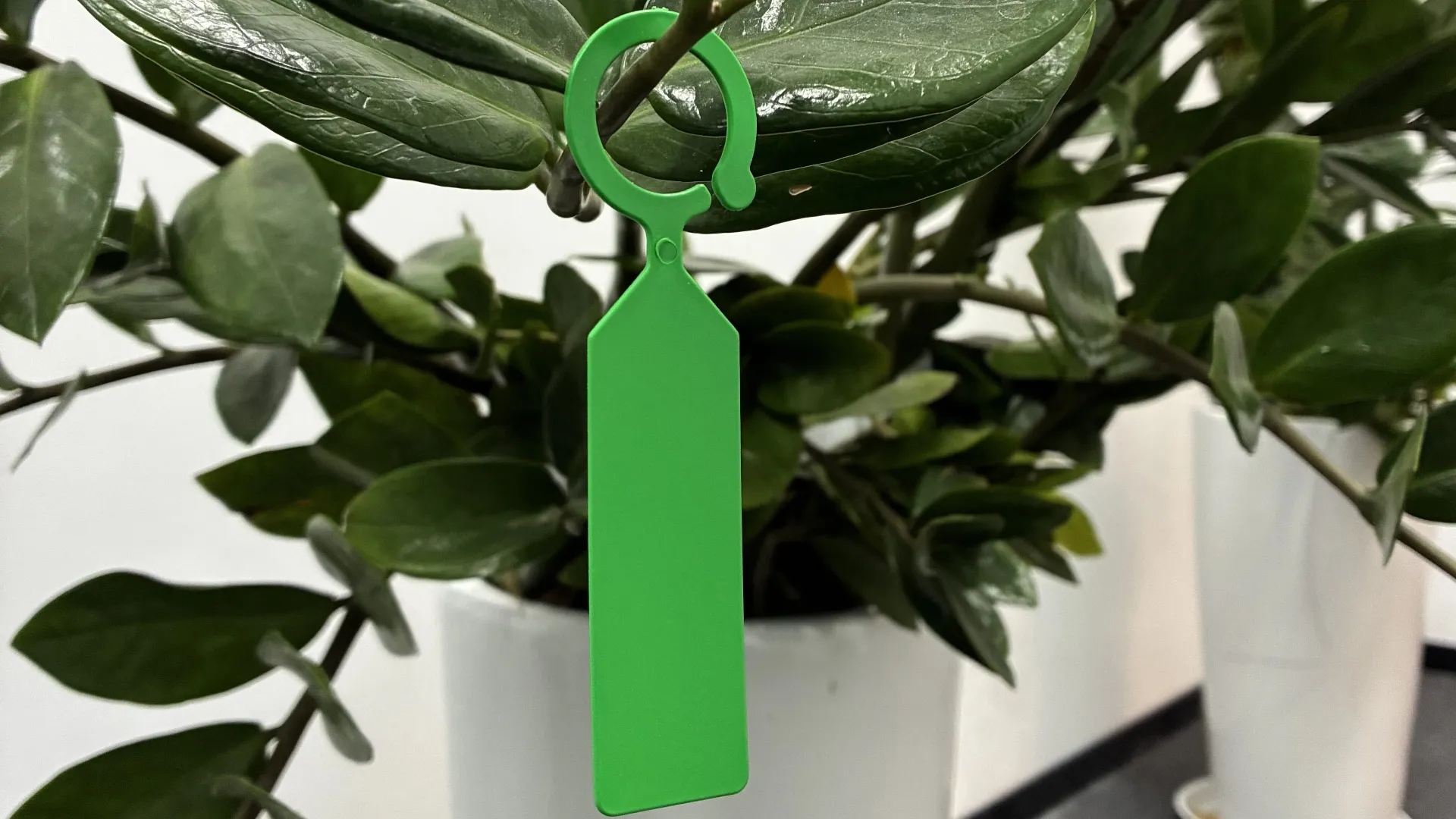
| T-Type | 10×6cm (most popular), 15×6cm, 20×6cm | Pots, seedlings, succulents | Stable in soil, large writing area |
| Arrow Shape | 10×2cm, 15×2cm | Small pots, succulents, windowsill plants | Slim appearance but limited writing space |
| Rectangular | 6×4cm, 8×5cm | Hanging tags, tree identification | Can be hung with string, suitable for larger plants |
| Folding Tag | 10×8cm (opened) | Nurseries and plant retail | Large information area but higher cost |
End User Preferences
| End User | Core Need | Preferred Material | Preferred Shape | Writing Method |
| Home gardeners | Plant identification | Plastic | T-Type | Marker |
| Succulent enthusiasts | Compact, attractive appearance | Bamboo/Wood | Arrow Shape | Pencil |
| Nurseries and growers | High-volume identification and branding | Plastic | T-Type + Folding | Thermal transfer printing |
| Garden center retail | Customer appeal and sales support | Plastic + Color | T-Type + Folding | Pre-printed |
| Indoor plant enthusiasts | Attractive home décor integration | Bamboo/Wood | T-Type | Marker |
Product Selection Recommendation
If you only stock one shape, choose the 10×6cm T-Type label. It covers the widest range of plant categories.
If you stock two shapes, add the Arrow Shape to serve succulent and small-pot customers.
Plant Labels Are More Than Identification Tools
Many wholesalers underestimate the hidden value of plant labels.
| Value | Explanation |
| Sales Tool | Care instructions increase customer confidence and improve conversion rates |
| Reduce Returns | Labels with care information help customers avoid plant losses |
| Brand Carrier | Nursery logos on labels create ongoing brand exposure |
| Social Media Prop | Bamboo labels paired with plants create highly shareable content |
Industry reports show that more growers are requesting custom labels featuring nursery or retailer logos. Labels are no longer just identification tools—they are sales tools.
Demand for folding labels is growing particularly quickly because they provide space for additional information, such as special soil requirements for acid-loving plants like azaleas.
Packaging Options: 10 Labels in One Color vs 10 Labels in Different Colors
This is a common challenge for wholesalers.
| Packaging Type | Customer Demand | Difficulty | Explanation |
| 10 Same Color | Mass market, nurseries | Low | Production lines naturally produce single-color batches |
| 10 Mixed Colors | Boutique garden centers, e-commerce | Requires secondary sorting | Different colors must be manually combined after production |
Key Point
Mixed-color packaging requires secondary sorting.
Factories typically produce one color at a time. A pack containing 10 labels in different colors must be assembled manually by selecting labels from multiple color inventories and repackaging them.
Recommendation
Mixed-color sets (for example, white, green, pink, blue, yellow, and red in equal proportions) often sell better than single-color packs because customers can purchase all colors at once.
However, secondary sorting costs must be considered.
The MOQ Trap: More Label SKUs Than Watering Cans
This is the most common mistake first-time buyers make.
A single SKU MOQ of 300 pieces sounds manageable, but labels require many more variations than most gardening products.
| Category | Options | Quantity |
| Colors | White, Green, Pink, Blue, Yellow, Red | 6 |
| Shapes | T-Type, Arrow, Rectangular | 3 |
| Sizes | Small, Medium | 2 |
| Total | 36 SKUs |
36 SKUs × 300 pieces MOQ = 10,800 labels.
Adding bamboo and wood versions can easily push total quantities above 15,000 pieces.
Unlike watering cans or hand tools, plant labels rely on multiple SKUs to meet different customer needs.
For first-time buyers, start with just 2–3 core SKUs:
- White PVC T-Type
- Mixed-color PVC T-Type
- Bamboo T-Type
Expand only after identifying proven sellers.
What Should Be Confirmed Before Purchasing?
| Checkpoint | What to Confirm | Why It Matters |
| Writeability | Can normal markers and pencils write clearly? | Some plastics are too smooth |
| Waterproof Performance | Does writing remain clear after watering? | Labels must remain readable |
| Color Consistency | Are colors consistent within the batch? | Color variation is the biggest complaint |
| Label Size | Does it fit seed trays and pots? | Incorrect sizing reduces usability |
| UV Resistance | Does it contain UV stabilizers? | Prevents outdoor fading |
| Mixed-Color Packaging | Can the supplier provide sorting and repacking? | Mixed-color packs require manual assembly |
Common Risks and How to Reduce Them
| Risk | Cause | Prevention |
| Surface too smooth for writing | Material selection issue | Test with markers and pencils |
| Writing becomes blurry after watering | Poor waterproof performance | Conduct watering tests |
| Color variation within batch | PVC material inconsistency | Use Pantone-approved color references |
| Rapid outdoor fading | No UV stabilizers | Confirm UV-resistant formulation |
| Mixed-color package inconsistency | Different inventory batches | Purchase all colors together |
| Mold on wooden labels | Moisture absorption | Confirm anti-mold treatment |
| Weak, uneven edges | Poor mold precision or injection pressure | Check edge rigidity during sample approval |
Product Combination Recommendations
Starter Package for E-Commerce Sellers
Goal: Cover the widest customer base with minimum investment.
| Product | SKU-A | SKU-B | Suggested Quantity | Notes |
| PVC Labels | T-Type 10×6cm White | T-Type 10×6cm Mixed Colors | White 2,000 pcs, Mixed 1,000 pcs | White is the safest option |
| Bamboo Labels | T-Type 10×6cm Natural | Arrow 10×2cm Natural | 500 pcs each | Eco-friendly and premium appeal |
Start with only three core SKUs and expand later.
Advanced Package for Garden Centers and Distributors
| Product | SKU-A | SKU-B | Suggested Quantity | Notes |
| Wooden Labels | T-Type 10×6cm Birch | T-Type 15×6cm Pine | 500 pcs each | Ideal for laser-engraved branding |
| Folding Labels | 10×8cm White PVC | 10×8cm Colored PVC | 2,000 pcs each | Suitable for detailed plant information |
| Hanging Tags | 6×4cm PVC | 8×5cm Copper | 500 pcs each | Tree and shrub identification |
Supply Chain: Where to Source
Plastic Labels — Taizhou, Zhejiang
Taizhou Luqiao is one of China's major production hubs for plastic plant labels. PVC T-Type labels wholesale for approximately $1–15 per 100 pieces, with MOQs as low as 100 pieces, six color options, and lead times of 7–10 days for stocked items.
Procurement Tip: Color control is critical. Request Pantone references before production and inspect against approved samples.
Bamboo Labels — Shaowu, Fujian
Shaowu is a major bamboo and wood craft production center. Bamboo labels wholesale for approximately $4–11 per 100 pieces and support laser engraving with MOQs of 500–1,000 pieces.
Procurement Tip: Laser engraving capacity is limited during peak spring ordering seasons. Place orders 2–3 months in advance.
Wooden Labels — Guangdong and Shandong
Wooden labels wholesale for approximately $8–36 per 100 pieces and support laser engraving from MOQs of 500 pieces.
Procurement Tip: Confirm anti-mold treatment. Untreated wooden products produced during humid seasons may develop mold during ocean transit.
How We Support Buyers
Scarecrow Garden Supplier helps wholesalers, garden centers, distributors and e-commerce sellers source plant labels from China — across plastic, bamboo and wood materials, with color consistency checking, mixed-color repackaging and consolidated shipping support.
If you are sourcing plant labels in volume, we can help with:
- Mixed-color sorting and repackaging — mixed-color packs require labels from multiple production runs to be manually combined and repackaged. We complete this process in our warehouse, so products arrive retail-ready.
- Color consistency inspection — every batch is checked against approved Pantone references before shipment to reduce complaints related to color variation.
- Coordination of laser engraving for bamboo and wooden labels — unlike plastic printing, laser engraving is economical at MOQs from 500 pieces and requires no tooling.
👉 Contact us: Queenie@gardentoolswholesale.com — Send us your customer profile and label requirements to receive material recommendations and wholesale pricing.
Frequently Asked Questions
Q: Which plant label material sells best?
White PVC T-Type labels. They are inexpensive, durable, highly visible, and free from color consistency concerns.
Q: Is printing a logo on plastic labels worthwhile?
Usually not. Printing often requires MOQs of 5,000+ units and tooling costs of $200–500. Bamboo and wood laser engraving is generally more cost-effective.
Q: Why does mixed-color packaging require secondary sorting?
Because production lines manufacture one color at a time. Mixed-color packs must be manually assembled from different inventory batches.
Q: How long do bamboo labels last outdoors?
Typically 6–12 months before weathering and discoloration begin. For long-term outdoor use, plastic labels are usually a better choice.
Q: How should samples be evaluated?
Use a dual-sample process: one sample for customer approval and one retained for reference. Test writing performance, water resistance, and color consistency.
Q: Can labels be sourced together with seed trays and markers?
Yes. Labels, seed trays, and markers are commonly sold together as a seed-starting identification kit.
Q: Which sells better: white labels or colored labels?
White labels are the safest choice and appeal to the broadest audience. Colored labels add value and variety but require stricter color management.
Q: How strong is demand for eco-friendly labels in Europe?
Demand is increasing. The EU Single-Use Plastics Directive is encouraging biodegradable alternatives, making bamboo labels particularly attractive in European markets.
Simplify Your Garden Product Sourcing from China
We help you combine multiple product categories into one sourcing flow with supplier matching, sample verification, and consolidated shipping.
Written by
ScarecrowGarden
💡About Scarecrow Garden Supplier Co., Ltd.
Scarecrow Garden Supplier Co., Ltd. is a China-based sourcing and wholesale partner specializing in garden tools, landscaping equipment, and outdoor supplies for international wholesalers, distributors, contractors, and brands.
With hands-on experience rooted in real garden use scenarios, we focus on durable materials, functional design, and stable large-volume supply. Our product range covers pruning tools, watering systems, hand tools, outdoor hardware, and customized garden solutions to support both retail and professional landscaping markets.
Beyond products, we help our partners navigate supplier selection, quality control, compliance requirements, and long-term sourcing strategies in China. Through our blog, we share practical insights on product selection, material comparisons, industry trends, and cost-effective purchasing—helping global buyers build stronger, more competitive supply chains.