






Updated 4 months ago
Indoor Greenhouse For Plants Wholesale
arafatshuvo509

Garden Tools Wholesale supplies indoor greenhouse for plants products for garden centers, plant shops, seedling growers, e-commerce sellers, supermarket garden aisles, and OEM garden-supply brands. Our indoor greenhouse collection focuses on compact tiered shelving with clear zip-up PVC covers, helping buyers offer practical growing space for seedlings, herbs, tropical plants, balcony gardening, and small indoor propagation.
For retailers and growers, the key is not only the greenhouse size. Buyers need the right balance of footprint, shelf capacity, cover durability, frame stability, carton efficiency, grow-light compatibility, and price level for bulk orders. We support wholesale and OEM projects with 2-tier, 3-tier, and 4-tier indoor greenhouse options, plus custom packaging and private-label specifications for different markets.
Wholesale Indoor Greenhouses for Plant Retailers and Growers
Indoor greenhouses are strong retail products because they solve several common plant-care problems in one compact kit. They help customers organize plants vertically, protect seedlings from drafts, retain humidity for moisture-loving plants, and create a cleaner growing area inside homes, balconies, patios, and retail plant displays.
For commercial buyers, our indoor greenhouse collection is suitable for:
- Garden centers and plant retailers
- Seed starting and propagation suppliers
- Online garden product sellers
- DIY greenhouse kit brands
- Balcony gardening product distributors
- Tropical plant and houseplant retailers
- Home improvement and supermarket garden departments
- OEM and private-label garden-supply programs
Each greenhouse is designed around tiered shelves, a lightweight but stable frame, and a transparent cover with a roll-up zippered front door. This makes the product easy to display, simple to ship, and practical for both beginner and experienced plant growers.
Product Collection: 2-Tier, 3-Tier and 4-Tier Indoor Greenhouses
Our indoor greenhouse for plants range can be supplied in different tier structures to match different selling channels and end-user needs.
A 2-tier model works well for compact apartments, small balconies, countertop plant care, and entry-level retail programs. A 3-tier model gives more vertical growing space while keeping the footprint manageable for home users. A 4-tier model is better for serious seed starting, plant collectors, and customers who want higher capacity in a narrow floor area.
The main product structure usually includes:
- Powder-coated steel tube frame
- Plastic connectors or reinforced frame joints
- Wire mesh or PE-coated shelves
- Clear PVC or PE cover
- Zip-up roll-up front door
- Tie straps or door holders
- Flat-pack carton design
- Tool-free or simple push-fit assembly
For buyers building a complete seed starting category, indoor greenhouses can be paired with 72-cell seedling trays, biodegradable seedling pots, and seedling grow bags.
Tier and Size Selection Table
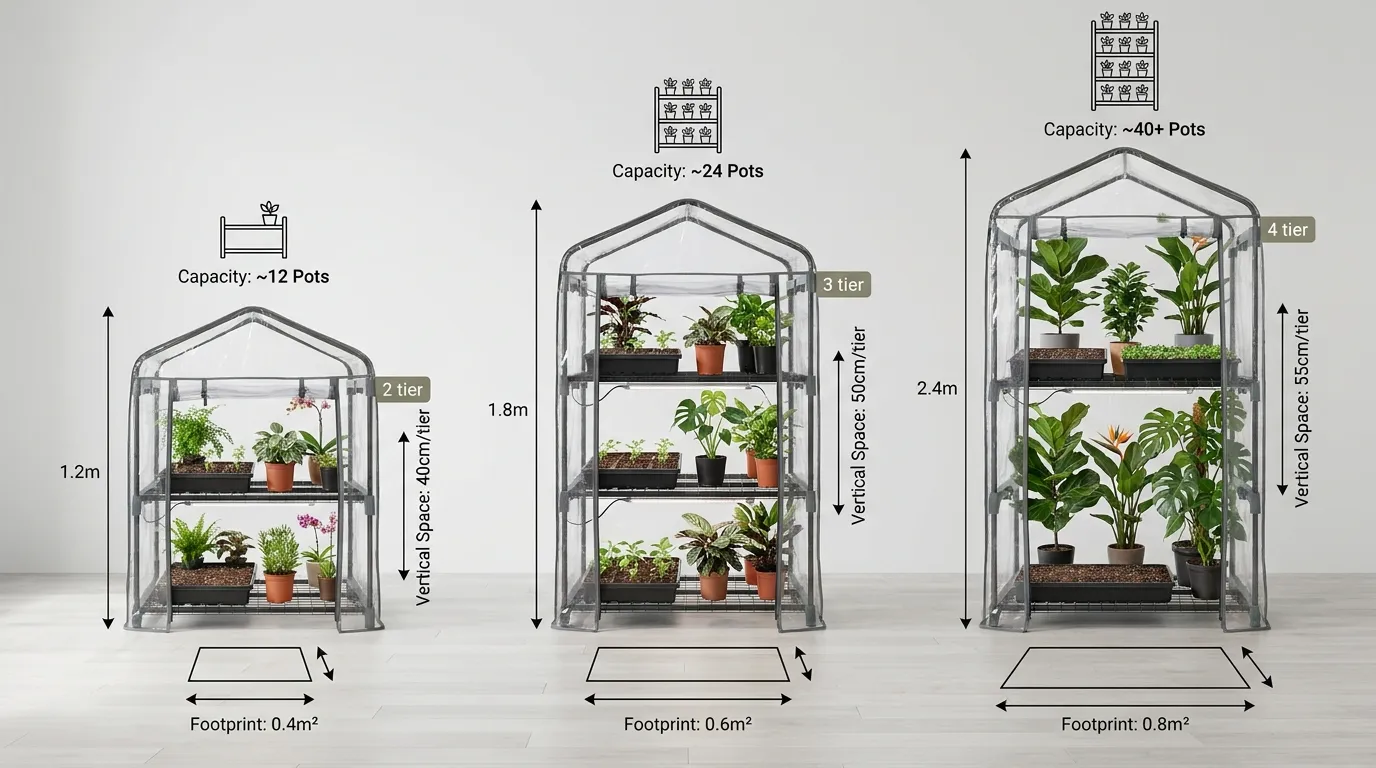
| Model Type | Typical Tier Count | Best For | Footprint Advantage | Capacity Level | Common Buyer Use |
|---|---|---|---|---|---|
| Compact Indoor Greenhouse | 2 tiers | Herbs, small pots, starter seedlings, apartment users | Small footprint, easy to place near windows | Low to medium | Entry-level retail SKU, balcony gardening, small plant shops |
| Standard Indoor Greenhouse | 3 tiers | Seed trays, tropical plants, mixed houseplants | Balanced height and capacity | Medium | Best-selling general-purpose model for garden retailers |
| High-Capacity Indoor Greenhouse | 4 tiers | Multiple seed trays, propagation, plant collectors | More vertical growing area without large floor space | High | E-commerce bundles, spring seed-starting promotions, grower supplies |
| Grow-Light Compatible Greenhouse | 3–4 tiers | Seedlings, herbs, indoor plant care, low-light homes | Shelf spacing supports LED bars or clip lights | Medium to high | Premium retail kits, OEM bundles, indoor growing programs |
Actual dimensions, shelf spacing, tube diameter, cover thickness, and shelf load can be adjusted depending on your target market, packaging requirements, and price level.
Footprint vs Capacity: How Buyers Choose the Right Model
For indoor greenhouse sourcing, footprint and capacity are usually more important than overall height alone. A taller greenhouse can look attractive in product photos, but if shelf spacing is too tight, customers may not be able to place taller plants, seedling trays with humidity domes, or grow lights.
Retail buyers should consider:
- How many standard seed trays fit per shelf
- Whether the greenhouse is for small pots or taller plants
- Whether the end user will place it indoors, on a balcony, or in a covered patio
- Whether LED grow lights need to be attached under each shelf
- How much carton size affects shipping cost
- Whether the model is easy for consumers to assemble
For general retail, a 3-tier indoor greenhouse is often the most balanced option. It offers enough capacity for seedlings and houseplants while remaining compact enough for apartments and balconies. For professional seed starting, e-commerce bundles, and higher-value retail sets, 4-tier indoor greenhouses usually offer stronger perceived value.
Zip-Up PVC Cover for Humidity Retention
The clear greenhouse cover is one of the most important parts of the product. It creates a protected microclimate around plants, helping retain humidity and reduce direct exposure to indoor drafts, air conditioning, dry winter air, or sudden balcony temperature changes.
A zip-up PVC cover is especially useful for:
- Tropical houseplants that prefer higher humidity
- Seedlings during early germination and growth
- Herb growing near windows
- Plant recovery after repotting
- Small propagation setups
- Retail display kits for beginner gardeners
The roll-up front door allows users to open the greenhouse for watering, ventilation, pruning, and plant access. When closed, the cover helps maintain a more stable environment around plants. For tropicals and seedlings, this humidity retention is often a major selling point.
Frame Materials: Steel Tubes, PE Shelves and Durable Connectors
Most wholesale indoor greenhouses use a lightweight steel tube frame because it offers a good balance of strength, cost, and shipping efficiency. Steel tubes can be powder-coated or plastic-coated to improve appearance and reduce corrosion risk in humid growing environments.
Common material options include:
- Powder-coated steel tubes for frame structure
- PE-coated or plastic-coated wire shelves
- PP or plastic connectors for fast assembly
- Clear PVC cover for visibility and humidity retention
- PE cover options for selected budget or outdoor-adjacent models
For buyers, the frame should feel stable after assembly, and the shelf system should support common seed trays and small potted plants. Connector quality is also important. Weak connectors may reduce stability, create poor customer reviews, and increase after-sales issues.
Cover Durability and Zipper Quality
For indoor greenhouse for plants products, the cover is a major quality point. Retail customers often judge the product by how clearly they can see the plants, how smoothly the zipper works, and whether the cover fits the frame tightly without tearing easily.
Important cover details include:
- PVC or PE material thickness
- Clear visibility for plant display
- Reinforced seams
- Smooth zipper operation
- Roll-up door straps
- Proper cover fit over the frame
- Resistance to normal pulling during assembly
For OEM projects, buyers can request different cover thickness, edge finishing, zipper style, and packaging descriptions. A stronger cover may increase unit cost, but it can improve customer satisfaction and reduce return risk in higher-value retail channels.
Grow-Light Compatible Indoor Greenhouse Options
Many indoor greenhouse customers also use LED grow lights, especially in apartments, offices, winter climates, and homes with limited natural sunlight. For this reason, grow-light compatibility is a strong commercial feature for 3-tier and 4-tier indoor greenhouse models.
A grow-light compatible design should consider:
- Shelf spacing for LED light bars
- Cable routing through the cover opening
- Heat clearance around plants
- Stable shelves for trays and pots
- Easy access to switch lights or timers
- Optional bundle packaging with grow lights
Garden Tools Wholesale can support greenhouse-only supply or OEM bundle planning depending on your project. If your market sells seed starting kits, a greenhouse can also be bundled with seed trays, nursery pots, labels, gloves, and other propagation accessories.
For smaller retail kits, you may also consider linking the category with a mini greenhouse kit wholesale program.
Easy Assembly for Retail Customers
Indoor greenhouses must be easy for end users to assemble. Most customers expect a simple push-fit frame with clear instructions and no complicated tools. A difficult assembly experience can lead to negative reviews even if the greenhouse materials are acceptable.
We focus on practical assembly details such as:
- Numbered or clearly grouped frame tubes
- Push-fit connector structure
- Simple shelf placement
- Cover that slides over the frame smoothly
- Roll-up door with easy tie straps
- Compact packaging for storage and delivery
For e-commerce sellers, assembly clarity is especially important because customer reviews directly affect conversion rates. OEM instruction manuals can be customized with your brand, language, diagrams, and retail compliance information.
OEM Indoor Greenhouse Manufacturing Options
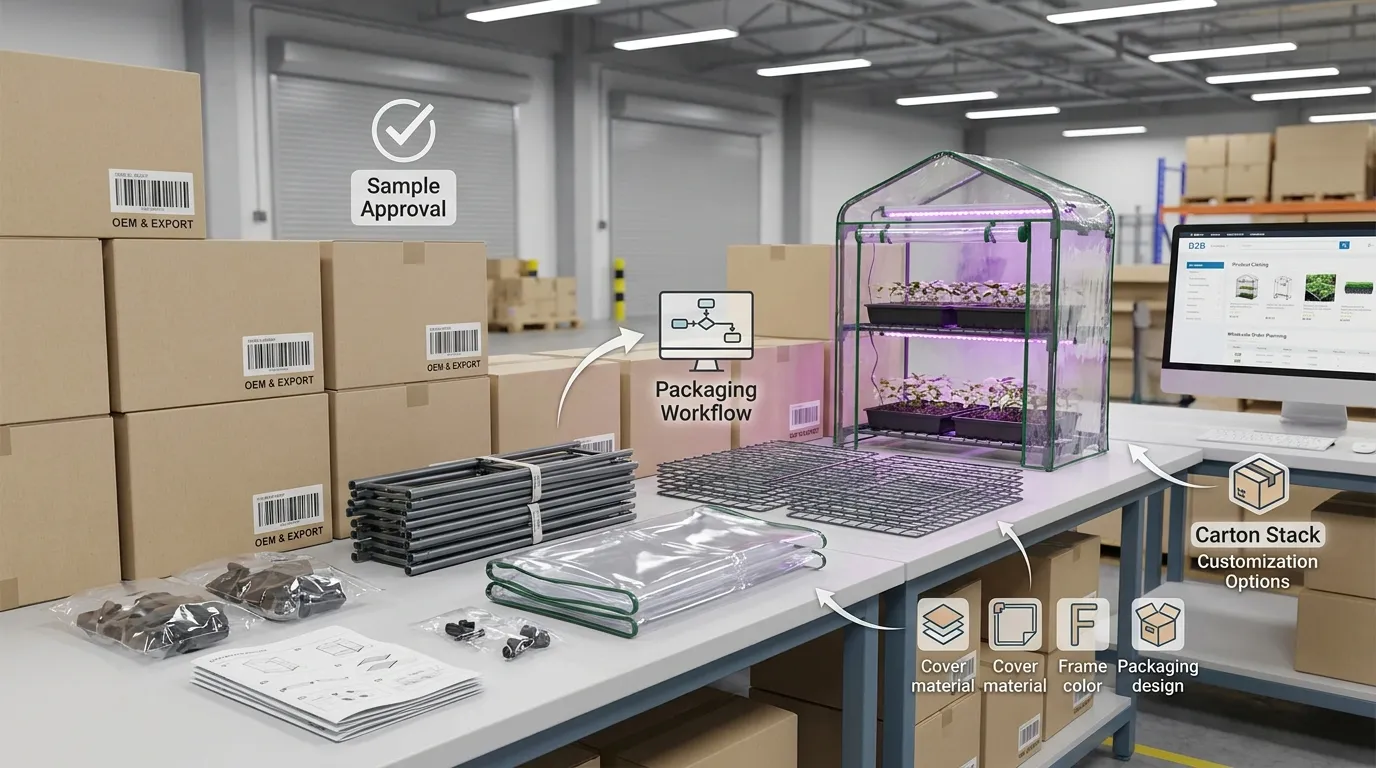
Garden Tools Wholesale supports OEM and private-label indoor greenhouse projects for brands, distributors, and retailers. We can adjust specifications based on your market positioning, carton requirements, and target price.
OEM options may include:
- Custom frame size
- 2-tier, 3-tier, or 4-tier structure
- Tube diameter and frame finish
- Shelf material and shelf spacing
- PVC or PE cover specification
- Zipper style and cover details
- Logo label or printed packaging
- Color box or mail-order carton
- Instruction manual customization
- Mixed-SKU order planning
- Accessory bundle development
For brand owners, we recommend selecting 2–3 core models rather than too many similar sizes. A compact 2-tier model, a best-selling 3-tier model, and a high-capacity 4-tier model can create a clear collection without making inventory management too complex.
MOQ, Samples and Bulk Order Planning
MOQ depends on the greenhouse model, packaging type, customization level, and current production schedule. Standard models usually have more flexible MOQ than fully customized OEM versions. Custom carton artwork, private-label branding, special cover thickness, and non-standard frame sizes may require higher minimum quantities.
For a smooth sourcing process, buyers should prepare:
- Target model size or tier count
- Estimated order quantity
- Destination country or port
- Packaging preference
- Logo and branding requirements
- Target retail channel
- Required quality level
- Expected delivery schedule
- Any test or compliance requirements for your market
Samples can be arranged for evaluation before bulk production. We recommend checking the assembled stability, zipper operation, cover fit, shelf strength, carton protection, and instruction clarity before finalizing a mass order.
Packaging and Export Considerations
Indoor greenhouses are normally shipped as flat-pack products. Good packaging reduces shipping volume, protects frame tubes and connectors, and makes the product easier for retailers or e-commerce sellers to handle.
Bulk packaging options may include:
- Mail-order carton for online sales
- Color box for retail shelf display
- Brown carton for wholesale distribution
- Custom label or barcode
- Multi-language manual
- Spare connector or accessory bag
- Master carton planning for container loading
For export orders, carton strength and packing layout are important. Long frame tubes, shelf panels, and PVC covers must be arranged carefully to reduce bending, scratching, and compression during transport.
Quality Points We Recommend Buyers Check
Before confirming a wholesale indoor greenhouse order, buyers should check more than the product photo. A good sourcing decision should include practical quality details that affect customer satisfaction.
Key checkpoints include:
- Frame tube thickness and coating quality
- Shelf load capacity for trays and pots
- Stability after full assembly
- Connector tightness
- Cover thickness and transparency
- Zipper smoothness
- Seam strength
- Door roll-up function
- Carton drop protection
- Instruction manual clarity
- Consistency between sample and bulk production
For retailers, these details help reduce returns and improve customer reviews. For growers, they ensure the greenhouse performs well during seed starting, propagation, and indoor plant maintenance.
Indoor Greenhouse Applications
Our indoor greenhouse for plants collection can be positioned for multiple retail and growing scenarios:
- Seed starting before outdoor transplanting
- Tropical plant humidity retention
- Herb growing near a sunny window
- Balcony plant protection
- Small-space apartment gardening
- Retail plant care kits
- Propagation for cuttings
- Starter greenhouse kits for beginners
- Seasonal spring gardening promotions
- Indoor grow-light plant shelves
This flexibility makes indoor greenhouses suitable for both core garden catalogs and seasonal promotional programs.
Why Source Indoor Greenhouses from Garden Tools Wholesale?
Garden Tools Wholesale works with buyers who need practical garden-supply products for bulk distribution, private-label sales, and retail category development. Our indoor greenhouse products are selected for strong commercial value: compact shipping, simple assembly, clear customer use cases, and flexible OEM options.
We can help you compare tier structures, cover specifications, packaging choices, and product combinations so your final SKU fits your market instead of simply copying a generic model.
Request a Wholesale Quote
Send us your target tier count, size, quantity, packaging style, destination market, and OEM requirements. Our team can recommend suitable indoor greenhouse for plants models, provide sample options, and support bulk order planning for your retail or grower supply program.
FAQs
What size indoor greenhouse for plants is best for retail sales?
For general retail, 3-tier indoor greenhouses are often the most balanced choice because they offer good capacity without taking too much floor space. A 2-tier model is better for entry-level customers, while a 4-tier model suits seed starting, plant collectors, and higher-capacity growing.
Can indoor greenhouses be used with grow lights?
Yes. Many 3-tier and 4-tier indoor greenhouses can be used with LED grow lights. Buyers should check shelf spacing, cable routing, heat clearance, and attachment points before creating a grow-light bundle or recommending lights to retail customers.
What cover material is used for indoor greenhouses?
Most indoor greenhouses use clear PVC covers because they provide visibility, humidity retention, and a clean retail appearance. PE cover options may also be available depending on the price level and product structure required for your wholesale project.
Are the indoor greenhouses easy to assemble?
Yes. Most models are designed for simple assembly using steel tubes, plastic connectors, shelves, and a fitted cover. Many versions are tool-free or require only basic assembly steps. Clear instructions can be customized for OEM orders.
What is the MOQ for wholesale indoor greenhouse orders?
MOQ depends on the model, size, packaging, and customization level. Standard models usually allow more flexible order quantities, while custom color boxes, private-label branding, special sizes, or custom cover specifications may require higher MOQ.
Can you customize indoor greenhouses for our brand?
Yes. Garden Tools Wholesale supports OEM customization, including size selection, tier count, frame finish, cover specification, logo labels, carton artwork, instruction manuals, and bundle planning with related seed starting products.