







Outdoor furniture wholesale
The “A/B Quality” Trap in China Outdoor Furniture Sourcing — and a Systematic Solution
Introduction: When a Perfect Sample Turns into a Costly Disappointment
In April 2023, Thomas, a German outdoor furniture importer, received a sample shipment from Ningbo, China: a beautifully designed aluminum rattan sofa set.
The craftsmanship was impressive—smooth welds, tight and even rattan weaving, flawless surface finishing.
“Finally, we’ve found the right supplier,” Thomas told his team with confidence. Shortly afterward, he placed a full 40-foot container order.
Three months later, when the container was opened at Hamburg Port, his confidence collapsed.
The delivered products bore little resemblance to the approved sample:
- Weld joints were rough, with visible gaps and missed welds
- Rattan weaving was loose and deformed
- Paint surfaces showed color inconsistency and sagging
- Random functional tests revealed structural noise in one chair and early rust on metal connectors in another
Thomas asked the same question countless international buyers have asked before him:
“The sample was perfect. How could mass production be so different?”
How the A/B Quality System Really Works: The Dual-Face Manufacturing Model
1.1 Parallel Production Lines: Two Standards, Two Realities
In China’s manufacturing ecosystem—especially in highly competitive sectors like outdoor furniture—it is common to find separate systems for samples and mass production.
This is not casual corner-cutting, but often a highly structured operational strategy.
Typical Case: Internal Structure of an Outdoor Furniture Factory
Grade-A Line (Sample Line)
- Located near the showroom
- Staffed by 8–10 senior craftsmen (≈5% of total workforce)
- Average experience: 8+ years
- Hourly wages: 40% higher than standard workers
- Equipped with full testing tools and precision equipment
- Sample production time: 3–5× that of mass production
Grade-B Line (Mass Production Line)
- Located in the main workshop
- 200 workers, ~70% with less than one year of experience
- Efficiency-driven workflows
- Standard production time: 1/3 of sample time
- Quality control based on sampling, not 100% inspection
Factory Owner’s Perspective (Anonymous)
“Samples are the entry ticket. They must be perfect.
But mass production has to survive on margins.
If we manufacture everything to sample standards, our price will be 30% higher than competitors—and we’ll lose the order.”
1.2 Three Common Forms of Material Substitution
Method 1: Specification Downgrading
- Sample: 2.0mm aluminum tubing → Mass production: 1.5mm
- Sample: 100% 304 stainless steel → Production: partial 201 stainless
- Sample: 600D waterproof fabric → Production: 400D standard fabric
Method 2: Process Simplification
- TIG welding + triple polishing → standard welding + minimal finishing
- Five-stage sanding + three paint layers → three sanding stages + two coats
- High-temperature rattan stabilization → skipped entirely
Method 3: Process Elimination
- 72-hour salt spray & load-cycle testing → visual inspection only
- Anti-rust treated fasteners → standard screws
- Reinforced internal structures → simplified designs
1.3 Why “Good Factories” Can Be Even More Dangerous
Well-managed factories often implement more sophisticated A/B strategies:
- Gradual Quality Erosion
First shipment matches the sample → trust established
Second shipment slightly downgraded → tolerance tested
Third shipment significantly reduced - Mixed-Batch Strategy
70% B-grade + 30% A-grade in one shipment
If inspectors sample A-grade units, the batch passes - Document Engineering
Complete—but misleading—material certificates, test reports, and production logs that appear compliant yet do not reflect reality
Why Even “Reputable” Factories Compromise Quality
2.1 Cost Pressure Transmission
Real Case: A Long-Established Zhejiang Manufacturer
Founded in 2005, this factory supplied mid-to-high-end European brands.
In 2022, it faced:
- Raw material cost increase: +20%
- Labor cost increase: +15%
- Euro depreciation reducing purchasing power
Management faced two options:
- Raise prices by 25% → lose ~60% of clients
- Reduce internal costs via material/process adjustments → maintain orders
- “We’re not dishonest by choice,” the owner admitted.
“The market has pushed us against the wall.”
The result was invisible degradation—internal materials and non-visible processes were quietly downgraded.
2.2 Capacity vs. Delivery Deadlines
Outdoor furniture manufacturing is highly seasonal:
- Jan–Apr: European ordering peak
- May–Aug: Production & shipping overload
- Sep–Dec: Retail peak, urgent replenishment
During peak capacity, factories choose between:
- Maintain sample standards → 30% capacity loss → late delivery penalties
- Accelerate production → simplified processes → quality erosion
Most choose the second—because delivery penalties are immediate, while quality failures surface months later.
2.3 Internal “Grey Management”
Even in structured factories, middle management faces conflicting KPIs:
- “If I fail cost, delivery, and quality targets, I lose my job.
Quality is the only variable that doesn’t explode immediately.”
This internal prioritization systematically sacrifices quality.
Locking the Sample: Controlling Risk at the Source
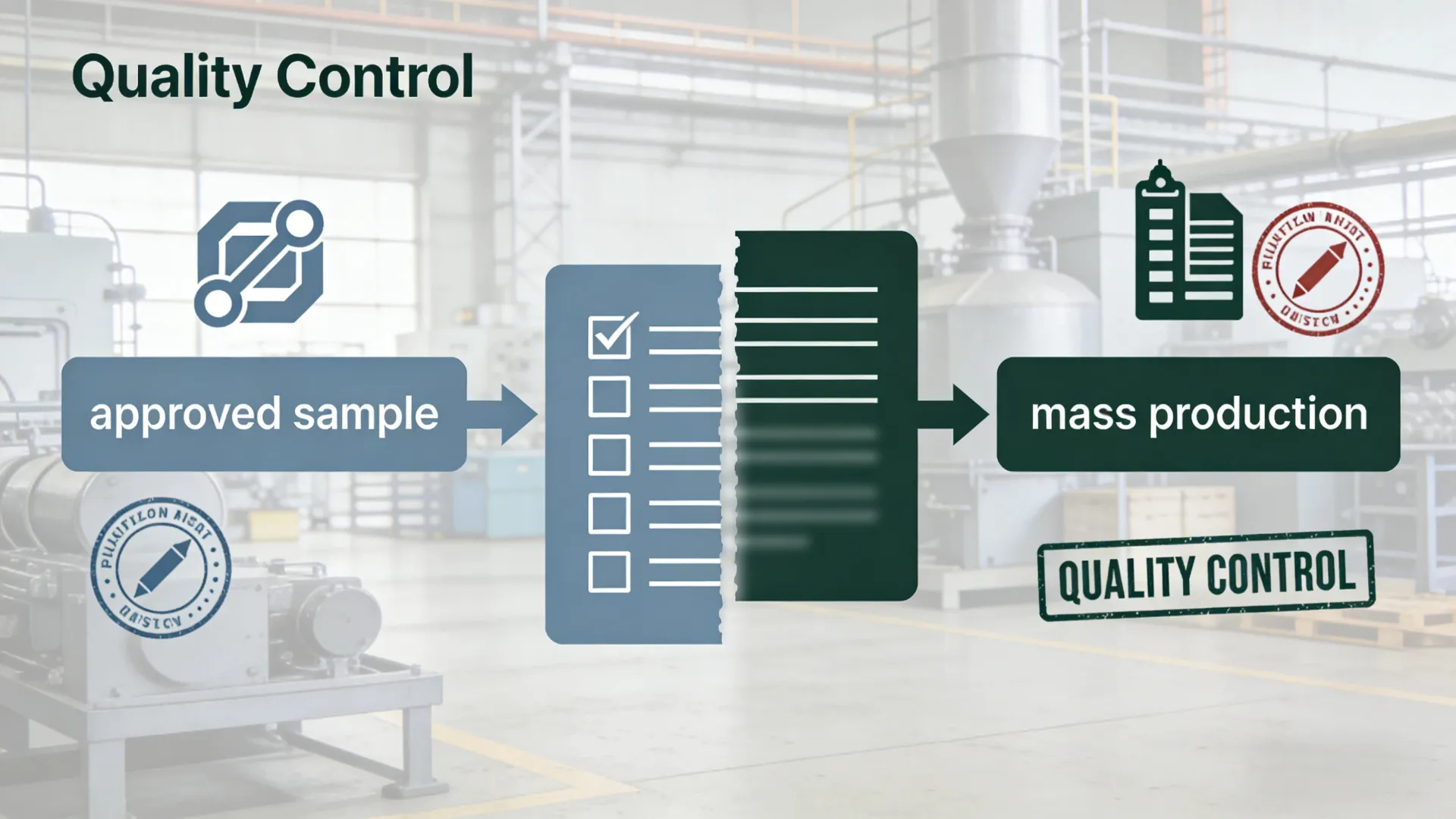
3.1 The Concept of a “Mass-Production-Ready Sample”
Traditional samples are often disconnected from real production conditions.
A true production sample must meet the following criteria:
- Made on the actual mass-production line
- Produced by regular line workers, not master craftsmen
- Built within standard production time
- Materials drawn from bulk procurement batches, with traceability
- Fully documented production parameters
Case: Scarecrow Garden Supply’s Sample Protocol
- Evaluate mass-producibility and revise non-scalable details
- Pull sample materials from bulk inventory
- Produce during standard shifts
- Record labor hours, materials, and process data
- Seal sample with full documentation as the production benchmark
3.2 Physical and Digital Sample Sealing
Physical Sealing
- Verified on-site by client or third-party inspector
- Tamper-proof sealed cases
- Dual custody: factory & buyer
Digital Sealing
- 360° high-resolution imaging
- Detailed sample specification sheet
- Blockchain-based timestamped record
- Database linking future inspections to sealed sample
3.3 Contractual Integration
Key Clause Example:
“All products delivered under this contract shall conform to the sealed reference sample (Sample No. ___) jointly confirmed on [date], including all materials, workmanship, appearance, and performance characteristics. Any deviation constitutes non-conforming goods and entitles the Buyer to rejection and contractual remedies.”
In-Process Inspection: The Real Control Point
4.1 Why Mid-Production Inspection Matters More Than Final Inspection
- Early detection → limited losses
- Mid-stage detection → corrective action possible
- Final-stage detection → total batch failure
Psychologically, unannounced inspections prevent early-stage shortcuts.
4.2 Optimal Inspection Milestones
30% Progress Inspection (Critical Intervention Point)
- Material verification
- Process parameter checks
- Operator compliance
- Semi-finished defect trends
60% Progress Inspection (Last Correction Window)
- Statistical quality analysis
- Functional & safety testing
- Packaging validation
- Production record consistency
4.3 The Power of Surprise Inspections
Unscheduled audits reveal the truth.
Case Example
A July 2023 inspection in Shandong uncovered mixed-grade wood despite certified documents.
30% of lower-grade materials were being used internally.
Early detection allowed full replacement before shipment.
A Full Lifecycle Quality Control System
5.1 Four-Stage Quality Validation Framework
- Pre-Production Verification
- Early Production Validation (20%)
- Mid-Production Validation (50–60%)
- Pre-Shipment Verification (100%)
5.2 Technical Tools
- Handheld XRF: Metal composition verification
- Infrared Spectroscopy: Plastics, coatings, textiles
- Coating Thickness Gauges
- IoT Environmental Monitoring
- Blockchain Traceability Systems
5.3 Supplier Incentive Realignment
The root cause of A/B quality lies in incentives.
Our approach:
- Long-term volume commitments
- Transparent cost structures
- Joint value engineering
- Shared savings mechanisms
Result: suppliers profit from efficiency—not deception.
Buyer’s Self-Protection Checklist
6.1 Pre-Order Due Diligence
- Factory audits (physical or live video)
- Warehouse material segregation
- QC capability assessment
- Reference customer validation
6.2 Contract Safeguards
- Sample legal enforceability
- Inspection rights at all stages
- Material traceability obligations
- Punitive substitution penalties
- Neutral arbitration venues
6.3 The ROI of Professional Quality Control
For a USD 100,000 container:
- Inspection cost: USD 800–1,200
- Potential failure loss: USD 50,000+
Risk mitigation ROI: 50× or higher
Conclusion
From Adversarial Buying to Sustainable Supply Chains
The A/B quality problem is not merely a quality issue—it is a supply chain relationship failure.
Sustainable solutions require:
- Reasonable supplier margins
- Cost transparency
- Technology-enabled verification
- Professional intermediaries
Outdoor furniture is not just a product—it shapes how people experience outdoor life.
Every piece delivered reflects a brand’s credibility.
If you are experiencing discrepancies between samples and mass production—or wish to build a more reliable outdoor furniture supply chain—we are here to help.
Scarecrow Garden Supplier doesn’t just inspect products.
We also help build trustworthy, scalable, and sustainable sourcing systems.

Written by
ScarecrowGarden
💡About Scarecrow Garden Supplier Co., Ltd.
Scarecrow Garden Supplier Co., Ltd. is a China-based sourcing and wholesale partner specializing in garden tools, landscaping equipment, and outdoor supplies for international wholesalers, distributors, contractors, and brands.
With hands-on experience rooted in real garden use scenarios, we focus on durable materials, functional design, and stable large-volume supply. Our product range covers pruning tools, watering systems, hand tools, outdoor hardware, and customized garden solutions to support both retail and professional landscaping markets.
Beyond products, we help our partners navigate supplier selection, quality control, compliance requirements, and long-term sourcing strategies in China. Through our blog, we share practical insights on product selection, material comparisons, industry trends, and cost-effective purchasing—helping global buyers build stronger, more competitive supply chains.