






Updated 2 days ago
Why Bulk Garden Tool Orders Fail — and How We Help Buyers Prevent Costly Quality Issues in China

ScarecrowGarden
💡About Scarecrow Garden Supplier Co., Ltd.
Scarecrow Garden Supplier Co., Ltd. is a China-based sourcing and wholesale partner specializing in biaogarden tools, landscaping equipment, and outdoor supplies for international wholesalers, distributors, contractors, and brands.
With hands-on experience rooted in real garden use scenarios, we focus on durable materials, functional design, and stable large-volume supply. Our product range covers pruning tools, watering systems, hand tools, outdoor hardware, and customized garden solutions to support both retail and professional landscaping markets.
Beyond products, we help our partners navigate supplier selection, quality control, compliance requirements, and long-term sourcing strategies in China. Through our blog, we share practical insights on product selection, material comparisons, industry trends, and cost-effective purchasing—helping global buyers build stronger, more competitive supply chains.
Why Bulk Garden Tool Orders Fail — And How Scarecrow Garden Supplier Helps Buyers Prevent Costly Quality Issues in China
In recent months, a video circulated widely within the China sourcing community:
A foreign buyer was seen bending a newly delivered silicone kitchen tool with one hand. The product failed instantly. The entire shipment was declared unusable.
The buyer had already paid for bulk production. The selling season was missed.
Public complaints followed — but the financial loss could not be reversed.
While this case involved kitchen tools, similar quality failures are common in the garden tools and outdoor products industry, often with even higher financial and reputational consequences.
This article explains why these failures happen and how we help buyers prevent them before production begins.
The Real Cost of a Quality Failure in Cross-Border Trade
In international sourcing, quality issues are rarely “fixable” after shipment.
A single incident can result in:
- Unsellable inventory
- Missed seasonal sales windows
- Retailer returns or recalls
- Negative reviews or social media exposure
- Long-term damage to brand credibility
For importers and brands, this is not just a product issue — it is a business risk.
The A/B Quality Trap: When Samples Lie
One of the most common causes of failure is known as A/B quality production.
- Sample stage (A-quality):
Materials and processes fully meet agreed specifications. - Mass production (B-quality):
Invisible cost reductions are introduced without buyer approval.
This may include:
- Reduced material thickness
- Lower-grade steel or plastic substitution
- Simplified heat treatment or finishing steps
- Reduced coating layers or curing time
Visually, products may look identical.
In use, their lifespan can be dramatically different.
Why Garden Tools Are Especially Vulnerable
Garden tools are detail-driven products.
Small, hidden differences lead to major performance gaps.
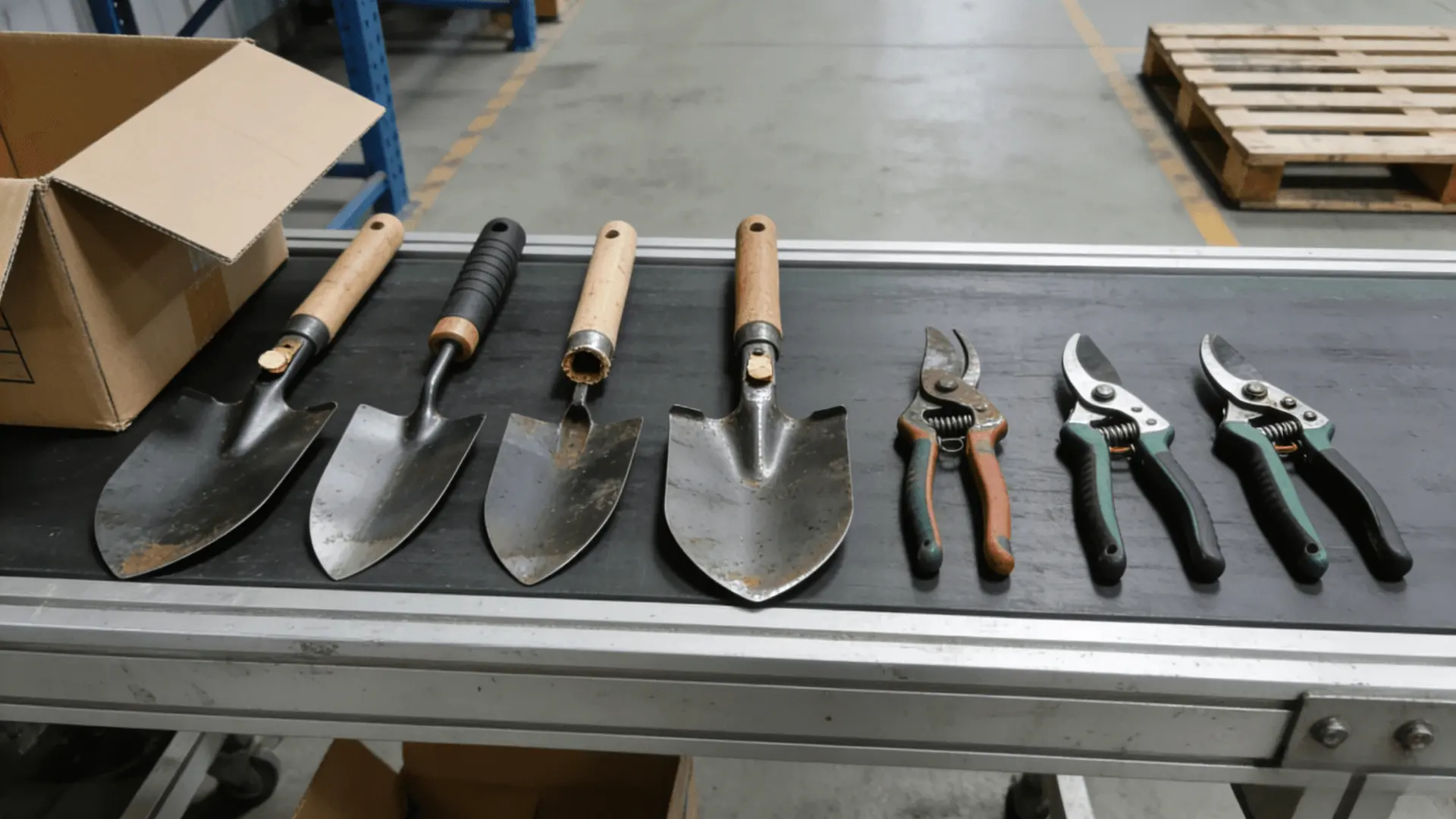
Typical risk points include:
- Metal thickness and hardness
- Heat treatment quality
- Welding or riveting strength
- Blade edge retention
- Spring fatigue life
- UV resistance and coating adhesion
For example, stainless steel garden shears may look similar, but:
- High-quality versions use steels like 7Cr17 or 8Cr13MoV, with proper quenching and tempering.
- Low-quality versions may use 3Cr13, 4Cr13, or even “stainless iron,” resulting in soft edges, chipping, or corrosion.
Without strict control, these substitutions are easy — and difficult to detect after delivery.
A Real-World Case of Sample–Mass Production Mismatch
Below is a publicly shared video that illustrates what can happen when quality control relies solely on approved samples, without effective control during mass production.
In this case, the buyer received a bulk shipment that appeared acceptable at first glance, yet the product could be bent by hand, rendering the entire order unsellable.
According to publicly available information, the approved samples met the agreed specifications, while the mass-produced goods were manufactured using downgraded materials — a typical example of A/B quality substitution.
This case does not represent the entire industry.
However, it clearly demonstrates a structural risk: when quality control stops at the sample stage, buyers remain highly exposed during mass production.
What failed here was not only product quality, but the absence of a systematic process to ensure consistency between samples and bulk orders.
Why Price Alone Is a Dangerous Indicator
In many failure cases, the order price is below the normal market range.
The difference often comes from:
- Lower-grade raw materials
- Reduced internal structure
- Fewer processing steps
- Skipped quality checks
These savings are rarely visible at the sample stage — but fully exposed in mass use.
How We Help Buyers Prevent These Failures
At Scarecrow Garden Supplier, we view quality failures as a shared risk.
If your product fails, our cooperation fails.
That is why we focus on prevention, not post-complaint solutions.
1. Factory Vetting Beyond Paper Credentials
China’s garden product manufacturing ecosystem ranges from small backyard workshops to large-scale factories. Paper certificates alone are not enough.
We assess:
- Factory ownership stability
- Management attitude toward long-term cooperation
- Raw material sourcing transparency
- Process repeatability and internal QC discipline
Whenever possible, we conduct on-site visits, spending time not only in workshops, but also speaking with frontline staff to understand real operating conditions.
2. Sealed Samples & Specification Locking
Before mass production:
- All technical specifications are confirmed in detail
- Material samples, process samples, and final samples are sealed
- These sealed samples become the only reference standard for bulk inspection
This prevents “sample-perfect, bulk-different” outcomes.
3. Multi-Stage Production Monitoring
Production is monitored at critical stages:
- First Article Inspection
Verifies tooling, materials, and process settings. - Mid-Production Inspection (20–30%)
Checks consistency and detects early deviations. - Random Spot Checks
Applied for longer production cycles.
Problems identified early are correctable.
Problems found at the shipment stage usually are not.
4. Product-Specific Quality Control Points
Different product categories require different controls:
- Garden Tools:
Hardness testing, blade sharpness and retention, spring fatigue tests - Irrigation Products:
Pressure testing, seal aging, UV resistance - Outdoor Furniture:
Tube wall thickness measurement, coating adhesion, salt spray testing - Planters & Decor:
Freeze-thaw resistance, structural integrity, surface finish durability
We focus on functional performance, not appearance alone.
5. Final Pre-Shipment Inspection — Simulating Real Use
Before shipment, we conduct final inspections that simulate actual usage:
- Continuous cutting tests
- Load and stability tests for furniture
- Drop tests for planters and packaging
- Labeling, compliance, and packaging verification
The goal is simple:
If it fails here, it should not reach your customers.
Long-Term Thinking: Building Supply Chains, Not Just Orders
Our goal is not to act as a one-time intermediary.
We aim to become a long-term sourcing and quality partner, aligned with your brand’s reputation and growth.
Choosing us means working with a team that understands:
- The realities of Chinese manufacturing
- The risks of international trade
- And the cost of getting quality wrong
Want to discuss your sourcing risks or quality concerns?
We welcome detailed product discussions, sample evaluations, and video calls.
Preventing problems is always cheaper than fixing them later.
Written by
ScarecrowGarden
💡About Scarecrow Garden Supplier Co., Ltd.
Scarecrow Garden Supplier Co., Ltd. is a China-based sourcing and wholesale partner specializing in biaogarden tools, landscaping equipment, and outdoor supplies for international wholesalers, distributors, contractors, and brands.
With hands-on experience rooted in real garden use scenarios, we focus on durable materials, functional design, and stable large-volume supply. Our product range covers pruning tools, watering systems, hand tools, outdoor hardware, and customized garden solutions to support both retail and professional landscaping markets.
Beyond products, we help our partners navigate supplier selection, quality control, compliance requirements, and long-term sourcing strategies in China. Through our blog, we share practical insights on product selection, material comparisons, industry trends, and cost-effective purchasing—helping global buyers build stronger, more competitive supply chains.
Related Articles

How to Source from China Without Missing Your Peak Season
China Public Holidays 2026: A Buyer’s Guide to Avoid Supply Chain Disruptions Before Long Shutdowns
Why Bulk Garden Tool Orders Fail — and How We Help Buyers Prevent Costly Quality Issues in China