






Updated 4 months ago
Seed Starter Tray Factory & OEM Supplier
arafatshuvo509

Garden Tools Wholesale supplies factory-direct seed starter trays for garden brands, nursery distributors, greenhouse suppliers, agricultural retailers, and seed-starting kit importers. We support bulk seed starter tray production through thermoforming and injection-molded PP manufacturing, with OEM options for cell count, tray depth, thickness, color, recycled-material blends, carton packing, and private-label presentation.
As a China-based seed starter tray factory, we focus on export-ready supply: stable mould development, practical durability grades, container loading efficiency, sample confirmation, and quality control before shipment. Whether you need lightweight seasonal trays for retail seed-starting kits or stronger multi-season propagation trays for greenhouse and nursery use, our team can help match the tray structure to your market, price point, and shipping plan.
Factory-Direct Seed Starter Tray Production for OEM Buyers
Seed starter trays are simple products only when they are bought in small quantities. For importers and garden-supply brands, the real sourcing challenge is different: the tray must stack correctly, fit domes and base trays, survive bulk transport, match the promised cell count, drain properly, and maintain consistent wall thickness across repeat orders.
Garden Tools Wholesale works with buyers who need seed starter trays for:
- Garden-center retail packs
- Greenhouse propagation supplies
- Nursery seedling production
- Seed-starting kits with trays, domes, heat mats, and grow lights
- Agricultural distributor product lines
- E-commerce gardening brands
- OEM and private-label garden supply programs
We can supply standard tray models or develop custom moulds for specific cell counts, cell depths, drainage styles, and packaging formats. For buyers building a complete seed-starting product range, trays can also be sourced together with matching seed starting heat mats, waterproof seedling heat mats, seed starter tray grow light kits, and seedling tray humidity domes.
Thermoforming and Injection PP Manufacturing
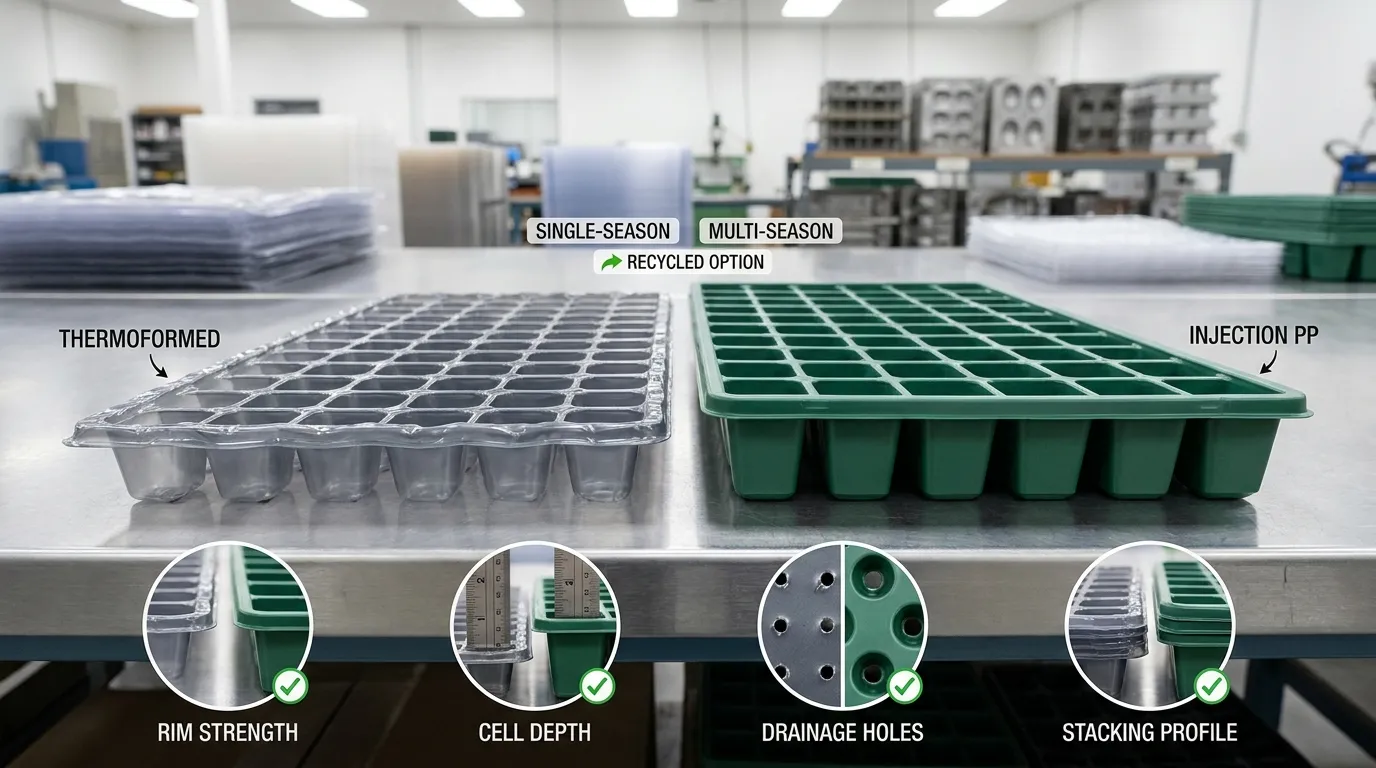
Different buyers need different tray grades. A discount retail kit does not need the same plastic structure as a commercial greenhouse tray. That is why we support both thermoformed trays and injection-molded PP trays.
Thermoformed seed starter trays are suitable for lightweight, cost-sensitive, high-volume orders. They are commonly used for seasonal retail packs, promotional gardening kits, and entry-level seed-starting products. Thermoforming allows efficient production for thin-wall trays, nested packing, and large container quantities.
Injection-molded PP seed starter trays are designed for stronger structure, better rigidity, and longer use cycles. They are a better choice for reusable seedling trays, nursery operations, greenhouse propagation, and buyers who want a higher-value product line. Injection PP trays can support more durable walls, stronger rims, better stacking strength, and a more premium feel.
For OEM projects, we help buyers compare both processes before mould investment or bulk production. The goal is not only to make the tray, but to choose the correct production method for your sales channel, customer expectation, container efficiency, and target durability grade.
Seed Starter Tray Sizes, Cell Counts and Depth Options
Common seed starter tray formats include small home-garden trays, 1020-compatible inserts, deep-cell propagation trays, plug trays, nursery seedling trays, and multi-cell kits with humidity domes. Buyers may request standard cell counts such as 6, 12, 24, 32, 40, 50, 72, 98, 105, 128, 162, 200, or 288 cells depending on market use.
For garden retail, lower cell counts are easier for beginners and often pair well with domes, base trays, grow lights, and heat mats. For nurseries and greenhouse propagation, higher cell counts help improve seedling density and reduce growing space per plant. Deep-cell trays are preferred for crops that require stronger root development before transplanting.
Important design points include:
- Overall tray length and width
- Cell count and cell spacing
- Cell depth and root volume
- Drainage hole size and position
- Rim strength and handling area
- Stacking height
- Dome and base-tray compatibility
- Labeling area or branding space
- Carton packing quantity
A small change in depth, rim shape, or plastic thickness can affect nesting, carton volume, shipping cost, and user experience. For bulk orders, these details should be confirmed during the sample stage before mass production.
Custom Seed Starter Tray Options
Garden Tools Wholesale supports OEM development for brands, wholesalers, distributors, and importers who need seed starter trays that fit their own product system. Customization can be based on existing moulds or new mould development, depending on the buyer’s target shape, order volume, and market positioning.
| Custom Item | Standard Option | OEM / Custom Option | Buyer Note |
|---|---|---|---|
| Cell count | Common plug tray formats | Custom cell layout, spacing, and count | Useful for branded kits or regional nursery standards |
| Cell depth | Standard shallow or medium cells | Deep-cell design for stronger root growth | Important for tomatoes, peppers, flowers, herbs, and nursery crops |
| Tray size | Standard garden tray dimensions | 1020-compatible or buyer-specific size | Confirm fit with domes, base trays, shelves, and cartons |
| Material thickness | Economy or standard thickness | Thicker walls, reinforced rim, stronger base | Affects durability, weight, cost, and container loading |
| Color | Black, green, or common stock colors | Custom color matching by order volume | Dark colors are common for seed starting and nursery use |
| Drainage | Standard drainage holes | Custom hole size, quantity, or position | Affects watering, root health, and soil retention |
| Surface finish | Standard plastic finish | Matte, textured, or smoother finish by mould design | Relevant for premium retail lines |
| Logo | No logo | Embossed logo, printed label, or packaging logo | Best for private-label garden brands |
| Packaging | Bulk carton packing | Retail sleeve, color box, sticker, barcode, master carton | Confirm sales channel before packing design |
| Mould | Existing mould | Private mould for exclusive design | Suitable for long-term OEM programs |
Material and Durability Grades
The right material depends on whether the tray is sold as a low-cost seasonal item, a reusable garden product, or a professional propagation tray. Buyers should not select material only by unit price. Thickness, rigidity, cold resistance, stacking strength, and long-term handling all affect customer satisfaction.
| Material / Grade | Process | Durability Level | Best Use | OEM Note |
|---|---|---|---|---|
| Lightweight thermoformed plastic | Thermoforming | Single-season or economy use | Retail seed-starting kits, promotional packs, budget garden lines | Good for high-volume container orders where cost and nesting matter |
| Standard thermoformed tray | Thermoforming | Seasonal to limited reuse | Home gardening, starter kits, e-commerce packs | Can balance price, thickness, and carton efficiency |
| Injection-molded PP | Injection molding | Multi-season reusable | Greenhouse, nursery, premium retail, heavy handling | Stronger rim and cell structure; suitable for higher-value product lines |
| Recycled PP blend | Injection molding or selected processes | Depends on blend and thickness | Eco-positioned garden supplies, distributor lines | Color consistency and strength should be confirmed by sample |
| Heavy-duty PP grade | Injection molding | Long-use commercial grade | Professional propagation and nursery handling | Best for buyers prioritizing durability over lowest price |
Recycled-material options can be discussed for buyers who want a more sustainable product range. The exact recycled content, color stability, flexibility, and strength should be tested through sample approval, because recycled blends may behave differently from virgin material during molding and use.
In-House Mould Development for Custom Cell Counts and Depths
For OEM seed starter tray projects, mould control is one of the most important sourcing factors. A tray mould determines cell shape, drainage, nesting, stacking, tray stiffness, and how well the tray works with other products.
Garden Tools Wholesale can support mould planning for:
- Custom cell count and tray layout
- Deep-cell propagation designs
- 1020-style tray inserts
- Reinforced rims and corners
- Custom drainage patterns
- Stackable tray geometry
- Compatibility with humidity domes and bottom trays
- Private-label tray designs
- Retail kit tray systems
Before opening a new mould, buyers should confirm the target market, target durability, expected annual order quantity, packaging style, and whether the tray must match existing accessories. A tray designed for a retail shelf may need different priorities from a tray designed for nursery workers who handle thousands of seedlings daily.
Production Capacity for Wholesale and Container Orders
Bulk seed starter tray sourcing requires stable production planning. Garden Tools Wholesale can arrange production based on tray type, material, mould availability, packaging requirements, and export schedule.
For standard stock moulds, production is generally easier to scale because the mould, dimensions, nesting method, and carton packing plan are already known. For custom moulds, the timeline includes design confirmation, mould development, sample testing, adjustment, production scheduling, and final packing.
Capacity planning should consider:
- Number of tray models in the order
- Standard mould or private mould
- Thermoformed or injection PP production
- Material color and thickness
- Custom packaging or plain bulk cartons
- Inspection requirements
- Container loading target
- Destination port and shipping window
For large programs, buyers can plan mixed-container orders with seed starter trays, humidity domes, base trays, heat mats, grow lights, labels, and other garden-supply accessories. This helps improve container utilization and gives distributors a more complete seasonal product range.
Quality Control for Seed Starter Tray Bulk Orders
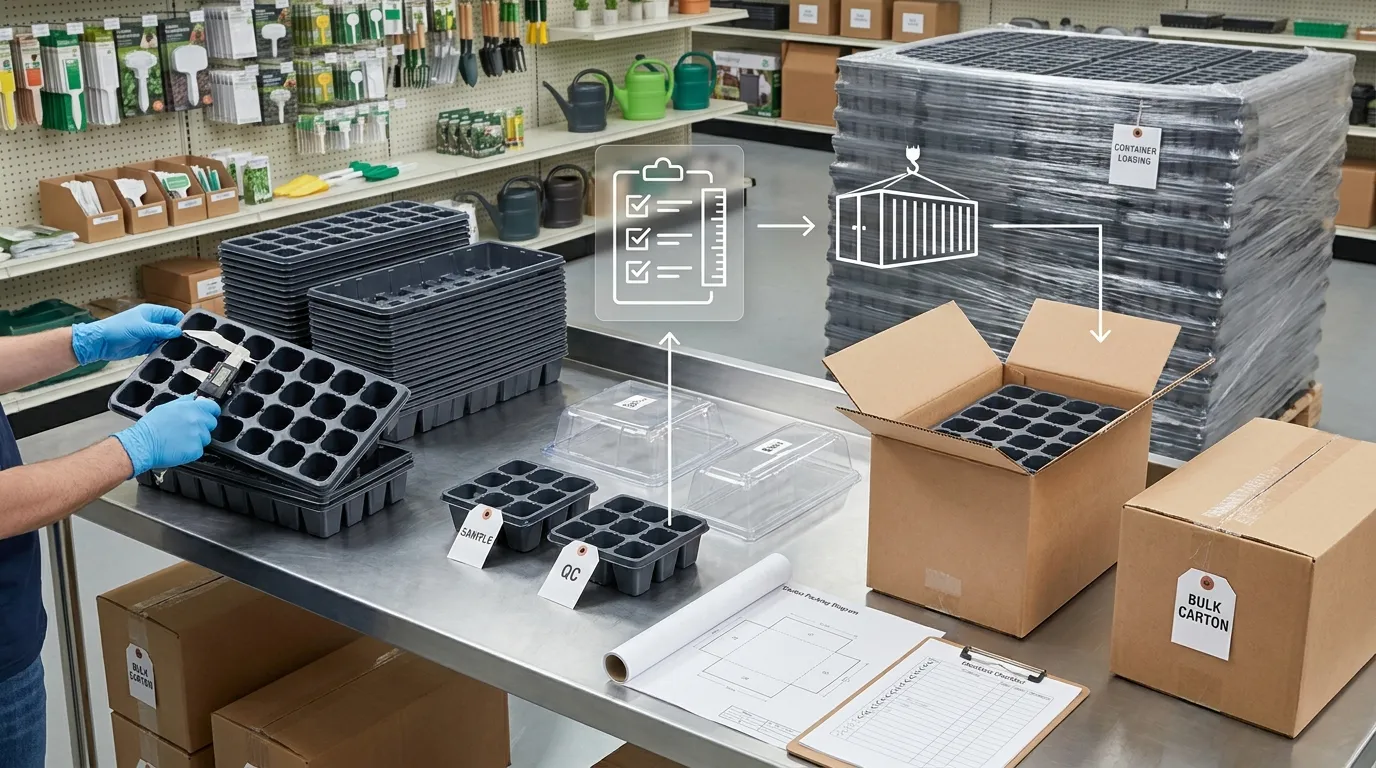
Seed starter trays look simple, but poor quality becomes obvious quickly during use. Thin corners, warped trays, weak cells, poor drainage holes, and unstable stacking can create complaints from retailers, growers, and end users.
Our QC focus includes:
- Raw material confirmation before production
- Tray size and cell count checking
- Wall thickness and weight consistency
- Cell depth and cell shape inspection
- Drainage hole position and cleanliness
- Rim strength and corner structure
- Stacking and nesting test
- Visual inspection for cracks, deformation, flash, or uneven forming
- Carton packing and quantity verification
- Export carton condition before loading
For injection PP trays, attention is placed on moulding stability, rim strength, cell consistency, and stacking performance. For thermoformed trays, QC focuses strongly on thickness distribution, cutting quality, drainage hole forming, and whether the tray can be nested without damage.
Sampling, MOQ and Order Confirmation
Samples help buyers avoid mistakes before placing a full container or private-label order. Garden Tools Wholesale can support sample review based on available tray models or custom development requirements.
A typical sourcing process includes:
- Buyer confirms target tray type, cell count, size, material, quantity, and market use.
- We recommend suitable standard moulds or discuss a custom mould option.
- Samples are prepared from available stock or pilot production where applicable.
- Buyer checks fit, thickness, cell depth, drainage, stacking, and packaging needs.
- Final specifications are confirmed for mass production.
- Production, QC, packing, and export preparation are arranged.
MOQ depends on tray model, material, color, production process, packaging, and whether a new mould is required. Stock trays usually allow more flexible order planning than custom-color, private-label, recycled-material, or private-mould projects. For accurate quotation, buyers should provide target quantity, tray size, desired thickness, packaging style, and destination port.
Private Label and Retail Packaging
For garden brands and importers, packaging is often as important as the tray itself. A seed starter tray may be sold as a single tray, a tray-and-dome set, a full seed-starting kit, or part of a seasonal gardening display.
Private-label options may include:
- Logo sticker
- Product label
- Barcode label
- Color sleeve
- Printed insert card
- Retail box
- Master carton mark
- Custom instruction sheet
- Bundle packing with dome, base tray, heat mat, or grow light
If the tray will be sold online, packaging should protect the corners and rim from compression. If it will be sold in garden centers, the retail presentation should make the cell count, tray size, and included accessories easy to understand. If it will be shipped in bulk to distributors, carton strength and container loading efficiency become more important.
Bulk Container Export and Packing
Seed starter trays are usually lightweight but bulky. Good packing design can reduce wasted container space and lower landed cost per tray. Nesting depth, rim design, tray height, carton size, and mixed-SKU loading all affect export efficiency.
For container export, we help buyers consider:
- Nested tray packing quantity
- Carton dimensions and carton strength
- Mixed cell-count loading plan
- Pallet or non-pallet shipment preference
- Master carton marks
- Loading sequence
- Accessories packed separately or together
- Destination warehouse handling requirements
Bulk packing is often best for distributors and greenhouse suppliers. Retail packaging is better for garden brands, e-commerce sellers, and chain-store programs. The best option depends on how the tray will be sold after import.
Build a Complete Seed-Starting Product Line
Many buyers source seed starter trays as part of a larger seed-starting range. A tray may need to match a humidity dome, waterproof heat mat, base tray, plant label set, or grow light kit. By planning these products together, buyers can improve compatibility and create stronger seasonal offers.
Garden Tools Wholesale can support sourcing for related products, including:
- Seed starting heat mats
- Waterproof seedling heat mats
- Seed starter tray grow light kits
- Seedling tray humidity domes
For private-label brands, this makes it easier to build a complete seed-starting kit instead of buying disconnected products from multiple suppliers.
What to Include in Your RFQ
To receive an accurate seed starter tray quote, please send as many details as possible. If you are not sure which specification is best, our team can recommend options based on your target market.
Useful RFQ details include:
- Required tray size
- Cell count
- Cell depth
- Material preference
- Single-season or multi-season use
- Thickness or target tray weight
- Color
- Drainage hole requirements
- Logo or private-label needs
- Bulk or retail packaging
- Estimated order quantity
- Destination country and port
- Whether you need matching domes, base trays, heat mats, or grow lights
The more complete the RFQ, the easier it is to recommend the right mould, material grade, MOQ, packing method, and production plan.
Why Source Seed Starter Trays from Garden Tools Wholesale?
Garden Tools Wholesale helps OEM buyers and wholesale importers reduce sourcing risk by focusing on the details that matter in bulk production. We support standard trays, custom moulds, thermoformed economy trays, injection PP reusable trays, recycled-material options, private-label packaging, and container export planning.
Our strength is practical manufacturing support for commercial buyers. We help you choose the correct tray grade, confirm sample details, control quality before shipment, and prepare packaging for your sales channel. Whether you need a simple bulk tray or a complete seed-starting product line, we can help develop a reliable supply plan for your market.
FAQ
Are you a seed starter tray factory or a trading company?
Garden Tools Wholesale works as a factory-direct OEM and wholesale supplier for seed starter trays and related garden-supply products. We support standard tray sourcing, custom mould development, private-label packaging, and bulk export orders.
What is the MOQ for wholesale seed starter trays?
MOQ depends on the tray model, material, color, production process, packaging, and whether the order uses an existing mould or a custom mould. Stock trays usually have more flexible MOQ than private-mould or custom-color orders.
Can I customize the cell count and tray depth?
Yes. We can support custom cell counts, tray depth, drainage design, tray size, rim structure, and stacking design based on mould feasibility and order volume. For unique designs, a private mould may be required.
Which is better: thermoformed trays or injection PP trays?
Thermoformed trays are usually better for lightweight, cost-sensitive, seasonal retail use. Injection PP trays are stronger and better for reusable, multi-season, nursery, greenhouse, and premium retail applications.
Do you offer recycled-material seed starter trays?
Yes, recycled-material options can be discussed for suitable projects. Buyers should confirm sample performance because recycled blends may affect color consistency, flexibility, strength, and long-term durability.
Can you supply seed starter trays with humidity domes and heat mats?
Yes. We can help buyers build complete seed-starting product lines with trays, humidity domes, base trays, waterproof seedling heat mats, grow lights, and retail packaging for private-label or wholesale distribution.