






Updated 1 month ago
Garden Trowel Handle Materials: Wood, TPR, Plastic and Fiberglass Compared
SCARECROW GARDEN SUPPLIER
When sourcing garden trowels, most buyers focus on the blade. Steel grade, thickness, bend resistance — these are the specs that show up on quote sheets and the details that buyers know to verify. But the handle is half the product, and even a good blade cannot compensate for a weak handle connection.
The four main handle material categories you will encounter when sourcing garden trowels — what each one offers, where it falls short, and what to verify before approving a sample.
Why the Handle Matters as Much as the Blade
Think about how a trowel is used. The operator pushes the blade into soil, leverages the handle to pry, and grips it repeatedly during transplanting. Every force the blade encounters is transferred through the handle. If the handle flexes excessively, the blade loses cutting efficiency. If the connection between handle and blade is weak, the handle loosens or separates under load.
Handle material also affects the end user’s experience. A handle that becomes slippery when wet, cracks after one season, or causes blisters during extended use will generate negative reviews — regardless of blade quality. For B2B buyers, handle quality is a predictor of return rates and warranty claims.
Handle diameter also matters. When evaluating a sample, measure the handle diameter — it is a simple check that many buyers overlook. Comfort during extended use depends on handle diameter, grip material, and the user’s hand size.
Wood Handles: Classic, Comfortable, and Vulnerable
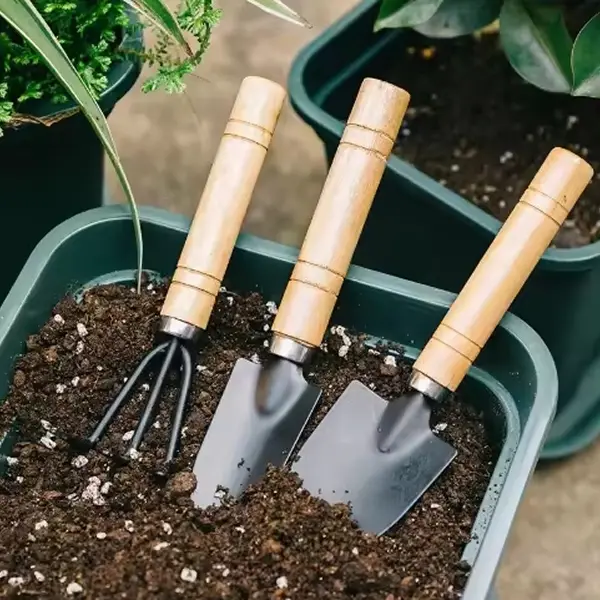
Wood is the traditional trowel handle material, and it remains common in supplier offerings. Ash wood is a frequently specified species, often labeled as “hard wood handle” or “first-grade ash wood handle” on supplier product pages.
Wood handles offer natural shock absorption and a warm feel that many gardeners prefer. But wood has well-documented vulnerabilities:
- Moisture absorption: Wood absorbs water, which can cause swelling, warping, and eventually cracking. A handle that performs well in dry conditions may fail after a season of wet-soil use.
- Loosening at the connection: As wood absorbs and releases moisture, it expands and contracts. This cycle can loosen the handle-to-blade joint over time.
- Surface degradation: Untreated or poorly finished wood can splinter, creating both a comfort problem and a safety concern.
When evaluating a wood-handled trowel, ask the supplier:
- What wood species is used? (Various species may be offered — each has different strength and moisture characteristics. Species examples are supplier-specific, not industry-standard choices)
- What is the moisture content at the time of assembly? (High moisture content at assembly means the handle will shrink and loosen over time)
- What surface treatment is applied? (Varnish, oil, or lacquer — and how many coats)
- Is the grain orientation correct? (Straight grain along the handle length provides strength; cross-grain or knots are failure points)
TPR and Rubberized Grips: Cost-Effective but Aging Risks Apply
Thermoplastic rubber (TPR) grips are increasingly common on garden trowels, often applied as an overmold on a metal or plastic core. Suppliers may use terms like TPR, TPE (thermoplastic elastomer), or “rubberized grip” — these are not necessarily the same material. Buyers should ask the supplier for the actual material name, hardness (Shore A), and overmold structure rather than assuming all “rubberized” grips use the same compound.
TPR handles offer practical advantages for the price point:
- Slip resistance: TPR provides better grip than bare wood or metal, especially when wet
- Comfort: The rubberized surface cushions the hand during repeated use
- Cost efficiency: Overmolded TPR may be cost-effective to produce compared to turned wood or fiberglass, depending on the supplier and production volume
The overmolding process itself matters for durability. Overmolding may involve inserting a metal or plastic core into a mold and injecting TPR around it. The bond between the TPR and the core may rely on mechanical interlock, adhesion, or compatible materials depending on the design — overmolding is not the same as two-shot molding, and a chemical bond is not guaranteed in all designs. If you see a TPR grip peeling at the edges, the overmold process or material compatibility was not properly controlled.
But TPR has aging characteristics that buyers should understand:
- UV degradation: Prolonged UV exposure may cause TPR to harden, crack, or lose its elastic properties depending on the formulation and stabilizer package. A handle that feels great out of the box may become stiff after outdoor storage — verify with the supplier or through aging tests.
- Overmold bonding: The bond between TPR and the core material can fail if the overmold process is not properly controlled. Check for peeling or separation at the interface.
- Color stability: Some TPR compounds fade or discolor with UV exposure, which affects the retail appearance even if function is unaffected.
When inspecting a TPR-handled sample, try to flex the grip aggressively and check for any separation from the core. Run your fingernail along the overmold seam — a well-bonded overmold should show no lifting.
Fiberglass and Metal-Core: Strength Claims Need Verification
Fiberglass and metal-core handles may be offered as options with different strength and weather-resistance characteristics. These are material properties — not automatic quality tiers. Actual performance depends on the specific construction, wall thickness, resin or steel grade, and the handle-to-blade connection.
What we can say about these materials:
Fiberglass:
- High strength-to-weight ratio
- Does not absorb moisture, so it will not swell, warp, or rot
- Does not splinter like wood
- Resistant to UV, though prolonged exposure can eventually degrade the resin matrix
In the absence of published performance data, request supplier test reports or conduct your own bend and impact tests on samples — the handle-to-blade connection is where you will see the difference first.
Metal-core (typically steel):
- Very high strength and rigidity
- Will not flex excessively under load
- Heavier than wood or fiberglass
- Can corrode if the coating is damaged
The key point: fiberglass and metal-core handles are only as good as the grip applied over them. A fiberglass core with a poorly bonded TPR overmold gives you a strong core with a grip that peels off. A steel core with no cushioning layer is strong but uncomfortable for extended use. Do not assume that a premium core material automatically means a better handle system.
Handle Material Quick Reference
| Material | Common Use | Main Risk |
| Wood (ash, beech) | Traditional/rustic positioning; garden centres | Moisture absorption, loosening, splintering |
| TPR overmold | Mass-market retail; e-commerce | UV degradation, overmold separation |
| Fiberglass | Professional/premium positioning | Limited public performance data; resin degradation long-term |
| Metal-core (steel) | Heavy-duty/professional use | Corrosion if coating damaged; heavier weight |
The Handle-to-Blade Connection: A Key Area to Inspect
The handle material matters, but the connection between the handle and the blade is a critical area to inspect. This connection — typically a tang-and-ferrule, a socket, or a welded joint — takes the full force of every digging and prying motion.
Common failure modes:
- Tang loosening: On tang-and-ferrule construction, the tang (the blade’s extension into the handle) can loosen if the ferrule crimps or the adhesive fails. This can be a common failure area.
- Socket cracking: On socket construction, where the handle fits into a socket on the blade, the socket wall can crack under leverage force if it is too thin.
- Weld failure: On welded connections, the weld can crack at the heat-affected zone if welding parameters are not properly controlled.
When you inspect a sample, grip the handle and the blade separately, then apply twisting and pulling force. Compare the movement against your approved sample or buyer-defined test load and design requirement — do not assume “zero movement” is the universal pass criterion for all designs.
Buyer Verification Checklist: Trowel Handle System
| Inspection Point | Wood | TPR/Rubberized | Fiberglass | Metal-Core |
| Material identification | Confirm species; check grain orientation | Confirm TPR/TPE compound; check overmold bond | Confirm fiberglass core; check resin quality | Confirm steel core; check coating integrity |
| Surface condition | Check for splinters, cracks, finish quality | Check for peeling, bubbles, discoloration | Check for surface cracks, fiber exposure | Check for rust, coating chips |
| Handle-to-blade connection | Twist and pull; check for play | Same | Same | Same |
| Grip when wet | Wet hands and grip; note slipperiness | Same | Same | Same |
| Flex under load | Push blade against surface; note handle flex | Same | Same | Same |
| Weight and balance | Weigh the complete tool; note balance point | Same | Same | Same |
| UV aging indicators | Ask supplier about UV testing data | Ask about UV stability of TPR compound | Ask about resin UV resistance | Check coating UV resistance |
| Repeated use simulation | Perform 20+ digging motions; check for loosening | Same | Same | Same |
| Replacement availability | Can handle be purchased separately? | Same | Same | Same |
Before committing to an order:
- Define your trowel specifications and target price point — blade material, handle type, and quality tier.
- Request a handle and connection evaluation — use the checklist above to compare trowels from multiple suppliers.
- Request a wet-use and repeated-use test — handle issues may appear only after extended use or wet conditions.
Explore Garden Trowel Options
Compare trowel handle materials, blade construction and sample-check details before selecting models for your market.
View Wholesale Garden TrowelsResearch Notes
- Handle material properties (wood moisture absorption, TPR UV degradation, fiberglass strength) are based on general material science. Specific performance for garden trowel applications depends on the manufacturer’s formulation, process, and quality control. Public performance data for garden trowel handles specifically is limited.
- The “20+ digging motions” in the inspection checklist is an internal sample check count, not a standardized durability test. Buyers should define their own test parameters based on expected use conditions.