








Garden Tool Market Trends and Consumer Preferences in Europe and America for 2026
Verified market signals, product opportunities, compliance risks, and sourcing actions for wholesalers, distributors, retailers, and garden brands.
The 2026 garden tool market is not a simple story of across-the-board growth. In the United States, total lawn and garden spending reached a record high — yet the number of participating households declined. In the UK, garden retail shows resilience, but monthly sales swing with weather and cautious consumer sentiment. Among the key gardening trends 2026 has brought so far, battery-powered tools, boundary-wire-free robotic mowers, water-saving irrigation, and repairable product design continue to gain ground — while Europe enters a new phase of enforcement on packaging, battery, repairability, and product safety rules.
Understanding these garden tool market trends for 2026 is not about chasing growth numbers. It is about identifying which trends can be turned into products that fit your channel, your price tier, and your compliance capacity — and which ones carry risks you need to verify before placing an order.
This article converts verifiable market signals into sourcing decisions. It covers 10 product trends shaping the 2026 gardening landscape, a Europe vs. North America comparison, a product opportunity matrix, a compliance checklist, and a buying calendar — all written for buyers sourcing wholesale garden tools for distribution, retail, and e-commerce channels.
Quick Answer: 2026 Market Snapshot
| Trend | Market Signal | Convertible Products | Buyer Action |
| Battery & cordless | Battery share continues to rise in major tool portfolios; STIHL reached 28% in FY2025. | Cordless pruners, trimmers, blowers, mower accessories, battery/charger kits. | Verify cells, BMS, run time, charger compatibility, transport docs, and certifications. |
| Robotic mowing | Boundary-wire-free systems expand rapidly; China-based brands account for roughly 40% of global robotic mower shipments (industry estimates). | Robotic mowers, garage covers, replacement blades, installation accessories. | Do not summarize with a single growth rate; differentiate professional vs. residential segments and technology routes. |
| Water efficiency | Climate pressure and measurable water savings support smart irrigation; EPA WaterSense-labeled controllers can reduce household irrigation by up to 30%. | Timers, drip kits, moisture sensors, connectors, hose reels. | Check flow rate, pressure rating, UV resistance, thread standards, and waterproof rating. |
| Ergonomics | Ageing populations make weight, grip, and reach commercially relevant; 22% of EU population is 65+. | Lightweight/telescopic tools, kneelers, raised beds, easy-grip pruners. | “Ergonomic” claims must be backed by structural design or test data. |
| Propagation & edible gardening | 64% of surveyed US gardeners plan to plant more in 2026; 59% of Canadian households already grow food. | Seed trays, domes, heat mats, grow lights, plant supports, grow bags. | Distinguish consumer intention from tool sales data. |
| Repairability & compliance | EU repair, battery, packaging, and general safety rules affect product design and documentation from 2024–2026. | Spare parts, modular components, replaceable batteries, compliant packaging. | Confirm per product and market; do not write generic legal conclusions. |
This table highlights the six trends with the broadest product implications. Trends 6–10 (compact tools, climate-resilient products, propagation deep-dive, sustainability & packaging, and retail-ready kits) are covered in detail in their respective sections below — giving you a complete view of the garden products buyers should stock for 2026.
Spending hours comparing models across supplier websites, still unsure which specs match your market? Send us your target market, current product list, and price range — we’ll prepare a 2026 product shortlist with model numbers, specs, and wholesale pricing — Get Product Models & Quotes
What Changed Since 2025?
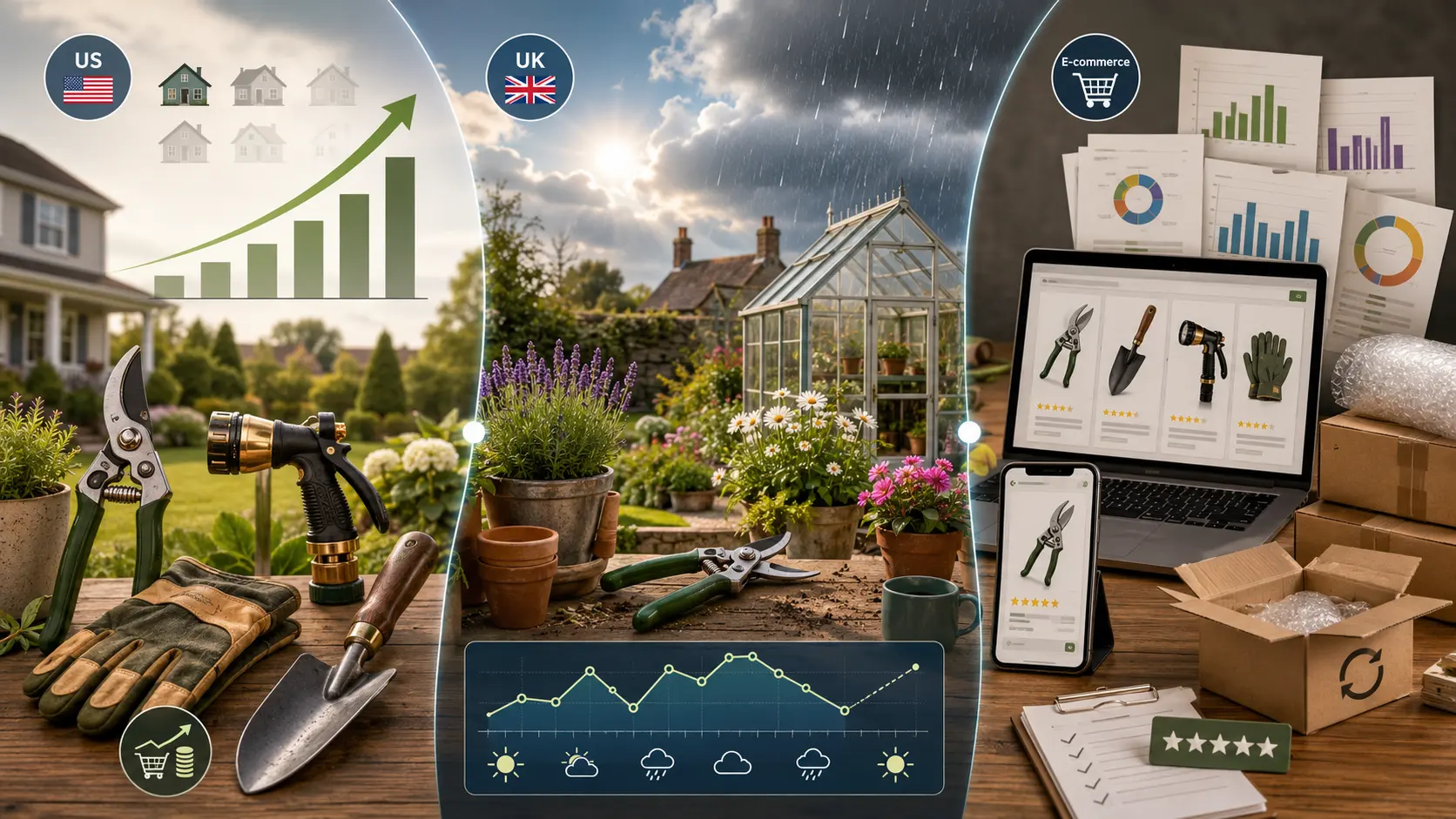
United States: Higher Spending, Fewer Gardeners
The 2025 National Gardening Survey (Garden Research) reports that US lawn and garden expenditure reached approximately $77 billion, up 13.5% year over year. Average household spending rose 18.3% to$740. But participation dropped from 84.1% to 79.2% — roughly 4.5 million households left the activity.
What this means for buyers in the US garden tool market: growth is not expanding uniformly. It is concentrated among higher-engagement, higher-spend households. Low-price, low-differentiation products face shrinking demand from casual participants. Product selection should favor upgrade-worthy tools, serviceable items, and combinations that increase average transaction value — not just more SKUs at the bottom of the price range.
Important caveat: The approximately $77 billion figure covers the broad “lawn and garden market,” which includes plants, services, and other consumer spending beyond tools. The 13.5% increase is in nominal terms and reflects cumulative inflation since 2019. It should not be quoted as a direct measure of garden tool sales growth.
United Kingdom: Resilient but Weather-Sensitive
The Horticultural Trades Association (HTA) reports that UK households spent approximately £9 billion on retail garden products in 2025. Seventy-seven percent of UK adults have access to a private garden — about 44 million people — and 58% of those use their garden for planting.
Monthly data tells a more cautious story. HTA’s May 2026 Market Update shows total sales down 1% versus an unusually strong May 2025, but up 5% versus May 2024. Garden tools and equipment grew 8% year over year in July 2025, and were up 15% year-to-date versus 2024 (HTA August 2025 Update). Category composition matters: in the monitored sample, plants/bulbs/seeds accounted for 38%, garden care & maintenance 12%, outdoor living 11%, and containers & structures 9%.
For buyers, this means: UK garden retail is structurally sound but month-to-month volatile. Tools must be understood within the full garden spending basket — a pruner sells alongside the rose it trims. Cross-merchandising, seasonal bundles, and weather-responsive reordering matter more than a single annual forecast.
E-Commerce: A Channel Reality, Not a Garden-Tool Statistic
US Census data shows Q1 2026 retail e-commerce sales up 9.8% year over year, reaching 16.9% of total retail. Eurostat reports 78% of EU internet users made online purchases in 2025, up from 62% in 2015.
These figures describe the channel environment, not garden tool online sales specifically. The practical implication for buyers: every product you source must work in a digital selling context. That means manageable shipping dimensions, photograph- and video-friendly design, clear instruction materials, packaging that survives parcel handling, and a plan for managing reviews and returns.
Why Market-Size Estimates Conflict
Published estimates of the “global garden tools market” for 2026 range from approximately $9.8 billion to over$126 billion, with hand-tool-only estimates exceeding $20 billion. The gap is not an error — it reflects fundamentally different product scopes. Some reports count only hand tools; others include outdoor power equipment, irrigation, garden retail, services, or even plants and landscaping.
This article does not use a single market-size figure. Instead, it relies on verifiable signals: government consumer surveys, retail association data, company financial reports, regulatory texts, and customs statistics. When a number appears, its source, scope, year, and geographic coverage are stated.
Trend 1 — Battery Platforms Are Reshaping Tool Portfolios
What the Data Shows
STIHL’s FY2025 results report group revenue of €5.48 billion, with battery-powered products reaching 28% of sales — up from 25% the prior year. This is one brand’s portfolio, not a market share figure, but it signals the direction: across garden equipment market trends, battery tools are moving from a niche to a core category.
China’s customs data reinforces the shift from the supply side. In 2025, China’s garden machinery exports (including chainsaws, lawn mowers, and related equipment and accessories) reached $4.88 billion (approximately 48.82 billion yuan), up 16.17% year over year — well above the 4.5% growth of the broader forestry machinery category. Lawn mower exports alone hit approximately 13.2 billion yuan (~$1.8 billion) in the first seven months of 2025, up 56.6% year over year (HS code 84331100, which includes traditional walk-behind and ride-on mowers alongside robotic units). The outperformance of garden machinery suggests that battery-driven and smart products are pulling the export mix upward.
What This Means for Product Selection
Battery platform strategy matters more than individual tool specs. Buyers should think in systems:
- Cross-tool battery compatibility: A customer who buys a cordless pruner is more likely to return for a string trimmer or blower on the same battery platform. Stocking a coherent battery family increases repeat purchase potential — and that logic applies whether you carry wholesale string trimmers or cordless blowers.
- Charger and accessory kits: Spare batteries, multi-voltage chargers, and storage cases are high-margin add-ons with low return risk.
- Aftermarket battery availability: EU Battery Regulation (EU) 2023/1542 increasingly requires that batteries be replaceable by end users. Products designed around sealed, non-replaceable cells face growing compliance risk — though a proposed EU Commission exemption (as of mid-July 2026, not yet formally adopted) may allow professional replacement for certain product categories (including some cordless garden tools with integrated batteries under 2.5 kg). Confirm your product’s status.
What to Verify Before Ordering
| Check Item | Why It Matters |
| Cell brand and origin | Affects consistency, safety, and recall traceability |
| BMS (Battery Management System) | Prevents overcharge, over-discharge, and thermal runaway |
| UN38.3 test report | Required for all lithium battery transport — air, sea, and road |
| Charger certifications | CE/GS for EU, UL/ETL for US, PSE for Japan — each market has its own |
| Run-time claims vs. test data | Verify that “2-hour run time” is measured under load, not standby |
| Transport documentation | MSDS, dangerous goods packing certificate, and shipping classification |
Safety lesson from the market: In 2025, CPSC recalled specific RYOBI battery-powered mowers due to fire hazard and RYOBI 40V cordless hedge trimmers due to blade-start risk. For buyers sourcing wholesale hedge trimmers, these recalls are not a statement about the brand overall — they illustrate why thermal management, switch design, battery contact integrity, and batch traceability must be verified for every model you stock, not just the sample.
For a deeper look at battery-powered garden tools, see Battery-Powered Garden Tools Wholesale 2026.
Trend 2 — Robotic & Boundary-Wire-Free Mowing: Fast Growth, Fragmented Market
For buyers sourcing wholesale lawn mowers, the robotic segment is where the most dramatic change is happening — but traditional walk-behind and ride-on units still dominate revenue. Understanding both is essential.
The Numbers — and Their Limits
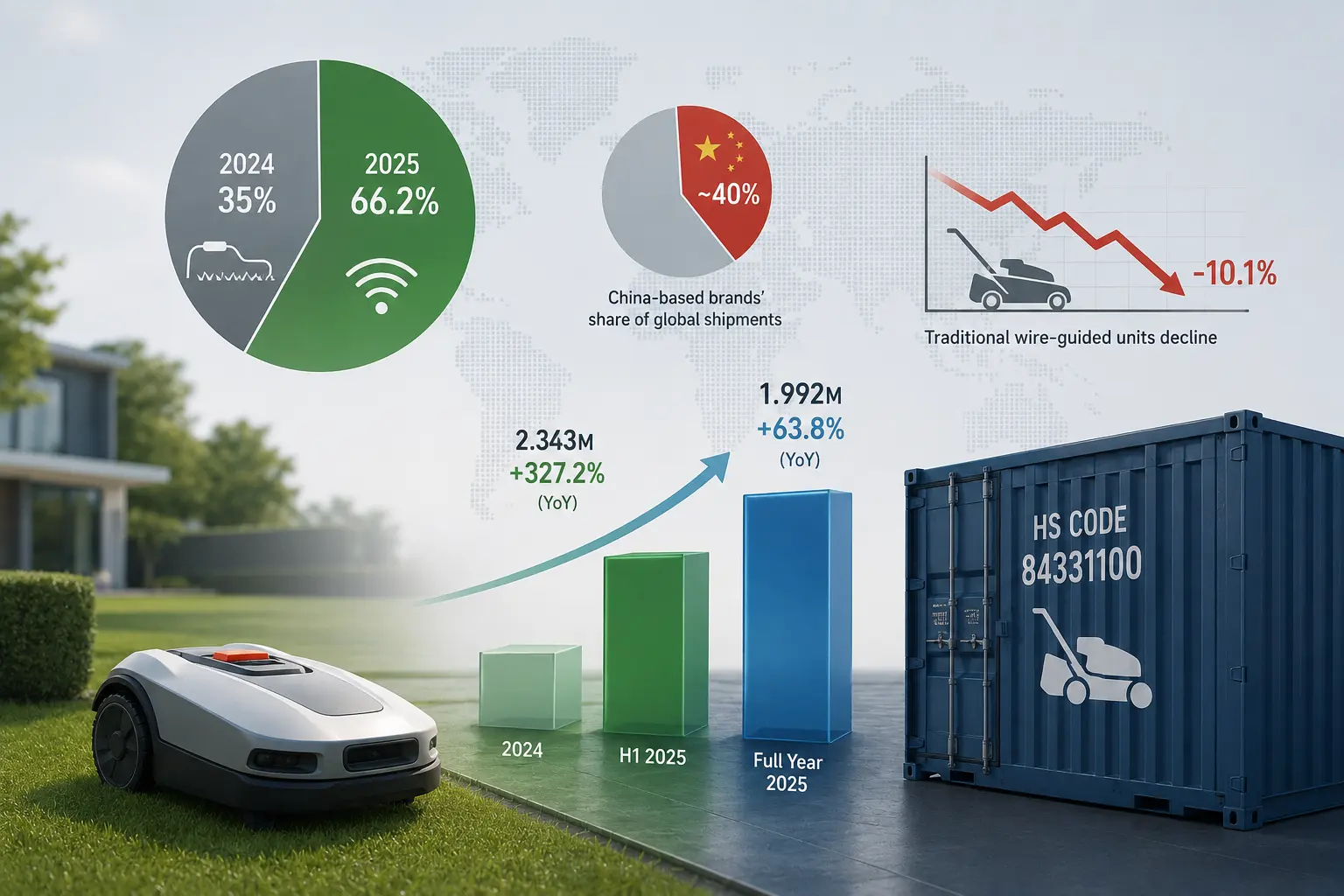
According to IDC data (as reported by industry sources), 2.343 million robotic mower units were shipped globally in H1 2025, up 327.2% year over year. Full-year 2025 data shows 1.992 million units, up 63.8% — a more stable figure after the low-base surge in H1. Boundary-wire-free models rose from 35% of shipments in 2024 to approximately 66.2% in the full-year 2025 data, while traditional wire-guided units declined 10.1%. China-based brands now account for roughly 40% of global robotic mower shipments, according to industry estimates.
These are striking figures, but they require context:
- The 327% H1 growth rate measures unit shipments, not revenue. A surge in lower-priced models can inflate unit counts without proportional revenue impact.
- The full-year 63.8% growth is more representative of the sustained trajectory. The full-year figure reflects IDC’s revised methodology and is not a simple sum of H1 and H2 shipments.
- “China-based brands” includes both domestic-market and export-oriented manufacturers. The share varies significantly by region and price tier.
- Customs HS code 84331100 (“lawn mowers”) includes traditional walk-behind and ride-on mowers, not just robotic units.
Technology Routes Are Diverging
The robotic mower market is not monolithic. Different navigation technologies suit different end-user scenarios — and different price tiers:
| Technology | How It Works | Best For | Limitation | Approximate Retail Price Tier |
| RTK satellite positioning | Satellite signal + base station, cm-level accuracy | Large open lawns, professional landscaping | Signal blocked by trees, buildings; unstable in remote areas | $800–1,500 |
| RTK + vision fusion | RTK positioning + camera-based obstacle avoidance | Mixed environments needing both precision and obstacle detection | Higher component cost | $1,200–2,000 |
| LiDAR + AI | 3D environment scanning + AI path planning | Complex terrain, precise obstacle avoidance | Highest cost; significant technical barrier | $2,000+ |
| Pure vision | Panoramic cameras interpret the environment | Cost-sensitive residential market | Precision and reliability still being validated | $500–900 |
Price tier affects which channel and customer segment the product fits. A $500 pure-vision mower sells through e-commerce and garden centers to residential users. A$2,000+ LiDAR unit targets professional installers and specialist dealers. Matching technology, price, and channel is the first selection decision — not just picking the cheapest option.
China’s Robotic Mower Supply Chain: A Rapidly Consolidating Landscape
China’s robotic mower industry is moving fast — and the competitive landscape matters for buyers evaluating which brands to stock.
Segway Navimow (Ninebot) has produced over 1 million units cumulatively and ranked first in global boundary-wire-free retail sales for two consecutive years. It topped Amazon Best Seller lists in six countries during Prime Day 2025 and has secured placement with Lowe’s in North America — a signal that China-based brands are moving from online-only to mainstream retail channels.
Other notable China-based entrants are differentiated primarily by navigation technology and channel strategy:
| Brand | Technology Route | Key Differentiator | Channel Status |
| LUBA (Mammotion) | RTK + vision | Large-area RTK positioning | USL partnership; North America focus |
| Dreame | RTK + vision | Mid-size lawn European models | Europe-focused launch |
| MOVA | 3D LiDAR (Hesai) | No positioning poles; light-independent | New entrant |
| Daye (大叶股份) | Vision algorithm | Grass-texture recognition; 97%+ overseas revenue (2024 annual report) | 70+ country distribution |
| Greenworks (格力博) | Lithium platform + AI | Commercial-grade OptimusZ; cross-tool battery ecosystem | Established global retail |
For buyers, the implication is clear: the robotic mower supply center is shifting toward China-based manufacturers, but the technology is still diverging. Brand concentration, software maturity, after-sales support infrastructure, and intellectual property position all matter — and they vary more than in traditional hand tools.
What to Stock Beyond the Mower
Robotic mowers generate accessory and service revenue:
- Replacement blades (consumable, recurring demand)
- Garage covers and weather shields
- Installation kits and boundary markers (for transitional models)
- Anti-theft locks and GPS trackers
- Seasonal maintenance kits
Trend 3 — Water-Saving & Smart Irrigation: Quantifiable Value
The Case for Water Efficiency
US EPA WaterSense reports that replacing a clock-type controller with a WaterSense-labeled irrigation controller can reduce household irrigation water use by up to 30%, saving up to approximately 15,000 gallons per year. Outdoor water use accounts for more than 30% of total household water use on average — and exceeds 60% in arid regions.
These figures are specific to the US and to products meeting the WaterSense label criteria. They should not be applied to arbitrary products or other markets without qualification. But the underlying logic — that smarter irrigation control delivers measurable savings — holds broadly and supports the product category.
Product Opportunities
| Product | Key Selling Point | Primary Market |
| Smart irrigation controllers | Programmable, app-connected, weather-responsive | US suburban, EU urban residential |
| Drip irrigation kits | Targeted watering, low flow, reduced waste | Arid regions, container/raised-bed gardeners |
| Soil moisture sensors | Data-driven watering, prevent over- and under-watering | Tech-oriented gardeners, professional landscapers |
| Hose-end timers | Simple automation at low price point | Entry-level market, garden centers |
| Wholesale garden hoses and hose reels | Flexible, kink-resistant options for every market; auto-retract reels add convenience | Broad retail, e-commerce |
| Connectors and adapters | Compatibility across hose and tap standards | Universal; region-specific thread types |
What to Verify
- Thread standards: US garden hose threads (GHT) differ from EU/UK BSP standards. A connector that fits a US tap will not fit a UK outdoor tap without an adapter. Verify thread type per target market.
- Pressure rating: Drip systems operate at low pressure; connectors and timers must be rated for the intended supply pressure. Overpressure causes leaks and premature failure.
- UV resistance: Plastic components in timers, connectors, and drip lines degrade under prolonged sun exposure. Request UV-stabilized material specifications.
- Waterproof rating: “Waterproof” on a product listing is not the same as a tested IP rating. Ask for the specific IP classification and its test conditions.
- Winter drainage: In cold-climate markets, above-ground components must be drainable or frost-resistant. This affects product design, packaging instructions, and return rates.
Choosing between timer brands or connector materials? Send us your target market and product categories — we’ll prepare comparison videos showing flow-rate tests and thread-compatibility demos across suppliers — Request Watering Product Comparison Videos
Trend 4 — Climate-Resilient Gardening Products
The Demand Logic
The European Environment Agency identifies more frequent and severe floods, droughts, and heatwaves as key climate adaptation priorities for Europe. Climate-ADAPT notes that drought-tolerant planting can reduce irrigation demand. These are macro-level risk assessments, not SKU-level sales forecasts. No responsible analysis should claim that “heatwaves will increase sales of product X by Y%.”
But the demand logic is sound: gardeners experiencing extreme weather need products that help plants survive it. This creates sourcing opportunities in several categories:
| Climate Challenge | Product Category | Examples |
| Heatwaves | Shade and cooling | Shade nets, greenhouse ventilation, sun cloths |
| Drought | Water retention | Mulch mats, water-retaining granules, self-watering planters, rain barrels |
| Heavy rain / flooding | Drainage and protection | Drainage grids, raised bed systems, flood barriers |
| Late frost | Frost protection | Fleece covers, cloches, frost blankets, cold frames |
| General resilience | Monitoring and shelter | Soil moisture meters, wholesale mini greenhouses, propagation domes |
Sourcing Considerations
- Material durability matters more than in normal-season products: A shade net that degrades after one summer defeats the purpose. Verify fabric weight (g/m²), UV stabilization, and expected lifespan.
- Seasonal procurement timing is critical: Frost protection products must arrive before the last frost date; shade products before peak summer. Work backward from the selling season to set order deadlines (see Buying Calendar section).
- Regional specificity: Drought-resilient products sell well in Mediterranean and arid US regions but are less relevant in cool, wet climates. Stock allocation should match your customer geography.
Trend 5 — Ergonomic & Accessible Tools: A Specification, Not a Slogan
The Demographic Driver
As of January 2025, 22.0% of the EU population is aged 65 or older, with a median age of 44.9 years (Eurostat). The US Census Bureau reports a similar trajectory, with adults 65+ now outnumbering children under 18. These are population statistics, not gardening participation rates — ageing does not automatically mean more older gardeners. But the demographic trend increases the commercial relevance of tools designed to reduce physical strain.
What “Ergonomic” Should Mean in a Product Specification
The word “ergonomic” appears on countless product listings. For buyers, it should translate into specific, verifiable design features:
| Feature | What to Look For | What to Ask |
| Weight reduction | Actual tool weight in grams; comparison to standard model | “Is this weight measured with or without the battery?” |
| Grip design | Handle diameter, material (TPR, EVA, cork), contour shape | “Do you have grip-pressure or hand-fatigue test data?” |
| Telescopic / extendable handles | Locking mechanism type, extended length, weight at full extension | “Does the lock hold under load? What is the failure rate?” |
| Shock absorption | Spring or buffer mechanism in loppers and pruners | “How many cycles has the spring been tested for?” |
| Reduced vibration | In powered tools — handle isolation, counterweight | “Is there a vibration emission value (m/s²) per EN 62841 series or equivalent?” |
| Elevated planting | Raised beds, standing-height planters, vertical gardens | “Load capacity at maximum soil volume? Drainage provisions?” |
Buyer reminder: An “ergonomic” claim without supporting specification or test data is a marketing label, not a product attribute. If the factory cannot provide weight, grip diameter, or test results, the claim cannot be verified — and unverified claims become return risks and compliance liabilities under EU GPSR.
Product Opportunities
For buyers evaluating wholesale pruning tools, the ergonomic segment offers several entry points:
- Lightweight pruners and loppers (aluminum or composite handles vs. steel)
- Telescopic hedge shears and pruning saws
- Ratcheting pruners for reduced hand force
- Kneelers, garden seats, and rolling work stools
- Raised garden beds (metal, wood-composite, or fabric)
- Two-wheeled garden carts with ergonomic handles
Not every buyer serves large properties or ageing customers — the next trend addresses the opposite end of the spectrum.
Trend 6 — Compact & Multi-Use Tools for Small Spaces
The Shelf-Space Problem
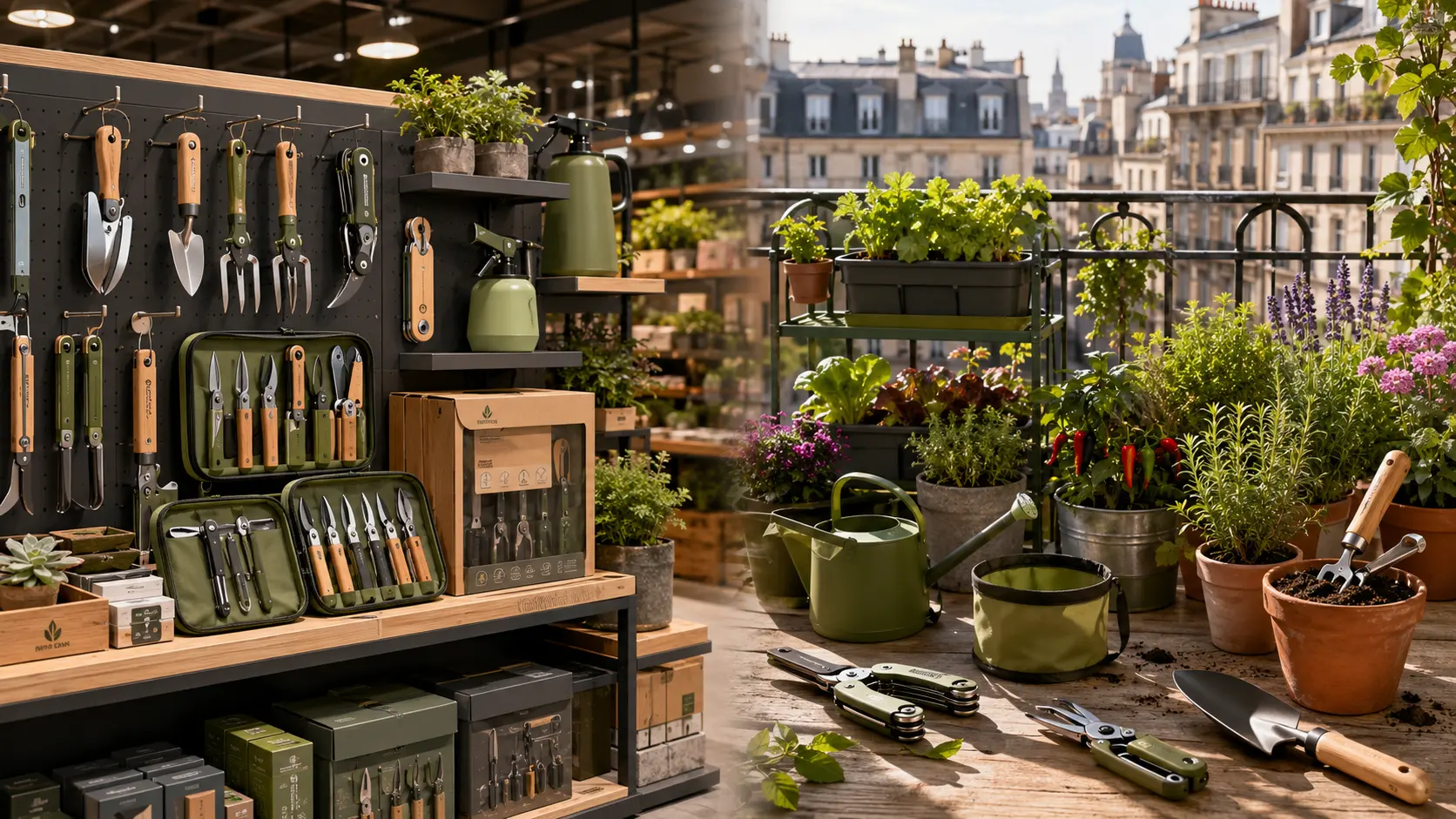
A garden center in Amsterdam stocks 200 SKUs in 40 m² of tool display space. Every product that does not earn its shelf area is a cost — in rent, in inventory carrying, in the opportunity cost of something that would sell faster. Compact and multi-use tools solve this problem: they take less space, serve multiple purposes, and appeal to the growing urban and balcony gardening segment.
Urban gardening, balcony planting, and container growing are real trends, especially in dense European and North American cities. The Axiom 2026 Gardening Outlook reports strong interest in expanding planting among surveyed US gardeners, and small-space solutions are a natural extension.
However, “small-space gardening” is a scene opportunity, not a uniform European preference. A balcony gardener in Berlin has different needs from a suburban homeowner in Dallas with a courtyard. Product selection should be targeted, not assumed.
Products That Serve This Segment
| Product | Why It Fits | Channel Fit |
| Folding pruning saws | Compact storage, safe carry | E-commerce, garden centers, camping/outdoor crossover |
| Narrow-head trowels and cultivators | Work in tight containers and window boxes | Garden centers, garden trowel wholesale buyers |
| Balcony watering kits | Drip systems sized for 3–10 pots | E-commerce, urban retail |
| Vertical planters and wall gardens | Maximize vertical space | Home décor crossover, e-commerce |
| Multi-tool garden sets (3-in-1, 5-in-1) | Gift appeal, low entry price | Gift market, garden center impulse displays |
| Collapsible watering cans and buckets | Easy storage in apartments | E-commerce, home organization retail |
Sourcing Risk: Over-Promising Versatility
Multi-use tools often compromise on each individual function. A 5-in-1 tool that does nothing well generates returns and negative reviews. Before stocking:
- Test each function independently: Does the trowel actually dig? Does the cultivator actually cultivate?
- Check joint durability: Folding and telescoping mechanisms are the most common failure points.
- Read existing customer reviews on similar products: Complaints about “flimsy” or “gimmick” are early warnings.
Trend 7 — Propagation, Edible Gardening & Soil-Health Products
Signals Supporting the Category
- The Axiom 2026 Gardening Outlook reports 64% of surveyed US gardeners plan to plant more or expand their garden in 2026.
- Statistics Canada reports 59% of Canadian households grew fruits, herbs, vegetables, or flowers in 2023.
- The RHS 2026 gardening predictions highlight edible planting and resilient varieties; their retail data shows tomato variety sales rising in 2025.
- Garden Media Group’s 2026 Trends Report covers technology, personal expression, ecology, and planting culture.
Important distinction: These are intention surveys and retail signals, not tool sales data. “64% plan to plant more” supports demand potential for propagation products — it does not guarantee that seed tray sales will rise 64%. Write the opportunity as “supports demand” or “creates a sourcing opportunity,” not as a sales forecast.

Product Opportunities
| Product | Demand Driver | Key Specification |
| Seed starter trays (with humidity domes) | Early-season indoor starting, grow-light compatibility | Cell count, tray material thickness, dome vent design |
For buyers sourcing seedling trays wholesale, tray thickness and dome vent design are the two specs most likely to cause returns if not verified. | Seedling heat mats | Extending the growing season, consistent germination | Size matching to standard trays, wattage, uniform heat distribution, safety certifications | | Grow lights (LED) | Indoor and early-season propagation | Spectrum, wattage, timer function, plug/voltage per market | | Plant labels and markers | Organization, variety identification — gift and educational appeal | Material (bamboo/wood for laser-engraved logos, plastic for budget), weather resistance | | Plant supports and cages | Tomatoes, peppers, climbing vegetables | Height, wire gauge, coating (rust resistance), foldability | | Grow bags (fabric) | Container gardening, root aeration | Fabric weight (g/m²), handle reinforcement, drainage | | Soil meters (moisture, pH, light) | Data-driven planting, gift potential | Probe length, display type, calibration instructions | | Starter kits (combined sets) | Gift market, new-gardener entry point | Component count, packaging, instruction clarity |
Innovation Note: Carbon Nanotube Heating Film
A new technology emerging from China’s supply chain is carbon nanotube (CNT) heating film for seedling heat mats. Compared to traditional resistance-wire heating elements, CNT film offers more uniform heat distribution, more precise temperature control, and 30–50% energy savings, according to manufacturer claims. A utility model patent has been granted in China (ZL CN202420825546.X, March 2025) for a “far-infrared seedling heating mat” using this technology.
For buyers, CNT-based heat mats represent a potential differentiation opportunity — but the energy savings and performance claims should be verified through independent testing before being used in marketing materials. Independent test data was not available at the time of writing; buyers should request verified performance data before making marketing claims based on these figures.
Trend 8 — Repairability, Spare Parts & Modular Design
The Regulatory Push
EU Directive (EU) 2024/1799 on the right to repair requires member states to transpose it into national law by July 31, 2026. The directive establishes a common framework promoting the repair of goods and amends related EU legislation. Its scope covers specific product categories — not all garden tools automatically. Which products fall within the directive’s requirements must be confirmed per item and per market.
Separately, EU Battery Regulation (EU) 2023/1542 includes provisions on battery replaceability, particularly for portable batteries used in consumer products. From 2027, portable batteries incorporated in appliances must be replaceable by the end user, using commonly available tools — no specialized equipment required.
Update (July 2026): In April 2026, the European Commission published a proposed delegated regulation that would grant exemptions from the end-user self-replacement requirement for certain product categories — reportedly including cordless garden tools with integrated batteries under 2.5 kg. As of mid-July 2026, this regulation had not yet been formally adopted and published in the Official Journal of the EU. If adopted as proposed, batteries in exempted products would need to be replaceable by a qualified professional rather than by the consumer directly — a significant modification of the original 2027 requirement. If you source battery-powered garden tools with sealed or integrated battery packs (e.g., cordless pruners, compact hedge trimmers), monitor the status of this regulation and confirm whether your product falls within a final exemption category — and ensure that professional-replacement instructions and service infrastructure are in place as an alternative compliance path.
What This Means for Product Design and Sourcing
Repairability is shifting from a brand differentiator to a compliance baseline for applicable products. Buyers should add these questions to their product evaluation:
| Check | Why It Matters |
| Can key components (blades, springs, spools, switches, batteries) be replaced without special tools? | EU requirements for applicable products; also reduces warranty and return costs |
| Is a spare parts list published or available? | Required under repair directive for applicable categories; supports after-sales service |
| How long will spare parts be available after the product is discontinued? | Directive sets minimum availability periods; verify the factory’s commitment |
| Is the battery removable and replaceable by the user? | EU Battery Regulation requirement for portable batteries from 2027 |
| Are disassembly instructions provided? | Supports both consumer repair and professional servicing |
| Does the product use standard fasteners (not glued or welded assemblies)? | Enables repair; reduces warranty claim costs |
Product Opportunities Beyond Compliance
Repairability creates commercial opportunities even beyond regulatory requirements:
- Spare parts as a recurring revenue stream: Blades, springs, spools, batteries, and handles are consumable or wear items. Stocking them builds customer loyalty and repeat purchases.
- Modular tool systems: A pruner with replaceable blades, a lopper with interchangeable cutting heads, a trimmer with detachable attachments — these extend product life and increase per-customer revenue.
- Repair kits and maintenance sets: Pre-packaged blade replacement kits, sharpening tools, lubrication sets. These are low-cost, high-margin items suitable for garden center point-of-sale displays.
Buyer caution: Repairability claims must match reality. A product advertised as “modular” but assembled with glued joints and non-standard fasteners is not repairable in practice. Verify disassembly method before committing to marketing claims.
Trend 9 — Verified Sustainability & Packaging Compliance
The Gift-Set Packaging Problem
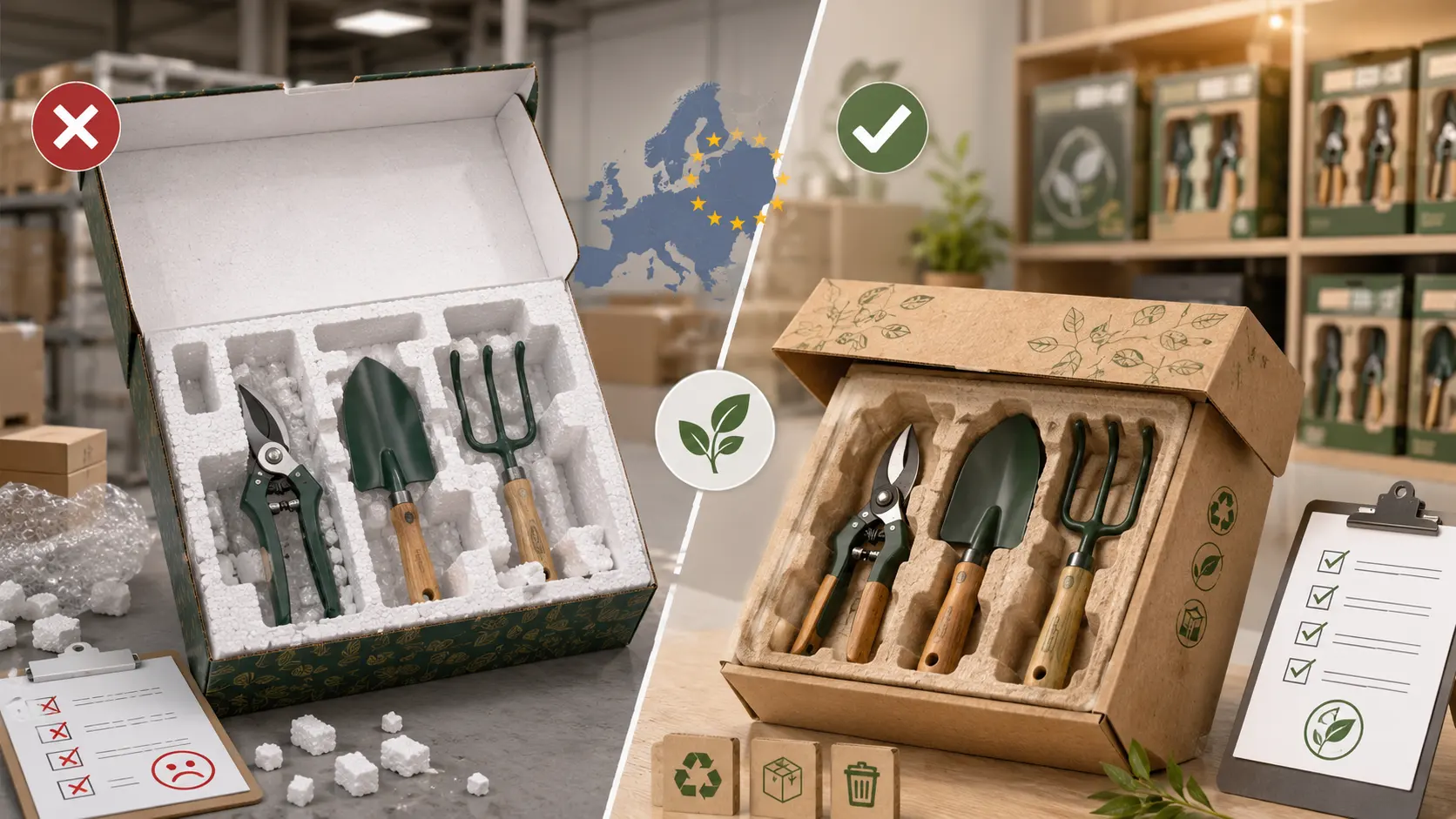
A garden tool gift set arrives in a box three times the product’s volume, filled with molded EPS inserts. Under PPWR, that box may not be legal to sell in the EU from August 2026. The regulation requires packaging minimization, defined recyclability criteria, and maximum empty-space ratios — rules that directly affect how your products are packed, shipped, and displayed.
Packaging Regulation Is Now in Enforcement Phase
The EU Packaging and Packaging Waste Regulation (PPWR), Regulation (EU) 2025/40, entered into force on February 11, 2025 and becomes applicable from August 12, 2026. This is not a future proposal — it is current law with a defined applicability date.
Key provisions affecting garden product packaging:
- Packaging minimization: Packaging volume and weight must be limited to the minimum necessary for functionality and safety.
- Recyclability requirements: All packaging must be recyclable according to defined criteria by specified dates.
- Empty space restrictions: Maximum allowable empty space ratios in packaging will be defined — relevant for retail sets and gift packaging.
- EPR (Extended Producer Responsibility): Producers and importers bear financial responsibility for collection, sorting, and recycling of packaging waste. Registration and reporting obligations vary by member state.
- Labeling requirements: Sorting instructions and material identification labels must follow harmonized formats.
What Buyers Should Do Now
Orders placed for the second half of 2026 and beyond must be assessed against PPWR requirements:
- Audit current packaging: Measure empty space ratios, material composition, and recyclability of your top-selling products.
- Request supplier packaging data: Material type, weight, recyclability certification, and compliance status per target market.
- Evaluate retail set packaging: Gift sets and starter kits often use oversized boxes with fillers. Redesign to meet minimization and empty-space rules.
- Check EPR registration: If you are the importer into an EU member state, you may bear producer responsibility. Confirm your registration and reporting obligations per country.
- Avoid greenwashing: “Eco-friendly,” “sustainable,” and “green” are marketing terms without legal definition. Material claims must be backed by composition data, certification, or test reports. PPWR enforcement will scrutinize vague environmental claims.
China’s Supply Chain Is Responding
Chinese packaging and material suppliers are adapting to PPWR requirements. Some developments worth tracking:
- Paper-based inner packaging replacing expanded polystyrene (EPS) inserts
- Mono-material packaging (single polymer type) enabling easier recycling
- Reduced-plastic plant labels (bamboo/wood options with laser-engraved branding)
- Mail-order packaging designed for e-commerce parcel survival without excessive protection
- FSC-certified recycled pulp bags and fluorine-free grease-resistant paper series (replacing PFAS-containing coatings)
For OEM and packaging customization options, see Custom & OEM Services.
Trend 10 — Retail-Ready Kits & Digital Selling
E-Commerce Is a Channel Requirement, Not a Trend
As noted earlier, e-commerce accounts for 16.9% of US retail and 78% of EU internet users shop online. These are channel environment statistics, not garden tool online sales data. The practical takeaway: every product you source must be sellable online — whether you sell through your own site, Amazon, or supply retailers who do.
What “Retail-Ready” Means for Garden Products
| Element | Physical Product | Digital Selling |
| Packaging | Retail box with shelf-ready design, barcode, and clear product name | Parcel-survivable packaging, manageable weight/dimensions for shipping cost |
| Instructions | Printed quick-start guide in local language | QR code linking to video tutorial, digital manual, or FAQ page |
| Visual assets | Clear product photography on packaging | Video demonstration clips, lifestyle images, unboxing content |
| Product claims | Verified specifications on box and insert | Consistent specs across listing, images, and documentation |
| Returns | Durable packaging that can be reused for returns | Products that survive round-trip shipping; clear return policy |
| Compliance | Required labels, warnings, and manufacturer information | Same information displayed in online listing and product images |
Kit and Set Opportunities
For buyers evaluating wholesale garden tool sets, pre-assembled kits solve multiple problems simultaneously: they increase average order value, simplify gift purchasing, reduce per-item packaging, and create a narrative for retail display:
- Starter kits: Seed starting set (tray + dome + heat mat + labels), pruning set (pruner + lopper + saw + wholesale gardening gloves)
- Watering sets: Hose + reel + spray gun + connectors, or drip kit + timer + sensor
- Gift sets: Herb garden kit, children’s gardening set, balcony garden starter
- Seasonal sets: Spring planting bundle, autumn bulb planting set
Sourcing Risk: Kit Assembly Quality
When a kit contains products from multiple factories, quality consistency becomes a coordination challenge:
- Missing components: The most common complaint in kit reviews. Each kit must have a verified contents list and a final assembly check.
- Mixed quality levels: A premium pruner paired with a budget glove creates a credibility gap. All components should meet a consistent quality standard.
- Instruction clarity: Kits for new gardeners need clear, step-by-step guidance. Ambiguous instructions drive returns.
- Barcode and labeling: Each kit needs its own SKU, barcode, and compliant labeling — not just the individual components’ labels thrown into a box.
For guidance on building product lines for different channels, see How New Distributors Choose Product Lines.
Europe vs. North America: Buying Differences That Affect Sourcing
This section compares the two largest garden tool markets across dimensions that directly affect product specification, packaging, compliance, and channel strategy. It treats EU, UK, US, and Canada as distinct markets — no single country’s data is used to represent an entire region.
Market, Garden & Use Differences
The first thing to understand: these are structurally different markets, not just different geographies. The European garden tool market is driven by smaller gardens and higher regulatory pressure; the North American garden tool market serves larger properties with more equipment demand and regional rule variations.
| Dimension | EU + UK | US + Canada |
| Market context | UK households spent ~£9B on retail garden products in 2025 (HTA); EU garden retail varies by country | US lawn & garden spending reached approximately $77B in 2025 (Garden Research); Canada: 59% of households grow food (StatCan 2023) |
| Participation & spending | UK: 77% have private garden access; steady participation; weather-sensitive monthly swings | US: participation dropped from 84.1% to 79.2%; spending per household rose 18.3% — growth concentrated among engaged gardeners |
| Typical garden | Smaller private gardens, courtyards, balconies; container and raised-bed growing common | Larger suburban lawns; more yard maintenance equipment demand; regional variation (Northeast vs. Southwest) |
| Primary tasks | Planting, pruning, container care, watering, propagation | Lawn care, mowing, edging, seasonal maintenance, leaf management |
| Growing season | Shorter in Northern Europe; Mediterranean regions have different timing | Varies by zone; Canada has very short outdoor seasons, driving indoor/propagation demand |
| Climate challenges | Drought in Southern Europe; frost in Northern; flooding in UK and coastal areas | Heatwaves in Southwest; frost in Northeast and Canada; hurricanes in Southeast |
Channel Structure
Where your customers buy determines how your products must be packaged, displayed, and documented.
| Dimension | EU + UK | US + Canada |
| Garden centers | Core channel for tools, plants, and seasonal sets; high cross-merchandise with plants | Present but less dominant; hardware and home-improvement stores carry more tools |
| Hardware / DIY stores | Significant for hand tools and basic power equipment | Major channel for power equipment and standard hand tools |
| E-commerce | Growing rapidly (78% of EU internet users shop online); Amazon and local platforms | 16.9% of US retail; Amazon dominant; DTC brands emerging |
| Nurseries & specialty | Important for propagation, soil, and plant-specific tools | Regional; strong in propagation and edible gardening supplies |
| Professional / landscape | Growing segment for ergonomic, durable, and repairable tools | Significant for commercial mowing, irrigation, and maintenance |
Channel structure differences directly determine your compliance priorities. A product sold through garden centers in the UK faces different documentation and labeling requirements than the same product sold on Amazon in the US. The regulatory tables below should be read with your primary channel in mind.
Regulatory Environment
| Dimension | EU + UK | US + Canada |
| Product safety | GPSR (EU) 2023/988 — applicable since Dec 2024; UK has separate consumer safety framework | CPSC jurisdiction; state-level variations (e.g., California CARB) |
| Battery rules | EU Battery Regulation (EU) 2023/1542 — phased requirements for sustainability, labeling, replaceability | No equivalent federal battery sustainability regulation; UN38.3 applies to transport |
| Repairability | EU Directive (EU) 2024/1799 — transposition deadline July 31, 2026 | No federal right-to-repair mandate for garden tools |
| Packaging | PPWR (EU) 2025/40 — applicable from Aug 12, 2026; EPR per member state | State-level packaging and recycling rules; no federal PPWR equivalent |
| Connected devices | UK PSTI regime since April 2024; EU cybersecurity rules evolving | FCC equipment authorization for RF devices; no equivalent connected-product security mandate |
| Emissions | No equivalent to CARB SORE rule | California CARB: most new small off-road engines must be zero-emission from 2024 |
Specification Differences That Directly Affect Sourcing
These are the differences that change your product specification — not preferences, but hard requirements that make the wrong product unsellable in the target market.
| Critical Specification | EU + UK | US + Canada | What Happens If You Get It Wrong |
| Voltage & plug | 230V, Type C/F/G plugs | 120V, Type A/B plugs | Product cannot be used; safety hazard; immediate returns |
| Hose threads | BSP standard | GHT (Garden Hose Thread) — not compatible without adapter | Connector leaks or cannot attach to local taps; customer frustration |
| Safety markings | CE mark (EU); UKCA mark (UK); GS mark (voluntary, high credibility) | UL/ETL listing marks; FCC mark for RF devices | Product may be refused at customs or pulled from shelves |
| Measurement units | Metric (mm, cm, L, kg) | Mixed (inches and mm; gallons and L; lbs and kg) | Confusion on packaging; returns if specs don’t match customer expectations |
| Color preferences | Earth tones, muted palettes, natural finishes | Brighter colors acceptable; black and bold accents in power tools | Not a compliance issue, but affects sell-through in garden centers |
| Language requirements | Multi-language instructions (often 5+ EU languages); UK English | English; French for Canada; Spanish for US regions | Inadequate instructions drive returns and complaints |
After-Sales & Returns
| Dimension | EU + UK | US + Canada |
| Return expectation | 14-day minimum withdrawal right for online purchases (EU); consumer-friendly return culture | Varies by retailer; Amazon sets a high return expectation |
| Warranty expectation | Minimum 2-year legal guarantee for consumer goods (EU) | Typically 1 year; extended warranty as upsell |
| Spare parts availability | Increasingly required by regulation for applicable products | Market-driven; no legal minimum for most garden tools |
| Product liability | Strict under GPSR; importer bears significant responsibility | CPSC enforcement; state consumer protection laws |
Tariffs, Trade Routes & Supply Chain Risk
The Tariff Landscape Is Shifting
Trade policy is reshaping where garden tools are made and how they reach market. Buyers sourcing from China need to understand three concurrent developments:
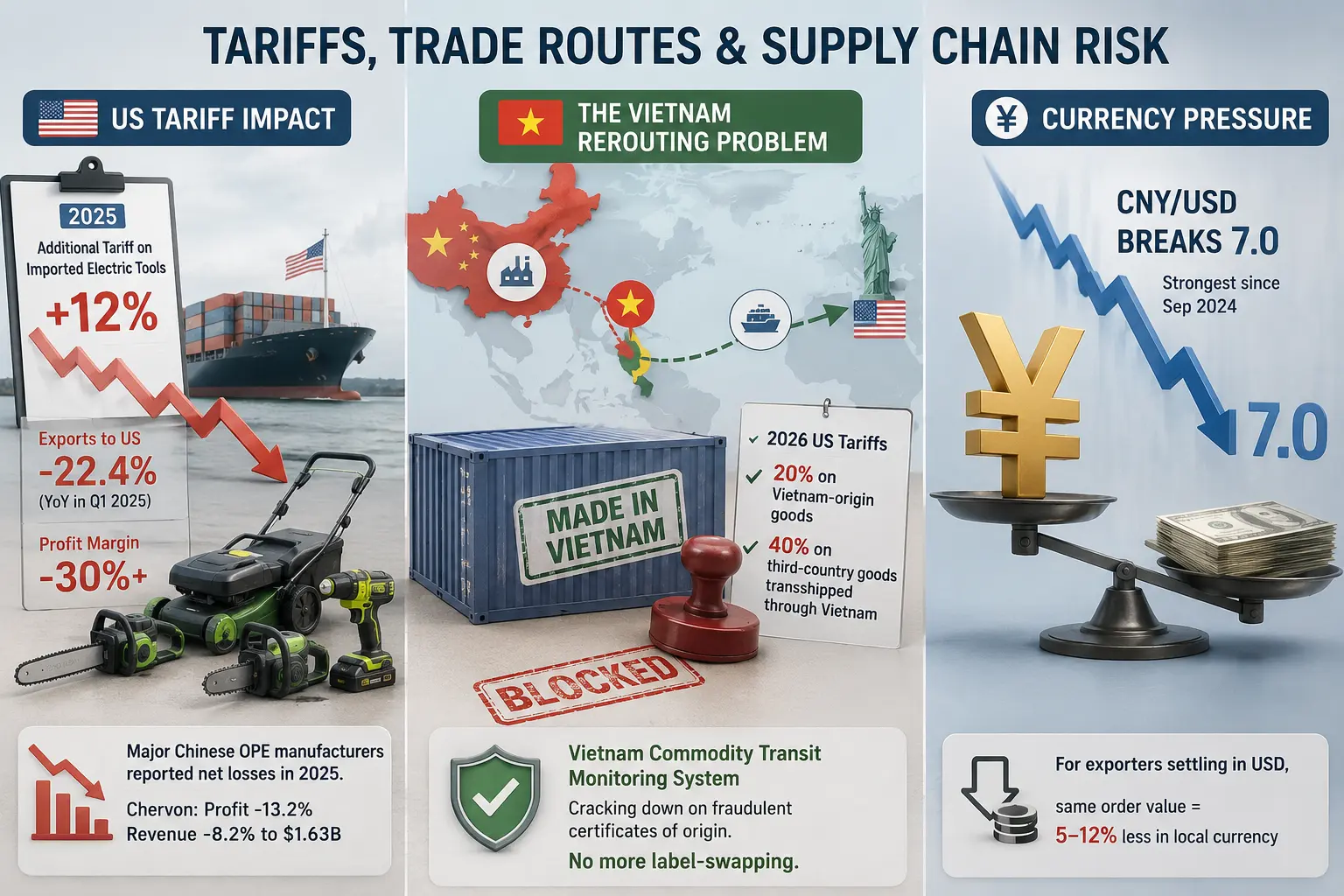
US tariff impact: In 2025, the US imposed an additional 12% tariff on imported electric tools. Q1 2025 data shows Chinese electric tool exports to the US fell 22.4% year over year, with average enterprise profit margins declining over 30%. Major Chinese OPE manufacturers — including Greenworks and Daye — reported net losses for 2025, while Chervon (泉峰控股) saw estimated profits decline approximately 13.2%, with revenue also contracting 8.2% to $1.63 billion, per its 2025 annual report.
The Vietnam rerouting problem: Some exporters attempted to route goods through Vietnam to circumvent US tariffs. In 2026, the US imposed a 20% tariff on Vietnamese-origin goods and a 40% punitive tariff on third-country goods transshipped through Vietnam. Vietnam has launched a “commodity transit monitoring system” to crack down on fraudulent certificates of origin. Simple label-swapping is no longer viable — genuine local production capacity is required.
Currency pressure: The yuan broke through the 7.0 per dollar threshold in late 2025 / early 2026, reaching its strongest level since September 2024. For exporters settling in dollars, the same order value yields 5–12% less in local currency.
What This Means for Buyers
- Diversify supply routes, but verify substance: If a supplier claims Vietnam or Mexico production, confirm that actual manufacturing — not just final packaging — takes place there.
- Build tariff scenarios into cost planning: A 12% tariff changes the landed cost equation. Model different tariff levels when evaluating price competitiveness.
- Watch the Europe–North America divergence: In January–February 2026, Chinese lawn mower exports to Europe rose 57% year over year, while exports to North America declined for the 10th consecutive month. European buyers may face increased competition for factory capacity; North American buyers may need to reassess sourcing strategies.
- Factor shipping risk: Since late February 2026, Strait of Hormuz tensions have triggered emergency fuel surcharges and war risk premiums from carriers, extending lead times and raising freight costs.
Product Opportunity Matrix: 10 Trends → Actionable SKUs
Not every trend fits every buyer — pick 3–5 that match your market, channel, and compliance capacity. This matrix is a sourcing planning tool, not a guarantee of sales.
| Trend | Candidate SKUs | Priority Markets | Channel Fit | Must Verify | Sourcing Risk |
| 1. Battery platforms | Cordless pruners, trimmers, blowers, mower accessories, battery/charger kits | EU/UK/US/Canada | Professional dealers, e-commerce, hardware | Cells, BMS, run time, charger certs, transport docs, platform compatibility | Medium–High |
| 2. Robotic mowing | Robotic mowers, blades, garage covers, installation accessories | EU mature markets, NA premium segment | Professional dealers, installers, DTC | Software maturity, IP position, after-sales, anti-theft, parts availability | High |
| 3. Water-saving | Drip kits, timers, valves, connectors, spray heads, moisture sensors, hose reels | Arid regions, urban/suburban gardeners | Garden centers, e-commerce, hardware | Thread type, pressure rating, flow rate, UV resistance, waterproof rating, winter drainage | Medium |
| 4. Climate resilience | Frost covers, shade nets, rain barrels, self-watering planters, raised beds, greenhouse ventilation | By climate zone | Garden centers, nurseries, farm supply | Material durability, fabric weight, UV stability, load capacity, seasonal procurement timing | Medium |
| 5. Ergonomics | Lightweight tools, telescopic tools, soft-grip pruners, kneelers, raised beds, wheeled carts | EU/US ageing demographic + comfort seekers | Retail, e-commerce, specialty | Weight, grip diameter, lock mechanism, load rating, shock absorption, test data | Low–Medium |
| 6. Compact / multi-use | Folding tools, narrow-head tools, balcony kits, collapsible watering cans, vertical planters | Urban areas, renters, balcony gardeners | E-commerce, home stores, garden centers | Storage dimensions, stability, joint durability, packaging, over-promising versatility | Low–Medium |
| 7. Propagation / edible | Seed trays, domes, heat mats, grow lights, labels, supports, grow bags, soil meters, starter kits | US/Canada/UK/EU — each with specific sub-segments | Nurseries, e-commerce, garden centers | Tray thickness, heat mat uniformity, light spectrum, plug/voltage, material claims, kit completeness | Medium |
| 8. Repairability / spare parts | Replacement blades, springs, spools, switches, batteries, handles, repair kits | EU priority, global professional channels | Professional dealers, brand/OEM | Parts availability commitment, version control, disassembly method, instructions, inventory cost | Medium–High |
| 9. Sustainability / packaging | Reduced-plastic labels, paper-based inserts, mono-material boxes, mail-order packaging, refill sets | EU/UK + brand customers | Retail, brand, e-commerce | PPWR/EPR compliance, material evidence, drop-test protection, empty space ratio, green claim substantiation | Medium |
| 10. Retail-ready kits / digital | Starter kits, watering sets, gift sets, QR-linked instructions, video content assets | Multi-market | E-commerce, gift, retail display | Kit contents completeness, instruction clarity, barcode/labeling, shipping dimensions, return resilience | Low–Medium |
Ready to evaluate real products? Send us your target SKUs, market, and quantity expectations — we’ll pull samples from verified suppliers, run quality checks in our warehouse, and ship consolidated sample packs to you — Request Product Samples
Turn These Trends Into a Product Shortlist
Send us the trends you want to pursue, your target market, and expected quantities. We’ll help compare relevant product options and sample routes before you commit to bulk orders.
Request Product Options & Samples →2026 Compliance & Quality Checklist
This checklist covers the major regulatory and quality verification points for garden tools entering EU, UK, US, and Canadian markets in 2026. Requirements vary by product and market — this is a planning framework, not a legal opinion. Confirm each item with compliance professionals or regulatory sources for your specific products.
Think of it this way: if you source a cordless pruner for the EU market, here is how the compliance requirements stack up — product safety, battery, packaging, and documentation all apply simultaneously. The tables below break these down by category so you can check each product against the right set of rules.
General Product Safety (All Garden Tools)
| Requirement | EU | UK | US | Canada |
| Product safety framework | GPSR (EU) 2023/988 — applicable since Dec 2024 | UK consumer safety legislation | CPSC jurisdiction | Health Canada / CCPSA |
| Manufacturer / importer identification | Required on product or packaging; online listing must also display | Required | Required for certain products | Required |
| Risk assessment documentation | Required under GPSR | Expected under UK framework | Voluntary but expected for liability defense | Expected |
| Traceability | Production batch identification required | Required | Expected | Expected |
| Online selling obligations | Online listings must display same safety info as physical packaging | Required | Required where applicable | Required |
Battery & Electrical Products
| Requirement | What to Verify | Applicable Markets |
| UN38.3 test report | Battery has passed all 8 UN38.3 tests; report available for transport | All markets (international transport requirement) |
| Battery replaceability | Portable batteries removable by end user with commonly available tools (proposed exemption for certain product categories, including some cordless garden tools with integrated batteries under 2.5 kg — regulation not yet formally adopted as of mid-July 2026; professional replacement may be acceptable for exempted products) | EU from 2027; UK aligning; US/Canada: no equivalent mandate |
| Battery labeling | Capacity, chemistry, hazard symbols, separate collection symbol per EU Battery Regulation | EU; UK aligning |
| Charger certification | CE + GS (EU), UL/ETL (US), PSE (Japan) — per target market | Per market |
| MSDS / Safety Data Sheet | Available for battery and chemical components | All markets for transport and customs |
| Dangerous goods packing certificate | Required for lithium battery sea and air shipments | All markets |
| Voltage and plug matching | Product voltage and plug type match target market standard | Per market — 230V/EU plug vs. 120V/US plug |
| Thermal management | Battery housing, ventilation, and temperature cutoff verified in design review | All markets — critical for safety and recall prevention |
| BMS (Battery Management System) | Overcharge, over-discharge, short circuit, and thermal protection confirmed | All markets |
If your product also has Wi-Fi or Bluetooth connectivity — for example, a smart irrigation controller with a battery and wireless module — the battery requirements above and the connected-device requirements below both apply. Check both tables for that product.
Connected / Smart Devices
| Requirement | What to Verify | Applicable Markets |
| UK PSTI compliance | Default passwords unique, vulnerability disclosure policy, software update support period stated | UK since April 2024 |
| FCC equipment authorization | RF device (Wi-Fi, Bluetooth) evaluated per FCC rules; proper labeling | US |
| EU cybersecurity | Evolving requirements under proposed EU Cyber Resilience Act | EU — timeline pending |
| Privacy and data handling | Data collection disclosed; GDPR compliance for EU markets | EU/UK; US state-level privacy laws |
| Software update commitment | Minimum support period stated in product documentation | UK PSTI; EU proposed; market expectation elsewhere |
Packaging & Environmental
| Requirement | What to Verify | Applicable Markets |
| PPWR minimization | Packaging volume and weight limited to minimum necessary | EU from Aug 2026 |
| PPWR recyclability | Packaging recyclable per defined criteria by specified dates | EU from Aug 2026 |
| PPWR empty space | Maximum empty space ratio compliant | EU from Aug 2026 |
| EPR registration | Importer registered in each member state where product is sold | EU per member state; UK EPR framework |
| Sorting labels | Harmonized sorting instructions on packaging | EU from specified dates |
| Material claims substantiation | “Recyclable,” “compostable,” “bio-based” backed by certification or test data | All markets — especially EU under PPWR enforcement |
| California CARB compliance | Small off-road engine products meet zero-emission requirements where applicable | California; other states may follow |
Worried that compliance upgrades will blow your landed cost? Send us your product list, target markets, and packaging requirements — we’ll quote per-SKU pricing that includes compliant materials, certified components, and documentation — Get Compliance-Ready Quotes
Buying Calendar & Supplier Validation
Procurement Timeline: Working Backward from the Selling Season
Garden tool sales are seasonal. Products must arrive before the selling window opens — not during it. This calendar works backward from target shelf dates to set order milestones.
| Selling Season | Milestone | Timing |
| European spring (Mar–May) | Sample confirmation + compliance documents | Oct–Nov (prior year) |
| Bulk order + production start | Dec–Jan | |
| Inspection + consolidation + shipping | Jan–Feb | |
| Arrival + shelf-ready | Feb–Mar | |
| US spring (Apr–Jun) | Same sequence, shifted ~1 month later | Nov–Mar (arrival) |
| European Christmas season | Sample confirmation | Jun–Jul |
| Bulk order | Jul–Aug | |
| Arrival | Oct–Nov | |
| Canadian short season (May–Aug) | Sample confirmation + compliance | Jan–Feb |
| Bulk production | Mar–Apr | |
| Arrival | Apr–May |
Note on lead times: Actual lead times vary by product, factory, and logistics route. As a directional guide, sample-to-shipment timelines for multi-category orders typically range from 8 to 14 weeks depending on complexity. Confirm specific timelines for your product list.
Supplier Validation Checklist
When evaluating a new supplier — whether a factory or a sourcing partner — these checks reduce risk before you commit volume:
| Validation Step | What to Do | Red Flags |
| Product identity confirmation | Verify that product name, images, specifications, and certifications all refer to the same model | Images show premium version; specs describe budget version |
| Material verification | Request material specification sheet; compare to sample | “SK5 steel” on listing but no material certificate; “stainless” that is actually coated carbon steel |
| Compliance documentation | Request full compliance file: certifications, test reports, declarations, labels | Missing UN38.3 for battery products; no CE/GPSR documentation for EU market |
| Sample quality assessment | Order and test samples before bulk; retain reference sample for comparison | Sample quality significantly different from listing; inconsistencies between units |
| Production capability check | Confirm factory can produce your required volume, specs, and timeline within stated lead time | Factory claims capacity but cannot provide production schedule; single-factory cannot handle multi-category order |
| Communication and documentation quality | Evaluate response time, spec accuracy, and willingness to provide documentation | Slow responses; vague answers; reluctance to share test reports or compliance files |
| After-sales support | Confirm spare parts availability, warranty handling, and return/replacement process | No spare parts policy; unclear warranty terms; no documented return process |
Quality Verification Points (All Products)
These are practical checks you perform during sample evaluation and bulk inspection — separate from the regulatory compliance tables above, but equally important for reducing returns and complaints.
| Check | Method | When to Apply |
| Material verification | Request material specification sheet; consider spot spectral analysis for metal claims | Before first order; random checks on bulk |
| Hardness / performance claims | Ask for test report supporting specific HRC, tensile strength, or run-time numbers | Before approval; compare sample to spec |
| Sample vs. bulk consistency | Lock BOM and process parameters; request batch consistency commitment; retain reference sample | Before and during bulk production |
| Image vs. reality match | Compare product listing images to physical sample; flag if photos show premium version while bulk uses lower spec | Before listing approval |
| Safety edge and finish | Check for sharp edges, burrs, unstable coatings; especially on metal tools and cutting products | Sample inspection; bulk spot checks |
| Packaging drop test | Verify packaging protects product through parcel shipping cycle | Before first shipment; especially for e-commerce |
China Supply Chain: Understanding the Manufacturing Landscape
China is the world’s largest manufacturer and exporter of garden tools. In 2025, garden machinery exports (including chainsaws, lawn mowers, and related equipment and accessories) reached $4.88 billion (approximately 48.82 billion yuan), up 16.17% year over year. Understanding current garden product sourcing trends means recognizing that China is not a single uniform factory — it is a network of specialized manufacturing clusters, each with distinct strengths:
| Cluster | Core Products | Sourcing Implication |
| Ningbo (Zhejiang) — Cixi/Yuyao | Watering products: spray guns, nozzles, quick-connect fittings, hose reels, drip irrigation components; lawn mowers (large OEMs based here) | Best starting point for watering & irrigation sourcing; deep SKU range; strong plastic/mold supply chain |
| Yongkang (Zhejiang) | Hand tools: pruners, shears, shovels, rakes, hoes, garden sets; electric pruners; battery mowers | “Hardware capital” — widest hand tool selection; complete metalworking supply chain |
| Taizhou (Zhejiang) — Luqiao/Huangyan | Sprayers (backpack, fogging), irrigation pumps; seedling trays, pots, plant labels | Strong mold and injection molding capability (“China’s mold capital”); full model range |
| Yangjiang (Guangdong) | Pruners, flower scissors, saw blades | Mature cutlery/scissor industry; mid-range and budget volume; some mid-tier quality |
| Qingdao (Shandong) — Jiaozhou/Gaomi | Garden carts, wheelbarrows, PU flat-free wheels, pneumatic rubber wheels | Complete “cart + wheel” system; traditional supply base for US/EU garden retail |
| Linyi (Shandong) | Basic hand tools: shovels, hoes, rakes, hand scoops | Northern hand tool cluster; competitive pricing for standard items |
| Nantong/Rudong (Jiangsu) | Garden gloves (nylon, HPPE, nitrile, latex, PU-coated) | Global protective glove manufacturing center; knitting + coating integrated |
| Jinzhou (Hebei) | Garden aprons, waterproof mats | ~80% of national apron market; 20,000+ workers; high volume efficiency |
| Chongqing (Bishan) | Gas-powered mowers, general-purpose engines | Major gas mower export base; significant capacity for markets where gas tools remain in demand |
What this means for buyers: Matching your product category to the right cluster gives you better supplier matches, shorter sample turnaround, and more competitive pricing. A sourcing partner with warehouse capability in China can consolidate products from multiple clusters into a single shipment — which is essential when your order includes pruners from Yangjiang, watering products from Ningbo, and carts from Qingdao.
For guidance on evaluating a garden tools wholesale supplier in China, see our supplier validation guide. For the full product catalog, see the Garden Tools Category.
Next Step: Get Product Models, Quotes & Samples for Your 2026 Range
Use this checklist to convert the 10 trends into your 2026 sourcing plan. Pick 3–5 trends that match your market, channel, and capacity — not all 10.
Step 1: Select Your Trend Priorities
| Question | Your Answer |
| Which 3–5 trends best match my customers’ needs and my sales channel? | ___________ |
| Which trends have the highest regulatory impact on my target market? | ___________ |
| Which trends represent new SKU opportunities I have not stocked before? | ___________ |
| Which trends require supplier capability I have not verified yet? | ___________ |
Step 2: Define Product Specifications
| Question | Your Answer |
| For each selected trend, what specific SKUs will I stock? | ___________ |
| What are the must-verify specifications for each SKU? (material, voltage, plug, thread, safety, packaging) | ___________ |
| What compliance documents must I collect before ordering? | ___________ |
| What is my target retail/wholesale price range per SKU? | ___________ |
Step 3: Plan the Procurement Timeline
| Question | Your Answer |
| What is my target shelf date for each product group? | ___________ |
| Working backward, when must I confirm samples? | ___________ |
| When must I place bulk orders? | ___________ |
| When must shipments arrive? | ___________ |
Step 4: Validate Suppliers and Sourcing Approach
| Question | Your Answer |
| Can my current suppliers deliver the required specs, compliance, and volume? | ___________ |
| Do I need new suppliers for any category? Which cluster should I target? | ___________ |
| Will I need consolidation for multi-category orders from different factories? | ___________ |
| What is my sample testing and bulk inspection plan? | ___________ |
Step 5: Take the Next Step
Tell us your market, target products, and quantity — we’ll match suppliers, prepare samples, and quote with compliance built in. Get Product Models, Quotes & Samples
Planning Your 2026 Garden Tool Range?
Share your target market, product categories, quantity range, and compliance requirements. We’ll help compare suitable product options, samples, supplier routes, and multi-category sourcing plans .
Send Your Sourcing Requirements →FAQ
Q: Should I drop all gas-powered tools from my 2026 range? A: Not universally. California’s CARB rule requires most new small off-road engines (including common mowers and leaf blowers) to be zero-emission from 2024 — but this is a California regulation, not a US federal ban. Other states may follow at different speeds. In Europe, no equivalent ban exists, though noise and emission norms in some municipalities restrict gas tool use in residential areas. The practical approach: maintain battery options — including wholesale leaf blowers and cordless mowers — as your growth category while keeping gas products for markets and professional segments that still demand them.
Q: How do I know if an “ergonomic” pruner is genuinely ergonomic? A: Ask for specifications, not labels. Key data points: tool weight (grams), handle diameter (mm), grip material composition, cutting force required (N), and any hand-fatigue or grip-pressure test results. If the factory cannot provide these, the “ergonomic” claim is unverified — and unverified claims carry return risk and GPSR liability risk in the EU.
Q: Can I use a single battery platform across all my cordless garden tools? A: It depends on the manufacturer’s platform design. Some brands (e.g., EGO, STIHL) offer cross-tool battery families where one battery fits pruners, trimmers, blowers, and mowers. Others use different voltages for different tool classes. For buyers sourcing from multiple factories, achieving a single battery platform across your entire range is unlikely — but you can group tools by voltage class and minimize the number of incompatible battery systems you stock. Verify platform compatibility before mixing brands in your range.
Q: What PPWR obligations affect my garden product packaging right now? A: PPWR (EU) 2025/40 becomes applicable from August 12, 2026. Key obligations: packaging minimization, recyclability requirements, empty space ratio limits, harmonized sorting labels, and EPR registration per member state. If you are the importer into an EU country, you likely bear producer responsibility. Orders for H2 2026 and beyond should be audited against these requirements now. Specific timelines and exemptions vary by packaging type — confirm per product and per market.
Q: How do I handle multi-category orders from different Chinese factories? A: This is where consolidation capability matters. When your order includes pruners from one factory, watering products from another, and carts from a third, each factory ships separately — different lead times, different quality standards, different packaging. A sourcing partner with warehouse capability in China can receive, inspect, repack, and consolidate all products into a single shipment. This reduces your logistics coordination burden, lowers per-unit shipping cost, and enables mixed-order packaging (e.g., combining 10 SKUs into one retail-ready shipment).
Q: What should I verify before ordering battery-powered garden tools? A: Five critical items: (1) Cell brand and BMS specification — affects safety and consistency; (2) UN38.3 test report — required for transport; (3) Charger certification for your target market (CE/GS for EU, UL/ETL for US); (4) Run-time claims backed by test data under working load, not standby; (5) Battery replaceability — EU Battery Regulation requires user-replaceable portable batteries from 2027, but note the proposed July 2026 exemption (not yet formally adopted as of mid-July 2026) for certain product categories (including some cordless garden tools with integrated batteries under 2.5 kg), where professional replacement may become acceptable if adopted. Request the full compliance file before placing the order.
Q: How are tariffs affecting garden tool sourcing from China? A: The US imposed an additional 12% tariff on imported electric tools in 2025, contributing to a 22.4% decline in Chinese electric tool exports to the US in Q1 2025. Attempting to reroute through Vietnam is now riskier: the US has imposed a 20% tariff on Vietnamese-origin goods and a 40% punitive tariff on transshipped third-country goods. Meanwhile, Chinese lawn mower exports to Europe rose 57% in January–February 2026, while North American-bound exports declined for the 10th consecutive month. Buyers should model tariff scenarios into landed cost calculations, verify the substance of any claimed non-China origin, and consider how the Europe–North America divergence may affect factory capacity allocation.
Source Notes
Key data points and their original sources:
- US lawn & garden spending approximately $77B, participation 79.2% — Garden Research, National Gardening Survey 2026 Edition. https://gardenresearch.com/
- 64% of US gardeners plan to plant more — Axiom 2026 Gardening Outlook. https://axiomcom.com/2026-gardening-outlook-study/
- UK garden retail ~£9B, 77% garden access — HTA Industry Statistics. https://hta.org.uk/news-events-current-issues/industry-data/garden-industry-statistics/
- UK tools & equipment +8% YoY (Jul 2025), +15% YTD — HTA August 2025 Market Update. https://hta.org.uk/resources/get?mediaId=23762
- US e-commerce 16.9% of retail (Q1 2026) — US Census Bureau. https://www.census.gov/retail/ecommerce.html
- EU online shoppers 78% — Eurostat. https://ec.europa.eu/eurostat/statistics-explained/index.php?title=E-commerce_statistics_for_individuals
- STIHL battery share 28%, revenue €5.48B — STIHL FY2025 figures. https://corporate.stihl.com/en/about-stihl/company/figures
- Robotic mower shipments 2.343M units H1 2025 (+327.2%), full-year 1.992M (+63.8%) — IDC data, as reported by industry media; IDC original report not publicly available.
- Boundary-wire-free share rose from 35% to ~66.2% — IDC 2025 full-year data, as reported by industry media; IDC original report not publicly available.
- China garden machinery exports $4.88B (approx. 48.82 billion yuan, including chainsaws, lawn mowers, and related equipment and accessories), +16.17% — China Forestry Machinery Association / Customs. https://www.forestry.gov.cn/c/www/lcdt/665903.jhtml
- China lawn mower exports approx. 13.2 billion yuan (~$1.8B) (Jan–Jul 2025, +56.6%) — Customs HS 84331100. https://www.163.com/dy/article/KBRP8KJJ0511D0C3.html
- EPA WaterSense: up to 30% irrigation water savings — EPA WaterSense Statistics. https://www.epa.gov/watersense/statistics-and-facts
- EU 22% population aged 65+ — Eurostat. https://ec.europa.eu/eurostat/statistics-explained/index.php?title=Population_structure_and_ageing
- Canada 59% households grow food — Statistics Canada 2023. https://www.statcan.gc.ca/o1/en/plus/8591-backyard-harvest
- GPSR (EU) 2023/988 — EUR-Lex. https://eur-lex.europa.eu/eli/reg/2023/988/oj/eng
- EU Battery Regulation (EU) 2023/1542 — EUR-Lex. https://eur-lex.europa.eu/eli/reg/2023/1542/oj/eng
- EU Right to Repair Directive (EU) 2024/1799 — EUR-Lex. https://eur-lex.europa.eu/EN/legal-content/summary/common-rules-promoting-the-repair-of-goods-and-amending-related-eu-legislation.html
- PPWR (EU) 2025/40 — EUR-Lex. https://eur-lex.europa.eu/eli/reg/2025/40/oj/eng
- UK PSTI regime — UK Government. https://www.gov.uk/guidance/regulations-consumer-connectable-product-security
- FCC equipment authorization — FCC. https://www.fcc.gov/oet/ea/rfdevice
- California CARB SORE rule — CARB. https://ww2.arb.ca.gov/news/carb-approves-updated-regulations-requiring-most-new-small-road-engines-be-zero-emission-2024
- CPSC RYOBI mower recall — CPSC. https://www.cpsc.gov/Recalls/2025/TTI-Outdoor-Power-Equipment-Recalls-RYOBI-Battery-Powered-Mowers-Due-to-Fire-Hazard
- CPSC RYOBI hedge trimmer recall — CPSC. https://www.cpsc.gov/Recalls/2025/TTI-Outdoor-Power-Equipment-Recalls-RYOBI-40-Volt-24-Inch-Cordless-Hedge-Trimmers-Due-to-Laceration-Hazard
- Segway Navimow cumulative 1M+ units, 2024 shipments ~870K, revenue 861M yuan (+283.92%) — Ninebot official, as reported by industry sources.
- US 12% tariff on electric tools, Q1 exports to US -22.4% — China Electromechanical Products Import/Export Chamber survey.
- Vietnam 20% tariff / 40% punitive tariff on transshipped goods — US-Vietnam trade agreement, multiple media sources.
- Lawn mower exports to Europe +57% (Jan–Feb 2026), to North America 10 consecutive months of decline — Export data / industry analysis.
- CNT heating mat patent ZL CN202420825546.X — China National Intellectual Property Administration.
- UN38.3 requirement for lithium battery transport — UN dangerous goods transport standard.

Written by
ScarecrowGarden
💡About Scarecrow Garden Supplier Co., Ltd.
Scarecrow Garden Supplier Co., Ltd. is a China-based sourcing and wholesale partner specializing in garden tools, landscaping equipment, and outdoor supplies for international wholesalers, distributors, contractors, and brands.
With hands-on experience rooted in real garden use scenarios, we focus on durable materials, functional design, and stable large-volume supply. Our product range covers pruning tools, watering systems, hand tools, outdoor hardware, and customized garden solutions to support both retail and professional landscaping markets.
Beyond products, we help our partners navigate supplier selection, quality control, compliance requirements, and long-term sourcing strategies in China. Through our blog, we share practical insights on product selection, material comparisons, industry trends, and cost-effective purchasing—helping global buyers build stronger, more competitive supply chains.