






flat shovel materials
Abstract
A flat shovel is an essential tool for your customers' gardening, construction, agricultural production, and daily cleaning. The performance and service life depend primarily on the materials of the shovel blade and handle. Choosing the right and more comprehensive material of flat shovels can significantly improve your customers' work efficiency and avoid losses or troubles caused by improper tool adaptation, and most importantly is that you can expand your market.
This article comprehensively analyzes the common materials of flat shovels, examines the core characteristics of each material, matches them with the optimal application scenarios, and helps users quickly find a flat shovel that meets their specific needs. Understanding the differences between carbon steel, stainless steel, aluminum alloy, and plastic flat shovels helps users choose the right tool for gardening, construction, or daily cleaning tasks.
Common Materials of Flat Shovels and Their Suitable Scenarios for Your Customers' Reference
1. Carbon Steel Flat Shovel: Features, Advantages, and Best Uses
Carbon steel is the most classic and widely used material for flat shovel blades, produced by incorporating a specific proportion of carbon into iron. It can significantly enhance the hardness and wear resistance of the shovel blade.
Carbon steel flat shovels offer excellent strength and durability. Their blades can withstand high-intensity impacts and friction without easy bending or deformation. Therefore, they are ideal for heavy-duty work on construction sites. They are often used to shovel gravel, concrete blocks, construction waste, and other materials with high hardness and strong wear resistance, handling harsh working conditions through outstanding wear resistance. In agricultural production, they can easily tackle heavy-duty tasks such as plowing compacted soil, digging irrigation ditches, and clearing crop residues. As a result, they help users efficiently complete land preparation work.
However, carbon steel has poor corrosion resistance. Blades are prone to rust and oxidation if not properly maintained after use, especially when used in humid environments, rainy conditions, or in contact with acidic-alkaline soil. After using a carbon steel flat shovel, it is necessary to promptly clean residual soil and debris from the blade, dry it thoroughly, and apply a thin layer of oil for rust prevention. You can inform your customers of these maintenance tips, which may increase your credibility.
This material is suitable for users who value tool strength, need to frequently handle heavy-duty work, and are willing to invest time in maintenance, including construction workers, farmers, and professional landscaping practitioners.
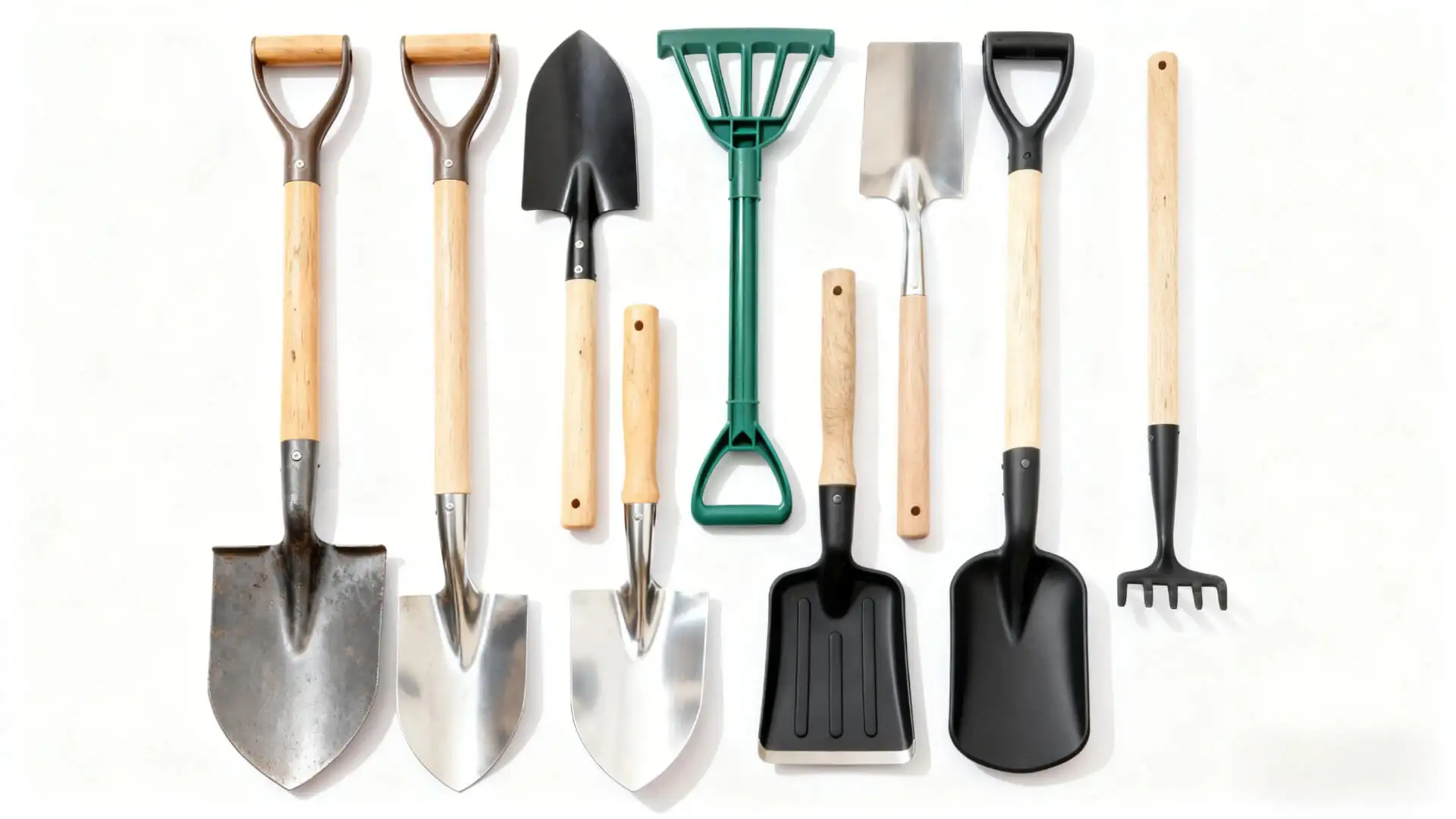
Carbon steel is one of the most common flat shovel materials due to its strength and cost-effectiveness.
2. Stainless Steel Flat Shovel: Rust Resistance, Maintenance, and Suitable Applications
Stainless steel flat shovels have blades made of stainless steel alloy, usually containing core elements such as chromium and nickel. These elements form a dense oxide protective film on the blade surface, endowing it with excellent corrosion and rust resistance.
Stainless steel flat shovels are rust-resistant, durable, and easy to clean. They can be used for a long time in humid environments, even in direct contact with water, moisture-containing soil, or food ingredients, without rusting problems. Therefore, they meet the hygiene requirements of environments that demand high cleanliness standards.
In food processing plants, they are widely used to shovel raw food materials such as grains, flour, and sugar, preventing contamination from rust impurities and complying with food hygiene standards. In daily life, when cleaning swimming pools, fish ponds, wet floors, or kitchen areas, their smooth surface can be cleaned thoroughly with simple rinsing, no complex maintenance required, saving time and effort.
However, stainless steel has slightly lower hardness than carbon steel flat shovels, making it unsuitable for shoveling extremely hard materials such as large rocks and thick concrete, which may cause blade deformation or curling. Stainless steel has higher production costs, so stainless steel flat shovels are usually more expensive than carbon steel models.
This material is suitable for customers whose usage scenarios require hygiene, rust resistance, and low maintenance, including food processing, aquaculture, household cleaning, and hotel housekeeping. This material is preferred in environments where moisture exposure is unavoidable and rust prevention is essential.
3. Aluminum Alloy Flat Shovel: Lightweight Design and Ideal Usage Scenarios
Aluminum alloy flat shovels are made of aluminum-based alloy combined with other metal elements, featuring both light weight and corrosion resistance. The density of aluminum alloy is much lower than that of steel, resulting in lighter flat shovels that greatly reduce physical strain during carrying and operation.
Aluminum alloy flat shovels are lightweight, labor-saving, and easy to operate. For this reason, they are particularly suitable for daily light-duty work. In gardening scenarios, they are used for shoveling flower soil, sand, plant debris, potted waste, and other tasks that do not require excessive force but involve frequent movement, making operations easier.
In household use, they can efficiently complete tasks such as cleaning garages, courtyards, driveways of dust, fallen leaves, and small debris, or repotting balcony plants. They are especially suitable for your customers who have limited physical strength or those needing long-term light work. Aluminum alloy has good corrosion resistance, does not easily rust even in humid environments, and requires basically no additional maintenance.
However, aluminum alloy flat shovels have limited strength, unable to withstand heavy loads or severe impacts. They cannot be used to shovel hard or heavy materials such as rocks, concrete, and compacted soil, as this may cause blade bending or deformation, affecting subsequent use.
This material is suitable for daily light-duty work and users who value operational portability, including housewives, gardening enthusiasts, general office cleaners, and camping enthusiasts. The lightweight structure makes aluminum alloy shovels ideal for some of your customers who prioritize portability and low physical effort.
4. Plastic Flat Shovel: Safety Benefits and Best Light-Duty Applications
The blades of plastic flat shovels are mostly made of high-strength engineering plastics such as polypropylene and nylon. Some high-quality products add a reinforcing rib design at the blade edge to further improve durability.
Plastic flat shovels are soft, extremely lightweight, and will not scratch contact surfaces. Therefore, they offer excellent safety for delicate materials. In household cleaning, they are suitable for removing stains and small debris from smooth surfaces such as glass, tiles, wooden floors, and furniture, avoiding scratch damage caused by traditional metal blades.
In gardening scenarios, when transplanting seedlings, laying flower soil, cleaning fallen leaves inside potted plants, or loosening soil, plastic blades can effectively protect plant roots from scratches, facilitating seedling care. In scenarios such as light auxiliary work in food processing, children's handcrafts, and beach activities, plastic flat shovels are preferred tools for your customers due to their non-toxic, safe material and risk-free operation.
However, plastic flat shovels have poor hardness and wear resistance. They cannot come into contact with sharp objects, hard materials, or be used for high-intensity work, as this may lead to blade damage or breakage.
This material is suitable for light-duty precision work and scenarios requiring protection of contact surfaces, including household precision cleaning, garden seedling cultivation, children's handcrafts, and light food processing. Plastic flat shovels are commonly selected for tasks that require surface protection and precision.
Call to Action
If you are unsure what to source for your shovel inventory — whether for your customer whose usage scenarios like gardening, construction, landscaping, or household use — feel free to share your customers' specific scenarios. Scarecrow Garden Supplier Co., Ltd can recommend the most suitable shovel sourcing of different materials based on the practical conditions of your local market. Please take a look to see if there are shovels you already want to source for your inventory.

Written by
ScarecrowGarden
💡About Scarecrow Garden Supplier Co., Ltd.
Scarecrow Garden Supplier Co., Ltd. is a China-based sourcing and wholesale partner specializing in biaogarden tools, landscaping equipment, and outdoor supplies for international wholesalers, distributors, contractors, and brands.
With hands-on experience rooted in real garden use scenarios, we focus on durable materials, functional design, and stable large-volume supply. Our product range covers pruning tools, watering systems, hand tools, outdoor hardware, and customized garden solutions to support both retail and professional landscaping markets.
Beyond products, we help our partners navigate supplier selection, quality control, compliance requirements, and long-term sourcing strategies in China. Through our blog, we share practical insights on product selection, material comparisons, industry trends, and cost-effective purchasing—helping global buyers build stronger, more competitive supply chains.
Related Articles

How to Source from China Without Missing Your Peak Season
China Public Holidays 2026: A Buyer’s Guide to Avoid Supply Chain Disruptions Before Long Shutdowns
Why Bulk Garden Tool Orders Fail — and How We Help Buyers Prevent Costly Quality Issues in China