







9 Essential Factors to Consider When Choosing Gardening Pruners | Scarecrow Garden Supplier
Garden pruning shears are one of the most essential garden hand tools for daily plant maintenance. For wholesalers, landscaping companies, and new gardeners alike, choosing the right gardening pruners is often more challenging than expected. Many gardeners search for how to choose the right pruning shears, yet 65% experience slow wound healing or branch damage due to choosing the wrong tool. This article breaks down 9 key factors (blade type, material, size, etc.) to help you avoid sourcing mistakes and pick a durable tool that suits your customers' needs.
1. Blade Type: Match Your Customers' Pruning Needs
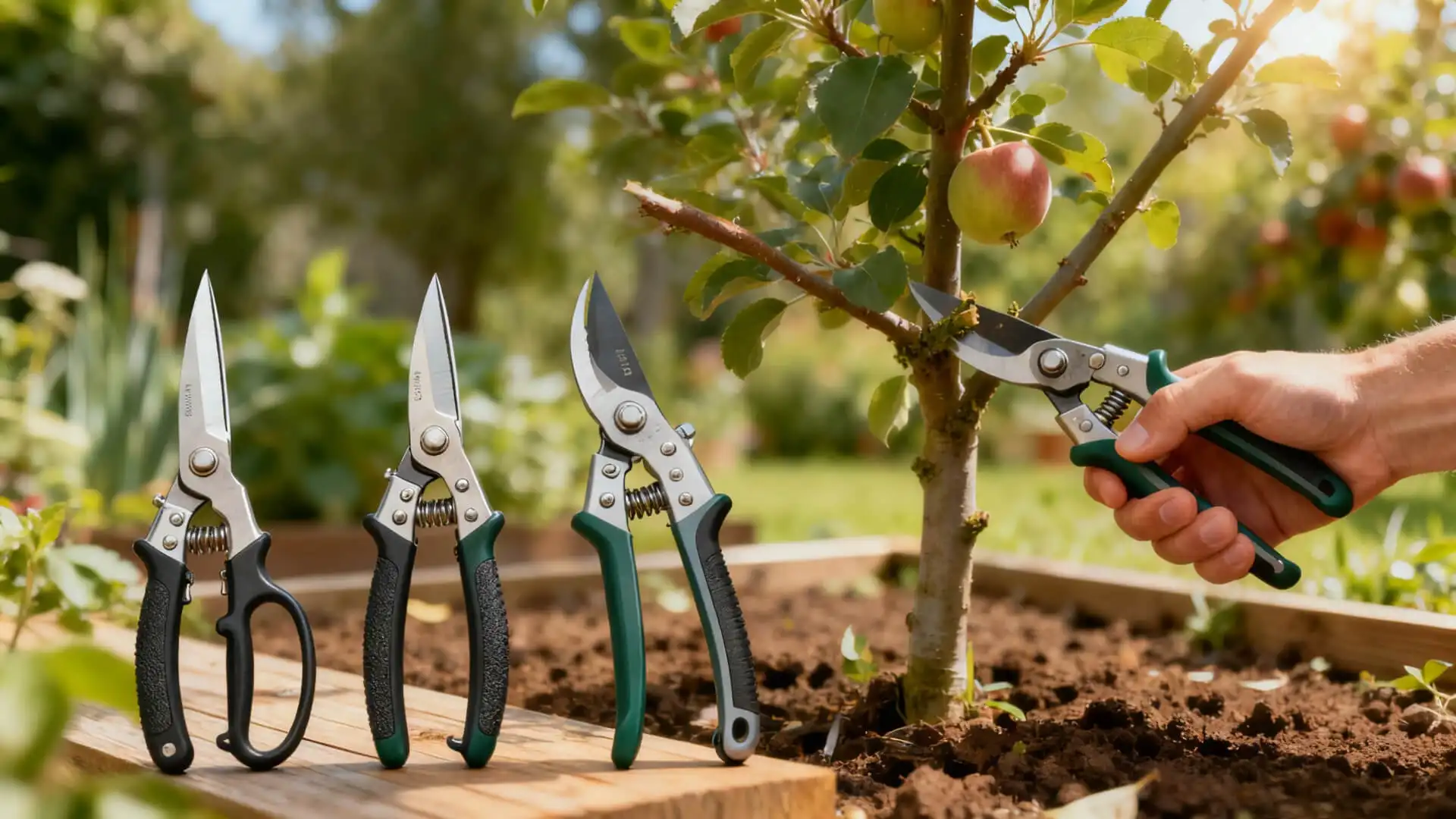
Garden pruning shears have three core blade types with three different application angles:
- Bypass: Scissor-like, ideal for 0.5-1.5 cm fresh branches (minimizes tissue damage; wounds heal 20%-30% faster than an anvil).
- Anvil: Blade + anvil design, for dry/hard branches (risks crushing fresh growth).
- Ratchet: Multi-stage cutting, reduces force by 30%-40%—great for weak hands or 1.5-2.5 cm thick branches.
Choose based on branch type (fresh/dry) and diameter. Choosing the correct blade type ensures cleaner cuts and reduces plant stress, which is essential for your customers, especially home gardeners and landscaping professionals.
2.Blade Material: Give Durability and Sharpness Priority
Blade material strongly influences the durability and sharpness of gardening pruners, especially for users who prune frequently:
- High-carbon steel: HRC 55–58 hardness, maintains its edge for 6–8 months; requires anti-rust oil.
- Stainless steel (304/440): Rust-resistant (HRC 50-52), sharpens every 3-4 months—good for humidity.
- Carbonized steel: HRC 60-62, 1.5-2x more durable than high-carbon steel (costs more; for heavy use).
Your customers will choose depending on the environment and frequency of use.
3. Blade Size and Cutting Capacity
Blade size and Cutting Capacity is usually measured by two core parameters: blade length (3-8 cm) and maximum cutting diameter (0.5-3 cm). Data shows that in home gardening scenarios, 80% of pruning needs involve branches with a diameter of 0.5-1.5 cm—pruners with a blade length of 4-6 cm can meet this demand. If your customers need to prune thicker branches (1.5-3 cm) from fruit trees or shrubs, choose a model with a blade length of 6-8 cm and a maximum cutting diameter of ≥2 cm.
Note that the "maximum cutting diameter" marked on some products is a value under ideal conditions. In actual use, it is recommended to leave a 10%-20% margin to avoid blade deformation due to overloading. For example, pruners marked with a maximum cutting diameter of 2 cm are more reliable for pruning branches with a diameter of 1.6-1.8 cm in daily use.
4. Handle Design and Grip: Minimize Hand Fatigue
Handle design should focus on grip comfort and anti-slip performance. Ergonomic garden pruning shears with palm-fitting handles can reduce hand fatigue by up to 40%, especially during long pruning sessions. In terms of handle materials, rubber-coated handles have an anti-slip coefficient of 0.8-0.9, maintaining a stable grip even when wet or covered in soil. PP plastic handles are lighter (about 50-80 grams) but have slightly weaker anti-slip performance, suitable for dry environments.
Additionally, handle length should match hand size: generally, users with a palm length of less than 18 cm should choose handles 12-14 cm long, while those with a palm length of more than 18 cm should choose 14-16 cm long handles—ensuring easy force application when gripping.
5. Balance and Weight: Affecting Long-Term Usage Experience
Garden pruning shears typically weigh between 150-350 grams. Too light shears(<150 grams) may lack stability during cutting; Too heavy shears(>350 grams) increase hand burden, leading to soreness after continuous use for more than 30 minutes. For balance, high-quality pruners should have their center of gravity at the junction of the blade and handle, or slightly towards the blade. Tests show that when the center of gravity deviation is controlled within ±1 cm, users achieve the highest cutting force efficiency.
It is recommended to test the grip in person when purchasing: simulate 10-15 consecutive pruning motions. If there is no obvious soreness in the hand and no "top-heavy" imbalance during cutting, the weight and balance are suitable. When comparing different garden supplies or pruning tools, weight distribution is often the most overlooked factor, yet it heavily impacts cutting comfort.
6. Safety Lock & Return Spring: Ensuring Safety and Efficiency
Safety lock is very crucial as a garden pruning shears’ safety component, mainly available in side-push, press, and rotary types. Its core function is to prevent the blade from opening accidentally when not in use. According to safety accident statistics, pruners without a safety lock have a risk of hand scratches 3 times higher than those with qualified safety locks. When your customers choose, they will check if the safety lock switches smoothly and if the blade is secure without looseness when locked.
The return spring affects cutting efficiency: high-quality springs enable quick blade reset, shortening the single cutting cycle by 0.3-0.5 seconds compared to low-quality springs, reducing the hassle of repeated operations in long-term use. It is recommended to prioritize products with manganese steel springs, which have a service life 2-3 times longer than ordinary springs and are less likely to break or lose elasticity.
A reliable safety lock and durable return spring are essential features when choosing reliable gardening pruners for frequent use.
7. Maintenance and Replaceable Parts: Reducing Long-Term Usage Costs
Maintenance and replaceable parts greatly reduce long-term garden tool maintenance costs, both for your customers, including hobbyists and professionals. Common maintainable/replaceable parts include blades, springs, and screws. For shears with replaceable blades, when the blade is severely worn or chipped, there is no need to replace the entire tool—only the blade needs to be replaced, saving 50%-60% of replacement costs.
As easily worn parts, springs and screws should be available as spare parts, or purchasable through the brand's official channels—this prevents the entire pruner from being discarded due to small part damage. For maintenance, choose models with detachable blades, which facilitate regular disassembly to clean plant sap and dirt from blade gaps, extending the blade's service life.
8. Matching Your Customers' Usage Frequency: Comprehensive Sourcing
Finally, choose garden pruning shears based on your customers' usage frequency.
For customers who prune occasionally at home (1-2 times a month), a basic model priced at 10-20 with stainless steel blades can meet their needs.
For gardeners who prune frequently (2-3 times a week), it is recommended to choose an advanced model priced at 20-60 with high-carbon steel or carbonized steel blades, balancing durability and cutting efficiency.
For professional gardeners (who use pruners daily), select a professional model priced above $60, featuring anti-slip handles, replaceable blades, and a long-term warranty—ensuring the tool can withstand high-intensity use.
This makes it easier to source the most comprehensive gardening pruners for your customers, including beginners, home gardeners, and professional landscapers.
Conclusion
Through the analysis of the above 9 dimensions, you should now have a clear picture of how to choose garden pruning shears for your customers. Understanding these nine factors will help you confidently source the right gardening pruners for your customers. Here, we also have some discussion about how to choose landscaping tools for sourcing garden tools to take reference.
For wholesale buyers, retailers, and landscaping companies, choosing the right gardening pruners is not just about price—it’s about durability, workload matching, and long-term cost control.
As a professional garden tools trading company, Scarecrow Garden Supplier helps B2B buyers compare specifications across multiple brands, select suitable pruning shears for different markets, and reduce sourcing risks.
If you are looking for wholesale gardening pruners, bulk pruning tools, or professional recommendations for your local market, feel free to contact us for tailored sourcing advice.

Written by
ScarecrowGarden
💡About Scarecrow Garden Supplier Co., Ltd.
Scarecrow Garden Supplier Co., Ltd. is a China-based sourcing and wholesale partner specializing in biaogarden tools, landscaping equipment, and outdoor supplies for international wholesalers, distributors, contractors, and brands.
With hands-on experience rooted in real garden use scenarios, we focus on durable materials, functional design, and stable large-volume supply. Our product range covers pruning tools, watering systems, hand tools, outdoor hardware, and customized garden solutions to support both retail and professional landscaping markets.
Beyond products, we help our partners navigate supplier selection, quality control, compliance requirements, and long-term sourcing strategies in China. Through our blog, we share practical insights on product selection, material comparisons, industry trends, and cost-effective purchasing—helping global buyers build stronger, more competitive supply chains.
Related Articles

How to Source from China Without Missing Your Peak Season

China Public Holidays 2026: A Buyer’s Guide to Avoid Supply Chain Disruptions Before Long Shutdowns
Why Bulk Garden Tool Orders Fail — and How We Help Buyers Prevent Costly Quality Issues in China